


12 Aug Tamil Nadu vs Kerala: SC Seeks Response on Mullaperiyar Dam Dispute
Mullaperiyar DamState of KeralaState of Tamil NaduWater level✎ The Mullaperiyar Dam dispute exemplifies the challenges in inter-state water governance, where judicial directives, structural safety, and ecological considerations must be balanced under the framework of the Dam Safety Act, 2021.
Subject Relevance — Where This Topic Fits
- GS Paper II — Polity and Governance (Inter-State Relations) | GS Paper III — Environment and Disaster Management (Dam Safety)
- Prelims: Mullaperiyar Dam, Inter-State Water Disputes Tribunal, Dam Safety Act 2021, Periyar River, Supreme Court Constitution Bench
- Essay: Federalism and Cooperative Federalism in India: Balancing Regional Autonomy and National Interest
Quick Revision: The Mullaperiyar Dam dispute exemplifies the challenges in inter-state water governance, where judicial directives, structural safety, and ecological considerations must be balanced under the framework of the Dam Safety Act, 2021.
Why is this in the news?
The State of Tamil Nadu has recently approached the Supreme Court alleging that the State of Kerala has adopted an ‘obstructionist attitude’ in the implementation of the apex court’s 2014 judgment on the Mullaperiyar Dam dispute, thereby delaying critical structural safety measures. This development underscores the persistent challenges in inter-state water governance and the enforcement of judicial directives in matters of dam safety and inter-state cooperation.
Background
- The dam is owned and operated by Tamil Nadu, despite being situated in Kerala, due to historical agreements and subsequent judicial interpretations.
- The dispute over the dam’s safety and water level management has persisted for decades, culminating in a 2014 Supreme Court judgment that permitted Tamil Nadu to raise the reservoir water level from 136 feet to 142 feet, subject to structural safety measures.
- The Supreme Court, in its 2014 judgment, declared the dam structurally safe and directed Kerala to cooperate with Tamil Nadu in completing strengthening measures, including grouting and reinforcement of the baby dam and earth dam.
- The Dam Safety Act, 2021, provides a legislative framework for the regulation and safety of dams across India, including provisions for inter-state cooperation and dispute resolution.
- The National Board for Wildlife (NBWL) and other regulatory bodies play a role in granting permissions for activities near ecologically sensitive areas, including dam sites.
What is the Mullaperiyar Dam Dispute?
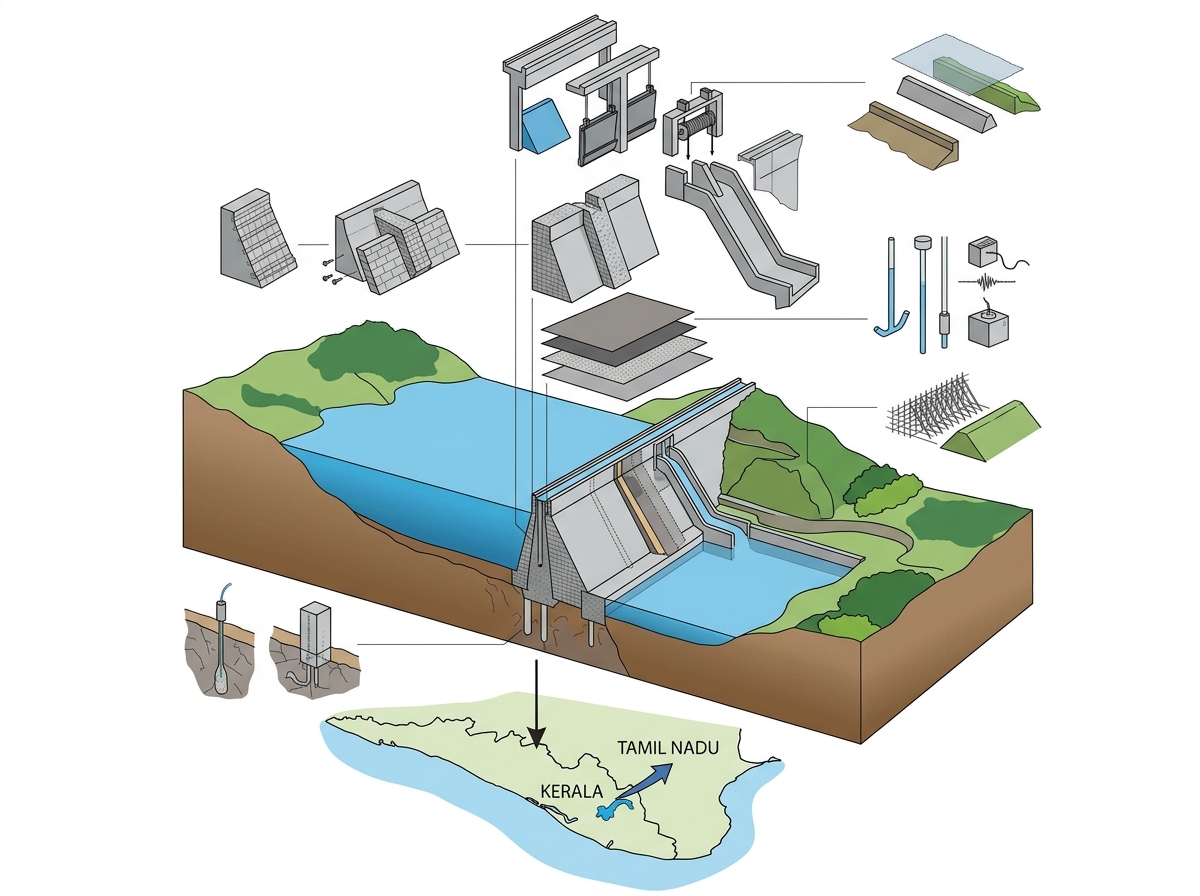
- The Mullaperiyar Dam is a masonry gravity dam constructed across the Periyar River in Kerala, owned and operated by Tamil Nadu under the terms of the 1886 Periyar Lake Lease Agreement.
- The dispute revolves around the structural safety of the dam, the permissible water level in the reservoir, and the implementation of judicial directives for strengthening measures.
- The Supreme Court, in its 2014 judgment, upheld the structural safety of the dam and permitted Tamil Nadu to raise the water level to 142 feet, subject to the completion of strengthening works.
- The 2014 judgment also directed Kerala to cooperate with Tamil Nadu in facilitating the timely completion of grouting, reinforcement of the baby dam, and other safety measures.
- The dispute highlights the complexities of inter-state water governance, where historical agreements, judicial interpretations, and ecological considerations intersect.
- The Dam Safety Act, 2021, aims to address such disputes by providing a statutory framework for dam safety, inter-state cooperation, and dispute resolution.
- The National Board for Wildlife (NBWL) and other regulatory bodies may be involved in granting permissions for activities near the dam site, particularly in ecologically sensitive areas.
- The enforcement of judicial directives in inter-state disputes often requires coordination between state governments, regulatory bodies, and judicial authorities.
Key Features
| Feature | Significance |
|---|---|
| Mullaperiyar Dam | A 131-year-old masonry dam across the Periyar River in Idukki district, Kerala, owned and operated by Tamil Nadu under the Periyar Lake Lease Agreement (1886). |
| Supreme Court Judgment (2014) | Constitution Bench declared the dam structurally safe and permitted Tamil Nadu to raise the reservoir water level from 136 feet to 142 feet, with potential for further increase to 152 feet upon completion of strengthening measures. |
| Strengthening Measures | Critical structural safety works include strengthening the baby dam, earth dam, and grouting of the main dam, essential for long-term stability and disaster mitigation. |
| Inter-State Dispute | The dispute exemplifies federalism challenges in water resource management, requiring judicial intervention to balance safety concerns with inter-state cooperation. |
| Wildlife Clearances | Permissions from the Standing Committee of the National Board for Wildlife are mandatory for certain activities near the dam, highlighting environmental governance constraints in infrastructure projects. |
Why it Matters
Water Resource Management
- The Mullaperiyar dam is a critical water storage infrastructure for Tamil Nadu, serving irrigation, drinking water, and hydroelectric purposes in the downstream regions.
- Inter-state water disputes, such as this, underscore the need for robust institutional mechanisms to resolve conflicts without compromising structural safety or environmental norms.
- Judicial intervention in such disputes sets precedents for balancing state rights, safety protocols, and ecological considerations in water governance.
Structural Safety and Disaster Mitigation
- The 2014 Supreme Court judgment explicitly linked water level increases to the completion of strengthening measures, emphasizing the primacy of structural integrity in dam management.
- Grouting and rehabilitation of the baby and earth dams are essential to prevent seepage, cracks, and potential catastrophic failures, which could have devastating downstream impacts.
- The dispute highlights the importance of timely compliance with judicial directives to ensure public safety and mitigate risks associated with aging infrastructure.
Federalism and Inter-State Relations
- The Mullaperiyar case is a classic example of inter-state water disputes in India, governed by constitutional provisions (Article 262) and judicial interpretations.
- It illustrates the challenges of coordination between states owning and operating shared water infrastructure, necessitating clear legal and administrative frameworks.
- The role of the Supreme Court as an arbiter in inter-state disputes reinforces the need for states to adhere to judicial orders to maintain constitutional harmony.
Environmental Governance
- Wildlife clearances and environmental impact assessments are integral to dam safety and strengthening projects, ensuring compliance with the Wildlife Protection Act, 1972.
- The dispute underscores the tension between developmental needs (water storage, irrigation) and environmental conservation, requiring balanced decision-making.
Judicial Role in Governance
- The Supreme Court’s intervention in the Mullaperiyar dispute demonstrates the judiciary’s role in resolving complex governance issues where executive and legislative channels face deadlocks.
- Judicial directives in such cases serve as binding frameworks for states to comply with safety and environmental norms, ensuring accountability.
Challenges
1. Inter-State Coordination Failures
- Delays in granting permissions for strengthening works by Kerala despite prior assurances, as highlighted by Tamil Nadu in its Supreme Court report.
- Lack of a structured mechanism for real-time inter-state communication and monitoring of dam safety measures.
- Divergent interpretations of judicial orders by states, leading to disputes over compliance and implementation timelines.
UPSC Link: Inter-State Relations (GS-II)
2. Structural Safety Risks
- Aging infrastructure (131-year-old dam) requiring urgent rehabilitation to prevent seepage, cracks, or structural failure.
- Incomplete strengthening measures (baby dam, earth dam, grouting) pose risks to downstream populations and ecosystems.
- Potential for catastrophic failure if judicial directives on safety measures are not strictly adhered to.
UPSC Link: Disaster Management (GS-III)
3. Environmental and Wildlife Clearances
- Delays in obtaining permissions from the National Board for Wildlife for activities near the dam site, as cited by Tamil Nadu in its report.
- Balancing environmental conservation with developmental needs in dam safety projects.
- Legal ambiguities in the scope of wildlife clearances for infrastructure projects in ecologically sensitive zones.
UPSC Link: Environmental Governance (GS-III)
4. Judicial Enforcement Challenges
- Ensuring compliance with Supreme Court orders by states, particularly when political or administrative hurdles arise.
- Addressing conflicting claims and counterclaims between states in inter-state disputes without undermining judicial authority.
- Streamlining judicial processes to expedite resolution of long-standing disputes like Mullaperiyar.
UPSC Link: Judicial Review (GS-II)
5. Resource Allocation and Funding
- Delays in releasing funds for strengthening measures, as indicated by Tamil Nadu’s reference to pending cost estimates (₹87,64,000).
- Ensuring adequate budgetary provisions for inter-state infrastructure projects with shared ownership.
- Balancing fiscal priorities between immediate safety needs and long-term developmental goals.
UPSC Link: Public Finance (GS-III)
Challenges — UPSC Perspective
| Issue | Concern |
|---|---|
| Permission Delays | Kerala’s failure to timely grant permissions for strengthening works despite prior assurances, as reported by Tamil Nadu. |
| Structural Integrity | Incomplete strengthening measures pose risks of seepage, cracks, or failure in the 131-year-old dam. |
| Wildlife Clearances | Delays in obtaining NBWL permissions for activities near the dam site, hindering safety projects. |
| Funding Gaps | Pending cost estimates and delays in releasing funds for strengthening measures. |
| Inter-State Trust Deficit | Divergent interpretations of judicial orders and lack of structured communication between states. |
| Judicial Compliance | Ensuring states adhere to Supreme Court directives without undermining their autonomy. |
Way Forward
- Establish a dedicated inter-state coordination mechanism under the aegis of the Ministry of Jal Shakti to monitor and expedite dam safety projects in shared water infrastructure.
- Formulate a standardized protocol for wildlife clearances in ecologically sensitive zones near dams, ensuring timely compliance with environmental norms.
- Constitute a high-powered technical committee comprising engineers, geologists, and environmental experts to oversee the completion of strengthening measures in Mullaperiyar and similar dams.
- Introduce a real-time monitoring system for dam safety parameters, with shared access for both states to enhance transparency and accountability.
- Allocate dedicated funds in the Union Budget for inter-state water infrastructure projects, with a focus on aging dams and disaster mitigation.
- Strengthen the role of the Central Water Commission in auditing and certifying the structural safety of inter-state dams, independent of state ownership.
- Encourage states to enter into legally binding agreements for the joint management of shared water resources, with provisions for dispute resolution.
- Promote public awareness campaigns to sensitize stakeholders on the importance of dam safety and inter-state cooperation in water governance.
UPSC Value Addition
Keywords for Mains Answer-Writing
Inter-State Water Disputes Act, 1956 · Mullaperiyar Dam dispute · Supreme Court’s constitutional role in inter-state disputes · Federalism in water governance · Dam safety and structural integrity · Periyar River water sharing · Constitution Bench judgments on inter-state rivers · National Board for Wildlife · Legal framework for dam strengthening · Constitutional provisions on Centre-State relations · Judicial review of executive decisions · Environmental clearances for dam projects · Water resource management in India · Constitutional remedies for inter-state conflicts
Constitutional & Policy Linkages
- Article 262: Inter-State Water Disputes (Provisions for adjudication and resolution of conflicts).
- Article 263: Inter-State Councils (Mechanism for coordination between states).
Concept Flow
Inter-state water dispute arises over Mullaperiyar dam ownership and safety → Supreme Court intervenes in 2014, permits water level increase with conditions → Tamil Nadu initiates strengthening measures (baby dam, earth dam, grouting) → Kerala delays permissions citing environmental and wildlife concerns → Tamil Nadu files complaint in Supreme Court alleging ‘obstructionist attitude’ → Supreme Court examines compliance with 2014 judgment → States submit conflicting reports on permissions granted → Judicial scrutiny intensifies to balance safety, federalism, and environmental norms → Way forward requires institutional reforms, clearances standardization, and inter-state coordination.
Prelims Practice Questions
Q1. Consider the following statements regarding the Mullaperiyar Dam dispute between Kerala and Tamil Nadu:
1. The Mullaperiyar Dam is located in Tamil Nadu and is operated by Kerala.
2. The Supreme Court, in 2014, allowed Tamil Nadu to raise the reservoir water level from 136 feet to 142 feet.
3. The Periyar Lake Lease Agreement of 1886 governs the water-sharing arrangement between the two states.
4. The dam is a masonry structure constructed pursuant to the 1886 agreement.
How many of the above statements are correct?
- Only one
- Only two
- Only three
- All four
Answer: Only three — Statements 2, 3, and 4 are correct. Statement 1 is incorrect as the Mullaperiyar Dam is located in Kerala but is owned and operated by Tamil Nadu.
Q2. Assertion (A): The Supreme Court has the authority to adjudicate disputes between states over water resources under Article 131 of the Constitution.
Reason (R): The Inter-State Water Disputes Act, 1956, empowers the Union Government to constitute tribunals for resolving inter-state water disputes, but does not exclude the Supreme Court’s jurisdiction.
Options:
A. Both A and R are true, and R is the correct explanation of A.
B. Both A and R are true, but R is NOT the correct explanation of A.
C. A is true, but R is false.
D. A is false, but R is true.
Answer: ? — Both A and R are true. The Supreme Court can adjudicate inter-state water disputes under its original jurisdiction (Article 131), and the Inter-State Water Disputes Act, 1956, does not exclude this jurisdiction.
Q3. Match the following pairs related to the Mullaperiyar Dam dispute:
Column I (Entity/Concept)
1. Mullaperiyar Dam
2. Periyar Lake Lease Agreement
3. Inter-State Water Disputes Act, 1956
4. National Board for Wildlife
Column II (Description/Role)
A. Governs water-sharing between Kerala and Tamil Nadu
B. A masonry dam owned and operated by Tamil Nadu
C. Constitutional provision for inter-state water disputes
D. Regulatory body for wildlife clearances
Select the correct match:
- 1-B, 2-A, 3-C, 4-D
- 1-A, 2-B, 3-C, 4-D
- 1-D, 2-A, 3-B, 4-C
- 1-C, 2-D, 3-A, 4-B
Answer: 1-B, 2-A, 3-C, 4-D — 1-B: Mullaperiyar Dam is a masonry structure owned and operated by Tamil Nadu. 2-A: The Periyar Lake Lease Agreement of 1886 governs water-sharing. 3-C: The Inter-State Water Disputes Act, 1956, provides the legal framework for resolving inter-state water disputes. 4-D: The National Board for Wildlife is involved in wildlife-related clearances.
Mains Practice Question
✍ The Supreme Court has repeatedly adjudicated the Mullaperiyar Dam dispute between Kerala and Tamil Nadu, underscoring its role as the final arbiter in inter-state water conflicts. Critically examine the constitutional and legal framework governing such disputes, with particular reference to the Supreme Court’s jurisdiction under Article 131 and the Inter-State Water Disputes Act, 1956. Also, analyse the implications of the Court’s involvement for the principles of federalism and cooperative governance in water resource management. (15 Marks)
Approach: MODEL-ANSWER SKELETON:
1. Constitutional Basis:
– Article 131: Original jurisdiction of the Supreme Court for disputes between states.
– Article 262: Exclusion of judicial review for water disputes but not absolute (e.g., Krishna Godavari Disputes Tribunal II).
– Inter-State Water Disputes Act, 1956: Empowers tribunals but does not oust Supreme Court jurisdiction under Article 131.
2. Legal Framework for Mullaperiyar:
– Periyar Lake Lease Agreement (1886): Historical context and its legal status.
– Constitution Bench judgment (2014): Structural safety and water level elevation to 142 feet.
– Subsequent judgments: Directions for dam strengthening and environmental clearances.
3. Federalism and Cooperative Governance:
– Tension between state autonomy and national interest in water management.
– Role of the Union Government: Advisory role under Article 262(2) and potential for mediation.
– Judicial activism vs. federal principles: Whether the Court oversteps or fills a governance vacuum.
4. Implications and Way Forward:
– Need for a permanent inter-state water dispute resolution mechanism.
– Strengthening institutional cooperation (e.g., River Boards under the River Boards Act, 1956).
– Balancing environmental concerns (e.g., National Board for Wildlife clearances) with developmental imperatives.
5. Balance of Views:
– Critique of judicial overreach in federal matters.
– Justification: Courts as neutral arbiters in politically charged disputes.
6. Recent Developments:
– Supreme Court’s 2026 directions on dam strengthening and environmental clearances.
– Role of the National Board for Wildlife in the Mullaperiyar case.
Source: The Hindu
Generated by AanyaAi for educational purpose.

- Gurugram’s groundwater extraction exceeds limit by 212%; HC seeks ban - October 4, 2026
- स्वतंत्रता सेनानी श्यामजी कृष्ण वर्मा की जन्म जयंती पर पीएम का श्रद्धांजलि - October 4, 2026
- KWML’s Feasibility Reports for Water Metro in 18 Cities: UPSC & PCS Insights - October 3, 2026

No Comments