


11 Aug Tamil Nadu’s ₹11,000 Crore Pension Scheme: Centre’s Nod Awaited
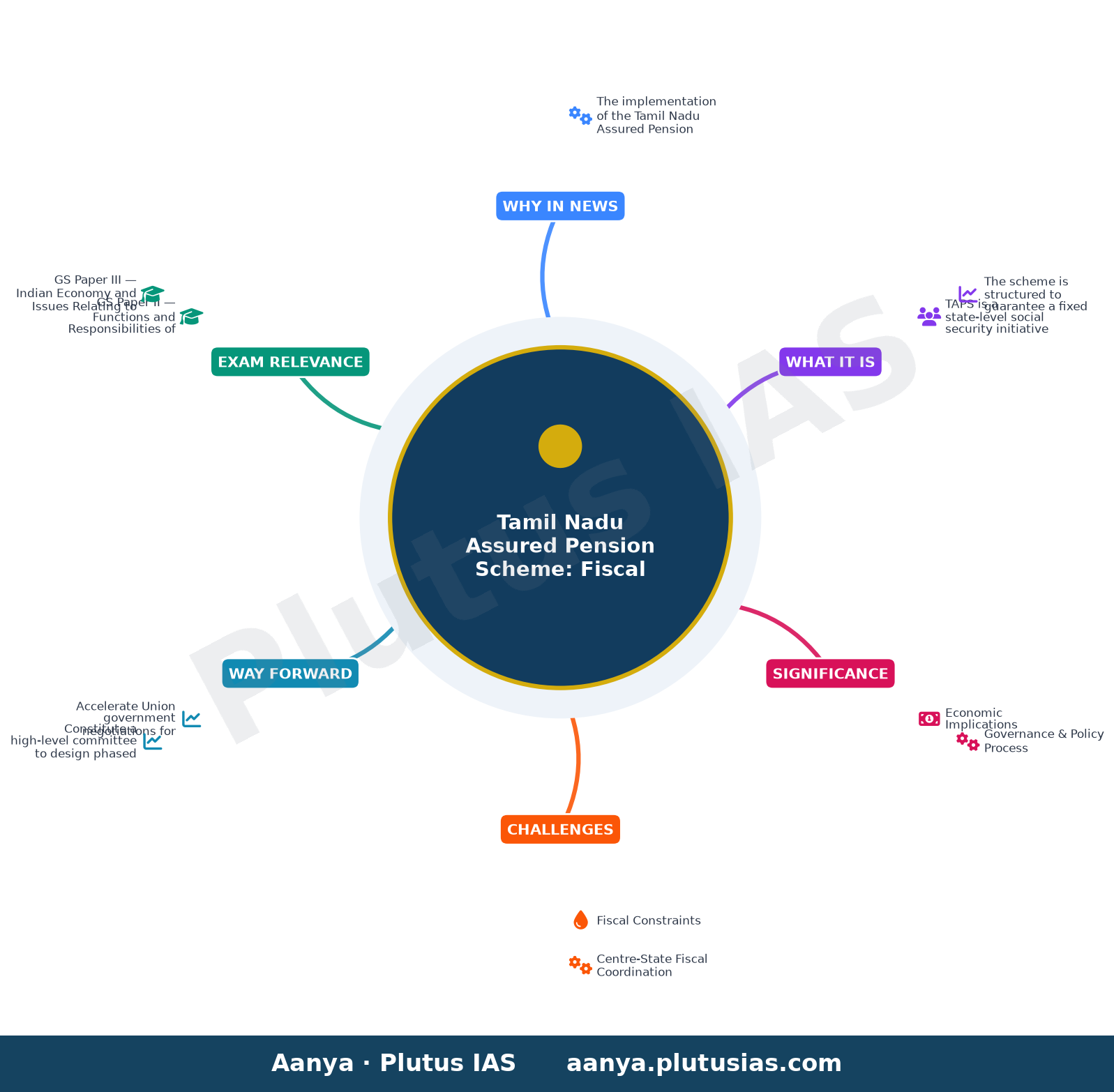
✎ The Tamil Nadu Assured Pension Scheme’s implementation hinges on central approval for state borrowing under the FRBM Act, highlighting the tension between social welfare expansion and fiscal discipline in cooperative federalism.
Subject Relevance — Where This Topic Fits
- GS Paper II — Functions and Responsibilities of the Union and the States | GS Paper III — Indian Economy and Issues Relating to Planning, Mobilisation of Resources
- Prelims: Assured Pension Scheme, Fiscal Deficit, State Borrowing Limits, Revenue Deficit, Gross State Domestic Product (GSDP), Debt-to-GSDP Ratio, Fiscal Responsibility and Budget Management (FRBM) Act
- Essay: Role of States in Social Security: Balancing Fiscal Autonomy and Federal Constraints
Quick Revision: The Tamil Nadu Assured Pension Scheme’s implementation hinges on central approval for state borrowing under the FRBM Act, highlighting the tension between social welfare expansion and fiscal discipline in cooperative federalism.
Why is this in the news?
The implementation of the Tamil Nadu Assured Pension Scheme (TAPS) has been delayed pending central approval for an ₹11,000 crore borrowing, as announced by the state’s Finance Minister. This highlights the interplay between state-level social welfare initiatives and the Centre’s fiscal oversight, particularly under the framework of cooperative federalism and fiscal discipline mechanisms like the FRBM Act. The development also underscores the challenges faced by states in balancing welfare commitments with fiscal sustainability.
Background
- The scheme’s implementation is contingent upon the Union government’s approval for the state’s proposed borrowing of ₹11,000 crore, reflecting the Centre’s role in regulating state borrowings under constitutional provisions.
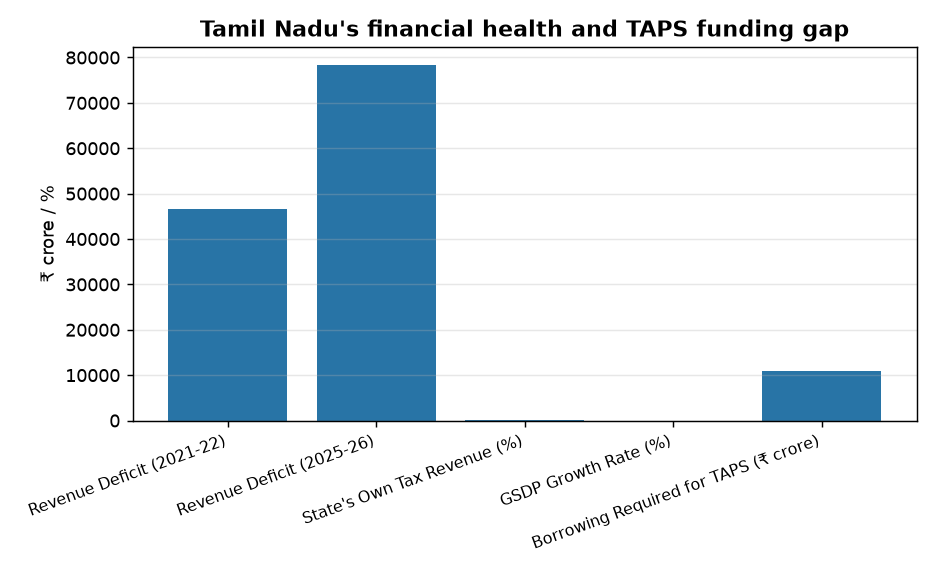
- The state’s fiscal health has deteriorated, with revenue deficit escalating from ₹46,538 crore in 2021-22 to ₹78,324 crore in 2025-26, and State Own Tax Revenue declining from 5.93% to 5.45% of GSDP.
- The Gross State Domestic Product (GSDP) growth rate has decelerated from 1.79% to 1.44%, exacerbating fiscal pressures and necessitating stringent borrowing discipline.
- The interim payout mechanism for retirees post-January 1, 2026, has been introduced as a stopgap measure pending full implementation of TAPS.
What is the Tamil Nadu Assured Pension Scheme (TAPS)?
- TAPS is a state-level social security initiative designed to provide assured pensions to eligible retirees, ensuring financial security post-employment.
- The scheme is structured to guarantee a fixed pension amount, reducing dependency on market-linked returns or uncertain post-retirement income streams.
- Eligibility criteria typically include minimum years of service, age thresholds, and contributions made during active employment, though specific thresholds are defined by state legislation.
- The financial outlay for TAPS is estimated at ₹11,000 crore, necessitating state borrowing, which requires central approval under fiscal federalism frameworks.
- Implementation challenges arise from fiscal constraints, as states must balance welfare commitments with adherence to borrowing limits prescribed by the FRBM Act.
- The interim payout mechanism serves as a transitional arrangement to address immediate pension needs while awaiting central sanction for the full scheme.
- TAPS exemplifies state-level innovation in social welfare, but its viability depends on sustainable fiscal management and central-state coordination.
Key Features
| Feature | Significance |
|---|---|
| Assured Pension Scheme (TAPS) | Guarantees a fixed pension amount to eligible retirees, ensuring financial security post-retirement. |
| Interim Payout Mechanism | Provides immediate financial relief to retirees pending formal scheme implementation. |
| Borrowing Sanction Requirement | Central approval for ₹11,000 crore borrowing is essential for full scheme rollout. |
| Revenue Deficit Trend | High revenue deficit (₹46,538 crore in 2021-22 to ₹78,324 crore in 2025-26) necessitates fiscal prudence. |
| State Own Tax Revenue Decline | Decline from 5.93% to 5.45% of GSDP indicates weakening revenue mobilization. |
Why it Matters
Economic Implications
- The Tamil Nadu Assured Pension Scheme (TAPS) aims to address the pension security gap for retirees, aligning with social security objectives under the Directive Principles of State Policy (Article 41).
- Central borrowing sanction highlights the interdependence of state and Union fiscal policies, particularly under the Fiscal Responsibility and Budget Management (FRBM) framework.
- Interim payouts mitigate immediate financial distress for retirees while awaiting scheme formalization, reflecting responsive governance.
- High revenue deficit and declining tax-to-GSDP ratio underscore the need for structural fiscal reforms to sustain welfare schemes.
Governance & Policy Process
- The scheme’s implementation hinges on Union government approval, demonstrating the constitutional division of fiscal powers (Article 293).
- Transparency in fiscal disclosures (e.g., White Paper) enhances public trust and policy credibility.
- Budgetary allocations reflect prioritization of manifesto commitments, balancing electoral promises with fiscal constraints.
Social Sector Impact
- Assured pensions enhance post-retirement financial stability, reducing elderly poverty risks.
- Interim payouts provide immediate relief, addressing short-term economic vulnerabilities.
- Long-term sustainability depends on balancing welfare commitments with fiscal health.
Challenges
1. Fiscal Constraints
- Revenue deficit escalation (₹78,324 crore in 2025-26) limits fiscal space for new welfare schemes.
- Declining State Own Tax Revenue (5.45% of GSDP) necessitates revenue augmentation strategies.
- High borrowing levels (₹20,881 crore in Q1 2026) raise concerns about debt sustainability.
UPSC Link: GS3: Fiscal Policy; FRBM Act
2. Centre-State Fiscal Coordination
- Dependence on Union borrowing sanction (₹11,000 crore) highlights structural fiscal asymmetries.
- Delays in approvals may impede timely scheme implementation, affecting retiree welfare.
- Need for predictable and transparent fiscal transfer mechanisms between Centre and states.
UPSC Link: GS2: Centre-State Relations; Article 293
3. Welfare Scheme Sustainability
- Balancing manifesto commitments with fiscal prudence requires prioritization and phased implementation.
- Ensuring long-term viability of schemes like TAPS without compromising developmental expenditures.
- Monitoring inflation-adjusted pension amounts to maintain real value over time.
UPSC Link: GS2: Directive Principles of State Policy (Article 41)
4. Public Trust & Accountability
- Transparent fiscal disclosures (e.g., White Paper) are essential to counter perceptions of fiscal mismanagement.
- Clear communication on interim payouts and scheme timelines is critical to manage expectations.
- Regular audits and performance reviews can enhance credibility of welfare initiatives.
UPSC Link: GS4: Ethics in Governance
Challenges — UPSC Perspective
| Issue | Concern |
|---|---|
| Revenue Deficit | Escalating deficit (₹78,324 crore) constrains fiscal flexibility for new schemes. |
| Tax Revenue Decline | State Own Tax Revenue drop to 5.45% of GSDP weakens resource mobilization. |
| Borrowing Dependence | Reliance on ₹11,000 crore central borrowing for TAPS implementation. |
| Inflation Erosion | Risk of pension value erosion due to inflation without periodic adjustments. |
| Implementation Delays | Centre-State coordination delays may defer retiree benefits. |
Way Forward
- Accelerate Union government negotiations for ₹11,000 crore borrowing sanction to expedite TAPS implementation.
- Constitute a high-level committee to design phased rollout strategies for welfare schemes, balancing fiscal constraints with social needs.
- Enhance State Own Tax Revenue through GST compliance reforms and digitalization of tax administration.
- Introduce inflation-indexed pension adjustments to maintain real value of benefits over time.
- Publish quarterly fiscal performance reports to improve transparency and public accountability.
- Explore public-private partnerships (PPPs) for cost-efficient delivery of welfare services.
- Strengthen inter-state fiscal coordination mechanisms to reduce dependence on central approvals.
UPSC Value Addition
Keywords for Mains Answer-Writing
Assured Pension Scheme · State finances and borrowing · Fiscal Responsibility and Budget Management (FRBM) Act · Revenue deficit and fiscal consolidation · Interim payout mechanisms for pensioners · Centre-State financial relations · Debt-GSDP ratio · State Own Tax Revenue (SOTR) · Fiscal federalism in India · Public finance management · Pension reforms in India · Tamil Nadu economy and fiscal health
Constitutional & Policy Linkages
- Article 293: Borrowing powers of states and Union consent requirements.
- Article 41: Directive Principle on securing public assistance in cases of unemployment, old age, sickness, etc.
Concept Flow
High revenue deficit and declining tax revenue → Fiscal constraints → Need for welfare scheme prioritization → TAPS introduced → Centre-State borrowing dependency → Interim payouts introduced → Scheme implementation pending sanction → Long-term sustainability challenges.
Prelims Practice Questions
Q1. Consider the following statements regarding the Tamil Nadu Assured Pension Scheme (TAPS):
1. TAPS aims to provide a guaranteed pension to all retired government employees in Tamil Nadu.
2. The scheme requires the Union government’s approval for borrowing ₹11,000 crore to fund its implementation.
3. The scheme includes an interim payout mechanism for retirees from January 1, 2026, pending final approval.
How many of the above statements are correct?
- Only one
- Only two
- All three
- None
Answer: All three — Statements 1 and 2 are correct. Statement 3 is incorrect as the interim payout is for those retiring on or after January 1, 2026, but the scheme’s implementation is contingent on Union government approval for borrowing ₹11,000 crore.
Q2. Assertion (A): The Tamil Nadu Finance Minister cited a decline in the State’s Own Tax Revenue (SOTR) from 5.93% to 5.45% as a reason for fiscal challenges.
Reason (R): A decline in SOTR indicates reduced revenue generation capacity of the state, which can exacerbate revenue deficits and fiscal imbalances.
In the context of the above statements, which of the following is correct?
- Both A and R are true, and R is the correct explanation of A
- Both A and R are true, but R is not the correct explanation of A
- A is true, but R is false
- A is false, but R is true
Answer: Both A and R are true, and R is the correct explanation of A — Both the assertion and reason are true. The decline in SOTR (Assertion A) is a valid indicator of reduced revenue generation, which contributes to fiscal challenges (Reason R). The reason correctly explains the assertion.
Q3. Match the following terms related to Tamil Nadu’s fiscal situation with their correct descriptions:
Column I (Term) Column II (Description)
A. Revenue Deficit 1. Difference between total revenue expenditure and total revenue receipts
B. Debt-GSDP Ratio 2. Ratio of total debt to Gross State Domestic Product
C. State Own Tax Revenue (SOTR) 3. Revenue generated by the state from its own tax sources
D. Fiscal Responsibility and Budget Management (FRBM) Act 4. Legal framework to ensure fiscal discipline and debt management
Select the correct match:
- A-1, B-2, C-3, D-4
- A-2, B-1, C-4, D-3
- A-3, B-4, C-1, D-2
- A-4, B-3, C-2, D-1
Answer: A-1, B-2, C-3, D-4 — The correct matches are: Revenue Deficit (A-1), Debt-GSDP Ratio (B-2), State Own Tax Revenue (C-3), and FRBM Act (D-4).
Mains Practice Question
✍ The Tamil Nadu Assured Pension Scheme (TAPS) exemplifies the challenges of balancing social welfare commitments with fiscal sustainability in Indian federalism. Critically examine the fiscal and constitutional dimensions of such state-level welfare schemes, with particular reference to the role of the Union government in regulating state borrowings. (15 Marks)
Approach: MODEL-ANSWER SKELETON:
1. **Introduction**: Define TAPS and its objective (assured pension for state employees), contextualising it within Tamil Nadu’s fiscal constraints (revenue deficit, declining SOTR, debt-GSDP ratio).
2. **Fiscal Sustainability**: Discuss the fiscal implications of TAPS, including the need for ₹11,000 crore borrowing and its impact on Tamil Nadu’s debt-GSDP ratio. Reference the FRBM Act (2003) and its provisions for state borrowings (Article 293 constraints, limits under FRBM).
3. **Centre-State Financial Relations**: Analyse the constitutional framework governing state borrowings (Article 293) and the Union government’s role in regulating state debt. Highlight the tension between state autonomy in welfare and fiscal discipline mandated by the Centre.
4. **Interim Payout Mechanism**: Explain the interim payout for retirees post-January 2026 as a stopgap measure, linking it to the Union’s role in sanctioning borrowings.
5. **Comparative Perspective**: Contrast Tamil Nadu’s approach with other states’ pension schemes (e.g., Kerala, Rajasthan) and their fiscal outcomes.
6. **Critique and Way Forward**: Evaluate the long-term sustainability of TAPS, including potential reforms (e.g., increasing SOTR, rationalising pension liabilities) and the need for cooperative federalism in managing such schemes.
7. **Conclusion**: Summarise the fiscal and constitutional trade-offs, emphasising the need for a balanced approach to welfare and fiscal prudence.
Source: The Hindu
Generated by AanyaAi for educational purpose.

- मद्रास उच्च न्यायालय में ‘वेट्ट्री पयणम’ योजना को असंवैधानिक घोषित करने की मांग - October 4, 2026
- Gurugram’s groundwater extraction exceeds limit by 212%; HC seeks ban - October 4, 2026
- स्वतंत्रता सेनानी श्यामजी कृष्ण वर्मा की जन्म जयंती पर पीएम का श्रद्धांजलि - October 4, 2026

No Comments