


04 Aug Taxation Bill 2026 & Anti-Defection Law: Key Parliament Updates for UPSC
✎ The Taxation and Other Laws (Amendment) Bill, 2026, seeks to amend the Payment and Settlement Systems Act, 2007, to enhance regulatory oversight, improve tax compliance, and align financial laws with contemporary economic needs.
Subject Relevance — Where This Topic Fits
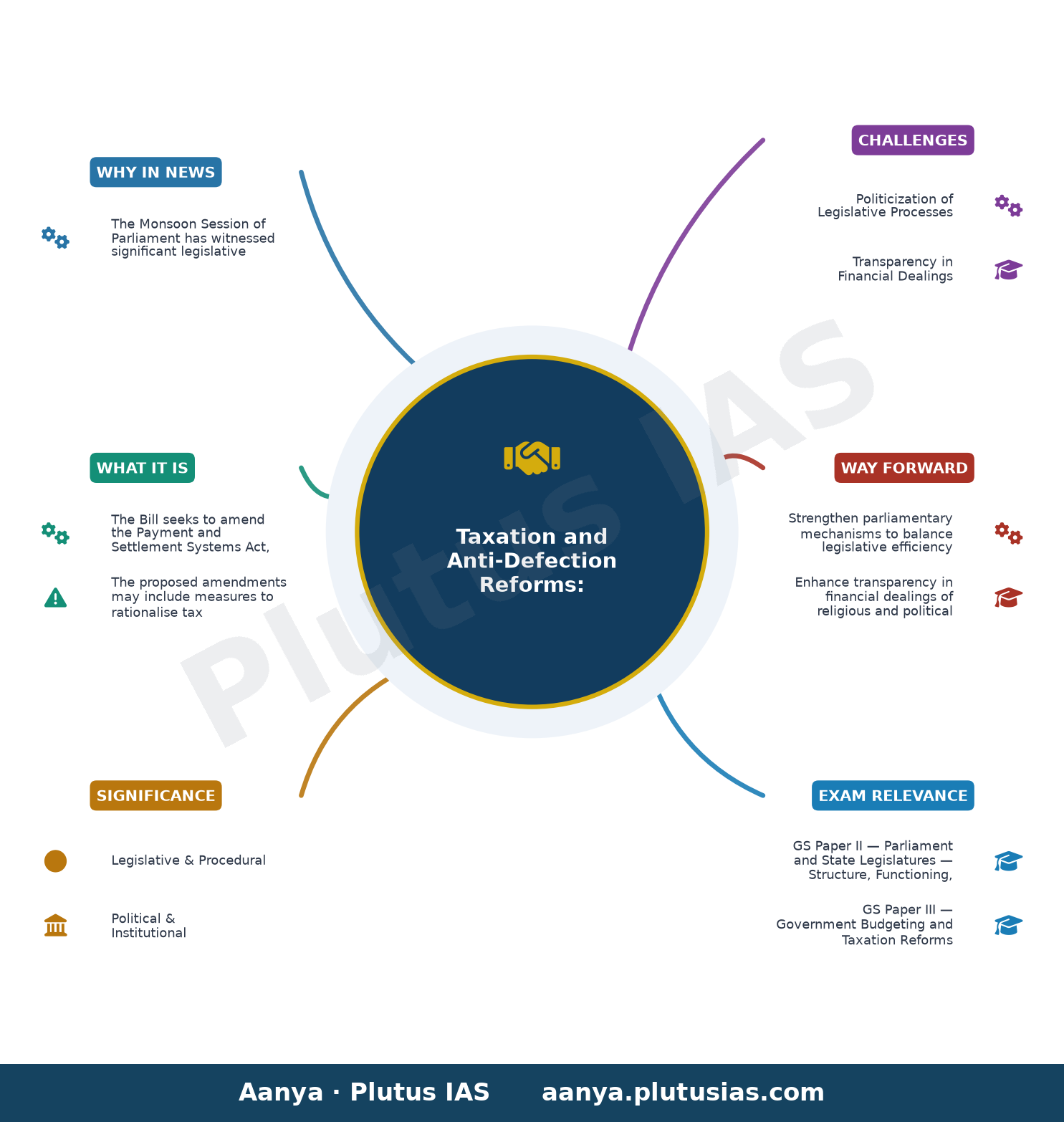
- GS Paper II — Parliament and State Legislatures — Structure, Functioning, Conduct of Business, Powers & Privileges | GS Paper III — Government Budgeting and Taxation Reforms
- Prelims: Anti-Defection Law (10th Schedule), 10th Schedule amendments, Taxation and Other Laws (Amendment) Bill 2026, Payment and Settlement Systems Act 2007, Income-tax Act 2025, Finance Act 2026, Adjournment Motion, Zero Hour, Question Hour
- Essay: The Role of Parliament in Democratic Governance: Balancing Efficiency and Accountability, Taxation as a Tool for Economic Equity and Fiscal Discipline
Quick Revision: The Taxation and Other Laws (Amendment) Bill, 2026, seeks to amend the Payment and Settlement Systems Act, 2007, to enhance regulatory oversight, improve tax compliance, and align financial laws with contemporary economic needs.
Why is this in the news?
The Monsoon Session of Parliament has witnessed significant legislative activity with the introduction of the Taxation and Other Laws (Amendment) Bill, 2026 in the Lok Sabha. Concurrently, Opposition parties, particularly the Congress, have demanded urgent discussions on strengthening the anti-defection law, citing concerns over opportunistic mass defections and erosion of ideological dissent within legislatures. These developments underscore the dual imperatives of fiscal policy reform and parliamentary ethics in India’s democratic framework.
Background
- The Monsoon Session of Parliament is a critical legislative calendar event where key bills and policy reforms are introduced and debated.
- The 10th Schedule of the Indian Constitution, popularly known as the Anti-Defection Law, was inserted in 1985 to prevent legislators from switching parties for personal or political gains, though it has faced criticism for limiting intra-party dissent.
- The Payment and Settlement Systems Act, 2007, regulates digital payment systems and financial market infrastructures in India, ensuring stability and consumer protection.
- Opposition parties have historically raised concerns about the misuse of defection laws and the need for reforms to balance party discipline with democratic dissent.
- The Ram Temple donation row has added a political dimension to the session, with Opposition parties alleging financial irregularities and demanding accountability from the government.
What is the Taxation and Other Laws (Amendment) Bill, 2026?
- The Bill seeks to amend the Payment and Settlement Systems Act, 2007, to enhance regulatory oversight of digital payment systems and address emerging risks in financial market infrastructures.
- The proposed amendments may include measures to rationalise tax exemptions, streamline tax administration, or introduce new levies to meet fiscal targets or address sectoral challenges.
- The Bill is part of the government’s broader agenda to modernise India’s tax and financial regulatory framework in line with global best practices and technological advancements.
- The explanatory statement accompanying the Bill will outline the necessity for immediate legislation, including any urgent economic or administrative imperatives that justify bypassing the usual legislative delays.
- The Bill’s introduction in the Lok Sabha marks the first step in the legislative process, followed by scrutiny by Parliamentary Standing Committees and debate in both Houses of Parliament.
Key Features
| Feature | Significance |
|---|---|
| Taxation and Other Laws (Amendment) Bill, 2026 | Proposes amendments to the Payment and Settlement Systems Act, 2007, the Income-tax Act, 2025, and the Finance Act, 2026, aimed at addressing systemic gaps in tax administration and digital payment frameworks. |
| Adjournment Motion on Anti-Defection Law | Seeks suspension of parliamentary business to discuss a new anti-defection law, highlighting concerns over mass political defections driven by opportunism rather than ideological differences. |
| Explanatory Statement by Finance Minister | Mandates the laying of a statement outlining the necessity for immediate legislation, ensuring transparency and legislative accountability in the amendment process. |
| Opposition Protest on Ram Temple Donations | Reflects broader political tensions over alleged financial irregularities, influencing legislative priorities and parliamentary discourse. |
Why it Matters
Legislative & Procedural
- The introduction of the Taxation and Other Laws (Amendment) Bill, 2026, underscores the government’s focus on fiscal reforms, particularly in tax administration and digital payment systems, which are critical for economic governance.
- The adjournment motion on the anti-defection law signals a renewed emphasis on parliamentary ethics and the need to balance party discipline with the protection of dissenting voices within legislatures.
- The procedural demand for an adjournment motion to discuss the anti-defection law highlights the Opposition’s strategy to prioritize legislative debates on governance issues over routine business.
Political & Institutional
- The Opposition’s protest over Ram Temple donations reflects growing public scrutiny of financial transparency in religious and political institutions, which can influence electoral politics and legislative accountability.
- The demand for a stricter anti-defection law indicates a perceived erosion of ideological commitment in political parties, which could impact the stability of governments and the quality of legislative debates.
- The government’s introduction of the taxation amendment bill amidst Opposition protests demonstrates the challenges of maintaining legislative focus in a politically charged environment.
Economic & Fiscal
- Amendments to the Payment and Settlement Systems Act, 2007, are likely to address gaps in digital payment infrastructure, which is essential for India’s transition to a cashless economy and formalization of the financial sector.
- Revisions to the Income-tax Act, 2025, and Finance Act, 2026, may introduce measures to streamline tax compliance, reduce evasion, and align with global best practices in fiscal policy.
Challenges
1. Politicization of Legislative Processes
- Ongoing Opposition protests and demands for adjournments disrupt parliamentary proceedings, delaying critical legislative and fiscal reforms.
- The focus on defection-related debates may overshadow substantive discussions on economic policies, affecting governance efficiency.
UPSC Link: Parliamentary Procedures
2. Transparency in Financial Dealings
- Allegations of financial irregularities in religious donations highlight the need for stronger regulatory oversight of non-governmental financial flows, which can impact public trust in institutions.
- Ensuring transparency in tax administration and digital payment systems remains a challenge, particularly in preventing fraud and ensuring equitable compliance.
UPSC Link: Financial Accountability
3. Balancing Party Discipline and Dissent
- The anti-defection law debate reflects the tension between maintaining party cohesion and allowing principled dissent, which is essential for a vibrant parliamentary democracy.
- Overly stringent anti-defection measures may stifle internal party democracy, while lax rules could encourage opportunistic defections, undermining governance stability.
UPSC Link: Anti-Defection Law
Challenges — UPSC Perspective
| Issue | Concern |
|---|---|
| Disruption of Parliamentary Proceedings | Frequent adjournments and protests delay legislative business, affecting the passage of critical bills. |
| Financial Transparency in Religious Institutions | Allegations of donation mismanagement raise questions about oversight and accountability in non-state financial entities. |
| Tax Evasion and Compliance Gaps | Amendments to tax laws must address loopholes to ensure fair and efficient revenue collection. |
| Digital Payment Fraud Risks | Expansion of digital payment systems requires robust safeguards against cyber threats and financial crimes. |
| Party Discipline vs. Dissent | Strict anti-defection laws may suppress internal democracy, while lenient rules could enable political opportunism. |
Way Forward
- Strengthen parliamentary mechanisms to balance legislative efficiency with the Opposition’s right to raise critical issues, possibly through structured debates or select committees.
- Enhance transparency in financial dealings of religious and political institutions by mandating independent audits and public disclosures.
- Accelerate the implementation of digital payment reforms while ensuring robust cybersecurity frameworks to prevent fraud.
- Reform the anti-defection law to protect principled dissent while discouraging opportunistic defections, possibly through tiered penalties or internal party mechanisms.
- Conduct a comprehensive review of tax administration to identify systemic gaps and align with global best practices in compliance and enforcement.
- Foster bipartisan consensus on fiscal reforms to ensure stability and continuity in economic governance amid political disagreements.
UPSC Value Addition
Keywords for Mains Answer-Writing
Anti-Defection Law · Constitution (Fifty-Second Amendment) Act, 1985 · Tenth Schedule of the Indian Constitution · Mass defections · Principled dissent in Parliament · Taxation and Other Laws (Amendment) Bill, 2026 · Payment and Settlement Systems Act, 2007 · Income-tax Act, 2025 · Finance Act, 2026 · Parliamentary procedures · Adjournment motion · Legislative accountability · Political opportunism · Institutional integrity of legislatures
Constitutional & Policy Linkages
- [‘Article 105 (Parliamentary Privileges)’, ‘Freedom of speech in Parliament’]
- [‘Article 118 (Rules of Procedure)’, ‘Conduct of parliamentary business’]
- [‘Article 191 (Disqualification of Members)’, ‘Anti-defection provisions’]
Concept Flow
Opposition protests over Ram Temple donations → Political tensions escalate → Demand for adjournment motion on anti-defection law → Adjournment motion seeks suspension of parliamentary business → Focus shifts to governance and ethical concerns in legislatures → Government introduces Taxation and Other Laws (Amendment) Bill, 2026 → Aimed at fiscal and digital payment reforms → Debate on anti-defection law highlights tension between party discipline and dissent → Potential legislative reforms → Parliamentary proceedings disrupted → Delay in passing critical economic bills → Impact on fiscal governance → Need for transparency in financial dealings → Calls for stronger regulatory oversight → Broader implications for institutional trust
Prelims Practice Questions
Q1. Consider the following statements regarding the Tenth Schedule of the Indian Constitution (Anti-Defection Law):
1. It was inserted by the Constitution (Fifty-Second Amendment) Act, 1985.
2. It applies to both Parliament and State Legislatures.
3. It prohibits legislators from voting against the whip of their party.
4. It allows legislators to defect without losing their membership if they join another party within 15 days of resignation.
How many of the above statements are correct?
- Only one
- Only two
- Only three
- All
Answer: Only three — Statements 1, 2, and 3 are correct. Statement 4 is incorrect as the Tenth Schedule does not permit defections without loss of membership; exceptions are limited to splits or mergers under specific conditions.
Q2. Assertion (A): The Taxation and Other Laws (Amendment) Bill, 2026 seeks to amend the Payment and Settlement Systems Act, 2007.
Reason (R): The Bill aims to introduce new tax exemptions for digital payment platforms.
Options:
A. Both A and R are true, and R is the correct explanation of A.
B. Both A and R are true, but R is not the correct explanation of A.
C. A is true, but R is false.
D. A is false, but R is true.
Answer: ? — Assertion (A) is true as the Bill does amend the Payment and Settlement Systems Act, 2007. However, Reason (R) is false because the Bill does not explicitly introduce tax exemptions for digital payment platforms; its amendments are broader and procedural.
Q3. Match the following provisions with their respective Acts:
Column I (Provision) | Column II (Act)
———————|——————-
A. Regulation of digital payments | 1. Income-tax Act, 2025
B. Prohibition of tax evasion | 2. Payment and Settlement Systems Act, 2007
C. Annual financial statements | 3. Finance Act, 2026
Options:
A. A-2, B-1, C-3
B. A-1, B-2, C-3
C. A-3, B-1, D-2
D. A-2, B-3, C-1
Answer: ? — A-2: The Payment and Settlement Systems Act, 2007 regulates digital payments. B-1: The Income-tax Act, 2025 deals with tax evasion. C-3: The Finance Act, 2026 governs annual financial statements.
Mains Practice Question
✍ Critically examine the efficacy of the Anti-Defection Law (Tenth Schedule) in curbing political opportunism while safeguarding the space for principled dissent in Parliament. Also, analyse the implications of recent adjournment motions seeking its reform. (15 Marks)
Approach: MODEL-ANSWER SKELETON:
1. **Introduction (2 marks)**
– Brief background: Insertion of the Tenth Schedule via the Constitution (Fifty-Second Amendment) Act, 1985.
– Objective: To prevent political defections driven by opportunism and to maintain party discipline.
2. **Provisions of the Tenth Schedule (3 marks)**
– Grounds for disqualification: Voting against party whip, joining another party, or abstaining from voting without prior permission.
– Exceptions: Split or merger of parties under specific conditions (e.g., 1/3rd of legislators in a split).
– Role of the Speaker/Chairperson: Discretionary power to decide disqualification, subject to judicial review (Kihoto Hollohan v. Zachillhu, 1992).
3. **Efficacy in Curbing Opportunism (4 marks)**
– Successes: Reduced instances of floor-crossing, strengthened party cohesion, and enhanced legislative stability.
– Failures: Overuse of the law to stifle dissent, lack of clarity in defining ‘whip’, and partisan decisions by Speakers (e.g., Manipur 2020, Karnataka 2019).
– Data: Cite instances of mass defections (e.g., Andhra Pradesh 2019, Goa 2023) despite the law.
4. **Safeguarding Principled Dissent (3 marks)**
– Theoretical justification: Dissent is essential for democratic deliberation and accountability.
– Practical challenges: The law conflates dissent with defection, discouraging legislators from expressing independent views.
– Judicial interventions: Supreme Court’s emphasis on balancing party discipline and dissent (e.g., Nabam Rebia v. Deputy Speaker, 2016).
5. **Recent Adjournment Motions and Reform Demands (3 marks)**
– Context: Recent adjournment motions (e.g., Congress’s demand for discussion on the Anti-Defection Law) highlight growing concerns over its misuse.
– Proposed reforms: Suggestions include reducing the Speaker’s discretion, defining ‘whip’ more precisely, and allowing dissent within parties without penalisation.
– Comparative perspective: Refer to global models (e.g., UK’s free vote system, South Africa’s more flexible approach).
6. **Conclusion (2 marks)**
– Balancing act: The law must curb opportunism while preserving democratic dissent.
– Way forward: Strengthening institutional safeguards (e.g., independent committees to decide disqualifications) and fostering a culture of intra-party democracy.
Source: Hindustan Times
Generated by AanyaAi for educational purpose.

- यूपी नीट यूजी काउंसलिंग राउंड-2: मेरिट लिस्ट हुई जारी, 22 सितंबर से रिपोर्टिंग शुरू - September 21, 2026
- UP NEET UG Counselling 2026 Round 2: Merit List Out, Key Dates & Reporting Process - September 21, 2026
- UPSC Civil Services (Main) Examination 2026 — Geology Optional Paper I: Question Paper | Plutus IAS - September 21, 2026

No Comments