


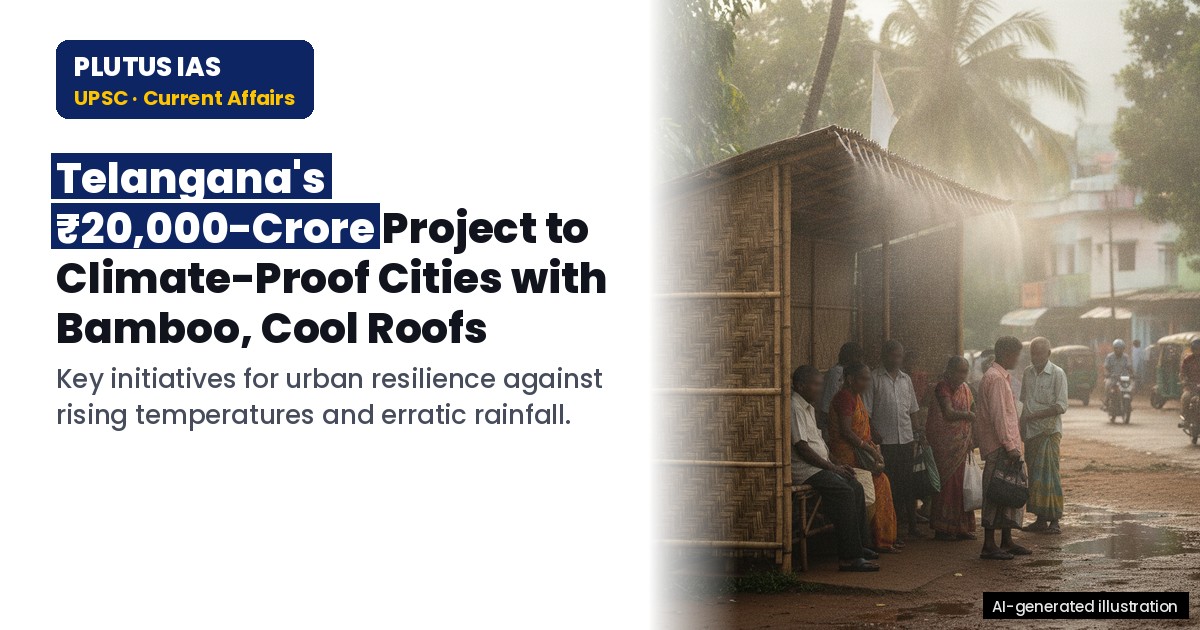
07 Nov Telangana’s Climate-Proofing Strategy: Bamboo & Cool Roofs
✎ Telangana's urban climate resilience initiative integrates policy, infrastructure projects, and institutional mechanisms to mitigate climate change impacts and enhance adaptive capacity in its cities.
Subject Relevance — Where This Topic Fits
- GS Paper I — Urbanisation, its problems and remedies | GS Paper III — Environmental Pollution and Degradation, Environmental Impact Assessment; Disaster Management
- Prelims: Climate resilience, Cool Roof Policy, Heatwave Action Plan, Treated Water Reuse Policy, Bio-mining, Non-revenue water, State Climate Centre for Cities, Urban Challenge Fund
- Essay: Urbanisation and Climate Change: Challenges and Opportunities for Sustainable Development, Building Resilient Cities: A Prerequisite for India’s Future Growth
Quick Revision: Telangana’s urban climate resilience initiative integrates policy, infrastructure projects, and institutional mechanisms to mitigate climate change impacts and enhance adaptive capacity in its cities.
Why is this in the news?
The State of Telangana is actively formulating a comprehensive strategy, encompassing a ₹20,000-crore project pipeline and a series of policy interventions, to enhance the climate resilience of its urban centres. This initiative aims to mitigate the adverse impacts of escalating temperatures and unpredictable rainfall patterns, integrating climate considerations into urban planning, infrastructure development, and municipal service delivery across all Urban Local Bodies (ULBs).
Background
- Indian cities are increasingly vulnerable to the multifaceted impacts of climate change, including intensified heatwaves, altered precipitation patterns, and increased frequency of extreme weather events.
- Rapid urbanisation in India has led to significant contributions to greenhouse gas emissions, primarily from sectors such as buildings, transport, waste management, and wastewater.
- The concept of ‘climate-proofing’ cities involves implementing measures that reduce vulnerability and enhance the adaptive capacity of urban systems and populations to climate change impacts.
- Sustainable urban development necessitates a paradigm shift towards integrating environmental considerations into all aspects of urban governance and infrastructure planning.
- Non-revenue water, which includes water lost through leaks, theft, and unbilled consumption, represents a significant challenge for urban water management and resource efficiency.
- Legacy waste dumps are major sources of methane emissions, a potent greenhouse gas, and occupy valuable urban land, necessitating interventions like bio-mining for environmental remediation and land reclamation.
Key Components of Telangana’s Urban Climate Resilience Strategy
- The strategy is anchored in the ‘Telangana Rising 2047’ vision, aiming for long-term integration of climate concerns into urban development.
- Policy frameworks are being strengthened through the introduction of a mandatory Urban Road Code, a Cool Roof Policy, a Heatwave Action Plan, and a Treated Water Reuse Policy.
- A project pipeline of approximately ₹20,000 crore has been proposed under the Urban Challenge Fund (UCF), with initial projects already receiving approval.
- Interventions include the deployment of low-carbon building materials, such as bamboo for bus shelters, to provide cooling and reduce carbon footprint.
- Bio-mining of legacy waste dumps is being undertaken to reduce methane emissions, reclaim land, and promote sustainable waste management practices.
- Measures to reduce non-revenue water involve leak detection, pipeline renewal, and digital monitoring of water supply networks.
- Expansion of underground sewerage networks and the promotion of treated wastewater reuse are critical components for sustainable water resource management.
Key Features
| Feature | Significance |
|---|---|
| Cool Roof Policy | Mandatory implementation to mitigate urban heat island effect and reduce energy consumption in buildings. |
| Bamboo Misting Bus Shelters | Utilisation of low-carbon building materials for public infrastructure, providing thermal comfort and promoting sustainable construction. |
| Bio-mining of Legacy Waste Dumps | Reduction of methane emissions from landfills, reclamation of urban land, and promotion of circular economy principles. |
| Treated Water Reuse Policy | Enhancement of water security through the recycling of wastewater, reducing reliance on freshwater sources and improving urban water management. |
| Urban Road Code | Standardisation of urban road infrastructure development to integrate climate resilience and sustainable mobility solutions. |
| State Climate Centre for Cities | Centralised coordination, data repository, and technical support mechanism for city-level climate action plans across urban local bodies. |
Why it Matters
Environmental Significance
- Mitigates urban heat island effect through cool roof technologies and green infrastructure, reducing ambient temperatures.
- Decreases greenhouse gas emissions, particularly methane from waste, contributing to climate change mitigation efforts.
- Promotes sustainable resource management by encouraging treated water reuse and the use of low-carbon building materials.
Urban Governance and Planning
- Integrates climate concerns into urban planning, infrastructure development, and municipal service delivery, fostering climate-resilient cities.
- Strengthens policy frameworks through mandatory codes and policies, ensuring systematic implementation of climate adaptation measures.
- Establishes institutional mechanisms like the State Climate Centre for Cities to coordinate and provide technical support for urban climate action.
Socio-Economic Benefits
- Enhances public health and comfort by reducing exposure to extreme heat through initiatives like cool roofs and shaded public spaces.
- Improves resource efficiency by reducing non-revenue water and promoting wastewater recycling, leading to cost savings and increased water availability.
- Reclaims valuable urban land through bio-mining, which can be repurposed for productive use, addressing land scarcity in urban areas.
Challenges
1. Funding and Financial Sustainability
- Securing and mobilising the substantial financial resources required for large-scale climate-proofing projects.
- Ensuring long-term financial sustainability for the maintenance and operation of new climate-resilient infrastructure.
UPSC Link: Urban infrastructure financing
2. Inter-Agency Coordination and Implementation
- Achieving seamless coordination among various government departments, urban local bodies, and stakeholders for integrated project execution.
- Overcoming bureaucratic hurdles and ensuring efficient implementation of policies and projects across diverse urban settings.
UPSC Link: Governance challenges, urban planning
3. Technical Capacity and Data Management
- Developing and retaining adequate technical expertise within urban local bodies for climate data analysis, project design, and monitoring.
- Establishing robust climate data repositories and ensuring data-driven decision-making for location-specific interventions.
UPSC Link: Capacity building, data governance
4. Public Awareness and Behavioural Change
- Fostering public awareness and participation in climate-resilient practices, such as waste segregation and water conservation.
- Encouraging adoption of new technologies and practices, like cool roofs, among individual citizens and private developers.
UPSC Link: Public participation, sustainable living
Challenges — UPSC Perspective
| Issue | Concern |
|---|---|
| Rising Temperatures | Increased frequency and intensity of heatwaves, posing health risks and increasing energy demand for cooling. |
| Erratic Rainfall | Unpredictable precipitation patterns leading to urban flooding and water scarcity, impacting infrastructure and livelihoods. |
| Urban Emissions | Significant contribution of cities to greenhouse gases from buildings, transport, waste, and wastewater, exacerbating climate change. |
| Non-Revenue Water | Substantial water losses due to leaks and inefficient distribution networks, compromising urban water security. |
| Legacy Waste Dumps | Emission of potent greenhouse gases like methane from unscientific waste disposal, occupying valuable urban land. |
| Urban Expansion | Unplanned growth leading to increased impervious surfaces, reduced green cover, and strain on existing infrastructure. |
Government Initiatives — Must-Memorise for Prelims
- Urban Challenge Fund (UCF)
Way Forward
- Strengthen financial mechanisms by leveraging public-private partnerships and exploring innovative green financing instruments for urban climate projects.
- Enhance inter-departmental coordination and establish clear mandates for climate action across all urban local bodies to ensure integrated planning and implementation.
- Invest in capacity building for municipal staff and urban planners, focusing on climate data analysis, resilient infrastructure design, and project management.
- Develop and implement robust monitoring and evaluation frameworks to track the effectiveness of climate-proofing interventions and facilitate adaptive management.
- Promote public awareness campaigns and community engagement initiatives to foster citizen participation in sustainable urban practices and policy adoption.
- Incentivise the adoption of green building codes and sustainable urban design principles through regulatory frameworks and financial incentives for private developers.
- Prioritise nature-based solutions, such as urban forests and wetlands, to enhance ecosystem services, mitigate climate impacts, and improve urban biodiversity.
UPSC Value Addition
Keywords for Mains Answer-Writing
Climate-resilient urban development · Urban local bodies (ULBs) · Cool Roof Policy · Heatwave Action Plan · Treated Water Reuse Policy · Bio-mining of legacy waste · Non-revenue water management · Low-carbon building materials · State Climate Centre for Cities · Climate data repository · Sustainable urban infrastructure · Circular economy principles
Constitutional & Policy Linkages
- Article 243W: Powers of Municipalities
- Seventh Schedule, List II: Public health, sanitation, water
Concept Flow
Climate change impacts (heatwaves, erratic rainfall) → Increased vulnerability of urban areas → Need for climate-proofing strategies → Policy formulation (Cool Roof, Treated Water Reuse) → Implementation of projects (bamboo shelters, bio-mining) → Enhanced urban climate resilience
Prelims Practice Questions
Q1. Consider the following statements regarding urban climate resilience initiatives in India:
1. The ‘Cool Roof Policy’ aims to mitigate the urban heat island effect by promoting reflective surfaces.
2. ‘Bio-mining’ of legacy waste dumps primarily focuses on reducing methane emissions and reclaiming land.
3. ‘Non-revenue water’ refers exclusively to water lost due to illegal connections in urban supply networks.
How many of the above statements are correct?
- Only one
- Only two
- Only three
- None
Answer: Only two — Statement 1 is correct: Cool roofs reflect sunlight and absorb less heat, thereby reducing indoor temperatures and mitigating the urban heat island effect. Statement 2 is correct: Bio-mining involves the scientific excavation and processing of old waste dumps to recover valuable resources and reduce environmental pollution, including methane emissions, while reclaiming land. Statement 3 is incorrect: Non-revenue water includes water lost through leaks, bursts, unbilled authorized consumption, and metering inaccuracies, in addition to illegal connections.
Q2. Which of the following policy measures are typically integrated into a comprehensive urban climate resilience framework?
1. Urban Road Code
2. Treated Water Reuse Policy
3. Heatwave Action Plan
4. Digital Monitoring of Water Supply
Select the correct answer using the code given below:
- 1 and 2 only
- 2, 3 and 4 only
- 1, 3 and 4 only
- 1, 2, 3 and 4
Answer: 1, 2, 3 and 4 — All four listed measures—Urban Road Code, Treated Water Reuse Policy, Heatwave Action Plan, and Digital Monitoring of Water Supply—are integral components of a comprehensive urban climate resilience framework, addressing various aspects from infrastructure to resource management and disaster preparedness.
Mains Practice Question
✍ Examine the multi-faceted approach required for enhancing urban climate resilience in Indian cities. Discuss the role of policy frameworks and technological interventions in achieving sustainable urban development. (15 Marks)
Approach: MODEL-ANSWER SKELETON:
1. Introduction: Define urban climate resilience and its growing importance in the context of climate change impacts on Indian cities (e.g., heatwaves, erratic rainfall, urban flooding).
2. Multi-faceted Approach (Dimensions):
a. Infrastructure Development: Mention cool roofs, low-carbon building materials (e.g., bamboo shelters), green infrastructure, robust drainage systems.
b. Resource Management: Discuss treated water reuse, non-revenue water reduction (leak detection, digital monitoring), waste management (bio-mining, waste-to-energy).
c. Planning and Governance: Emphasize integrated urban planning, location-specific interventions based on climate data, establishment of climate centres/cells.
d. Public Health and Safety: Include Heatwave Action Plans, provision of public cooling spaces.
3. Role of Policy Frameworks:
a. Regulatory Policies: Urban Road Code, Cool Roof Policy, Treated Water Reuse Policy.
b. Strategic Plans: State-level visions (e.g., Telangana Rising 2047), City-level Climate Action Plans.
c. Funding Mechanisms: Urban Challenge Funds, incentivizing climate-friendly projects.
4. Role of Technological Interventions:
a. Data and Monitoring: Climate data repositories, digital monitoring of water supply, GIS for urban planning.
b. Sustainable Technologies: Bio-mining for waste, advanced sewage treatment, energy-efficient building materials.
c. Innovation: Promoting research and development in climate-resilient urban solutions.
5. Challenges: Discuss challenges such as funding gaps, inter-agency coordination, public awareness, rapid urbanization pressures, and capacity building.
6. Conclusion: Summarize the need for a holistic, integrated, and collaborative approach involving all stakeholders for building truly resilient and sustainable Indian cities, aligning with national and international climate goals.
Source: The Hindu
Telangana PCS (TGPSC (TSPSC)) — State PCS Practice
Prelims: Which of the following statements accurately reflects the benefits of implementing bamboo shelters and cool roofs in Telangana cities, particularly concerning climate resilience?
- A. Bamboo shelters primarily serve as temporary housing during natural disasters, while cool roofs are designed solely for aesthetic enhancement of urban landscapes.
- B. Both bamboo shelters and cool roofs are cost-effective solutions that contribute to reducing urban heat island effect and enhancing energy efficiency in buildings.
- C. Cool roofs are effective in mitigating air pollution, whereas bamboo shelters are primarily utilized for promoting biodiversity within urban areas.
- D. The main purpose of bamboo shelters is to provide structural support for new high-rise constructions, and cool roofs are mandated for all commercial buildings to increase property value.
Answer: B. Both bamboo shelters and cool roofs are cost-effective solutions that contribute to reducing urban heat island effect and enhancing energy efficiency in buildings. — Bamboo shelters and cool roofs are recognized for their cost-effectiveness and ability to reduce urban heat and energy consumption, contributing to climate resilience.
Mains: Discuss how the adoption of bamboo shelters and cool roofs can contribute to climate-proofing Telangana cities, addressing aspects of sustainability, urban heat island effect, and energy efficiency in the context of the state’s developmental goals.
Generated by AanyaAi for educational purpose.
Related guides on our sites
- How to prepare for GS paper 1 for UPSC CSE mains exam
- Best UPSC coaching for IFOS exam
- Best geography optional coaching
- Best geography optional coaching

- आरबीआई द्वारा 91, 182 और 364 दिनीय ट्रेजरी बिलों की नीलामी: प्रमुख तथ्य - November 7, 2026
- Shram Samvad: Capacity Building on Labour Codes in Ujjain - November 7, 2026
- पटना में ठोस अपशिष्ट प्रबंधन: नगर निगम की नई योजना - November 7, 2026

No Comments