


16 Aug Telangana’s ₹200 Cr EV Auto Scheme: UPSC & State PCS Analysis
✎ The Telangana Auto Rickshaw Electric Conversion Scheme 2026 offers up to ₹1.50 lakh subsidy per vehicle for converting ICE auto-rickshaws to EVs, either through retrofitting (AIS-123-approved kits) or new purchases, with funding…
Subject Relevance — Where This Topic Fits
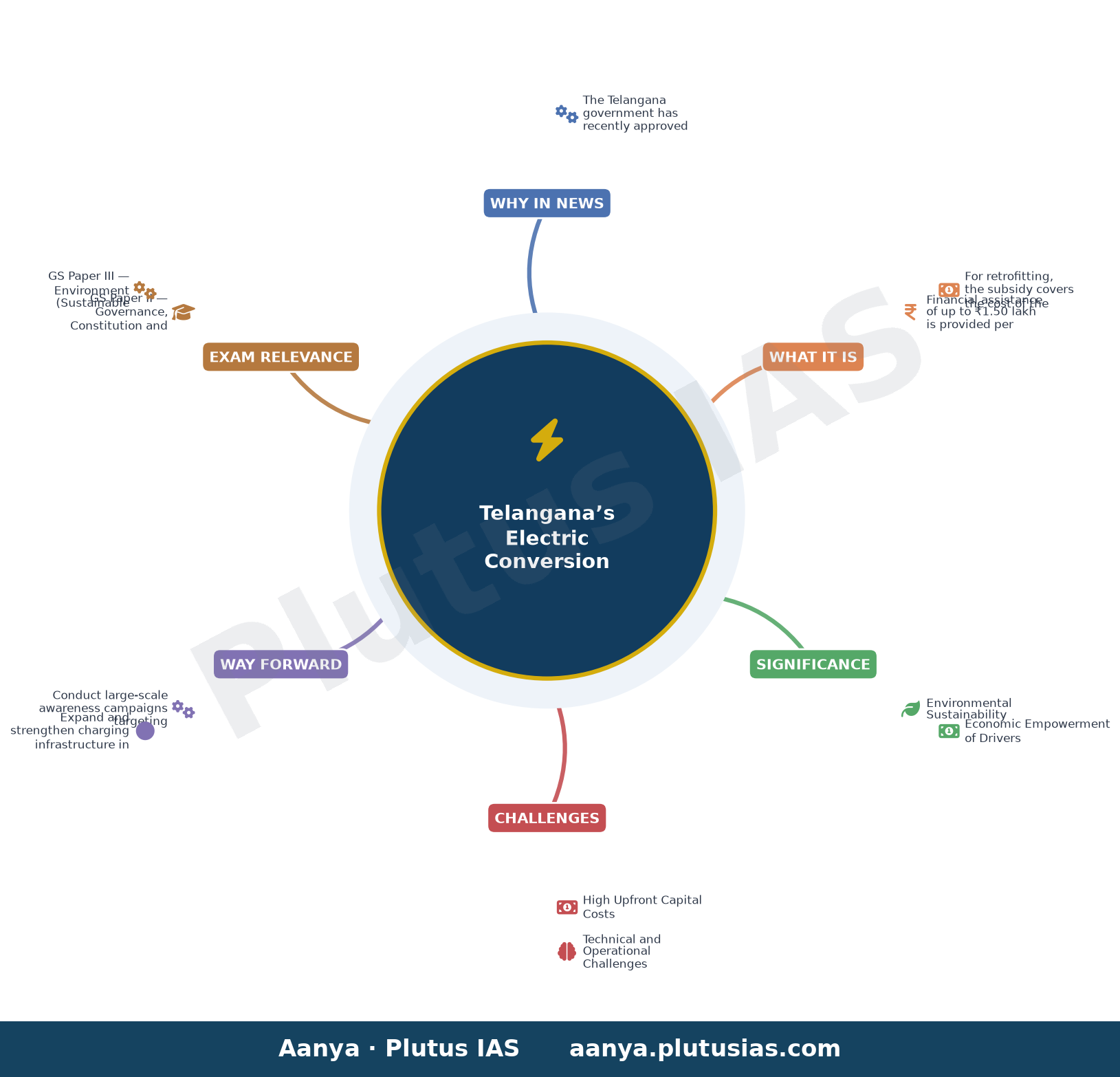
- GS Paper II — Governance, Constitution and Polity (Sub-national Governance, Urban Local Bodies) | GS Paper III — Environment (Sustainable Development, Air Pollution Control, Electric Mobility) | GS Paper III — Economy (Subsidies, Fiscal Incentives, Public Transport Economics)
- Prelims: AIS-123 (Automotive Industry Standard for EV kits), FAME-II Scheme, Urban Local Bodies (ULBs), Net-Zero Emissions, Retrofitting of Vehicles, Empanelled Vendors, Type-Approved Vehicles, Swappable Battery Systems
- Essay: Sustainable Urban Development: Balancing Economic Growth and Environmental Conservation, The Role of Subsidies in Accelerating Green Transitions
Quick Revision: The Telangana Auto Rickshaw Electric Conversion Scheme 2026 offers up to ₹1.50 lakh subsidy per vehicle for converting ICE auto-rickshaws to EVs, either through retrofitting (AIS-123-approved kits) or new purchases, with funding sourced from multiple welfare departments and implemented via a three-tier governance structure.
Why is this in the news?
The Telangana government has recently approved the Telangana Auto Rickshaw Electric Conversion Scheme 2026, a ₹200 crore initiative aimed at converting 18,766 petrol and diesel auto-rickshaws into electric vehicles (EVs) in the Core Urban Region Economy (CURE) region. This scheme is significant as it represents a targeted intervention in urban transport decarbonisation, addressing environmental degradation, fuel price volatility, and the economic vulnerabilities of auto-rickshaw drivers through a structured financial subsidy mechanism.
Background
- Urban transport systems in Indian cities are a major source of particulate matter (PM) and nitrogen oxides (NOx), contributing to severe air pollution and public health risks.
- Auto-rickshaws, numbering over 1.5 million across India, are a critical mode of last-mile connectivity but predominantly operate on fossil fuels, exacerbating urban emissions.
- The Government of India’s FAME-II (Faster Adoption and Manufacturing of Electric Vehicles) scheme, launched in 2019, provides financial incentives for electric vehicles, including three-wheelers, but state-level schemes are essential for localized implementation.
- Telangana’s scheme aligns with its broader climate action commitments, including the State Action Plan on Climate Change (SAPCC) and the Hyderabad Metropolitan Development Authority’s (HMDA) urban sustainability goals.
- The scheme’s design reflects lessons from pilot retrofitting programs in cities like Delhi and Bengaluru, where financial incentives and vendor empanelment were used to ensure quality and scalability.
- Hyderabad, with over 18,000 auto-rickshaws in its core urban region, is a high-impact target for electrification due to its dense traffic and significant contribution to local air pollution.
What is the Telangana Auto Rickshaw Electric Conversion Scheme 2026?
- Financial assistance of up to ₹1.50 lakh is provided per vehicle, covering either retrofitting of existing autos using AIS-123-approved electric kits or the purchase of new factory-built electric three-wheelers.
- For retrofitting, the subsidy covers the cost of the AIS-123-approved electric kit, installation, and standard fitment accessories, with the lower of ₹1.50 lakh or the actual cost being disbursed.
- Beneficiaries opting for retrofitting may choose between fixed or swappable battery systems, providing flexibility based on operational needs and infrastructure availability.
- For new vehicle purchases, owners must surrender their internal combustion engine (ICE) auto-rickshaws and buy a type-approved electric passenger three-wheeler, with a fixed subsidy of ₹1.50 lakh deducted at the point of sale by empanelled dealers.
- The scheme is open to all eligible auto-rickshaw owners in the CURE region, irrespective of social category, with funding sourced from the SC, ST, BC, and Minority Welfare Departments (₹50 crore each).
- Implementation is structured through a three-tier mechanism: a State-Level Steering Committee for policy oversight, a Scheme Implementation Committee for operational management, and District Sanction Committees for local execution and monitoring.
- The scheme aims to reduce urban air pollution, lower operational costs for drivers by mitigating fuel price volatility, and accelerate Hyderabad’s transition toward a net-zero carbon emissions urban transport system.
Key Features
| Feature | Significance |
|---|---|
| Financial Assistance of ₹1.50 lakh | Provides substantial subsidy for either retrofitting existing autos or purchasing new electric autos, reducing the financial burden on auto-rickshaw drivers. |
| Dual Conversion Options | Allows beneficiaries to choose between retrofitting existing vehicles using AIS-123-approved kits or purchasing new factory-built electric autos, ensuring flexibility. |
| Empanelled Vendors & Dealers | Mandates installation and procurement through empanelled vendors and dealers, ensuring quality control and standardisation of electric kits and vehicles. |
| Fixed and Swappable Battery Systems | Offers both options for battery systems, addressing concerns of range anxiety and operational convenience for drivers. |
| Multi-Level Implementation Mechanism | Establishes a State-Level Steering Committee, Scheme Implementation Committee, and District Sanction Committee for structured governance, monitoring, and grievance redressal. |
Why it Matters
Environmental Sustainability
- Promotes transition to zero-emission urban transport in Hyderabad, aligning with national and global climate commitments under the Paris Agreement.
- Reduces vehicular emissions in the Core Urban Region Economy (CURE), contributing to improved air quality and public health outcomes.
- Supports India’s Nationally Determined Contributions (NDCs) to reduce greenhouse gas emissions intensity by 45% by 2030.
Economic Empowerment of Drivers
- Alleviates financial stress on auto-rickshaw drivers by subsidising conversion costs, thereby stabilising their livelihoods in the face of rising fuel prices.
- Encourages adoption of cost-effective electric vehicles with lower operational and maintenance expenses compared to internal combustion engine (ICE) vehicles.
- Enhances economic viability of the auto-rickshaw sector by integrating modern, energy-efficient technologies.
Urban Mobility and Infrastructure
- Facilitates the development of a sustainable urban transport ecosystem in Hyderabad, reducing dependence on fossil fuels.
- Supports the integration of electric mobility solutions with existing public transport networks, fostering multimodal connectivity.
- Encourages private sector participation in the electric vehicle ecosystem, including manufacturing, retrofitting, and battery management.
Policy and Governance Innovation
- Demonstrates a state-led model for implementing large-scale electric vehicle adoption policies with structured financial and administrative mechanisms.
- Sets a precedent for other states to replicate or adapt similar schemes for their urban transport sectors.
- Highlights the role of state governments in achieving national climate and energy transition goals through targeted interventions.
Challenges
1. High Upfront Capital Costs
- Despite subsidies, the initial cost of retrofitting or purchasing new electric autos may still be prohibitive for many drivers, particularly those with limited access to credit.
- Limited availability of affordable financing options for auto-rickshaw drivers to supplement the government subsidy.
UPSC Link: GS3: Infrastructure-Energy
2. Technical and Operational Challenges
- Retrofitting existing autos with AIS-123-approved kits may face compatibility issues, requiring stringent quality assurance and post-installation monitoring.
- Range anxiety and battery degradation in swappable systems could impact driver confidence and operational efficiency.
- Lack of widespread charging infrastructure in Hyderabad’s urban and peri-urban areas may hinder the seamless adoption of electric autos.
UPSC Link: GS3: Science & Tech
3. Supply Chain and Vendor Dependence
- Dependence on empanelled vendors for retrofitting kits and electric autos may lead to supply bottlenecks or delays, particularly during peak demand periods.
- Potential for vendor monopolies or cartelisation in the retrofitting and electric vehicle supply chain, necessitating robust regulatory oversight.
UPSC Link: GS3: Economy
4. Driver Awareness and Training
- Limited awareness among auto-rickshaw drivers about the benefits, operational requirements, and maintenance of electric vehicles may slow adoption rates.
- Inadequate training infrastructure for drivers to handle electric vehicle technology, including battery management and troubleshooting.
UPSC Link: GS3: Human Resource
5. Equity and Inclusion Concerns
- The scheme’s funding model, which draws from welfare departments, may raise questions about the equitable distribution of resources across social categories.
- Marginalised communities, including women and minority auto-rickshaw drivers, may face additional barriers to accessing the scheme due to socio-economic constraints.
UPSC Link: GS2: Governance
6. Environmental Trade-offs
- The environmental benefits of electric autos may be offset if the electricity used to charge them is generated from fossil fuel-based power plants, particularly in regions with high coal dependency.
- Disposal and recycling of lithium-ion batteries from electric autos pose long-term environmental risks if not managed through a formal circular economy framework.
UPSC Link: GS3: Environment
Challenges — UPSC Perspective
| Issue | Concern |
|---|---|
| Financial Barriers | High upfront costs for drivers despite subsidies may limit scheme uptake and exacerbate inequalities among auto-rickshaw operators. |
| Infrastructure Gaps | Inadequate charging infrastructure in Hyderabad’s urban and peri-urban areas could undermine the operational feasibility of electric autos. |
| Vendor Dependence | Over-reliance on empanelled vendors may lead to supply chain inefficiencies, delays, or quality compromises in retrofitting and vehicle procurement. |
| Driver Capacity | Limited awareness and training among drivers about electric vehicle technology may hinder smooth transition and adoption. |
| Equity Considerations | Potential disparities in access to the scheme across social categories may require targeted outreach and support mechanisms. |
| Battery Disposal | Lack of formalised battery recycling and disposal systems could pose environmental and health risks in the long term. |
Way Forward
- Conduct large-scale awareness campaigns targeting auto-rickshaw drivers to educate them on the benefits, operational aspects, and maintenance of electric autos, including battery management.
- Expand and strengthen charging infrastructure in Hyderabad’s urban and peri-urban areas, prioritising high-traffic zones and auto-rickshaw stands.
- Establish a dedicated financing window under schemes like the Pradhan Mantri Mudra Yojana (PMMY) to provide low-interest loans to auto-rickshaw drivers for supplementing the government subsidy.
- Develop a robust monitoring and evaluation framework to track the scheme’s progress, including metrics on adoption rates, emission reductions, and driver satisfaction.
- Institute a grievance redressal mechanism under the District Sanction Committees to address issues related to vendor performance, kit quality, and subsidy disbursement delays.
- Promote public-private partnerships (PPPs) to incentivise private investment in battery recycling and disposal infrastructure, ensuring environmental sustainability.
- Collaborate with academic and technical institutions to provide training programmes for auto-rickshaw drivers on electric vehicle technology and maintenance.
- Explore the integration of the scheme with other urban mobility initiatives, such as the Faster Adoption and Manufacturing of Hybrid and Electric Vehicles (FAME) scheme, for enhanced synergy.
UPSC Value Addition
Keywords for Mains Answer-Writing
Electric Vehicle (EV) Policy · Urban Transport Decarbonisation · Autorickshaw Conversion Scheme · AIS-123 Standards · Subsidised Retrofitting · Net-Zero Carbon Emissions · Sustainable Urban Mobility · Empanelled Vendors · State-Level Steering Committee · Core Urban Region Economy (CURE)
Concept Flow
Rising fuel costs and environmental degradation → Government recognises need for sustainable urban transport → Formulation of Telangana Auto Rickshaw Electric Conversion Scheme 2026 → Financial subsidy of ₹1.50 lakh offered for retrofitting or new EV purchase → Drivers choose between retrofitting existing autos or purchasing new EVs → Empanelled vendors ensure quality installation of AIS-123-approved kits → Multi-level governance mechanism monitors implementation → Transition to electric autos reduces emissions and operational costs → Improved air quality and driver livelihoods → Contribution to national climate goals and sustainable urban development.
Prelims Practice Questions
Q1. Consider the following statements regarding the Telangana Auto Rickshaw Electric Conversion Scheme 2026:
1. The scheme provides financial assistance up to ₹1.50 lakh for retrofitting existing autos with AIS-123-approved electric kits.
2. Beneficiaries opting for new electric autos must surrender their ICE autorickshaws.
3. The scheme is funded exclusively from the State Budget without any external assistance.
4. The scheme covers only diesel autorickshaws in the Core Urban Region Economy (CURE) region.
How many of the above statements are correct?
- Only one
- Only two
- Only three
- All four
Answer: Only three — Statements 1 and 2 are correct as per the scheme details. Statement 3 is incorrect because the scheme draws funds from multiple welfare departments. Statement 4 is incorrect as the scheme covers both diesel and petrol autorickshaws.
Q2. Assertion (A): The Telangana Auto Rickshaw Electric Conversion Scheme 2026 mandates the use of AIS-123-approved electric kits for retrofitting existing autos.
Reason (R): AIS-123 standards ensure safety, performance, and compatibility of electric conversion kits with the vehicle structure.
Options:
A. Both A and R are true, and R is the correct explanation of A.
B. Both A and R are true, but R is not the correct explanation of A.
C. A is true, but R is false.
D. A is false, but R is true.
Answer: ? — Both the Assertion (A) and Reason (R) are true, and R correctly explains A as AIS-123 standards are designed to ensure safety and compatibility for electric conversions.
Mains Practice Question
✍ Evaluate the role of state-led financial incentives in accelerating the transition to electric mobility in India’s urban transport sector. Analyse with reference to the Telangana Auto Rickshaw Electric Conversion Scheme 2026. (15 Marks)
Approach: MODEL-ANSWER SKELETON:
1. **Introduction**: Define electric mobility and its significance for urban transport decarbonisation in India.
2. **Scheme Analysis**:
– Outline the key provisions of the Telangana scheme: subsidy structure (₹1.50 lakh), dual options (retrofitting/new purchase), AIS-123 standards, and funding sources.
– Highlight the institutional mechanism: State-Level Steering Committee, Scheme Implementation Committee, and District Sanction Committee.
3. **Governance and Policy Framework**:
– Link to India’s broader EV policies (e.g., Faster Adoption and Manufacturing of Hybrid and Electric Vehicles (FAME) scheme, National Electric Mobility Mission Plan).
– Discuss the role of state governments in complementing central schemes for localised impact.
4. **Challenges and Critiques**:
– Financial sustainability: reliance on welfare department funds; scalability concerns.
– Implementation hurdles: vendor empanelment, AIS-123 compliance, and driver awareness.
– Equity considerations: access to subsidies across social categories and vehicle ownership.
5. **Comparative Perspective**:
– Contrast with other state initiatives (e.g., Delhi’s EV policy, Gujarat’s electric vehicle policy) to assess effectiveness of financial incentives.
6. **Conclusion**:
– Assess the scheme’s potential to reduce carbon emissions and fuel costs for auto-rickshaw drivers.
– Emphasise the need for integrated urban transport planning and multi-stakeholder collaboration.
Source: The Hindu
Generated by AanyaAi for educational purpose.

- मद्रास उच्च न्यायालय में ‘वेट्ट्री पयणम’ योजना को असंवैधानिक घोषित करने की मांग - October 4, 2026
- Gurugram’s groundwater extraction exceeds limit by 212%; HC seeks ban - October 4, 2026
- स्वतंत्रता सेनानी श्यामजी कृष्ण वर्मा की जन्म जयंती पर पीएम का श्रद्धांजलि - October 4, 2026

No Comments