


22 Apr The Economic Cost of Disinflation Across the Globe
This article covers “Daily Current Affairs”
SYLLABUS MAPPING : GS-3: Indian Economy
FOR PRELIMS : Inflation, Monetary Policy, and Growth
FOR MAINS : Evaluate the impact of global crude oil price volatility on India’s “Twin Deficit” (Fiscal and Current Account).
Context
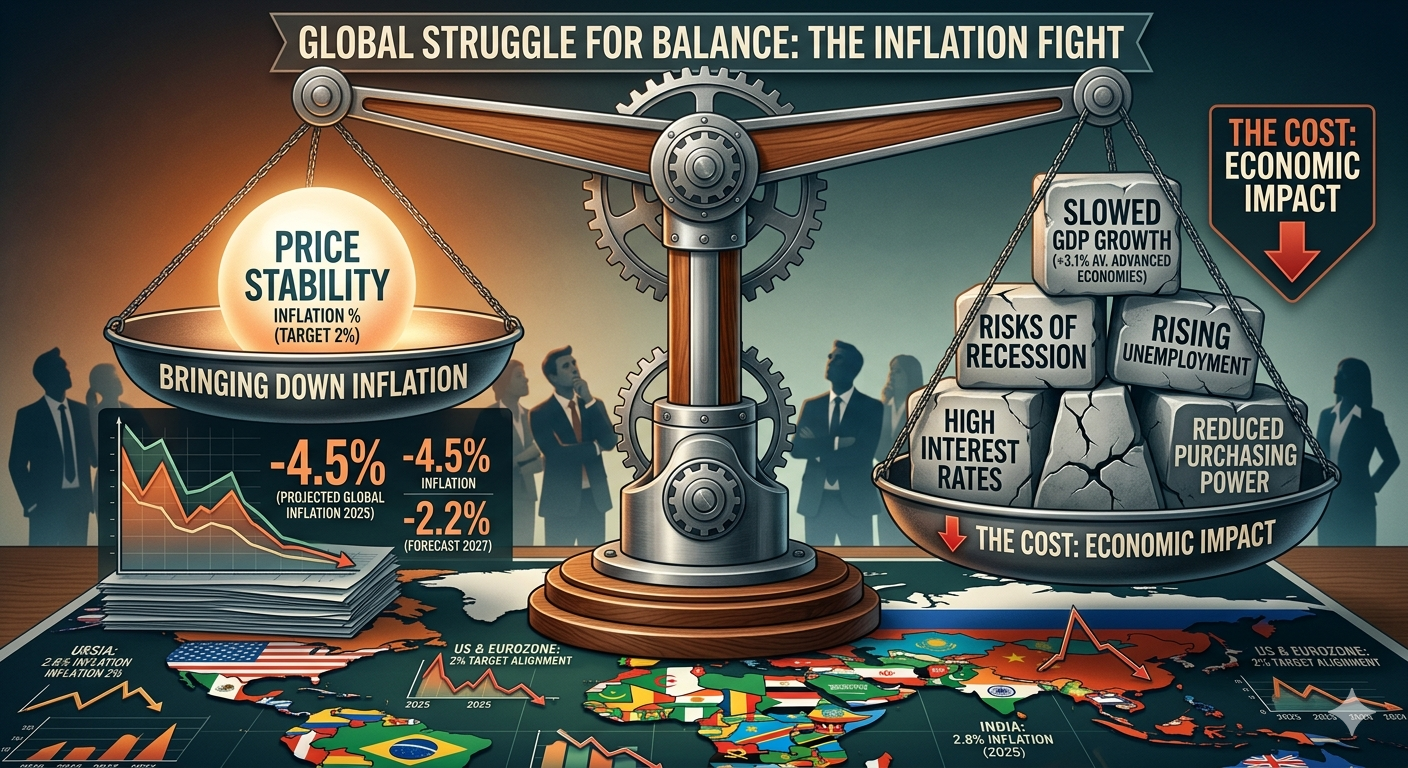
A recent analysis highlights the varying economic “sacrifice ratios” faced by India, the U.S., and the U.K. as they conclude their multi-year battle against the inflation surge that began in 2021-2022. While central banks globally have brought inflation down from historic peaks, the “cost” of this disinflation—measured in lost economic output and growth—has differed significantly across these major economies.
Key Highlights of the Global Disinflation Journey (2021–2026)
The Sacrifice Ratio: This economic metric measures the percentage of lost output (GDP) for every percentage point reduction in inflation. Economists noted that the U.S. achieved a “near-zero” sacrifice ratio, managing to curb inflation without a major recession.
The U.S. Performance: Despite the Federal Reserve hiking rates 11 times to a peak of 5.25–5.50% by July 2023, the U.S. economy avoided a downturn due to robust supply chains and a resilient labor market.
The U.K.’s Struggle: In contrast, Britain faced a technical recession in late 2023. Inflation peaked at 11.1% in October 2022, and the Bank of England (BoE) had to maintain high rates (5.25%) despite stagnant growth to reach its 2% target by early 2026.
India’s Balanced Path: The Reserve Bank of India (RBI) raised the repo rate from 4% to 6.5% between May 2022 and February 2023. India successfully avoided a recession, but its growth slowed from above 8% in 2023-24 to approximately 6.5% in 2024-25.
New Challenges: The West Asian Conflict & Currency Crisis
The disinflationary success is currently being tested by a new geopolitical crisis in West Asia, which began in early 2026.
Oil Price Surge: Crude oil has recently crossed the $120 per barrel mark, threatening to spark a fresh round of global inflation.
Rupee Depreciation: The Indian Rupee hit a record low of 95.22 per dollar on March 30, 2026. This has created a “currency crisis” where a weakening rupee makes essential imports, like fuel, significantly more expensive.
Monetary Policy Bind: The RBI held the repo rate steady at 5.25% in its April 2026 meeting. It faces a dilemma: cutting rates to boost a slowing economy could further weaken the rupee, while hiking rates to support the currency could “strangle” domestic growth.
Challenges For India
1. The Dominance of Food Prices
While advanced economies like the U.S. and U.K. focus on “core inflation” (excluding food and fuel), the Reserve Bank of India (RBI) cannot easily ignore food prices because they have historically comprised nearly half of the Indian household’s budget.
Climate Sensitivity: Food prices are acutely vulnerable to harvest outcomes. For instance, a below-normal monsoon forecast for 2026 (estimated at 92% of the average) is currently raising concerns about production drops in key crops like urad pulses, which could lead to price spikes in late 2026.
Minimum Support Prices (MSP): Government-set MSPs for staples like rice and wheat act as a price floor. While these support farmers, they also institutionalize higher food costs, making it difficult for inflation to drop below certain levels.
2. The Oil and Rupee “Double-Edged Sword”
As a major importer of nearly 80% of its oil, India is highly sensitive to global crude price shocks.
Imported Inflation: Every $10 increase in global oil prices can add approximately 0.7% to 1% to wholesale inflation and shave 0.5% off GDP growth.
Currency Pressure: High oil prices increase the demand for US dollars, putting downward pressure on the Rupee. A weaker Rupee further inflates the cost of all other imports, creating a vicious cycle of “imported inflation”.
Monetary Dilemma: This leaves the RBI in a “policy dilemma.” Raising interest rates may not stop a food price hike caused by a bad monsoon, but cutting them to support growth could trigger further Rupee depreciation and fuel-linked inflation.
3. Current Inflation Trajectory (2025–2026)
Despite these structural challenges, India recently achieved some of its lowest inflation readings on record:
Recent Lows: Average headline inflation fell to 1.7% during April–December 2025, largely due to a general disinflationary trend in food and fuel.
Projected Rise: Inflation has begun edging back up, reaching 3.4% in March 2026 as food and fuel-linked pressures returned.
RBI Stance: The RBI has maintained a neutral policy stance lately, remaining “nimble” to prevent persistent supply shocks—such as those from Middle East conflicts—from turning into long-term inflation.
Summary Table: Inflation & Growth Trends (2022–2026)
Way Forward for India
The RBI is expected to remain in a “wait-and-watch” mode. While headline inflation remains within the 2–6% target range (3.40% as of March 2026), the upside risks from energy prices and supply chain disruptions in the Strait of Hormuz necessitate a neutral but vigilant monetary stance.
Prelims Practise question:
- Aggressive selling of US Dollars from the Forex reserves.
- Increasing the Basic Customs Duty on essential edible oils.
- Implementing a “Dear Money Policy” (raising repo rates).
- Reducing the excise duty on Petrol and Diesel.
A) 1 and 3 only
B) 2 and 4 only
C) 1, 3, and 4 only
D) 1, 2, 3, and 4
Answer : C (1, 3, and 4 only)
-
- Logic: Selling USD (1) strengthens the Rupee, making imports cheaper. Raising rates (3) attracts capital and supports the currency. Reducing excise duty (4) directly lowers the passed-on cost of imported oil. Increasing customs duty (2) would actually increase the price of imported goods, worsening inflation.
Mains Practise question:
“The supply-side nature of India’s inflation makes the RBI’s monetary policy transmission a secondary tool compared to fiscal and structural interventions.” Critically analyze this statement in the context of the high weightage of food and fuel in the CPI basket.
(15 Marks, 250 Words)

- India’s Youth Unemployment and Education Crisis - August 5, 2026
- India’s Sports Infrastructure and the 2036 Olympics Ambition - August 5, 2026
- Critical Minerals: The Foundation of Strategic Power - August 4, 2026

No Comments