


08 May The Great Ocean Shutdown: AMOC Collapse and the Climate Chaos Ahead
This article covers “Daily Current Affairs”
SYLLABUS MAPPING : GS Paper 3 : Environment
FOR PRELIMS : What is AMOC , Tipping Point , El Niño
FOR MAINS : “Climate tipping points like AMOC collapse reveal fundamental gaps in global governance architecture — a system built for gradual change, not abrupt and irreversible shifts.” Critically evaluate this statement with reference to AMOC risk, the role of IPCC and UNFCCC, and the adequacy of the Paris Agreement framework in addressing tipping point threats. (15 M)
Why in News?
Scientists are increasingly alarmed about the stability of a vast system of ocean currents in the Atlantic, after new research suggested it could weaken far more severely than previously thought. The Atlantic Meridional Overturning Circulation (AMOC), which regulates climate across much of the globe, may slow by up to 59% by 2100 under high-emission scenarios, with potentially devastating consequences for weather systems as far away as the Indian subcontinent. The findings have particular significance for India, where hundreds of millions of people depend on the summer monsoon for their agricultural livelihoods and water supplies.
What is AMOC?
The Global Conveyor Belt
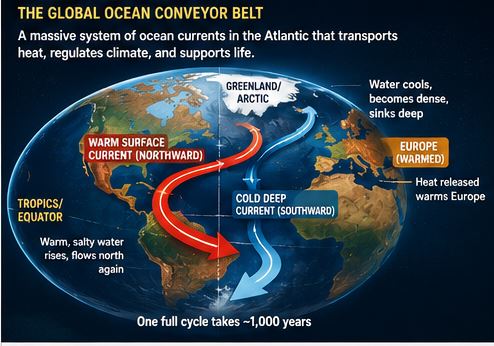
Think of the Earth’s oceans as having a massive, invisible conveyor belt. In the Atlantic Ocean, this system is scientifically known as the AMOC. Warm, salty surface water from the tropics flows north towards Greenland. As it reaches the freezing Arctic, the water cools, becomes denser, and sinks several kilometres into the deep ocean. It then drifts back south as a cold deep-water current before eventually rising to the surface to warm up and restart the loop.
This slow machinery moves vast amounts of heat across the globe. To put its pace in perspective, a single cubic metre of water takes about 1,000 years to complete the journey. It is the reason Europe has a mild climate, and it heavily influences rainfall in Africa, the Americas, and Asia — including India’s summer monsoon.
Key Physical Drivers
The Tipping Point — Why Scientists Are Alarmed
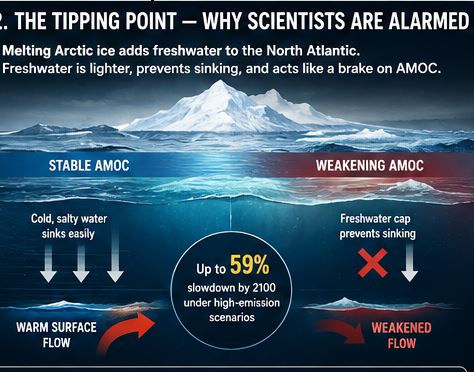
The conveyor belt relies on a delicate balance of ocean temperature and salt levels. Human-induced climate change is melting Arctic ice at an alarming rate, dumping massive amounts of freshwater into the North Atlantic. Because fresh water is lighter and less salty, it does not sink easily — this acts like a brake on the entire AMOC system.
While past studies estimated a 15% slowdown over the last 50 years, new research using real-time measurements projects a much sharper decline, potentially weakening the currents by up to 59% by 2100. This matters because the AMOC is a “climate tipping point.” Just like a chair tilted past its balancing point, once the AMOC crosses a certain threshold, it could irreversibly collapse into a new, sluggish state. Scientists debate the exact timeline, though some warn it could happen as early as this century.
Tipping point — what makes AMOC different
- Unlike gradual changes, a tipping point means the system tips suddenly and is very hard to reverse, even if warming is stopped
- Models show a weakened AMOC can reach a point where freshwater feedback loops accelerate its own collapse
- An early warning signal analysis (2021, Nature Climate Change) found AMOC may be approaching a critical transition
- The IPCC AR6 (2021) assessed it as “very likely” AMOC will weaken this century, with a small but non-negligible chance of abrupt decline
Historical and Scientific Timeline
How AMOC Decline Affects the World — Two Syndromes
El Niño Connection
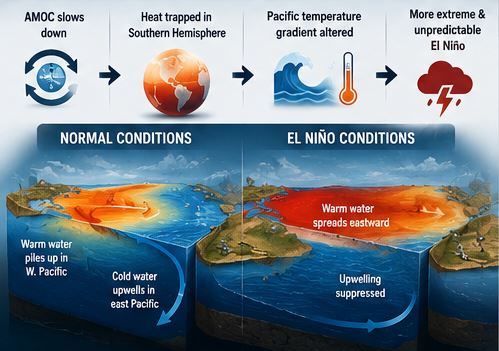
Though the AMOC is in the Atlantic, its breakdown would trigger chaos in the Pacific. El Niño is a periodic warming of the Pacific Ocean that disrupts global weather. Because global ocean currents and wind patterns are deeply interconnected, a sluggish AMOC traps heat in the southern hemisphere and leaves the North Pacific cooler. This throws off the delicate temperature balance that drives El Niño. Studies suggest a weaker AMOC will make El Niño events more unpredictable and extreme. Recent powerful El Niños (2015–16 and 2023–24) caused massive worldwide disruptions — an AMOC decline would compound these risks.
Effect on India
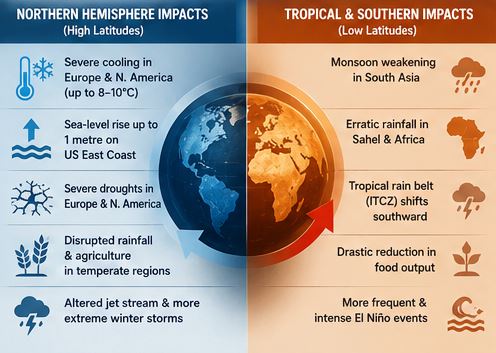
For India, an AMOC collapse is more than a distant oceanic event — it is a direct threat to food security. The Indian summer monsoon, which is the backbone of the country’s agriculture and economy, relies on specific global heat distributions. When the Atlantic conveyor slows down, less heat travels north. This shift pulls the planet’s tropical rain belt (the ITCZ) southward, away from the Indian subcontinent.
Research indicates this would severely weaken the wind systems that carry moisture from the Arabian Sea into India. The result would be shorter wet seasons, longer dry spells, and an overall drying trend. Furthermore, an unpredictable El Niño, worsened by AMOC’s decline, would only compound these climate risks, trapping Indian farmers between extreme droughts and erratic, destructive floods.
India — specific consequences
- Indian summer monsoon weakens — June–September rainfall could decline by 10–20% in worst-case scenarios
- Kharif crops (rice, soybean, cotton, sugarcane) face severe stress; food inflation risk rises sharply
- Arabian Sea moisture transport disrupted — regions dependent on the southwest monsoon (Western Ghats, central India) face prolonged droughts
- Sea level rise in the Indian Ocean could threaten coastal populations in Mumbai, Kolkata, and the Sundarbans
- India’s hydropower generation (Himalayan rivers) becomes erratic as monsoon variability increases
- Agricultural GDP — ~14% of India’s total GDP — directly exposed to monsoon reliability
Governance and International Response
IPCC and Global Scientific Consensus
The IPCC Sixth Assessment Report (AR6, 2021) concluded it is “very likely” AMOC will weaken this century. It identified AMOC collapse as one of the most consequential low-likelihood, high-impact climate risks — a potential “tipping cascade” that could trigger other tipping points such as Amazon dieback and Greenland ice sheet melt.
Paris Agreement Relevance
Keeping global warming below 1.5°C–2°C (the Paris Agreement targets) substantially reduces — but does not eliminate — the risk of AMOC collapse. At 3°C or above, multiple models show AMOC entering a collapsed state. This makes deep emission cuts directly tied to oceanic stability.
Global Governance Gaps
- No dedicated binding international treaty governs ocean circulation monitoring or tipping point preparedness
- The UN Ocean Treaty (BBNJ Agreement, 2023) addresses biodiversity in high seas but does not directly target circulation monitoring
- Observing systems like RAPID and OSNAP depend on voluntary national funding — a systematic underfunding concern
- Climate finance (Green Climate Fund, Loss & Damage Fund) must account for AMOC-driven disruptions to agriculture and coastal infrastructure in developing nations
Prelims Question
1. AMOC is driven primarily by density differences caused by temperature and salinity variations in the Atlantic Ocean.
2. AMOC collapse would cause cooling in Europe and weakening of the Indian summer monsoon simultaneously.
3. Sea levels on the US East Coast are expected to fall if AMOC weakens, because less warm water would flow northward.
4. The Andes virus is the primary biological threat associated with AMOC tipping events.
Which of the statements given above are correct?
Statement 1 is CORRECT.AMOC is driven by thermohaline circulation — “thermo” = temperature and “haline” = salinity. Cold, salty water in the North Atlantic is denser, sinks, and drives the circulation.
Statement 2 is CORRECT.An AMOC collapse would simultaneously cool Europe (by cutting off northward heat transport) and weaken the Indian summer monsoon (by shifting the tropical rain belt southward, away from South Asia).
Statement 3 is INCORRECT.The opposite is true. AMOC currently acts like a pump that pulls water northward, lowering sea levels on the US East Coast. If AMOC weakens, this pumping effect diminishes and sea levels on the US East Coast wouldrise— by an estimated additional metre in severe scenarios.
Statement 4 is INCORRECT.The Andes virus is a hantavirus strain associated with a 2026 cruise ship outbreak — it has no connection to AMOC tipping events. This statement is a deliberate distractor.
Mains Question

- India’s Youth Unemployment and Education Crisis - August 5, 2026
- India’s Sports Infrastructure and the 2036 Olympics Ambition - August 5, 2026
- Critical Minerals: The Foundation of Strategic Power - August 4, 2026

No Comments