


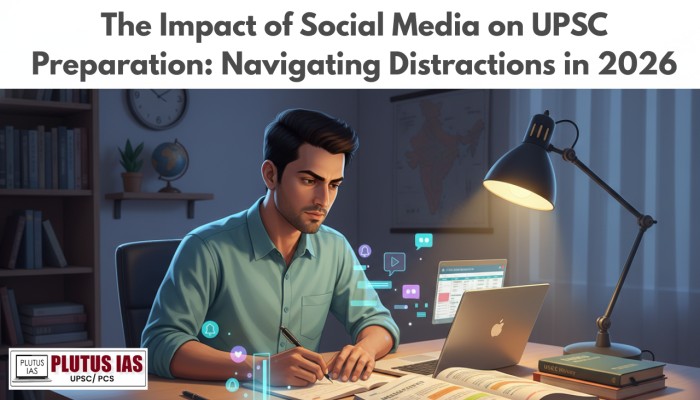
21 Mar The Impact of Social Media on UPSC Preparation: Navigating Distractions in 2026
You sit down at your study desk at 9:00 AM, ready to tackle a difficult chapter on the Indian Economy. Your phone vibrates. It is a notification from a Telegram group: “New Strategy PDF by AIR 1!” You open it. After reading the PDF, you see a link to a YouTube video. While watching the video, an Instagram notification pops up. You tell yourself, “Just five minutes of scrolling to relax.”
Suddenly, you look at the clock. It is 11:30 AM. Your book is still open to the same page. Your coffee is cold. Your mind is filled with random images, political memes, and the “perfect lives” of strangers. You feel a heavy sense of guilt, anxiety, and exhaustion before you have even started your day.
If you are preparing for UPSC 2026, you are living in the most digitally connected era in human history. For an IAS aspirant, social media is a double-edged sword. It offers a library of free knowledge, but it also acts as a “black hole” that sucks away your time, your focus, and your mental peace. In this comprehensive guide, we will explore the deep impact of social media on UPSC preparation and how you can navigate these distractions to stay on the path to success.
1. The Paradox of Social Media: Tool vs. Trap
Before we discuss the negatives, we must acknowledge the positives. Social media has “democratized” UPSC preparation. Ten years ago, you had to move to Delhi and pay lakhs of rupees for quality coaching. Today, for the 2026 attempt, you can access world-class lectures on YouTube, download official reports from Telegram, and follow expert analysis on Twitter—all for free.
However, the very thing that makes social media a tool also makes it a trap. Because the information is infinite, your brain never knows when to stop. You stop studying the subject and start studying the “preparation” for the subject. You spend more time watching “How to Read the Newspaper” videos than actually reading the newspaper. This is the first and most dangerous impact: The Illusion of Productivity.
2. The Science of the “Dopamine Loop” and Reduced Attention Span
The UPSC exam demands Deep Work. To understand the Basic Structure Doctrine or the complexities of Climate Change, your brain needs to focus intensely for at least 90 minutes. However, social media platforms like Instagram Reels, YouTube Shorts, and TikTok are designed by psychologists to do the exact opposite.
Must Check :- Best IAS Coaching in Delhi
These platforms provide “micro-hits” of dopamine every 15 to 30 seconds. Your brain gets addicted to this rapid stimulation. When you try to go back to a “boring” textbook like M. Laxmikanth, your brain feels under-stimulated. You find it impossible to read more than two pages without wanting to check your phone. For a UPSC 2026 aspirant, this reduced attention span is a silent killer. If you cannot focus, you cannot analyze; if you cannot analyze, you cannot clear the Mains.
3. The “Topper Comparison” Syndrome
Social media has created a “Performance Culture” in UPSC preparation. Every day, you see pictures of other aspirants’ study desks filled with colorful highlighters and neatly organized notes. You see “Study with Me” videos of people sitting for 16 hours straight. You see toppers enjoying their training at LBSNAA.
While these are meant to be motivational, for many, they trigger Social Comparison Anxiety. You look at your own messy desk and your 6-hour study routine and feel like a failure. You start doubting your own strategy. You think, “Maybe I should use their pen,” or “Maybe I should join that group.” This constant comparison steals your joy and replaces it with a feeling of “not being enough,” which leads to burnout and depression.
4. The Telegram Trap: Information Hoarding
For a UPSC aspirant, Telegram is often the biggest distraction disguised as a “study aid.” There are thousands of groups sharing daily news, mock tests, and handwritten notes. Many aspirants suffer from Digital Hoarding. They download every PDF they see, thinking they will read it later. Their phone is filled with 5,000 files, but their brain hasn’t processed even 50 of them.
Telegram groups also breed “Toxic Discussions.” Aspirants spend hours debating whether a particular question in a mock test was right or wrong, or predicting when the UPSC notification will come. This “noise” creates mental clutter and takes you away from the core task: Mastering the Static Syllabus.
5. The Death of Original Thinking
UPSC Mains is a test of your opinion and your ability to synthesize facts. However, social media provides “readymade opinions.” You watch a 10-minute video analysis of an editorial, and you simply copy the YouTuber’s points. You stop thinking for yourself. You stop questioning. You stop struggling with the text.
When you enter the exam hall in 2026, the question will be slightly twisted. Because you only memorized someone else’s opinion from a video, you will find it impossible to frame a unique, high-scoring answer. Over-reliance on social media for content “digestion” makes your mind lazy and unoriginal.
6. Navigating Distractions: The Digital Minimalism Strategy
You do not need to delete every social media app to clear the UPSC. In the 2026 landscape, that might even be counterproductive. Instead, you need to practice Digital Minimalism. Here is how you can take control of your digital life:
A. The “Work-Phone” Mindset
Treat your smartphone as a professional tool, not an entertainment device. Remove all non-essential apps from your home screen. Turn off all notifications—especially for Telegram, WhatsApp, and Instagram. You should decide when to open the app; the app should not decide when to pull you in.
B. Scheduled Usage (The Batching Rule)
Allocate a specific “Internet Time” in your daily schedule. For example, from 7:00 PM to 8:30 PM, you are allowed to check Telegram groups, watch specific YouTube lectures, and reply to messages. Outside of this window, the internet should be off. This creates a psychological boundary between “Study Mode” and “Digital Mode.”
C. Physical Boundaries
The easiest way to avoid distraction is to make the phone physically inaccessible. When you sit down for a 3-hour study block, keep your phone in a different room. If you need it for a timer, use a physical clock. If you need it for music, use an old MP3 player or a dedicated device with no internet. The “Out of Sight, Out of Mind” rule is the most effective way to improve focus.
7. Curating Your Feed: The “Unfollow” Audit
If you are going to be on social media, make sure your feed works for you, not against you. Do a weekly “Audit” of your following list.
- Unfollow: People who make you feel anxious, political accounts that trigger anger, and “lifestyle” influencers who distract you from your goals.
- Follow: Official government accounts (PIB, Sansad TV, ISRO), international organizations (UN, IMF), and mentors who provide calm, logical, and infrequent advice.
Your digital environment is just as important as your physical study room. If your feed is filled with junk, your mind will be filled with junk.
8. The Importance of “Boredom” in UPSC Preparation
Social media has killed our ability to be bored. The moment we feel a second of boredom, we reach for our phones. But boredom is essential for creativity and memory consolidation.
When you are bored, your brain “replays” what you studied during the day. It builds connections. It thinks about that Ethics case study or that History timeline. By constantly filling every gap with social media, you are preventing your brain from doing its job. In 2026, the aspirants who can sit in silence and just think will be the ones who write the best answers.
9. How to Use YouTube and Telegram the “Smart Way”
To benefit from these platforms without getting distracted, follow these strict rules:
- YouTube: Never “browse” the home page. Go to YouTube with a specific search term (e.g., “Monetary Policy explained”). Watch that one video, and then close the tab. Use “Incognito Mode” so the algorithm doesn’t start recommending distractors.
- Telegram: Leave 90 percent of your groups. Stay in only 2 or 3 high-quality channels that provide essential information. Disable the “Auto-Download” of media to prevent your phone from becoming a junkyard of PDFs.
Conclusion: Reclaiming Your Mind for UPSC 2026
The UPSC Civil Services Examination is a test of your character as much as your knowledge. One of the most important traits of a modern administrator is the ability to filter out “Noise” and focus on “Signal.” Social media is 99 percent noise and 1 percent signal.
Distractions will always exist. In 1996, it was the television; in 2026, it is the smartphone. The technology changes, but the solution remains the same: Discipline and Intentionality.
Do not let a five-inch screen stand between you and your dream of serving the nation. Reclaim your time. Reclaim your attention span. Reclaim your ability to think deeply. Use social media as a servant, but never let it become your master. Your 2026 success depends on the choices you make every time your phone vibrates. Choose your future over a dopamine hit.
Frequently Asked Questions (FAQs)
Q1: Is it mandatory to delete Instagram and Facebook for UPSC?
No, it is not mandatory, but it is highly recommended if you find yourself unable to control your usage. For many, these apps provide zero value for the exam and only increase stress. If you can use them for 15 minutes a day and stop, keep them. If 15 minutes turns into 2 hours, delete them immediately. Your IAS dream is worth more than a few likes.
Q2: How do I handle the “Information Anxiety” of missing Telegram updates?
Remind yourself that UPSC is a test of basic concepts, not obscure news. If a piece of news is truly important, it will be in the newspaper and in every monthly magazine. You don’t need to see it the second it is posted on Telegram. Trust your standard books and monthly compilations. They are enough to clear the exam.
Q3: Can I use social media for “Motivation” when I feel low?
Social media “motivation” is like sugar—it gives a quick energy boost but leads to a crash. Real motivation comes from within—from your desire to solve problems in society and your passion for the subjects. If you feel low, instead of watching a “Topper Entry” video, go for a walk, talk to a friend, or read a book on an inspiring historical figure. These are much healthier and more sustainable sources of energy.
Must Check :- Best IAS Coaching in Delhi
Q4: My coaching classes are online/on social media. What should I do?
If you must use social media for classes, use a dedicated device like a laptop or a tablet, and keep your phone in another room. Disable all other tabs. The moment your class is over, close the device. Do not use the same device for both “study” and “entertainment.” Creating this mental distinction is crucial for maintaining focus.
Related Articles
- Best Economics Optional Coaching in Delhi
- Best History Optional IAS Coaching in Delhi
- Best PSIR Optional Coaching in Delhi
- Best Mathematics Optional Coaching in Delhi
- Best Sociology Optional Coaching in Delhi
- Best Anthropology optional Coaching in Delhi
- Best Anthropology Optional Teacher for UPSC
- Best Teacher for Sociology Optional UPSC
- Best Teacher for Mathematics Optional UPSC Exam
- Best Teacher for UPSC PSIR Optional UPSC
- Best Teacher for History Optional UPSC Exam
- Best Teacher For UPSC Economics Optional

- Best AI Tool for UPSC Preparation - July 27, 2026
- Best UPSC + Diploma Coaching - April 28, 2026
- Best UPSC + MBA Coaching - April 28, 2026

No Comments