


12 Feb The Office of the Lok Sabha Speaker: Constitutional Sanctity and the Challenge of Impartiality
This article covers “Daily Current Affairs” and From The Office of the Lok Sabha Speaker: Constitutional Sanctity and the Challenge of Impartiality
SYLLABUS MAPPING
GS-2- Polity & Governance- The Office of the Lok Sabha Speaker: Constitutional Sanctity and the Challenge of Impartiality
FOR PRELIMS
What is the role of the Speaker in the Lok Sabha?
FOR MAINS
What challenges arise when the post of Deputy Speaker remains vacant?
Why in the News?
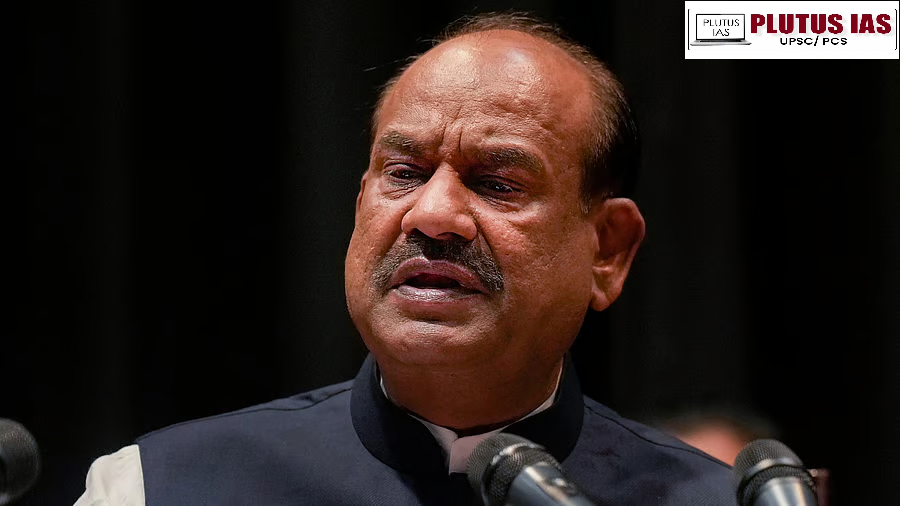
In a significant constitutional development, more than 100 Opposition MPs from the Congress and allied parties submitted a formal resolution in February 2026 seeking the removal of Lok Sabha Speaker Om Birla. This move, coordinated across multiple political entities, alleges that the Speaker has engaged in partisan conduct and the abuse of constitutional office during the Budget Session. The notice is currently being examined by the Lok Sabha Secretariat to determine its admissibility and the subsequent procedural steps.
Defining the Concept: The Speaker as the “Umpire” of Democracy
The Speaker of the Lok Sabha is not merely a presiding officer; they are the guardian of the powers and privileges of the House and its members. In a parliamentary system, the Speaker represents the dignity and freedom of the House. While the Speaker is elected from a political party, the office demands absolute neutrality to ensure that the “voice of the minority” (the Opposition) is heard alongside the “will of the majority” (the Government). The removal process is a rare constitutional safety valve intended to hold the Chair accountable to the House as a whole.
Background and Context: The Rarity of Removal
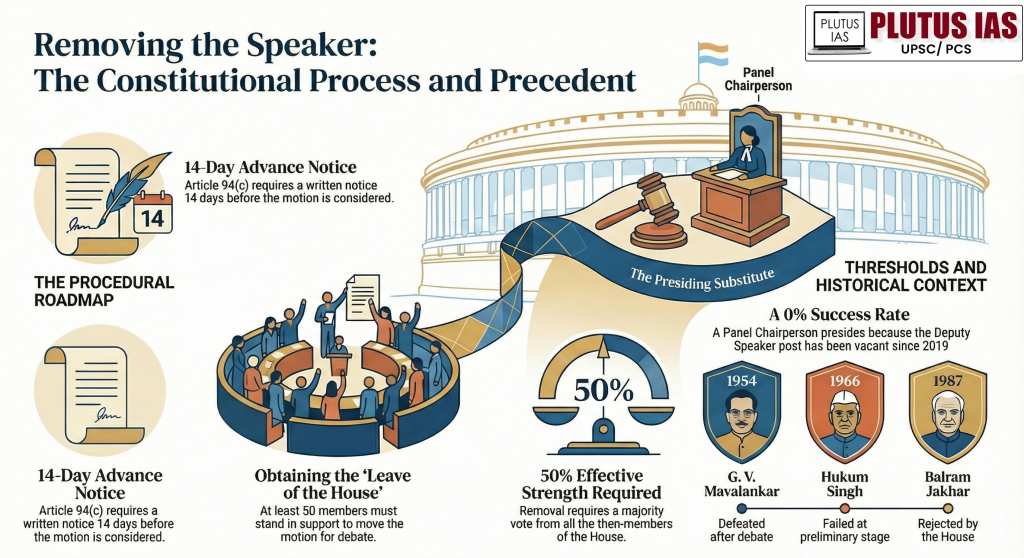
The removal of a Speaker is a high-threshold event in Indian parliamentary history. Historically, such attempts are rare and have never resulted in a successful removal. Since Independence, the Lok Sabha has witnessed only three previous efforts:
• 1954: A motion against the first Speaker, G. V. Mavalankar, was debated and ultimately defeated.
• 1966: A resolution against Hukum Singh failed at the preliminary stage because it did not secure the support of the required 50 members.
• 1987: A motion against Balram Jakhar was rejected by the House.
The current resolution arises in a polarized political climate where the Opposition has specifically cited the denial of speaking time to the Leader of the Opposition, the suspension of opposition MPs, and a perceived failure to act against objectionable remarks by ruling party members as the primary triggers for the motion.
Constitutional and Legal Dimensions
1. The Constitutional Mandate (Article 94): Under Article 94(c), a Speaker can be removed by a resolution passed by a majority of all the then members of the House. This is known as an “effective majority,” meaning more than half of the total strength of the Lok Sabha, excluding current vacancies.
2. Procedural Safeguards (Rule 200): To prevent frivolous attempts at removal, Rule 200 of the Rules of Procedure and Conduct of Business in Lok Sabha stipulates that a written notice of fourteen days must be given before the motion can even be considered by the House.
3. The Preliminary Threshold (Rule 10): Once the motion is listed, it must obtain the “leave of the House.” This requires at least 50 members to stand in their places in support of the motion. If this threshold is not met, the motion fails at the preliminary stage, as seen in the 1966 Hukum Singh case.
4. Temporary Recusal (Article 96): During the consideration of a resolution for their removal, Article 96 prohibits the Speaker from presiding over the House. This ensures that the individual being judged does not act as the judge of the proceedings against them.
Significance and Importance of the Office
The Speaker holds a pivotal role in maintaining the separation of powers and the integrity of legislation.
• Managing Debates: The Speaker is responsible for the fair allocation of time and the management of floor discipline.
• Institutional Stability: The Chair ensures that the House functions according to established rules, preventing the executive from steamrolling the legislature.
• Representation: As the representative of the House to the outside world, any perceived bias in the Speaker’s conduct tarnishes the image of the legislature itself.
Key Issues and Governance Challenges
1. The Crisis of the Vacant Deputy Speaker (Article 93): A critical issue highlighted by the current resolution is the ongoing vacancy in the post of Deputy Speaker, which has remained empty since June 2019. While Article 93 mandates that the House “shall” choose both a Speaker and a Deputy Speaker, the position has not been filled since the end of the 16th Lok Sabha.
• Impact on Removal: Under Article 96, the Deputy Speaker is supposed to preside when a removal motion against the Speaker is pending. In the current absence of a Deputy Speaker, the House must rely on Article 95(2) and Rule 9, which allow a member from the Panel of Chairpersons to preside. This member exercises the same authority as the Speaker during the debate and vote.
2. Allegations of Partisanship and “Abuse of Office”: The current resolution is built on the allegation of “abuse of constitutional office”. The Opposition argues that the Speaker’s power to suspend members and manage debates has been used selectively to favor the ruling party. This raises fundamental questions about the neutrality of the Chair in a majoritarian system.
3. The Effectiveness of Oversight: When the Speaker is perceived as biased, the ability of the Opposition to fulfill its duty of parliamentary oversight is diminished. The denial of floor time to the Leader of the Opposition is cited as a direct blow to the accountability of the government.
Global Comparison: The UK Model vs. The Indian Model
(Note: The following information on the UK model is not in the sources and is provided for analytical depth; you may want to independently verify this). Unlike the Indian system, where the Speaker often retains their political party affiliation (even if unofficially), the United Kingdom follows the principle of “once a Speaker, always a Speaker.” In the UK, the Speaker formally resigns from their party upon election and is generally not challenged by major parties during general elections. This ensures a higher degree of perceived and actual neutrality compared to the Indian model, where the Speaker remains vulnerable to accusations of partisan loyalty.
Ethical and Democratic Concerns
The survival of a deliberative democracy depends on the ethical conduct of the Speaker. If the Chair becomes an instrument of the executive, the legislature ceases to be a forum for debate and becomes a mere rubber stamp. The frequent use of disciplinary actions, such as suspensions, without perceived impartiality, creates an atmosphere of confrontation rather than consensus-building.
Way Forward: Strengthening Parliamentary Institutions
1. Mandatory Election of Deputy Speaker: To uphold the spirit of Article 93, there should be a defined timeline for electing a Deputy Speaker, who, by convention, often belongs to the Opposition to ensure balance.
2. Codification of Conventions: Clearer guidelines for the allocation of speaking time and the suspension of members should be codified to minimize the subjective discretion of the Chair.
3. Adopting Neutrality Norms: India should consider the ethical convention of the Speaker formally resigning from their political party upon election to the Chair. This would bolster public and parliamentary confidence in the neutrality of the office.
4. Strengthening Article 96 Mechanisms: The reliance on the Panel of Chairpersons (who are nominated by the Speaker) to preside over the Speaker’s removal resolution could lead to a conflict of interest. A more independent mechanism or a prioritized election of a Deputy Speaker is essential for constitutional propriety.
5. Transparent Adjudication: The Lok Sabha Secretariat should ensure that the examination of the removal notice is conducted with transparency and within a strict timeframe to avoid the perception of procedural delay.
Conclusion
The office of the Speaker is the cornerstone of democratic governance in India. The current resolution, while politically contentious, serves as a reminder that constitutional offices are not immune to the principles of accountability and constitutional morality. Ensuring the impartiality of the Speaker is not just a matter of parliamentary procedure; it is essential for inclusive growth and the protection of the rights of the minority within the legislature. As India strives toward the vision of Viksit Bharat 2047, the resilience of its institutions will be measured by their ability to remain neutral arbiters in a vibrant, multi-party democracy. Upholding the sanctity of Articles 93, 94, and 96 is vital to ensuring that the “Temple of Democracy” remains a space for robust, fair, and unobstructed deliberation.
Best ias coaching in delhi Best ias coaching in chandigar
Prelims question:
Q. With reference to the removal of the Speaker of the Lok Sabha, consider the following statements:
1. The Speaker can be removed by a resolution passed by a simple majority of members present and voting.
2. A 14-day prior notice is mandatory before moving a resolution for removal of the Speaker.
3. During the consideration of the removal resolution, the Speaker can preside over the House but cannot vote.
4. At least 50 members must support the motion for it to be taken up for consideration.
Which of the statements given above are correct?
(a) 1 and 2 only
(b) 2 and 4 only
(c) 2, 3 and 4 only
(d) 1, 2 and 4 only
Answer: B
Q. Discuss the constitutional procedure for the removal of the Speaker of the Lok Sabha. How does the vacancy of the Deputy Speaker affect the functioning of this mechanism?
(250 words)

- RBI’s Shrinking Real-Rate Cushion Amid Rising Inflation and Strong Demand - September 21, 2026
- India’s NGOs at a New Funding Crossroads - September 21, 2026
- Deep-Sea Discovery, Environmental Responsibility - September 19, 2026

No Comments