


08 Aug Tiger Death in NSTR: Poaching or Natural Cause? UPSC Exam Insights
✎ Tiger mortality investigations in India must adhere to NTCA SOPs, including forensic analysis, rapid patrolling, and legal action under the Wildlife Protection Act, 1972, to address poaching, poisoning, or habitat degradation.
Subject Relevance — Where This Topic Fits
- GS Paper III — Environment, Biodiversity, and Climate Change | GS Paper III — Forest and Wildlife Conservation Policies | GS Paper IV — Ethical Concerns in Wildlife Conservation
- Prelims: Project Tiger, Nagarjunasagar Srisailam Tiger Reserve (NSTR), Wildlife Protection Act, 1972, NTCA SOPs for tiger mortality investigation, Poaching, poisoning, and human-wildlife conflict, Forensic analysis in wildlife crimes, Forest patrolling and vigilance mechanisms
- Essay: Ethical responsibility of humanity towards endangered species conservation, Balancing developmental pressures with ecological sustainability
Quick Revision: Tiger mortality investigations in India must adhere to NTCA SOPs, including forensic analysis, rapid patrolling, and legal action under the Wildlife Protection Act, 1972, to address poaching, poisoning, or habitat degradation.
Why is this in the news?
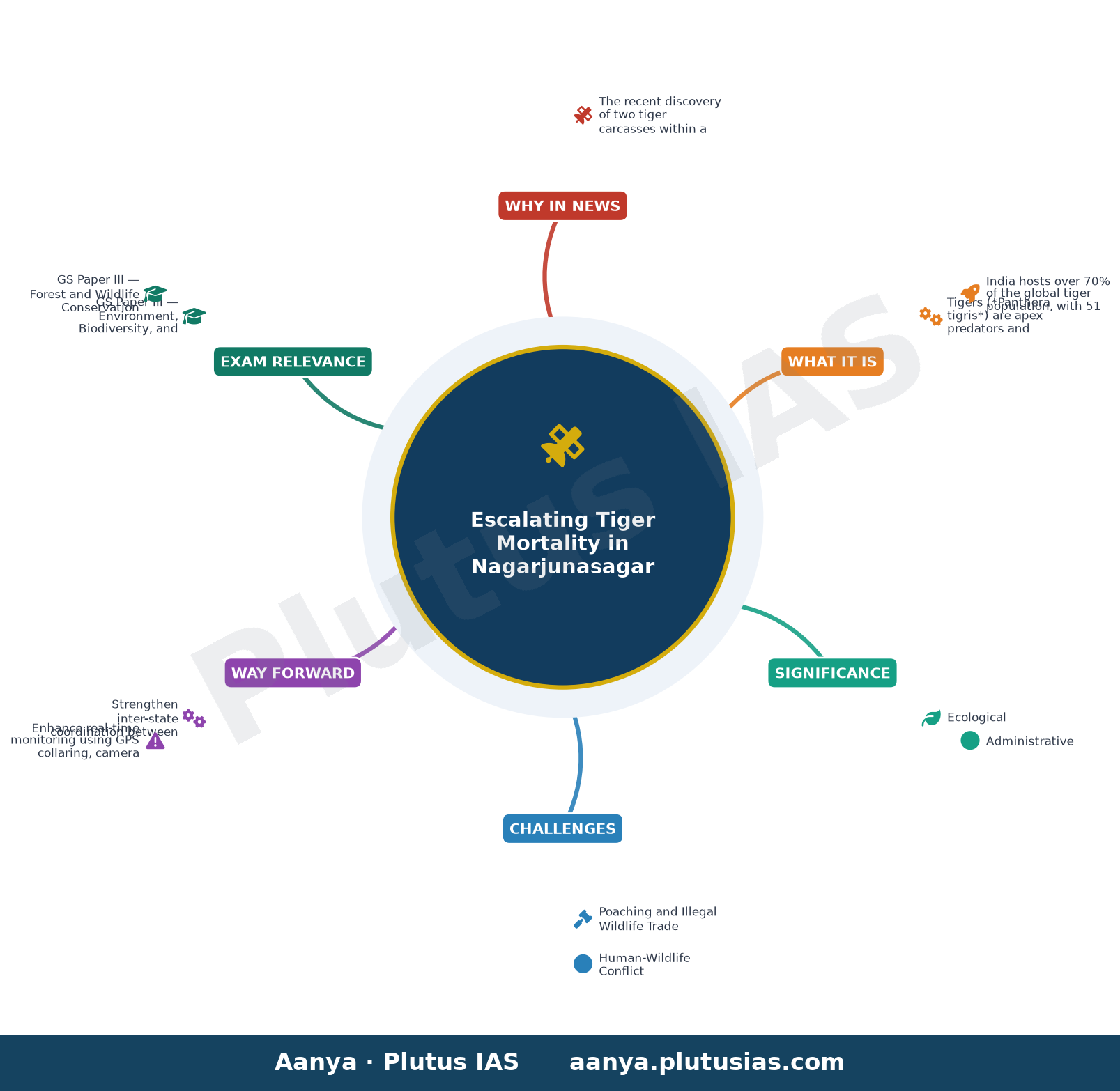
The recent discovery of two tiger carcasses within a span of three days in the Nagarjunasagar Srisailam Tiger Reserve (NSTR) has triggered urgent investigations and administrative responses. The absence of claws and limbs on one carcass, coupled with the Deputy Chief Minister’s directive for a transparent probe, underscores systemic vulnerabilities in wildlife protection mechanisms. This incident occurs against the backdrop of broader conservation challenges in India’s third-largest tiger reserve, necessitating a re-evaluation of enforcement protocols and habitat management strategies.
Background
- Nagarjunasagar Srisailam Tiger Reserve (NSTR), spanning Andhra Pradesh and Telangana, is India’s third-largest tiger reserve and a critical component of Project Tiger, notified in 1983.
- The reserve hosts an estimated 50–70 tigers (as per the last official census in 2022), with a declining trend observed in recent years due to habitat fragmentation and anthropogenic pressures.
- NSTR is part of the Eastern Ghats landscape, a biodiversity hotspot with significant ecological connectivity but increasingly threatened by mining, irrigation projects, and encroachments.
- The Wildlife Protection Act, 1972, provides the legal framework for tiger conservation, including stringent penalties for poaching, habitat destruction, and wildlife trade.
- The National Tiger Conservation Authority (NTCA), established in 2005, sets guidelines for tiger mortality investigations, including forensic analysis and rapid response protocols.
- Andhra Pradesh’s recent initiative to translocate gaurs from central India to supplement tiger prey base in Nallamala forests highlights the state’s proactive but contentious approach to ecological restoration.
What is the Significance of Tiger Conservation in India?
- Tigers (*Panthera tigris*) are apex predators and umbrella species, whose conservation ensures the health of entire ecosystems, including prey populations and forest structure.
- India hosts over 70% of the global tiger population, with 51 tiger reserves under Project Tiger, a centrally sponsored scheme launched in 1973 to reverse the decline in tiger numbers.
- Tiger conservation is a flagship indicator of biodiversity health, with the National Tiger Conservation Authority (NTCA) monitoring populations through the All India Tiger Estimation (every 4 years).
- The Wildlife (Protection) Act, 1972, classifies tigers under Schedule I, affording them the highest legal protection, with offences punishable by imprisonment up to 7 years and fines up to ₹50,000.
- Human-induced threats to tigers include poaching for skin, bones, and body parts (driven by illegal wildlife trade), habitat fragmentation due to linear infrastructure (roads, railways), and retaliatory killings due to human-wildlife conflict.
- Conservation strategies in tiger reserves include habitat restoration, prey augmentation, community-based conservation, and stringent anti-poaching measures such as the Special Tiger Protection Force (STPF).
- Forensic analysis in tiger mortality cases involves post-mortem examinations, toxicology tests, and DNA profiling to determine causes of death, including poisoning, electrocution, or natural factors.
- The socio-economic dimensions of tiger conservation require balancing the needs of local communities (livelihoods, resource access) with ecological imperatives, often necessitating participatory governance models.
Key Features
| Feature | Significance |
|---|---|
| Nagarjunasagar Srisailam Tiger Reserve (NSTR) | One of India’s largest tiger reserves, spanning Andhra Pradesh and Telangana, critical for tiger conservation and biodiversity preservation. |
| Post-mortem and forensic analysis | Adherence to NTCA SOPs ensures scientific determination of cause of death, aiding in conservation policy formulation. |
| Patrolling and vigilance enhancement | Increased field-level monitoring to deter poaching, poisoning, or human-wildlife conflict. |
| Wildlife Protection Act, 1972 | Legal framework governing tiger conservation, with stringent penalties for offences like poaching or habitat destruction. |
| NTCA guidelines | Standardised protocols for tiger mortality investigations, ensuring uniformity and transparency in conservation efforts. |
Why it Matters
Ecological
- Loss of apex predators disrupts trophic cascades, potentially leading to overpopulation of herbivores and degradation of forest ecosystems.
- Tiger deaths, especially in contiguous reserves like NSTR, threaten the genetic diversity and long-term viability of tiger populations in India.
- NSTR serves as a vital corridor for tiger movement between Eastern and Western Ghats, critical for metapopulation dynamics.
Administrative
- Demonstrates the need for robust inter-state coordination in wildlife crime prevention, given NSTR’s trans-boundary nature.
- Highlights the importance of real-time monitoring and rapid response mechanisms in tiger reserves.
- Reinforces the role of state forest departments in executing conservation policies under the guidance of central authorities like NTCA.
Policy
- Underscores the necessity of aligning state-level wildlife policies with national conservation frameworks (e.g., Project Tiger, NTCA guidelines).
- Emphasises the role of political leadership in prioritising wildlife conservation through resource allocation and accountability measures.
- Illustrates the challenges in balancing developmental pressures with conservation imperatives in forest-adjacent regions.
Challenges
1. Poaching and Illegal Wildlife Trade
- Tiger parts (claws, limbs) missing from carcasses suggest potential poaching for illegal trade, a persistent threat to tiger populations.
- Weak enforcement of wildlife laws and inadequate patrolling exacerbate vulnerability to organised wildlife crime.
- Corruption and collusion within local networks facilitate illegal activities, requiring systemic reforms in forest governance.
UPSC Link: GS-III: Environmental Conservation
2. Human-Wildlife Conflict
- Expanding human settlements and agricultural activities encroach upon tiger habitats, increasing conflict incidents.
- Retaliatory killings by local communities due to livestock predation or perceived threats to human safety.
- Lack of effective mitigation strategies (e.g., compensation mechanisms, early warning systems) to reduce conflict.
UPSC Link: GS-III: Disaster Management
3. Habitat Fragmentation and Degradation
- Linear infrastructure projects (roads, railways) and mining activities fragment tiger habitats, isolating populations.
- Climate change-induced shifts in forest composition and prey availability threaten ecological balance.
- Inadequate ecological restoration efforts to mitigate habitat loss and improve connectivity.
UPSC Link: GS-III: Environmental Pollution
4. Forensic and Investigative Gaps
- Delayed or incomplete post-mortem reports hinder accurate determination of cause of death.
- Insufficient forensic infrastructure and expertise in state forest departments for advanced analysis.
- Lack of standardised protocols for evidence collection and chain of custody in wildlife crime investigations.
UPSC Link: GS-II: Governance
5. Community Engagement and Awareness
- Low awareness among local communities about the ecological importance of tigers and conservation policies.
- Inadequate participation of tribal and forest-dwelling communities in conservation planning and implementation.
- Economic incentives for communities to support conservation (e.g., eco-tourism, sustainable livelihoods) remain underdeveloped.
UPSC Link: GS-II: Social Justice
Challenges — UPSC Perspective
| Issue | Concern |
|---|---|
| Poaching | Organised wildlife crime networks exploit weak enforcement, leading to targeted killings of tigers for illegal trade. |
| Habitat Fragmentation | Infrastructure and developmental projects isolate tiger populations, reducing genetic diversity and resilience. |
| Human-Wildlife Conflict | Encroachment into tiger habitats triggers retaliatory killings, undermining conservation efforts. |
| Forensic Gaps | Inadequate post-mortem and forensic analysis delay justice and fail to identify systemic threats. |
| Community Alienation | Lack of awareness and economic alternatives fosters resentment toward conservation initiatives. |
Way Forward
- Strengthen inter-state coordination between Andhra Pradesh and Telangana forest departments to address trans-boundary wildlife crime.
- Enhance real-time monitoring using GPS collaring, camera traps, and drone surveillance in high-risk zones of NSTR.
- Implement community-based conservation programs, including awareness campaigns and livelihood support (e.g., eco-tourism, NTFP collection).
- Establish rapid response teams for wildlife crime investigations, equipped with forensic tools and legal training.
- Develop and enforce strict protocols for post-mortem examinations, forensic analysis, and evidence preservation in tiger deaths.
- Promote ecological restoration projects to improve habitat connectivity and prey availability in fragmented landscapes.
- Increase penalties for wildlife offences under the Wildlife Protection Act, 1972, and ensure swift prosecution of offenders.
- Collaborate with national and international agencies (e.g., WCCB, TRAFFIC) for capacity building and intelligence-sharing on wildlife crime.
UPSC Value Addition
Keywords for Mains Answer-Writing
Project Tiger Division · Nagarjunasagar Srisailam Tiger Reserve (NSTR) · NTCA Standard Operating Procedures (SOPs) · Wildlife Protection Act, 1972 · tiger conservation challenges · human-wildlife conflict · forensic analysis in wildlife crimes · forest patrolling mechanisms · transboundary wildlife protection · carnivore mortality factors · State Forest Departments and tiger protection · National Tiger Conservation Authority (NTCA) guidelines · wildlife forensic science · tiger poaching and poisoning · biodiversity conservation governance
Concept Flow
Expansion of human settlements and infrastructure into tiger habitats → Increased human-wildlife conflict and habitat fragmentation. → Fragmentation of tiger habitats → Isolation of tiger populations → Reduced genetic diversity and increased vulnerability to disease. → Poor enforcement of wildlife laws and weak patrolling → Rise in poaching and illegal wildlife trade → Decline in tiger populations. → Inadequate forensic analysis and delayed investigations → Inability to determine cause of death → Failure to address systemic threats. → Low community engagement and awareness → Lack of support for conservation efforts → Continued encroachment and retaliation killings. → Political prioritisation of developmental projects over conservation → Weakening of institutional frameworks → Erosion of wildlife protection measures.
Prelims Practice Questions
Q1. Consider the following statements regarding the National Tiger Conservation Authority (NTCA):
1. NTCA is a statutory body constituted under the provisions of the Wildlife Protection Act, 1972.
2. NTCA is chaired by the Prime Minister of India.
3. NTCA formulates policies for tiger conservation and approves the Tiger Conservation Plans.
4. NTCA is empowered to declare tiger reserves in India.
How many of the above statements are correct?
- Only one
- Only two
- Only three
- All
Answer: All — Statements 1, 3, and 4 are correct. The NTCA is indeed a statutory body under the Wildlife Protection Act, 1972, and formulates policies while approving Tiger Conservation Plans and declaring tiger reserves. However, the NTCA is chaired by the Minister of Environment, Forest and Climate Change, not the Prime Minister.
Q2. Assertion (A): The Wildlife Protection Act, 1972, provides for the establishment of Project Tiger Divisions within tiger reserves.
Reason (R): The Act mandates the creation of dedicated administrative units to ensure the protection and conservation of tigers and their habitats.
Options:
A. Both A and R are true, and R is the correct explanation of A.
B. Both A and R are true, but R is not the correct explanation of A.
C. A is true, but R is false.
D. A is false, but R is true.
Answer: ? — Both Assertion (A) and Reason (R) are true, and Reason (R) correctly explains Assertion (A). The Wildlife Protection Act, 1972, indeed provides for the establishment of Project Tiger Divisions to ensure focused conservation efforts within tiger reserves.
Q3. Which of the following is NOT a function of the National Tiger Conservation Authority (NTCA)?
- Formulating the National Tiger Conservation Authority Guidelines
- Approving Tiger Conservation Plans
- Declaring tiger reserves
- Conducting forensic analysis of tiger deaths
Answer: Conducting forensic analysis of tiger deaths — Conducting forensic analysis of tiger deaths is not a direct function of the NTCA. While NTCA sets guidelines and approves conservation plans, forensic analysis is typically conducted by specialized agencies or laboratories under the supervision of forest departments and NTCA SOPs.
Mains Practice Question
✍ The recent deaths of tigers in the Nagarjunasagar Srisailam Tiger Reserve (NSTR) underscore systemic challenges in India’s tiger conservation governance. Critically examine the efficacy of the existing institutional and legal framework for tiger conservation in India, with particular reference to the role of the National Tiger Conservation Authority (NTCA), State Forest Departments, and the Wildlife Protection Act, 1972. (15 Marks)
Approach: MODEL-ANSWER SKELETON:
1. **Institutional Framework**:
– Role of NTCA as a statutory body under the Wildlife Protection Act, 1972 (Sections 38O, 38P, 38Q).
– Functions: Formulating guidelines, approving Tiger Conservation Plans, monitoring tiger populations, and declaring tiger reserves.
– Composition: Chairperson (Union Minister for Environment), members from MoEFCC, WII, and state representatives.
2. **State Forest Departments**:
– Implementation of NTCA guidelines at the ground level.
– Challenges: Inadequate staffing, lack of specialized training, and resource constraints (e.g., patrolling, forensic analysis).
– Case reference: NSTR deaths highlight gaps in patrolling and forensic investigation (NTCA SOPs mandate post-mortem and sample collection for forensic analysis).
3. **Legal Framework**:
– Wildlife Protection Act, 1972: Sections 9, 38, 38H, and 57 provide for protection of tigers and their habitats.
– Offences under the Act: Poaching, poisoning, and habitat destruction (Section 51).
– Challenges: Delayed investigations, lack of transparency, and weak enforcement (e.g., missing limbs/claws in NSTR tigers).
4. **Critical Analysis**:
– **Strengths**: NTCA’s guidelines and Tiger Conservation Plans have contributed to a 33% increase in tiger population since 2006 (NTCA 2022 data).
– **Weaknesses**: Fragmented implementation, lack of inter-state coordination (e.g., transboundary poaching), and insufficient forensic infrastructure.
– **Recent Initiatives**: Use of technology (camera traps, GPS collaring) and community-based conservation (e.g., Eco-development Committees).
5. **Way Forward**:
– Strengthening NTCA’s oversight role with greater autonomy and resources.
– Enhancing state capacity through training, technology, and forensic labs.
– Promoting community participation and transboundary cooperation (e.g., with Karnataka and Telangana).
6. **Conclusion**: Balance between statutory provisions and ground-level implementation remains the key challenge. The NSTR incident is a reminder of the need for a multi-pronged approach involving institutional reforms, technological integration, and community engagement.
Source: The Hindu
Generated by AanyaAi for educational purpose.

- यूपी में पहली बार तेंदुओं का बधियाकरण: मानव-वन्यजीव संघर्ष रोकेगा अभियान - September 24, 2026
- UP’s Groundbreaking Leopard Sterilization Plan to Curb Human-Wildlife Conflict - September 24, 2026
- महाराष्ट्र में त्योहार जुलूसों पर बॉम्बे हाईकोर्ट का बड़ा फैसला: पटाखे, लेजर और संगीत पर रोक - September 24, 2026

No Comments