


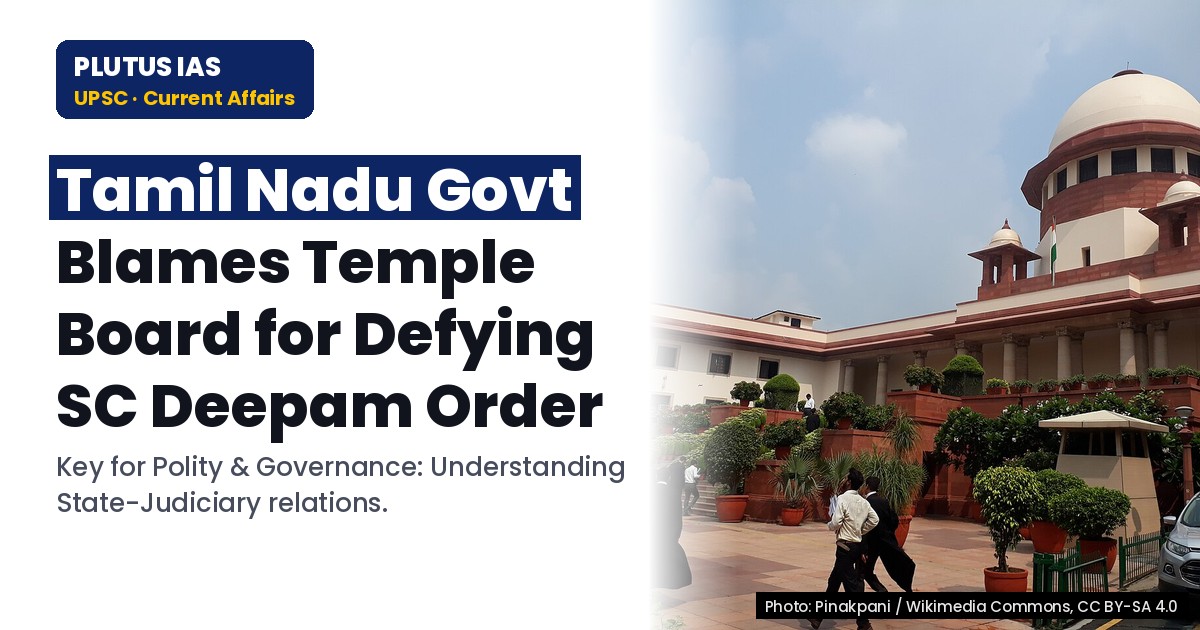
25 Nov TN Blames Temple Board for Defying SC Deepam Order
Relevance for UPSC & State PCS: Polity
The recent incident in Tamil Nadu, where the state government attributed the non-compliance with the Supreme Court’s “Deepam” order to the temple board, holds significant implications for UPSC and State PCS aspirants, particularly concerning the subject of Polity. This event underscores the intricate relationship between the judiciary, executive, and religious institutions in India, highlighting potential points of friction and the challenges in enforcing judicial pronouncements. For aspirants, it’s crucial to analyze this through the lens of judicial activism, the separation of powers, and the constitutional mandate of upholding the rule of law. The Supreme Court’s order, and the subsequent failure to implement it, raise questions about the accountability of various state and semi-state bodies and their adherence to judicial directives.
Furthermore, this situation brings to the forefront the role of temple boards, often operating under state endowments departments, and their autonomy versus their obligation to follow court orders. The Tamil Nadu government’s stance of blaming the temple board suggests a potential attempt to deflect responsibility, which is a common political maneuver but one that has constitutional ramifications. Aspirants should consider how such incidents test the effectiveness of the Indian legal system and the mechanisms available for ensuring compliance with judicial orders, especially when religious sentiments and administrative complexities are involved. This case could be a valuable illustration for questions on contempt of court, the powers of the Supreme Court under Article 142, and the practical challenges of governance in a diverse and religiously pluralistic society.
Finally, the incident serves as a practical example of the checks and balances inherent in the Indian democratic framework. While the Supreme Court issues orders, their implementation relies on the executive machinery, which includes various state departments and autonomous bodies. The blame game between the state government and the temple board demonstrates the potential for institutional friction and the need for clear lines of authority and accountability. For aspirants, understanding this dynamic is essential for comprehending the real-world application of constitutional principles and the complexities of public administration. It provides a concrete case study for analyzing the efficacy of judicial remedies and the political will required for their successful execution, offering insights into the practical challenges of upholding constitutional supremacy.
Source: ndtv.com
Practice Questions
Q1. Which state’s temple board was recently in news for allegedly defying a Supreme Court’s ‘Deepam Order’?
- Kerala
- Andhra Pradesh
- Tamil Nadu
- Karnataka
Answer
Tamil Nadu — The news story indicates that Tamil Nadu blamed its Temple Board for defying the Supreme Court’s Deepam Order.
Q2. The term ‘Deepam Order’ in the context of temple administration most likely refers to regulations concerning:
- The architectural style of temple gopurams
- The conduct of specific lighting rituals or festivals
- The appointment process of temple priests
- The management of temple land endowments
Answer
The conduct of specific lighting rituals or festivals — While the specific details of the ‘Deepam Order’ are not provided, ‘Deepam’ generally refers to a lamp or light, strongly suggesting regulations related to lighting rituals or festivals within a temple context.
Generated by AanyaAi for educational purpose.
Related guides on our sites
- Current affairs for upsc 2026
- Best PSIR optional coaching for upsc
- Best PSIR optional teacher for upsc
- Best teacher of PSIR optional for upsc

- TN Blames Temple Board for Defying SC Deepam Order - November 25, 2026
- पुनीत राजकुमार हृदय ज्योति योजना: कर्नाटक में विस्तार और स्वास्थ्य सेवा सुधार - November 25, 2026
- Thirupparankundram Deepam Row: TN Apologizes to SC - November 25, 2026

No Comments