


19 Nov Towards Inclusive Governance: India’s Comprehensive Measures for Transgender Persons
This article covers “Daily Current Affairs” and From Towards Inclusive Governance: India’s Comprehensive Measures for Transgender Persons
SYLLABUS MAPPING
GS-2- Social Justice -Towards Inclusive Governance: India’s Comprehensive Measures for Transgender Persons
FOR PRELIMS
What is the Digital Personal Data Protection Act, 2023?
FOR MAINS
What challenges may arise in implementing the DPDP Act across India’s digital ecosystem?
Why in the News?
India’s growing focus on the rights and welfare of transgender and non-binary persons has come into the spotlight following the government’s renewed emphasis on implementing the Transgender Persons (Protection of Rights) Act, 2019, strengthening the National Council for Transgender Persons, and expanding services through the National Portal for Transgender Persons. Recent data based on Census 2011 estimates, which recorded 4.87 lakh individuals under the “other” gender category, has further highlighted the need for targeted policies and improved access to welfare schemes.

The developments also gain importance as India reflects on a decade since the Supreme Court’s landmark NALSA (2014) judgment, which recognised transgender persons as a “third gender” and guaranteed their right to self-identification. Together, these steps underscore India’s continuing efforts toward inclusion, dignity, legal protection, and mainstream integration of transgender communities.
Transgender Persons (Protection of Rights) Act, 2019 — Key Provisions
| Section / Theme | Key Features |
|---|---|
| 1. Definition (Sec 2) | Defines “transgender person” to include trans-men, trans-women, intersex persons, gender-queer, hijra communities, irrespective of surgery. |
| 2. Non-Discrimination (Sec 3) | Prohibits discrimination in education, employment, healthcare, public services, residence, movement, and access to government schemes. |
| 3. Legal Recognition (Sec 4–7) | Right to self-perceived gender identity. Application to District Magistrate for Certificate of Identity. Revised certificate possible after SRS (optional). |
| 4. Government Duties (Sec 8) | Mandates welfare schemes, social inclusion, rescue & rehabilitation, and sensitisation/awareness programs. |
| 5. Employment & Family Rights (Sec 9–12) | No employment discrimination; complaints mechanism via Complaint Officer. Right to reside in the family household. |
| 6. Education & Healthcare (Sec 13–15) | Inclusive education, vocational training, access to gender-affirming healthcare, counselling, SRS procedures, and insurance coverage. |
| 7. National Council (Sec 16–18) | Establishes National Council for Transgender Persons to advise government, monitor implementation, and address grievances. |
| 8. Offences & Penalties (Sec 19–20) | Penalties include imprisonment up to 2 years + fine for abuse, denial of rights, forced labour, or violence. |
Transgender Persons (Protection of Rights) Rules, 2020 – Key Provisions
1. Procedure for Certificate of Identity: Application can be submitted online or offline to the District Magistrate (DM). Based on self-declaration of gender identity. No medical, psychological, or physical examination required. DM must process the application within a fixed time frame (usually 30 days).
2. Revised Certificate (After SRS): Applicable only if the person opts for gender-affirming surgery (SRS). A revised certificate is issued after submission of the medical certificate from the hospital. Process is optional—surgery is NOT mandatory for identity recognition.
3. Duties of Establishments: Mandatory appointment of a Complaint Officer in every government and private establishment. Establishments must maintain annual compliance reports on steps taken to implement the Act.
Ensure non-discrimination policies, suitable infrastructure, and workplace inclusion.
4. Grievance Redress Mechanism: All institutions must set up accessible and confidential grievance mechanisms. Complaints must be resolved in a time-bound manner. Regular monitoring of grievance handling.
5. Welfare & Support Measures: Shelters (Garima Grehs): Safe housing, food, skill training, and support.
Healthcare: Gender-affirming care, mental health counselling, access to insurance.
Education: Inclusive classrooms, scholarships, vocational and digital skilling programs.
Livelihood Support: Social security schemes, pensions, employment assistance.
6. Sensitisation & Awareness
Mandatory training for: Police, Healthcare workers, Teachers & school staff, Government officials, Awareness campaigns to reduce stigma and promote inclusion.
Government Initiatives for Transgender Welfare
| Initiative | Year / Ministry | Key Features / Benefits |
|---|---|---|
| National Council for Transgender Persons | MoSJE | • Advises Government on policies • Monitors welfare schemes • Coordinates inter-ministerial efforts |
| National Portal for Transgender Persons | Launched: 25 Nov 2020 | • Online self-service portal for Certificate & ID Card • Paperless, transparent, time-bound processing • Access to schemes & grievance redress |
| SMILE Scheme (Support for Marginalised Individuals for Livelihood & Enterprise) | 2022, MoSJE | • Livelihood support & skill training • Shelter support through Garima Greh • Counselling & rehabilitation • Includes Ayushman Bharat TG Plus health package |
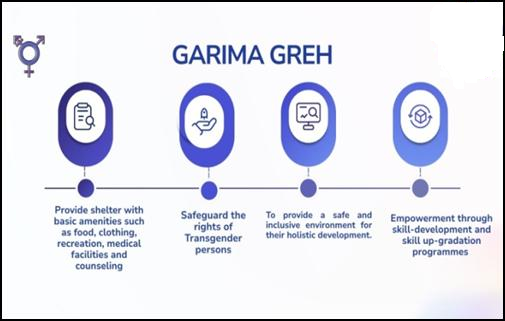
| Garima Greh (Shelter Homes) | Under SMILE | • Safe housing, food, medical care • Counselling & skill development • Social and economic rehabilitation |
| Equal Opportunities Policy for Transgender Persons | DoSJE | • Ensures equal access in employment • Prohibits workplace discrimination • Mandates grievance redress mechanisms |
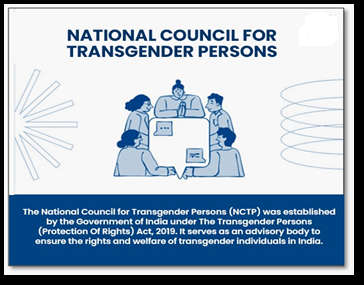
National Council for Transgender Persons
1. Constitution & Status: Constituted on 21 August 2020; reconstituted on 16 November 2023. A statutory body under the Ministry of Social Justice & Empowerment (MoSJE).
2. Composition: Five representatives from the transgender community. Representatives from NHRC, NCW, State Governments & UTs. Experts from NGOs working in the field.
3. Advisory Role: Advises the Central Government on policies, laws, programmes, and schemes related to transgender persons.
4. Monitoring Function: Monitors and evaluates implementation and impact of welfare schemes & protections under the 2019 Act.
5. Review & Coordination: Reviews and coordinates the work of ministries, departments, and NGOs. Ensures consistency, avoids duplication, and strengthens service delivery.
6. Grievance Redressal: Addresses grievances and ensures prompt resolution of rights violations faced by transgender persons.
SMILE Scheme (2022)
1. Nature & Launch
Full form: Support for Marginalised Individuals for Livelihood and Enterprise.
Launched on 12 February 2022 by MoSJE as a Central Sector Scheme.
Aligns with the Transgender Persons (Protection of Rights) Act, 2019.
2. Objectives: Ensures rehabilitation, empowerment, livelihood, and dignity for transgender persons. Upholds equality, non-discrimination, and dignity under Articles 14, 15, and 21.
3. Skill Development & Employment: Provides skill training, vocational opportunities, and livelihood support. Promotes inclusive education and employability.
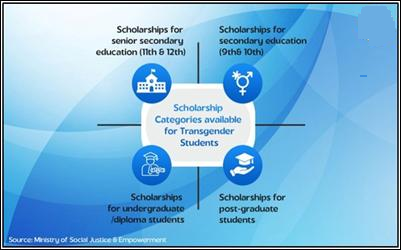
4. Scholarships for Education: Supports transgender students to reduce dropouts. Online, automated application using a single login credential.
5. Composite Medical Health Support: Access to gender-affirming healthcare, HIV surveillance, counselling. Integration with Ayushman Bharat PM-JAY.
Launch of Ayushman Bharat TG Plus: ₹5 lakh free medical coverage per person per year. Covers SRS, hormone therapy, post-operative care, and other treatments.
6. Garima Greh (Safe Shelters): Provides shelter, food, medical care, and counselling for transgender persons in distress. Mandated as per Section 12(3) of the 2019 Act. 21 Garima Grehs are functional across 17 States; 3 more recently sanctioned.
7. Protection Cells & Portal Integration: District-level Transgender Protection Cells under DMs. Ensure FIR registration, monitor offences, and conduct sensitisation. Integrated with the National Portal for Transgender Persons for transparency and service delivery.
National Portal for Transgender Persons
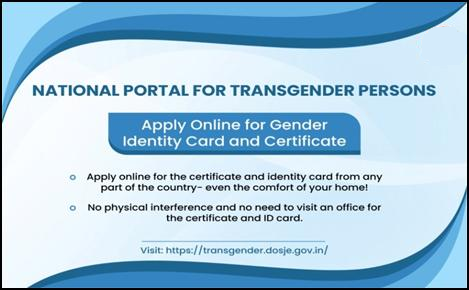
The National Portal for Transgender Persons was launched on 25th November, 2020 to issue certificates and ID cards to eligible Transgender persons. The Portal is accessible in multiple languages (English, Hindi, Gujarati, Malayalam and Bengali). This is an end-to-end online process where the applicant can apply for the TG certificate and also download the certificate after issue without any requirement to go to any office of issue.
Conclusion
Recent years have witnessed significant legal and policy reforms for the transgender community in India, spearheaded by the Government of India and its concerned ministries. The Transgender Persons (Protection of Rights) Act, 2019, together with subsequent amendments and targeted schemes such as SMILE and Garima Greh, have laid robust foundations for affirmative action, legal recognition, and social protection of transgender persons. In 2025, the Ministry of Social Justice and Empowerment-continued to organise capacity building programmes, national campaigns, and conferences to promote awareness, address stigma, and ensure the effective inclusion of transgender individuals in policy frameworks and public life.
Prelims question:
Q. With reference to transgender welfare in India, consider the following statements:
1. The Transgender Persons (Protection of Rights) Act, 2019 allows self-perceived gender identity without requiring medical or physical examination.
2. Ayushman Bharat TG Plus Scheme provides ₹5 lakh annual health coverage exclusively for transgender persons, including gender-affirming procedures.
3. Garima Greh shelters are implemented under the National Portal for Transgender Persons.
How many of the above statements are correct?
(a) Only one
(b) Only two
(c) All three
(d) None
Answer: B
Mains Question:
Q. Discuss the key provisions of the Transgender Persons (Protection of Rights) Act, 2019 and evaluate the role of recent government initiatives—such as the National Council for Transgender Persons, SMILE Scheme, Garima Greh, and the National Portal for Transgender Persons—in strengthening inclusion, welfare, and legal protections for the transgender community in India.
(250 words)

- RBI’s Shrinking Real-Rate Cushion Amid Rising Inflation and Strong Demand - September 21, 2026
- India’s NGOs at a New Funding Crossroads - September 21, 2026
- Deep-Sea Discovery, Environmental Responsibility - September 19, 2026

No Comments