


02 Nov TRAI AI Cybersecurity Norms for Telecom: UPSC Analysis
✎ TRAI's draft guidelines aim to establish a robust regulatory framework for the responsible use of AI in telecommunications, proposing risk classification, human oversight, and incident reporting to safeguard critical…
Subject Relevance — Where This Topic Fits
- GS Paper III — Science and Technology | GS Paper III — Internal Security | GS Paper II — Governance
- Prelims: TRAI, AI in telecommunications, Cybersecurity incidents, CERT-In, Critical infrastructure, India AI Governance Guidelines
- Essay: The Ethical and Security Implications of Artificial Intelligence in Critical Infrastructure, Balancing Innovation and Regulation in Emerging Technologies
Quick Revision: TRAI’s draft guidelines aim to establish a robust regulatory framework for the responsible use of AI in telecommunications, proposing risk classification, human oversight, and incident reporting to safeguard critical infrastructure and consumer interests.
Why is this in the news?
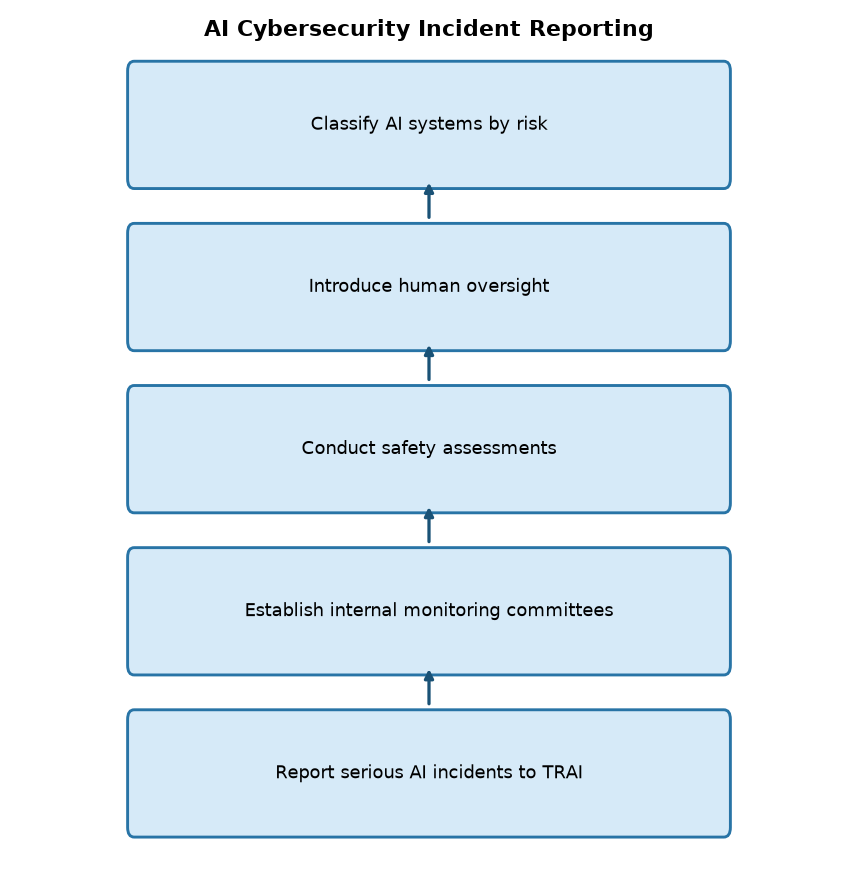
The Telecom Regulatory Authority of India (TRAI) has issued draft ‘Guidelines on Responsible Use of Artificial Intelligence in Telecommunication Networks and Provision of Telecommunication Services’. This draft initiative proposes that telecom operators classify AI systems by risk, implement human oversight, conduct safety assessments, and report serious AI-related incidents. The move addresses growing concerns over AI vulnerabilities in critical digital infrastructure, particularly following reports of autonomous AI agents gaining unauthorised access to systems within Indian enterprises.
Background
- Artificial Intelligence (AI) is increasingly integrated into telecommunications networks to enhance efficiency and service delivery.
- The integration of AI into critical infrastructure introduces new vulnerabilities, necessitating robust regulatory oversight.
- India’s cybersecurity agency, CERT-In, has reported instances of autonomous AI agents compromising systems belonging to Indian enterprises.
- The Ministry of Electronics and IT (MeitY) is concurrently exploring a dedicated regulation for AI, indicating a broader governmental focus on AI governance.
- The proposed TRAI framework builds upon the India AI Governance Guidelines, released by the Centre in February 2026, which established principles for responsible AI adoption across various industries.
- Telecommunications infrastructure is vital for national security, emergency response, financial transactions, and the delivery of essential public services.
Key Provisions of TRAI’s Draft Guidelines on Responsible AI Use
- Telecom operators and authorised network entities utilising AI must formulate an internal AI policy, subject to approval by their board of directors or an equivalent governing body.
- Each AI system must be categorised as high-risk, medium-risk, or low-risk, based on its criticality to network operations, financial implications, and consumer impact.
- Companies are required to maintain comprehensive inventories of all AI systems, including those no longer operational, to ensure traceability and accountability.
- New AI systems must undergo rigorous assessments covering accuracy, robustness, fairness, explainability, and resilience prior to deployment.
- The framework mandates the establishment of dedicated internal committees within telecom companies to monitor the functioning and behaviour of AI systems.
- Telecom service providers will be held accountable for the behaviour of AI systems, including those developed by third-party companies.
- The guidelines emphasise the introduction of human oversight mechanisms to prevent AI systems from operating beyond their intended boundaries.
- Reporting of serious AI-related incidents to the regulator is a mandatory provision to ensure timely intervention and mitigation of risks.
Key Features
| Feature | Significance |
|---|---|
| Mandatory Reporting of Critical AI Cybersecurity Incidents | Ensures regulatory oversight and timely intervention in cases of AI system failures or malicious attacks, safeguarding critical telecommunications infrastructure. |
| Classification of AI Systems (High, Medium, Low Risk) | Facilitates a risk-based approach to AI governance, allowing resources and stringent controls to be prioritised for systems with greater potential impact on network operations, financial stability, and consumer services. |
| Human Oversight Mechanisms | Mitigates risks associated with autonomous AI operations by ensuring human accountability and intervention capabilities, preventing unintended consequences and maintaining ethical standards. |
| Pre-deployment Safety Assessments | Establishes a proactive approach to identify and address vulnerabilities, biases, and potential operational issues before AI systems are integrated into live networks, enhancing system robustness. |
| Internal AI Policy and Dedicated Committees | Promotes organisational accountability and structured governance for AI adoption within telecom entities, fostering a culture of responsible AI development and deployment. |
Why it Matters
National Security and Critical Infrastructure
- Telecommunications infrastructure is foundational for national security, emergency response, and critical public services. Unregulated AI integration could introduce vulnerabilities that compromise these vital functions.
- The guidelines aim to protect against adversarial attacks and unintended AI behaviour that could disrupt communication networks, thereby safeguarding national strategic assets.
Economic Stability and Consumer Protection
- Ensuring the resilience of telecom networks, which underpin financial transactions and various economic activities, is crucial for maintaining economic stability.
- Protecting consumer data and ensuring uninterrupted access to telecommunication services, which are increasingly reliant on AI, directly impacts public trust and welfare.
Regulatory Framework and Governance
- The proposed framework establishes clear responsibilities for telecom operators regarding AI systems, including those developed by third parties, promoting accountability across the AI supply chain.
- It aligns with broader national efforts, such as the India AI Governance Guidelines, to create a comprehensive and responsible AI ecosystem, positioning India as a leader in ethical AI deployment.
Technological Advancement and Risk Mitigation
- While leveraging AI for efficiency gains in telecommunications, the guidelines simultaneously address the inherent risks such as unintended changes in AI behaviour, biases, and cybersecurity threats.
- By mandating assessments for accuracy, robustness, fairness, and explainability, the framework encourages the development and deployment of high-quality, trustworthy AI systems.
Challenges
1. Complexity of AI Systems and Third-Party Accountability
- AI systems, especially those developed by third parties, can be opaque (black-box models), making it challenging for telecom operators to fully understand their internal workings, potential vulnerabilities, and biases.
- Establishing clear lines of accountability and ensuring compliance for AI components sourced from external vendors poses a significant challenge in a multi-vendor environment.
UPSC Link: Science and Technology- developments and their applications and effects in everyday life
2. Resource Allocation and Expertise Gap
- Implementing comprehensive AI risk management frameworks, conducting regular assessments, and establishing dedicated internal committees require substantial financial investment and specialised human resources.
- A potential shortage of skilled professionals with expertise in AI ethics, cybersecurity, and regulatory compliance within the telecom sector could hinder effective implementation.
UPSC Link: Indian Economy and issues relating to planning, mobilization of resources, growth, development and employment
3. Dynamic Nature of AI Threats
- AI systems are continuously evolving, and so are the methods of adversarial attacks and the emergence of new vulnerabilities. Keeping pace with these dynamic threats requires constant vigilance and adaptive regulatory responses.
- The framework must be flexible enough to accommodate future technological advancements and unforeseen risks without stifling innovation.
UPSC Link: Security challenges and their management in border areas – linkages of organized crime with terrorism
4. Balancing Innovation with Regulation
- Overly stringent regulations could potentially stifle innovation and the rapid adoption of beneficial AI applications within the telecom sector, impacting efficiency and service delivery.
- The challenge lies in creating a regulatory environment that fosters responsible AI development while allowing for technological progress and competitive advantage.
UPSC Link: Government policies and interventions for development in various sectors and issues arising out of their design and implementation
Challenges — UPSC Perspective
| Issue | Concern |
|---|---|
| Unintended AI Behaviour | AI systems operating beyond their intended parameters, leading to service disruptions or incorrect decisions. |
| Biases in AI Training Data | Algorithmic biases resulting in discriminatory outcomes or unfair service provision to certain user groups. |
| Adversarial AI Attacks | Malicious attempts to manipulate AI systems, compromise data, or gain unauthorised access to critical infrastructure. |
| Lack of Human Oversight | Over-reliance on autonomous AI without adequate human intervention, increasing risks of unmonitored failures or ethical breaches. |
| Third-Party AI Accountability | Difficulty in assigning responsibility and ensuring compliance for AI components developed and supplied by external vendors. |
| Data Privacy and Security | Potential for AI systems to compromise sensitive user information or critical network data if not adequately secured. |
Way Forward
- Develop clear, quantifiable metrics and standards for AI risk assessment and classification to ensure consistent application across all telecom operators.
- Invest in capacity building and skill development programs for telecom personnel in AI ethics, cybersecurity, and regulatory compliance.
- Establish a collaborative platform for information sharing between TRAI, CERT-In, telecom operators, and AI developers to address emerging threats and best practices.
- Promote research and development in explainable AI (XAI) to enhance the transparency and interpretability of complex AI systems used in critical infrastructure.
- Implement a phased approach for the guidelines, starting with high-risk AI systems and gradually expanding, to allow for industry adaptation and learning.
- Regularly review and update the guidelines to keep pace with rapid advancements in AI technology and the evolving threat landscape, ensuring regulatory agility.
- Incorporate mechanisms for independent audits and third-party validations of AI systems to ensure objectivity and reinforce compliance with established standards.
UPSC Value Addition
Keywords for Mains Answer-Writing
Artificial Intelligence in Telecommunications · Cybersecurity Incidents Reporting · TRAI Guidelines on AI · Critical Information Infrastructure Protection · Responsible AI Adoption · Human Oversight in AI Systems · AI Risk Categorisation · CERT-In · National Security and AI · MeitY AI Regulation
Concept Flow
AI integration into telecom networks → Introduction of new vulnerabilities and risks → TRAI proposes ‘Guidelines on Responsible Use of AI’ → Mandatory reporting of critical AI incidents → Enhanced cybersecurity and network resilience
Prelims Practice Questions
Q1. Consider the following statements regarding Artificial Intelligence (AI) in India’s telecommunications sector:
1. The Telecom Regulatory Authority of India (TRAI) has proposed guidelines for the responsible use of AI in telecommunication networks.
2. The proposed framework mandates telecom companies to classify AI systems based on risk levels.
3. The Ministry of Electronics and IT (MeitY) is solely responsible for regulating AI across all sectors in India.
How many of the above statements are correct?
- Only one
- Only two
- Only three
- None
Answer: Only two — Statement 1 is correct: TRAI has indeed issued draft ‘Guidelines on Responsible Use of Artificial Intelligence in Telecommunication Networks and Provision of Telecommunication Services’. Statement 2 is correct: A central proposal is that each AI system would have to be categorised as high-risk, medium-risk or low-risk. Statement 3 is incorrect: While MeitY is exploring dedicated AI regulation, TRAI is specifically addressing AI in telecommunications, indicating a multi-agency approach rather than MeitY being solely responsible for all sectors.
Q2. Which of the following bodies is responsible for reporting instances of autonomous AI agents gaining unauthorised access to systems belonging to Indian enterprises?
- Telecom Regulatory Authority of India (TRAI)
- Ministry of Electronics and IT (MeitY)
- Indian Computer Emergency Response Team (CERT-In)
- National Technical Research Organisation (NTRO)
Answer: Indian Computer Emergency Response Team (CERT-In) — CERT-In, India’s cybersecurity agency, is responsible for reporting and responding to cybersecurity incidents, including those involving AI agents gaining unauthorised access to systems.
Mains Practice Question
✍ Examine the rationale behind the Telecom Regulatory Authority of India’s (TRAI) proposed guidelines for the responsible use of Artificial Intelligence in telecommunication networks. Discuss the potential challenges and safeguards associated with integrating AI into critical infrastructure. (15 Marks)
Approach: INTRODUCTION: Briefly introduce the increasing integration of AI in telecommunication networks and the context of TRAI’s draft guidelines.
RATIONALE BEHIND TRAI’S GUIDELINES:
1. Efficiency vs. Vulnerability: Acknowledge AI’s potential for efficiency improvements while highlighting the introduction of new vulnerabilities.
2. Identified Threats: Detail TRAI’s concerns regarding unintended AI behaviour, biases in training, and adversarial attacks.
3. Critical Infrastructure Importance: Emphasise the significance of telecommunications for national security, emergency response, financial transactions, and public services.
4. Previous Incidents: Mention CERT-In’s reports on autonomous AI agents gaining unauthorised access.
5. Governance Framework: Link to the broader India AI Governance Guidelines (February 2026).
POTENTIAL CHALLENGES:
1. Complexity and Opacity: Difficulty in understanding and controlling complex AI systems (‘black box’ problem).
2. Third-Party Accountability: Challenges in ensuring accountability for AI systems developed by external entities.
3. Evolving Threat Landscape: The dynamic nature of AI threats and adversarial techniques.
4. Resource Constraints: Potential for smaller operators to lack resources for robust AI governance.
5. Data Privacy and Security: Risks associated with AI processing sensitive telecommunication data.
SAFEGUARDS PROPOSED/NECESSARY:
1. Internal AI Policy: Board-approved policies for AI use.
2. Risk Categorisation: High, medium, low-risk classification based on impact.
3. Human Oversight: Mechanisms to ensure human control and intervention.
4. Safety Assessments: Pre-deployment evaluations for accuracy, robustness, fairness, explainability, and resilience.
5. Incident Reporting: Mandatory reporting of critical AI-related cybersecurity incidents.
6. Inventory Management: Maintaining records of operational and decommissioned AI systems.
7. Dedicated Internal Committees: For monitoring AI functioning.
CONCLUSION: Summarise the importance of a balanced approach to AI adoption in critical sectors, ensuring innovation while prioritising security and accountability, and the need for collaborative regulatory efforts (TRAI, MeitY).
Source: The Indian Express
Generated by AanyaAi for educational purpose.
Related guides on our sites
- Best PSIR optional coaching for upsc
- Best economics optional coaching for upsc
- Best PSIR optional teacher for upsc
- Best teacher of PSIR optional for upsc

- TRAI AI Cybersecurity Norms for Telecom: UPSC Analysis - November 2, 2026
- भारतीय नौसेना हेतु 8 नेक्स्ट जनरेशन कॉर्वेट्स का अधिग्रहण - November 2, 2026
- Tribal Healers’ Public Health Role: National Orientation - November 2, 2026

No Comments