


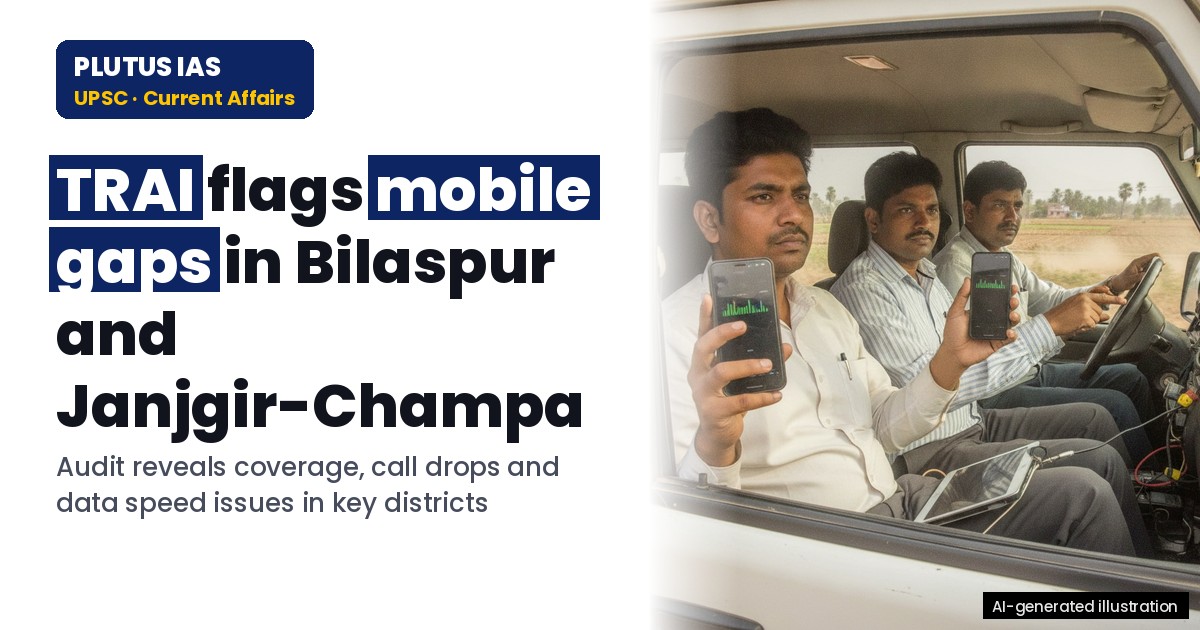
09 Oct TRAI’s Mobile Network Audit in Bilaspur & Janjgir-Champa: Key Findings for UPSC
✎ Independent Drive Tests (IDTs) by TRAI objectively assess mobile network performance in real-world conditions using key QoS parameters such as coverage gaps, call drop rates, and data throughput, ensuring regulatory compliance…
Subject Relevance — Where This Topic Fits
- GS Paper II — Governance, Transparency and Accountability | GS Paper III — Infrastructure: Energy, Ports, Roads, Airports and Telecommunication
- Prelims: Telecom Regulatory Authority of India (TRAI), Mobile Network Quality of Service (QoS), Independent Drive Test (IDT), Licensed Service Area (LSA), Call Drop Rate, Signal Coverage Gap, Throughput, Latency, Packet Drop Rate, Speech Quality (MOS), Telecom Service Providers (TSPs), Bharat Sanchar Nigam Limited (BSNL), Reliance Jio Infocomm Limited (RJIL), Vodafone Idea Limited (VIL), Bharti Airtel Limited (Airtel), 5G, 4G, 2G, 3G
- Essay: Digital Infrastructure and Inclusive Growth in India, Regulatory Governance and Consumer Protection in Telecommunication Sector
Quick Revision: Independent Drive Tests (IDTs) by TRAI objectively assess mobile network performance in real-world conditions using key QoS parameters such as coverage gaps, call drop rates, and data throughput, ensuring regulatory compliance and consumer protection.
Why is this in the news?
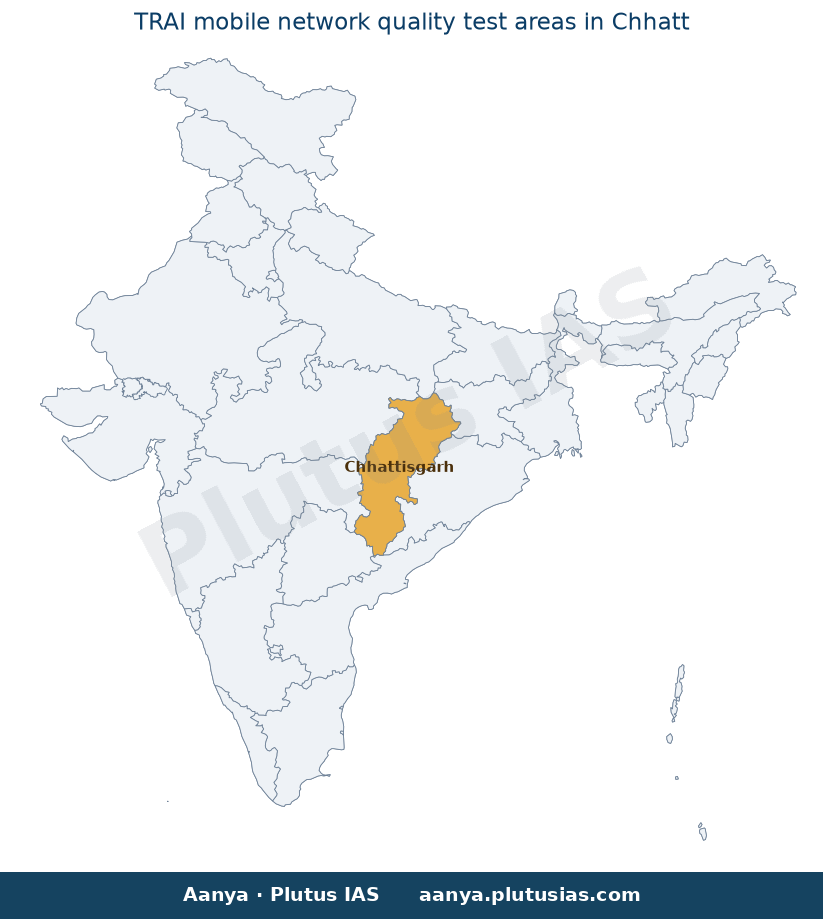
The Telecom Regulatory Authority of India (TRAI) released the results of its Independent Drive Tests (IDT) conducted in August 2026 to assess the real-time quality of mobile network services (voice and data) in Bilaspur and Janjgir-Champa cities under the Madhya Pradesh Licensed Service Area (MP LSA). The tests, carried out by a designated agency, evaluated key Quality of Service (QoS) parameters such as call drop rates, signal coverage gaps, call setup success rates, and data throughput, providing empirical insights into the performance of telecom service providers (TSPs) in these regions.
Background
- The Telecom Regulatory Authority of India (TRAI) is a statutory body established under the Telecom Regulatory Authority of India Act, 1997, to regulate telecommunication services, including fixation of tariffs for telecom services, ensuring quality of service, and protecting consumer interests.
- TRAI conducts Independent Drive Tests (IDTs) to objectively measure the real-time performance of mobile networks across various parameters, independent of telecom service providers (TSPs).
- The Madhya Pradesh Licensed Service Area (MP LSA) is one of the 22 LSAs in India, governed by TRAI’s regulatory framework for telecom services.
- Mobile network quality directly impacts digital inclusion, economic productivity, and public service delivery, particularly in urban and peri-urban areas.
- TRAI’s QoS regulations mandate TSPs to maintain minimum service standards, failure of which may lead to penalties or regulatory action.
- The tests were conducted under the supervision of TRAI’s Bhopal Regional Office, ensuring methodological rigour and impartiality.
What are Independent Drive Tests (IDTs) and Quality of Service (QoS) in Mobile Networks?
- Independent Drive Tests (IDTs) are field-based assessments conducted by TRAI to evaluate the real-time performance of mobile networks across key parameters such as call quality, data speed, and signal coverage.
- IDTs are designed to simulate actual user experience by testing networks in diverse environments, including urban areas, highways, public transport hubs, and hotspots.
- Quality of Service (QoS) refers to the collective performance of a telecom network in delivering voice and data services to end-users, measured through parameters like call drop rates, latency, throughput, and signal strength.
- Key QoS parameters assessed in IDTs include: (a) Coverage Gap: Percentage of samples where signal strength falls below the minimum threshold for a given technology (2G/3G/4G/5G); (b) Voice Service Metrics: Call Setup Success Rate (CSSR), Drop Call Rate (DCR), Call Setup Time, Call Silence Rate, and Speech Quality (MOS); (c) Data Service Metrics: Download/Upload Throughput, Latency, Jitter, and Packet Drop Rate.
- TRAI’s QoS regulations (e.g., Telecom Regulatory Authority of India (Quality of Service) Regulation, 2009) prescribe minimum standards for TSPs to ensure consumer protection and service reliability.
- IDTs provide transparent, empirical data to consumers, enabling informed choices and incentivizing TSPs to improve service quality through competitive benchmarking.
- The results of IDTs are published periodically, allowing TRAI to monitor compliance with QoS norms and take corrective measures if necessary.
- TRAI’s role in regulating QoS is part of its broader mandate to foster a competitive, transparent, and consumer-friendly telecom ecosystem in India.
Key Features
| Feature | Significance |
|---|---|
| Independent Drive Test (IDT) | A field-based evaluation mechanism to assess real-time mobile network performance across different environments (urban areas, highways, public transport hubs) using automated tools and manual sampling. |
| Quality of Service (QoS) Parameters | Standardised metrics including call success rates, drop rates, signal strength, data throughput, latency, and speech quality to objectively measure telecom service delivery. |
| Coverage Gap Analysis | Identifies geographic areas where signal strength falls below regulatory thresholds for specific technologies (2G/3G/4G/5G), enabling targeted infrastructure improvements. |
| Cross-Technology Benchmarking | Comparative assessment of multiple Telecom Service Providers (TSPs) on identical routes and conditions to promote competitive service quality. |
| Consumer Empowerment | Public disclosure of performance data empowers subscribers to make informed choices and incentivises TSPs to enhance service reliability and coverage. |
Why it Matters
Telecom Governance
- Demonstrates the role of the Telecom Regulatory Authority of India (TRAI) in regulating and monitoring telecom service quality through independent audits.
- Highlights the institutional framework for ensuring consumer protection and service standardisation in the telecom sector.
Digital Infrastructure
- Underscores the importance of robust mobile networks for enabling digital inclusion, financial transactions, and e-governance services in tier-2 and tier-3 cities.
- Reinforces the link between telecom infrastructure and socio-economic development in urban and peri-urban areas.
Regulatory Compliance
- Illustrates the application of TRAI’s QoS regulations (e.g., Telecom Consumers Protection Regulations, 2012) to ensure minimum service standards.
- Showcases the enforcement mechanism through field audits and public reporting to maintain accountability.
Urban Planning
- Provides data-driven insights for urban planners and municipal authorities to identify areas requiring telecom infrastructure upgrades.
- Supports evidence-based policy formulation for improving connectivity in high-density urban corridors.
Challenges
1. Urban Coverage Disparities
- Persistent coverage gaps in densely populated urban areas despite high subscriber density, indicating infrastructure bottlenecks.
- Variability in signal strength across different neighbourhoods and highways, affecting service uniformity.
UPSC Link: GS3: Infrastructure – Telecommunications
2. Quality of Service Variability
- Inconsistent performance across TSPs, with some providers exhibiting higher call drop rates and lower speech quality.
- Data service inconsistencies, including low throughput and high latency, impacting user experience.
UPSC Link: GS3: Service Delivery Mechanisms
3. Regulatory Enforcement Challenges
- Ensuring compliance with QoS standards across diverse geographic and demographic contexts.
- Balancing consumer protection with the operational constraints of TSPs in expanding infrastructure.
UPSC Link: GS2: Statutory Bodies – TRAI
4. Digital Divide in Tier-2 Cities
- Limited penetration of advanced technologies (e.g., 5G) in non-metropolitan urban centres, exacerbating digital inequality.
- Need for targeted interventions to bridge the gap between urban and rural telecom infrastructure.
UPSC Link: GS2: Social Sector – Digital Divide
5. Data Privacy and Security
- Ensuring the integrity and confidentiality of data collected during drive tests, particularly in sensitive urban areas.
- Mitigating risks of unauthorised access or misuse of telecom performance data.
UPSC Link: GS3: Cybersecurity – Data Protection
Challenges — UPSC Perspective
| Issue | Concern |
|---|---|
| Signal Coverage Gaps | Areas with inadequate signal strength for voice/data services, particularly in high-density urban corridors. |
| Call Drop Rates | Higher-than-expected termination of active calls, impacting user experience and business continuity. |
| Data Throughput Variability | Inconsistent internet speeds across different TSPs and locations, affecting digital applications. |
| Speech Quality Degradation | Poor audio clarity during calls, leading to miscommunication and user dissatisfaction. |
| Latency and Jitter | Delays in data transmission and packet loss, critical for real-time applications like video conferencing. |
Way Forward
- Strengthen TRAI’s mandate to conduct periodic and surprise drive tests in urban and rural areas to ensure sustained compliance with QoS standards.
- Mandate TSPs to publish detailed coverage maps and performance reports on their websites for public scrutiny.
- Introduce performance-linked incentives and penalties for TSPs to improve service quality in identified high-priority areas.
- Facilitate public-private partnerships to accelerate telecom infrastructure deployment in underserved urban zones.
- Enhance consumer awareness campaigns to educate subscribers on reporting service issues and utilising QoS data for informed choices.
- Encourage the adoption of advanced technologies (e.g., 5G, small cell networks) in tier-2 cities to bridge the digital divide.
- Establish a grievance redressal mechanism with time-bound resolution for telecom service complaints.
- Promote interoperability and roaming agreements among TSPs to ensure seamless connectivity across different networks.
UPSC Value Addition
Keywords for Mains Answer-Writing
Telecom Regulatory Authority of India (TRAI) · Quality of Service (QoS) in telecom · Independent Drive Test (IDT) · Mobile Network Coverage · Telecom Service Providers (TSPs) · Consumer Protection in Telecom · Right of Way (RoW) for telecom infrastructure · Universal Service Obligation Fund (USOF) · Digital Infrastructure Policy · Telecom Spectrum Management · Network Performance Monitoring · Regulatory Governance in Telecom
Concept Flow
Telecom Service Providers (TSPs) deploy infrastructure in urban areas → TRAI conducts Independent Drive Tests (IDTs) to assess QoS → Performance data reveals coverage gaps and service inconsistencies → Regulatory framework (QoS regulations) enforces standards → TSPs undertake corrective measures → Consumer experience improves → Digital inclusion and socio-economic development are facilitated.
Prelims Practice Questions
Q1. Consider the following statements regarding the Telecom Regulatory Authority of India (TRAI):
1. TRAI is a statutory body established under the Telecom Regulatory Authority of India Act, 1997.
2. TRAI is empowered to issue directions to telecom service providers for improving service quality.
3. TRAI can impose penalties on telecom service providers for non-compliance with its regulations.
4. TRAI is responsible for the allocation of telecom spectrum in India.
How many of the above statements are correct?
- Only one
- Only two
- Only three
- All
Answer: All — Statements 1, 2, and 3 are correct as TRAI is a statutory body empowered to regulate telecom services and issue directions. Statement 4 is incorrect as spectrum allocation is handled by the Department of Telecommunications (DoT), not TRAI.
Q2. Assertion (A): The Independent Drive Test (IDT) conducted by TRAI assesses the real-time performance of mobile networks across different geographical areas.
Reason (R): IDT is designed to evaluate the Quality of Service (QoS) parameters such as call drop rates, signal strength, and data throughput to ensure consumer protection.
Options:
A. Both A and R are true, and R is the correct explanation of A.
B. Both A and R are true, but R is not the correct explanation of A.
C. A is true, but R is false.
D. A is false, but R is true.
Answer: ? — Both Assertion (A) and Reason (R) are true. The IDT is indeed a real-time assessment of mobile network performance, and its purpose is to evaluate QoS parameters to protect consumer interests. R correctly explains A.
Q3. Match the following regulatory bodies with their primary functions:
Column I
1. Telecom Regulatory Authority of India (TRAI)
2. Department of Telecommunications (DoT)
3. Wireless Planning and Coordination Wing (WPC)
4. Telecom Disputes Settlement and Appellate Tribunal (TDSAT)
Column II
A. Spectrum allocation and licensing
B. Regulatory oversight of telecom services
C. Adjudication of telecom disputes
D. Management of wireless telegraphy and spectrum
Options:
A. 1-B, 2-A, 3-D, 4-C
B. 1-A, 2-B, 3-C, 4-D
C. 1-C, 2-D, 3-A, 4-B
D. 1-D, 2-C, 3-B, 4-A
Answer: ? — The correct matching is: 1-B (TRAI regulates telecom services), 2-A (DoT handles spectrum allocation), 3-D (WPC manages wireless telegraphy), and 4-C (TDSAT adjudicates disputes).
Mains Practice Question
✍ The Telecom Regulatory Authority of India (TRAI) conducts Independent Drive Tests (IDTs) to assess the Quality of Service (QoS) of mobile networks across urban areas. In this context, critically examine the significance of QoS regulation in India’s telecom sector. Also, discuss the mechanisms through which TRAI ensures compliance with QoS standards. (15 Marks)
Approach: MODEL-ANSWER SKELETON:
1. **Introduction (2 Marks)**
– Define QoS in telecom and its relevance for consumers and the digital economy.
– Mention TRAI’s mandate under the TRAI Act, 1997, to regulate telecom services and ensure consumer protection.
2. **Significance of QoS Regulation (5 Marks)**
– **Consumer Rights**: QoS regulation ensures reliable voice and data services, addressing issues like call drops, poor signal strength, and slow data speeds.
– **Digital Inclusion**: High QoS is essential for bridging the digital divide, especially in urban areas where mobile networks are the primary mode of internet access.
– **Economic Impact**: Poor QoS can deter investment in digital infrastructure and affect businesses reliant on seamless connectivity.
– **Competitive Equity**: QoS standards ensure a level playing field for all Telecom Service Providers (TSPs), preventing monopolistic practices.
– **Regulatory Transparency**: Mechanisms like IDTs provide empirical data to assess TSP performance, fostering accountability.
3. **Mechanisms for Ensuring QoS Compliance (5 Marks)**
– **Independent Drive Tests (IDTs)**: Explain the methodology, parameters assessed (e.g., call drop rates, signal strength, data throughput), and their role in identifying service gaps.
– **Consumer Grievance Redressal**: TRAI’s role in addressing complaints via the Telecom Consumers Protection and Redressal of Grievances Regulations, 2012.
– **Penalties and Incentives**: TRAI’s power to impose penalties on non-compliant TSPs and incentivize high-performance providers.
– **Public Disclosure**: Publication of QoS reports to inform consumers and incentivize TSPs to improve services.
– **Collaboration with DoT and TSPs**: Coordination with the Department of Telecommunications (DoT) for spectrum management and infrastructure development.
4. **Challenges and Way Forward (3 Marks)**
– **Infrastructure Bottlenecks**: High-density urban areas often face coverage gaps due to Right of Way (RoW) issues and limited tower installations.
– **Technological Advancements**: Rapid adoption of 5G and future technologies necessitates dynamic QoS frameworks.
– **Balancing Regulation and Innovation**: Ensuring regulations do not stifle innovation while protecting consumer interests.
– **Suggestions**: Strengthening consumer awareness, leveraging AI for real-time monitoring, and incentivizing public-private partnerships for infrastructure development.
Source: PIB (Press Information Bureau)
Chhattisgarh PCS (CGPSC) — State PCS Practice
Prelims: Under the Mobile Number Portability (MNP) framework, the Telecom Regulatory Authority of India (TRAI) conducted a quality assessment of mobile networks in which two cities of Chhattisgarh in August 2026?
- A. Raipur and Bilaspur
- B. Bilaspur and Janjgir-Champa
- C. Durg and Korba
- D. Ambikapur and Jagdalpur
Answer: B. Bilaspur and Janjgir-Champa — TRAI assessed mobile network quality in Bilaspur and Janjgir-Champa under the Mobile Number Portability framework in August 2026.
Mains: Discuss the significance of TRAI’s quality assessment of mobile networks in Bilaspur and Janjgir-Champa for the telecom sector and consumers in Chhattisgarh. Also, analyze how improved mobile network quality can contribute to the state’s digital economy and governance initiatives.
Generated by AanyaAi for educational purpose.
Related guides on our sites
- Current affairs for upsc 2026
- UPSC EPFO Test series
- How to prepare for GS paper 1 for UPSC CSE mains exam
- Best UPSC coaching for IFOS exam

- सीएक्यूएम ने दिल्ली में धूल प्रदूषण नियंत्रण के लिए उठाए कदम, एमसीडी को मिले निर्देश - October 22, 2026
- India-Australia AUSTRAHIND 2026 Exercise: Key Highlights for UPSC & State PCS - October 22, 2026
- एससीओ बैठक में भारत का आतंकवाद विरोध: क्षेत्रीय सहयोग पर जोर - October 22, 2026

No Comments