


27 Oct TRAl assesses mobile network quality in Vijayanagara, Karnataka
✎ TRAI’s Independent Drive Tests (IDTs) objectively assess mobile network quality using standardized metrics like call drop rates, data throughput, and signal coverage, ensuring transparency and accountability in telecom services.
Subject Relevance — Where This Topic Fits
- GS Paper II — Governance, Transparency and Accountability | GS Paper III — Infrastructure: Energy, Ports, Roads, Airports and Telecommunications
- Prelims: Telecom Regulatory Authority of India (TRAI), Independent Drive Test (IDT), Call Drop Rate (CDR), Call Setup Success Rate (CSSR), Quality of Service (QoS), Telecom Service Providers (TSP), Signal Coverage Gap, Data Throughput, Latency, Jitter, Packet Drop Rate, Mobile Network Performance, Consumer Protection
- Essay: Regulation and Innovation in Digital Infrastructure: Balancing Consumer Rights and Industry Growth, The Role of Independent Regulatory Bodies in Ensuring Public Service Accountability
Quick Revision: TRAI’s Independent Drive Tests (IDTs) objectively assess mobile network quality using standardized metrics like call drop rates, data throughput, and signal coverage, ensuring transparency and accountability in telecom services.
Why is this in the news?
The Telecom Regulatory Authority of India (TRAI) released the findings of its Independent Drive Tests (IDT) conducted in Vijayanagara district, Karnataka, in August 2026, to assess the real-time quality of mobile network services (voice and data) provided by Telecom Service Providers (TSPs). The assessment, aimed at informing telecom consumers and encouraging TSPs to improve service quality, evaluated key parameters such as call drop rates, call setup success rates, and data throughput, highlighting the regulator’s role in ensuring transparency and accountability in telecom services.
Background
- The Telecom Regulatory Authority of India (TRAI) is a statutory body established under the Telecom Regulatory Authority of India Act, 1997, to regulate telecom services and ensure fair competition in the sector.
- TRAI conducts Independent Drive Tests (IDTs) to objectively measure the performance of mobile networks across various terrains, including urban areas, highways, and public transport hubs, using advanced testing equipment and real-time monitoring systems.
- The assessment of mobile network quality is critical for consumer protection, as poor network performance directly impacts service reliability, economic productivity, and digital inclusion.
- Vijayanagara district in Karnataka, with its diverse topography and growing telecom demand, serves as a representative case for evaluating network performance in semi-urban and rural areas.
- TRAI’s IDT methodology aligns with global best practices, including the use of multiple test devices, live data sessions, and standardized metrics to ensure accuracy and comparability across TSPs.
- The findings of such assessments are published to empower consumers with data-driven insights and incentivize TSPs to enhance infrastructure and service delivery.
What is the Telecom Regulatory Authority of India (TRAI) and its Independent Drive Test (IDT) mechanism?
- The Telecom Regulatory Authority of India (TRAI) is an autonomous regulatory body under the Ministry of Communications, Government of India, mandated to regulate telecom services, protect consumer interests, and promote fair competition in the sector.
- Independent Drive Tests (IDTs) are field-based assessments conducted by TRAI to evaluate the real-time performance of mobile networks across different environments, including cities, highways, and public spaces.
- IDTs use advanced testing devices and software to measure key Quality of Service (QoS) parameters such as signal coverage, call drop rates, call setup success rates, data throughput, latency, and packet drop rates.
- The tests are conducted using live SIM cards from all major Telecom Service Providers (TSPs) across 2G, 3G, 4G, and 5G networks to ensure a comprehensive and unbiased evaluation.
- IDT results are published to inform consumers and encourage TSPs to improve network infrastructure, thereby enhancing service reliability and digital connectivity.
- The methodology adheres to international standards, ensuring transparency, reproducibility, and comparability of results across different regions and TSPs.
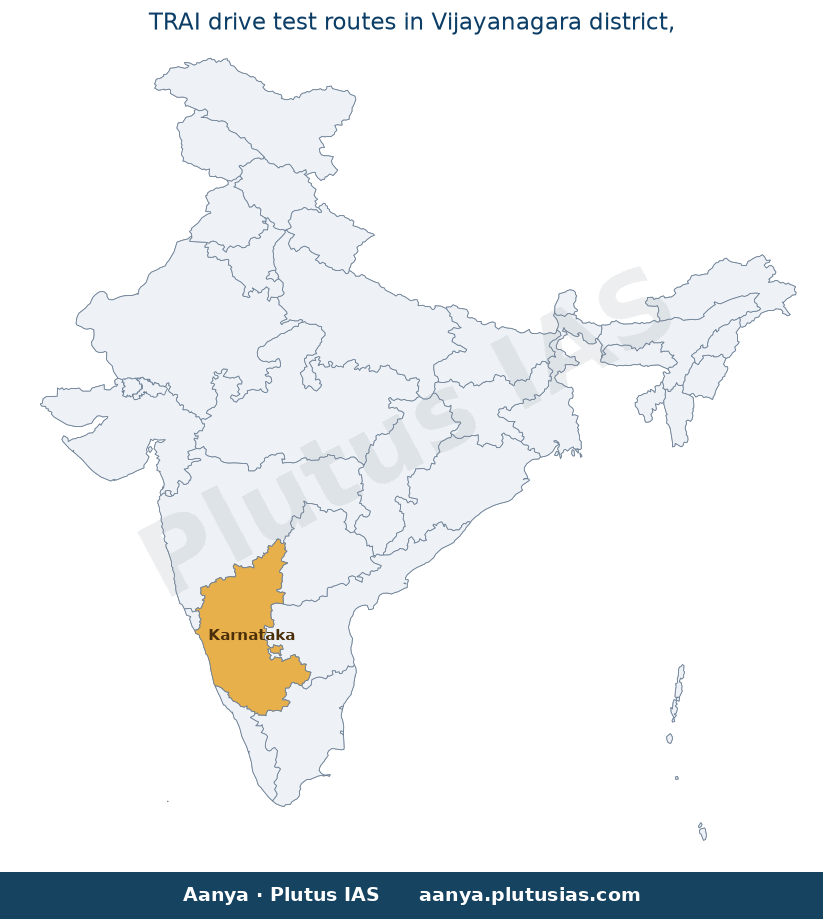
- TRAI’s IDT reports also include visual representations, such as route maps, to highlight areas with poor network performance, enabling targeted interventions by TSPs and policymakers.
Key Features
| Feature | Significance |
|---|---|
| Independent Drive Test (IDT) | Objective assessment of mobile network performance by TRAI using live data across 2G, 3G, 4G, and 5G networks to ensure transparency and consumer awareness. |
| Coverage Gap Analysis | Measures the percentage of samples where signal strength falls below the minimum threshold for a given technology, identifying areas with poor connectivity. |
| Call Drop Rate (CDR) | Tracks the percentage of successfully established calls that terminate prematurely, indicating network reliability and quality of service. |
| Call Setup Success Rate (CSSR) | Evaluates the efficiency of call initiation, reflecting network responsiveness and user experience in establishing connections. |
| Data Throughput (Download/Upload) | Assesses real-time data transfer speeds, latency, and jitter, critical for digital services, e-commerce, and remote work. |
| Call Silence Instances | Quantifies instances of audio disruption during active calls, highlighting issues in voice quality and network stability. |
Why it Matters
Economic Productivity
- Reliable mobile networks are essential for seamless business operations, digital payments, and e-commerce, particularly in industrial and commercial hubs like Vijayanagara district.
- High data throughput and low latency support remote work, telemedicine, and digital education, enhancing workforce productivity and inclusion.
- Reduction in call drops and data latency directly impacts customer satisfaction and retention for telecom service providers (TSPs), influencing market competition.
Digital Inclusion & Governance
- Transparent assessment of network quality empowers consumers to make informed choices, fostering accountability among TSPs and reducing information asymmetry.
- Data-driven governance enables targeted policy interventions, such as Universal Service Obligation (USO) Fund allocations, to improve connectivity in underserved regions.
- Supports the Digital India initiative by ensuring equitable access to high-speed internet across urban, semi-urban, and rural areas.
Strategic Infrastructure
- Robust mobile networks are critical for emergency services, disaster management, and national security, ensuring uninterrupted communication during crises.
- 5G deployment, as assessed in the IDT, is pivotal for India’s transition to Industry 4.0, smart cities, and IoT-based applications.
- Identification of coverage gaps informs infrastructure planning, including tower installations and spectrum allocation, to bridge the digital divide.
Consumer Protection & Regulatory Role
- TRAI’s IDT framework aligns with its mandate under the Telecom Regulatory Authority of India Act, 1997, to protect consumer interests and promote fair competition.
- Public disclosure of network performance metrics fosters trust in regulatory oversight and incentivizes TSPs to improve service quality.
- Benchmarking exercises like IDT provide a standardized methodology for evaluating network performance, reducing disputes between consumers and TSPs.
Challenges
1. Geographical Coverage Gaps
- Topographical challenges in Vijayanagara district, including hilly terrain and sparse population density, exacerbate signal attenuation and coverage inconsistencies.
- Urban-rural divide in infrastructure deployment leads to disparities in network quality, with rural areas often lagging in 4G/5G penetration.
- High capital expenditure required for tower installations and fiber-optic backhaul in remote regions deters private investment, necessitating public-private partnerships.
UPSC Link: GS3: Infrastructure – Energy, Ports, Roads, Airports & Railways
2. Technological Limitations
- Legacy 2G/3G networks, though still operational, suffer from lower data speeds and higher latency, impeding the transition to advanced digital services.
- Interoperability issues between older and newer network generations (e.g., 2G to 4G handover) contribute to call drops and service disruptions.
- Spectrum allocation constraints and regulatory delays in spectrum auctions can limit TSPs’ ability to expand network capacity.
UPSC Link: GS3: Science & Technology – Developments & their Applications
3. Regulatory & Compliance Challenges
- Ensuring uniform compliance with TRAI’s Quality of Service (QoS) regulations across diverse TSPs and geographical regions remains a persistent challenge.
- Balancing consumer protection with industry growth requires dynamic policy adjustments, such as revising QoS benchmarks for emerging technologies like 5G.
- Monitoring and penalizing non-compliance necessitates robust data collection and enforcement mechanisms, which can be resource-intensive.
UPSC Link: GS2: Statutory, Regulatory & Various Quasi-judicial Bodies
4. Market Competition & Consumer Choice
- Monopolistic or oligopolistic tendencies in certain regions may limit consumer options, reducing incentives for TSPs to improve service quality.
- Price wars and aggressive marketing strategies can divert focus from infrastructure investments, leading to compromised network performance.
- Lack of standardized benchmarking across TSPs complicates direct comparisons, making it difficult for consumers to evaluate service quality objectively.
UPSC Link: GS3: Indian Economy & Issues Relating to Planning, Mobilization of Resources
5. Environmental & Social Constraints
- Stringent environmental regulations and public opposition to tower installations can delay critical infrastructure projects, exacerbating coverage gaps.
- Socio-economic disparities in access to smartphones and affordable data plans limit the utility of improved network quality for marginalized communities.
- Cybersecurity risks, including data breaches and network vulnerabilities, pose additional challenges to maintaining robust and secure telecom infrastructure.
UPSC Link: GS3: Environment & Disaster Management
Challenges — UPSC Perspective
| Issue | Concern |
|---|---|
| Topographical Barriers | Hilly terrain and sparse population density hinder signal propagation and increase infrastructure costs. |
| Legacy Network Retention | Persistent use of 2G/3G networks limits bandwidth and increases latency, impeding digital transformation. |
| Spectrum Scarcity | Limited availability of spectrum bands restricts TSPs’ ability to expand network capacity and improve service quality. |
| Regulatory Enforcement Gaps | Inconsistent monitoring and delayed penalties for non-compliance undermine the effectiveness of QoS regulations. |
| Consumer Awareness Deficit | Lack of understanding about network performance metrics prevents consumers from making informed choices. |
| Climate Vulnerability | Extreme weather events and natural disasters can damage telecom infrastructure, leading to service disruptions. |
Way Forward
- Enhance TRAI’s IDT framework by incorporating AI-driven predictive analytics to identify coverage gaps proactively and prioritize interventions.
- Strengthen public-private partnerships to accelerate the deployment of telecom infrastructure in underserved and remote regions, leveraging the USO Fund.
- Revise Quality of Service (QoS) regulations to align with emerging technologies (e.g., 5G, IoT) and introduce dynamic benchmarks for performance metrics.
- Promote digital literacy campaigns to educate consumers about network performance metrics, enabling them to make informed decisions and demand better services.
- Streamline spectrum allocation processes and expedite auctions to ensure TSPs have adequate bandwidth for network expansion and capacity enhancement.
- Invest in research and development to improve signal propagation in challenging terrains, including the use of small cells, mesh networks, and satellite-based solutions.
- Establish a centralized grievance redressal mechanism for consumers to report service issues, ensuring timely resolution and accountability among TSPs.
- Integrate telecom infrastructure planning with urban and rural development policies to ensure equitable access to high-speed internet across all regions.
UPSC Value Addition
Keywords for Mains Answer-Writing
Telecom Regulatory Authority of India (TRAI) · Quality of Service (QoS) parameters · Independent Drive Test (IDT) · Mobile Network Coverage · Call Drop Rate (CDR) · Call Setup Success Rate (CSSR) · Data Throughput · Telecom Service Providers (TSPs) · Consumer Protection in Telecom · Regulatory Oversight · Telecom Disputes Settlement and Appellate Tribunal (TDSAT) · Right to Broadband as a Digital Right · Universal Service Obligation Fund (USOF) · Telecom Infrastructure Development · Consumer Grievance Redressal Mechanism
Concept Flow
Telecom Regulatory Authority of India (TRAI) Act, 1997 mandates consumer protection and fair competition. → TRAI conducts Independent Drive Tests (IDTs) to assess mobile network quality using standardized QoS parameters. → IDT results reveal coverage gaps, call drops, and data throughput issues in Vijayanagara district. → Identified challenges (e.g., topographical barriers, legacy networks) inform policy interventions and infrastructure planning. → Regulatory bodies (TRAI, DoT) collaborate with TSPs to address gaps via spectrum allocation, tower installations, and QoS compliance. → Improved network quality enhances digital inclusion, economic productivity, and emergency response capabilities. → Transparent reporting fosters consumer awareness and accountability, driving continuous improvement in telecom services.
Prelims Practice Questions
Q1. Consider the following statements regarding the Telecom Regulatory Authority of India (TRAI):
1. TRAI conducts Independent Drive Tests (IDTs) to assess the quality of mobile network services provided by Telecom Service Providers (TSPs).
2. IDTs measure parameters such as Call Drop Rate (CDR), Call Setup Success Rate (CSSR), and Data Throughput.
3. TRAI has the power to impose penalties on TSPs for non-compliance with its Quality of Service (QoS) regulations.
4. TRAI is a statutory body established under the Telecom Regulatory Authority of India Act, 1997.
How many of the above statements are correct?
- Only one
- Only two
- Only three
- All
Answer: All — Statements 1, 2, and 4 are correct. Statement 3 is incorrect because while TRAI can recommend penalties, the power to impose penalties lies with the Government of India or the Telecom Disputes Settlement and Appellate Tribunal (TDSAT) under the TRAI Act, 1997.
Q2. Assertion (A): The Telecom Regulatory Authority of India (TRAI) conducts Independent Drive Tests (IDTs) to evaluate the real-time performance of mobile networks.
Reason (R): IDTs are designed to measure parameters such as coverage gaps, call drop rates, and data throughput across different network technologies (2G, 3G, 4G, 5G).
Options:
A. Both A and R are true, and R is the correct explanation of A.
B. Both A and R are true, but R is not the correct explanation of A.
C. A is true, but R is false.
D. A is false, but R is true.
Answer: ? — Both Assertion (A) and Reason (R) are true, and Reason (R) correctly explains Assertion (A). IDTs are specifically designed to assess real-time network performance by measuring the stated parameters.
Q3. Match the following parameters assessed during TRAI’s Independent Drive Tests (IDTs) with their respective definitions:
Column I (Parameter) | Column II (Definition)
1. Call Drop Rate (CDR) | A. Percentage of successfully established calls out of total call attempts.
2. Call Setup Success Rate (CSSR) | B. Time taken for a call to be connected after dialing.
3. Data Throughput | C. Rate at which data is successfully transmitted over a network, measured in Mbps.
4. Coverage Gap | D. Percentage of established calls that are terminated prematurely.
Options:
A. 1-D, 2-A, 3-C, 4-B
B. 1-D, 2-A, 3-B, 4-C
C. 1-A, 2-D, 3-C, 4-B
D. 1-D, 2-B, 3-C, 4-A
Answer: ? — 1-D: Call Drop Rate (CDR) is the percentage of established calls that are terminated prematurely. 2-A: Call Setup Success Rate (CSSR) is the percentage of successfully established calls out of total call attempts. 3-C: Data Throughput is the rate at which data is successfully transmitted over a network, measured in Mbps. 4-B: Coverage Gap refers to areas where signal strength falls below the minimum required threshold for a given technology.
Mains Practice Question
✍ The Telecom Regulatory Authority of India (TRAI) conducts Independent Drive Tests (IDTs) to assess the quality of mobile network services. In light of this, critically examine the role of TRAI in ensuring consumer protection and enhancing service quality in the telecom sector. Also, discuss the challenges faced by TRAI in regulating the telecom industry in contemporary India. (15 Marks)
Approach: [‘Define TRAI and its statutory mandate under the TRAI Act, 1997.’, ‘Briefly explain the purpose and methodology of Independent Drive Tests (IDTs) as a tool for assessing mobile network quality.’] [“Consumer Protection: TRAI’s role in safeguarding consumer interests through QoS regulations, grievance redressal mechanisms, and public disclosure of network performance data (e.g., IDTs).”, “Regulatory Oversight: TRAI’s authority to set QoS benchmarks, monitor compliance, and recommend penalties for non-compliance by TSPs.”, “Promotion of Competition: TRAI’s efforts to foster a competitive telecom market through tariff regulations, interconnection agreements, and spectrum management.”, “Technological Advancement: TRAI’s role in encouraging the adoption of advanced technologies (e.g., 5G) and ensuring equitable access to digital infrastructure.”] [‘Rapid Technological Changes: Difficulty in keeping pace with technological advancements (e.g., 5G, IoT) and evolving consumer demands.’, ‘Infrastructure Gaps: Challenges in ensuring universal coverage, particularly in rural and remote areas, despite the USOF.’, ‘Regulatory Arbitrage: Issues arising from the overlapping jurisdictions of TRAI, the Department of Telecommunications (DoT), and the Telecom Disputes Settlement and Appellate Tribunal (TDSAT).’, ‘Consumer Grievances: Limitations in addressing the grievances of consumers due to the lack of punitive powers with TRAI.’, ‘Spectrum Management: Challenges in efficient spectrum allocation and management to prevent monopolistic practices and ensure fair competition.’] [“Summarize TRAI’s significance in maintaining a robust telecom ecosystem.”, ‘Highlight the need for legislative reforms to empower TRAI with greater autonomy and punitive powers.’, ‘Emphasize the importance of multi-stakeholder collaboration (government, TSPs, consumers) to address the challenges.’] [‘Constitutional and statutory bodies (TRAI Act, 1997).’, ‘Role of regulatory bodies in governance (e.g., SEBI, IRDAI) for comparative insights.’, ‘Consumer protection frameworks in India (Consumer Protection Act, 2019).’, ‘Digital India initiatives and the right to broadband as a digital right.’]
Source: PIB (Press Information Bureau)
Karnataka PCS (KPSC) — State PCS Practice
Prelims: Which of the following is the primary objective of the Telecom Regulatory Authority of India (TRAI) in assessing mobile network quality in Vijayanagara district, Karnataka?
- A. To evaluate the financial performance of telecom operators in the region
- B. To ensure compliance with quality of service (QoS) benchmarks for mobile networks
- C. To promote the use of 5G technology exclusively in the district
- D. To regulate the pricing of mobile services in Karnataka
Answer: B. To ensure compliance with quality of service (QoS) benchmarks for mobile networks — TRAI assesses mobile network quality to ensure adherence to predefined Quality of Service (QoS) benchmarks, which is critical for consumer protection and service reliability.
Mains: Analyze the significance of TRAI’s assessment of mobile network quality in Vijayanagara district, Karnataka, in the context of improving digital connectivity and socio-economic development. Suggest measures to enhance network coverage and quality in the region.
Generated by AanyaAi for educational purpose.
Related guides on our sites
- Prelims test series
- UPSC EPFO Test series
- Anthropology optional test series
- Best PSIR optional test series

- लखनऊ में श्रम संहिताओं पर राज्य स्तरीय क्षमता विकास कार्यक्रम संपन्न - October 27, 2026
- TRAl assesses mobile network quality in Vijayanagara, Karnataka - October 27, 2026
- आईसीएआर-एमजीआईएफआरआई ने ‘खेत बचाओ अभियान 2026’ से कृषि में क्रांति की शुरुआत - October 27, 2026

No Comments