


11 Nov Transforming Roads into Intelligent Mobility Networks: India’s New-Age Highway Evolution
This article covers “Daily Current Affairs” and From Transforming Roads into Intelligent Mobility Networks: India’s New-Age Highway Evolution
SYLLABUS MAPPING
GS-3- Indian Economy- Transforming Roads into Intelligent Mobility Networks: India’s New-Age Highway Evolution
FOR PRELIMS
What are the major challenges India faces in producing green hydrogen?
FOR MAINS
What is the importance of Intelligent Transport Systems (ITS) in reducing road accidents and improving traffic management on Indian expressways?
Why in the News?
India’s highways are undergoing a profound transformation in the digital age. Once built solely as physical pathways for vehicles, the country’s road network is now evolving into an integrated, intelligent mobility system powered by data, technology, and real-time decision-making. These smart corridors are redefining how people travel, how goods move, how tolls are collected, and how infrastructure is monitored—paving the way for a more efficient, transparent, and sustainable national highway ecosystem.
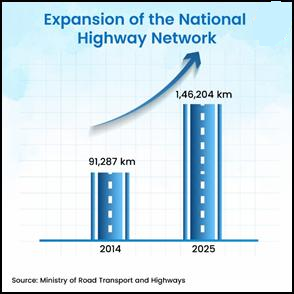
As of March 2025, India has built over 63 lakh kilometres of roads—the second-largest network in the world. The transformation of national highways has been particularly remarkable. The network has grown to 1,46,204 km, up from 91,287 km in 2013–14, marking a 60% expansion, with 54,917 km added between 2014 and 2025. This rapid expansion has made digital governance indispensable for managing and upgrading such a massive asset base.
Digital Tolling & Payment Reforms: Toward Seamless Mobility
1. FASTag & National Electronic Toll Collection (NETC): The National Payments Corporation of India (NPCI) has operationalized NETC, a unified, interoperable electronic tolling system. Its centerpiece, FASTag, uses RFID technology to deduct tolls automatically through linked user accounts. With 98% penetration and 8 crore+ users, FASTag has revolutionized highway tolling.
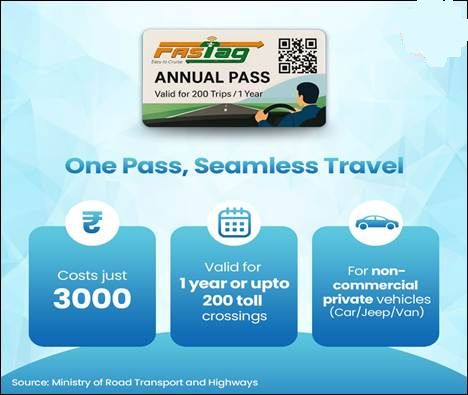
2. FASTag Annual Pass: Mobility Made Easier: Launched for non-commercial vehicles, the pass offers:
One-time payment of ₹3,000
Validity: 1 year or 200 toll crossings
Access across 1,150 toll plazas
Activation within 2 hours via Rajmargyatra/NHAI website
Within two months of launch (Aug–Oct 2025), the pass crossed 25 lakh users with 5.67 crore transactions, highlighting strong nationwide adoption.
3. Revised Tolling Rules (Effective 15 Nov 2025)
To accelerate digital payments and reduce cash usage:
Non-FASTag vehicles paying cash → Double toll fee
UPI payments → 1.25× toll amount
4. India’s First Multi-Lane Free Flow (MLFF) Tolling: In August 2025, India launched its first MLFF toll plaza at Choryasi on NH-48, Gujarat. The barrier-free system reads FASTag/vehicle details on the move, eliminating stoppages and reducing fuel consumption, congestion, and emissions.
Rajmargyatra: India’s Most Successful Highway App
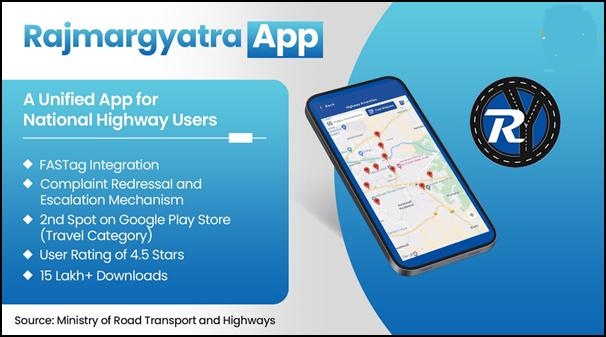
The Rajmargyatra app has become a nationwide favourite for highway commuters with features such as:
1. Real-time highway and toll information
2. Weather updates
3. Speed limit alerts
4. Nearby health facilities & EV charging stations
5. Voice assistance for drivers
6. FASTag integration
7. Geo-tagged grievance reporting
The app has crossed 15 lakh downloads, boasts a 4.5★ rating, and ranks 2nd in India’s Travel category, making it the highest-ranked government mobility app.
NHAI One: Digital Backbone for Field Operations
NHAI One is a unified digital platform that integrates internal operations through five modules:
1. Staff attendance
2. Highway maintenance tracking
3. Road safety audits
4. Public toilet monitoring
5. Daily construction audits (RFIs with geo-tagged evidence)
With real-time data, geo-enabled reporting, and strict accountability, the app ensures that projects progress smoothly from the field to the headquarters.
GIS Mapping & PM Gati Shakti: Planning with Precision
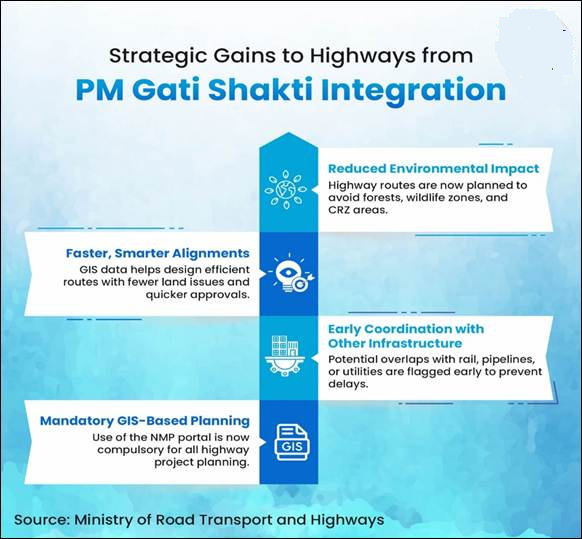
Under the PM Gati Shakti National Master Plan, India’s entire National Highway network has been mapped using 550+ GIS layers, creating a powerful tool for strategic planning. These layers include:
1. Logistics hubs
2. Environmental and forest buffers
3. Industrial clusters
4. Rail & port linkages
5. Eco-sensitive zones
Digitizing all 1.46 lakh km of national highways marks a major milestone in modernising infrastructure planning through spatial intelligence.
Intelligent Transport Systems (ITS)
| Category | Details |
|---|---|
| Purpose of ITS/ATMS | To ensure timely response, controlled traffic flow, enhanced safety, and real-time monitoring across highways and expressways. |
| Key Features of ATMS | • Automatic incident detection • Speed and lane enforcement • Traffic density monitoring • Emergency response activation • Variable message signboards |
| Expressways Equipped with ATMS | • Delhi–Meerut Expressway • Trans-Haryana Expressway • Eastern Peripheral Expressway • Bengaluru–Mysore Expressway |
| Impact (Bengaluru–Mysore Expressway) | Significant reduction in accidents and fatalities after ATMS deployment (July 2024). |
| Modern Safety Enhancements | • QR-enabled Information Boards for instant helpline access • Network Survey Vehicles (NSVs) with 3D laser scanners & 360° imaging |
| NSV Survey Coverage | Surveyed 20,933 km across 23 states, identifying: • Safety gaps • Pavement defects • Maintenance requirements |
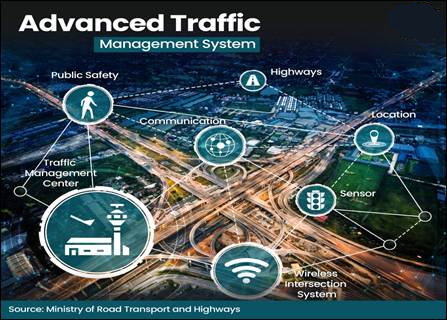
Green Highways Mission: Sustainability in Every Mile
Sustainability is now integral to India’s road-building strategy under the Green Highways Mission.
1. Massive Afforestation Efforts
2. 56 lakh trees planted (2023–24)
3. 67.47 lakh (2024–25)
4. 4.69 crore total plantations
These green buffers help reduce carbon emissions, control dust, and improve ecosystem resilience.
Water Conservation under Mission Amrit Sarovar
467 water bodies revived or developed
Generated 2.4 crore cubic meters of reusable soil
Saved an estimated ₹16,690 crore in construction material costs
Circular Economy in Construction
In 2023–24 alone, NHAI utilised:
631 lakh metric tonnes of fly ash, reclaimed asphalt, and plastic waste
This reflects India’s commitment to waste reduction and green construction technologies.
Smart, Sustainable & Citizen-Centric: The Highway of the Future
India’s highways are now becoming live, intelligent systems that:
1. Sense real-time events
2. Analyse traffic and safety data
3. Respond instantly to emergencies
4. Enable seamless mobility through digital tolling
5. Promote sustainability through green initiatives
6. Empower citizens through transparent, user-friendly apps
Conclusion
India’s digital highway revolution is more than an infrastructure upgrade—it represents a national shift toward intelligent mobility. Through GIS-based planning, real-time ATMS alerts, MLFF tolling, seamless FASTag services, waste-based construction materials, and citizen-friendly apps, the country is redefining what modern highways can achieve. These new-age corridors are transforming the movement of people and goods while contributing to sustainability, transparency, and economic growth. India is not just building highways—it is building digital, sustainable, and intelligent mobility ecosystems for the future.
Prelims question:
Q. With reference to India’s digital transformation of National Highways, consider the following statements:
1. The Multi-Lane Free Flow (MLFF) system allows toll collection without stopping vehicles and was first launched in Gujarat in 2025.
2. Under the revised National Highways Fee Rules (2025), toll paid through UPI is equal to the standard toll amount.
3. Rajmargyatra app provides geo-tagged grievance redressal, real-time highway information, and FASTag integration.
4. Network Survey Vehicles (NSVs) deployed by NHAI are used only for toll audit purposes.
Which of the statements given above are correct?
A. 1 and 3 only
B. 1, 2 and 3 only
C. 2 and 4 only
D. 1, 3 and 4 only
Answer: A
Mains Question:
Q. Discuss the key components of this transformation and evaluate how digital tolling, GIS-based planning, Intelligent Transport Systems (ITS), and sustainability initiatives are reshaping India’s road transport ecosystem.
(250 words)

- Europe’s AI Rules May Become India’s Opportunity - August 14, 2026
- Transparency as the Foundation of Trust in Medicine - August 14, 2026
- A Timely Reset for the Food Security Act: From Foodgrain Security to Nutrition Security - August 13, 2026

No Comments