


05 Nov Treasury Bills Auction: RBI Releases Full Results for UPSC Exam
✎ Treasury Bills are short-term, zero-coupon government debt instruments issued at a discount and redeemed at par, serving as a key tool for government's short-term financing and a benchmark for money market rates.
Subject Relevance — Where This Topic Fits
- GS Paper III — Economy
- Prelims: Treasury Bills, Government Securities, Public Debt Management, Reserve Bank of India, Monetary Policy Instruments, Fiscal Deficit, Open Market Operations, Yield to Maturity, Weighted Average Yield, Competitive Bidding, Non-Competitive Bidding
- Essay: The role of public finance in economic stability and growth, Government borrowing and its implications for fiscal policy
Quick Revision: Treasury Bills are short-term, zero-coupon government debt instruments issued at a discount and redeemed at par, serving as a key tool for government’s short-term financing and a benchmark for money market rates.
Why is this in the news?
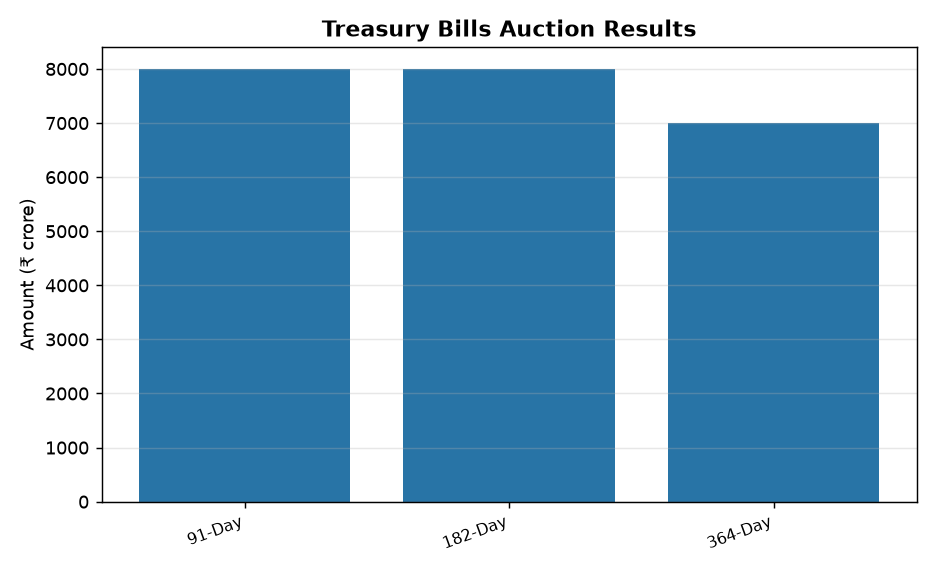
The Reserve Bank of India (RBI) recently published the full auction results for 91-Day, 182-Day, and 364-Day Treasury Bills. These results provide critical insights into the government’s short-term borrowing activities and the prevailing market demand and yield expectations for these instruments, reflecting the broader liquidity conditions and interest rate environment within the economy.
Background
- Government securities (G-Secs) are debt instruments issued by the government to borrow money. These are primarily issued to finance the fiscal deficit and manage the government’s cash flow.
- Treasury Bills (T-Bills) are short-term money market instruments issued by the Government of India, acting through the Reserve Bank of India, to meet its short-term funding requirements.
- T-Bills are currently issued in three tenors: 91-day, 182-day, and 364-day. They are zero-coupon instruments, meaning they do not pay interest directly. Instead, they are issued at a discount to their face value and redeemed at par.
- Auctions for T-Bills are conducted by the RBI on a weekly basis, with the specific schedule announced in the quarterly calendar.
- The auction process involves both competitive and non-competitive bidding. Competitive bidders are typically large institutional investors who bid on the basis of price/yield, while non-competitive bidders are smaller investors who place bids without specifying a price, ensuring allotment at the weighted average yield of the competitive bids.
- The cut-off price/yield determined in the auction reflects the market’s perception of the government’s creditworthiness and the prevailing interest rate environment. A lower yield indicates higher demand and lower borrowing costs for the government.
- The management of public debt, including the issuance of T-Bills, is a crucial function of the RBI, aimed at ensuring efficient financing for the government while maintaining market stability.
- The yields on T-Bills serve as a benchmark for other short-term interest rates in the economy, influencing the cost of borrowing for corporations and individuals.
- The difference between the notified amount and the accepted amount, along with the partial allotment percentage, indicates the extent of market demand relative to the government’s borrowing target.
- The Weighted Average Yield (WAY) provides an overall average yield at which the T-Bills were allotted, offering a comprehensive measure of the government’s borrowing cost for that particular auction.
- The auction results are a key indicator for financial market participants, providing insights into liquidity conditions, interest rate expectations, and the government’s borrowing programme.
- The Reserve Bank of India, as the debt manager for the central government, plays a pivotal role in conducting these auctions and ensuring the smooth functioning of the government securities market.
What are Treasury Bills?
- Treasury Bills (T-Bills) are short-term debt instruments issued by the Government of India to raise funds for its immediate financial needs.
- They are considered highly liquid and risk-free instruments, backed by the full faith and credit of the government.
- T-Bills are issued at a discount to their face value and redeemed at par upon maturity, with the difference between the issue price and the face value representing the investor’s return.
- Currently, T-Bills are available in three maturities: 91-day, 182-day, and 364-day.
- Non-competitive bidding allows smaller investors, including individuals and provident funds, to participate without having to quote a price, ensuring they receive an allotment at the weighted average price/yield of the competitive bids.
- T-Bills form an integral part of the government’s short-term borrowing strategy and are a key component of the money market, influencing short-term interest rates.
- The Reserve Bank of India manages the issuance and auction of T-Bills on behalf of the central government, as part of its public debt management function.
- The yield on T-Bills is influenced by various factors, including inflation expectations, monetary policy stance, liquidity conditions, and the overall demand and supply dynamics in the government securities market.
Key Features
| Feature | Significance |
|---|---|
| Treasury Bills (T-Bills) | Short-term debt instruments issued by the Government of India to meet its temporary liquidity requirements. They are zero-coupon securities, meaning they do not pay interest directly but are issued at a discount and redeemed at par value. |
| Auction Mechanism | T-Bills are issued through a competitive bidding process, where bidders quote prices/yields, and a non-competitive bidding process, which facilitates participation from smaller investors and those who do not have the expertise to bid competitively. |
| Maturity Periods | Available in three fixed maturities: 91 days, 182 days, and 364 days. This offers flexibility to both the government in managing its short-term finances and to investors seeking short-duration assets. |
| Cut-off Price/Yield | The price/yield at which the last successful bid is accepted in an auction. This determines the effective rate of return for investors and the cost of borrowing for the government. |
| Weighted Average Price (WAP)/Yield (WAY) | The average price/yield of all accepted bids, weighted by their respective amounts. It provides a comprehensive measure of the borrowing cost for the government in that particular auction. |
| Notified Amount | The pre-announced amount that the Reserve Bank of India (RBI) intends to borrow through the T-Bill auction on behalf of the government. This sets the target for the government’s short-term funding needs. |
Why it Matters
Fiscal Management
- Treasury Bills are a crucial tool for the Government of India to manage its short-term cash flow mismatches and meet immediate expenditure requirements without resorting to long-term debt, thereby maintaining fiscal discipline.
- The successful auction of T-Bills indicates the market’s confidence in the government’s ability to repay its short-term obligations, which is vital for maintaining fiscal stability and attracting investments.
Monetary Policy Implications
- T-Bill auctions influence the short-term interest rate environment in the economy. Higher yields can signal tighter liquidity conditions or increased borrowing costs for the government, potentially impacting other market rates.
- The Reserve Bank of India (RBI) uses T-Bills as part of its open market operations (OMOs) to manage liquidity in the banking system. By buying or selling T-Bills, the RBI can inject or absorb liquidity, influencing short-term interest rates and credit availability.
Financial Market Development
- T-Bills provide a safe and liquid investment avenue for various market participants, including banks, financial institutions, and individuals, contributing to the depth and breadth of the Indian money market.
- The yields on T-Bills serve as a benchmark for other short-term financial instruments, aiding in the pricing of various debt products and fostering a more efficient financial market.
Challenges
1. Yield Volatility
- Fluctuations in T-Bill yields can increase the government’s borrowing costs, especially during periods of economic uncertainty or rising inflation expectations.
- Significant changes in yields can also impact the profitability of financial institutions that hold T-Bills, affecting their balance sheets and overall market stability.
UPSC Link: Indian Economy and issues relating to planning, mobilization of resources
2. Market Absorption Capacity
- If the market’s appetite for T-Bills is low, or if there is insufficient liquidity, the government might struggle to raise the desired amount at competitive rates, leading to under-subscription or higher borrowing costs.
- Over-reliance on T-Bills for short-term funding can crowd out private sector borrowing if the government’s demand for funds is consistently high, potentially impacting private investment.
UPSC Link: Government Budgeting; Indian Economy
3. Inflationary Pressures
- High inflation can lead investors to demand higher yields on T-Bills to compensate for the erosion of purchasing power, thereby increasing the government’s interest burden.
- Managing the balance between financing government expenditure through T-Bills and controlling inflationary pressures is a continuous challenge for both the Ministry of Finance and the RBI.
UPSC Link: Inflation and its impact; Indian Economy
Challenges — UPSC Perspective
| Issue | Concern |
|---|---|
| Rising Yields | Increases the cost of short-term borrowing for the government, potentially widening the fiscal deficit. |
| Under-subscription | Indicates insufficient market demand, forcing the government to either accept higher yields or fall short of its borrowing target. |
| Liquidity Management | Ensuring adequate liquidity in the market to absorb T-Bill issuances without causing undue pressure on short-term interest rates. |
| Global Economic Shocks | External factors such as global interest rate hikes or capital outflows can impact investor sentiment and demand for domestic government securities. |
| Fiscal Slippage | Any deviation from fiscal targets can erode investor confidence, leading to higher risk premiums demanded on government securities. |
Way Forward
- Maintain fiscal prudence and transparency in government borrowing programs to enhance investor confidence and stabilize T-Bill yields.
- Diversify the investor base for T-Bills by encouraging broader participation from retail investors and non-banking financial institutions.
- Strengthen communication between the government and the Reserve Bank of India to ensure coordinated fiscal and monetary policies, particularly regarding debt management.
- Continuously monitor domestic and global liquidity conditions to adjust T-Bill issuance strategies and ensure optimal borrowing costs.
- Explore innovative debt instruments and market mechanisms to enhance the attractiveness and efficiency of the government securities market.
- Improve financial literacy and awareness among potential investors regarding government securities to deepen market participation.
- Utilize technology for more efficient auction processes and better dissemination of market information to all participants.
UPSC Value Addition
Keywords for Mains Answer-Writing
Treasury Bills · Government Securities · Money Market Instruments · Public Debt Management · Reserve Bank of India · Fiscal Deficit Financing · Monetary Policy Transmission · Financial Market Liquidity · Debt Management Strategy · Yield Curve
Constitutional & Policy Linkages
- Article 112: Annual Financial Statement (Budget)
- Article 292: Borrowing by the Government of India
- Article 282: Expenditure defrayable by the Union
Concept Flow
Government requires short-term funds. → Ministry of Finance, in consultation with RBI, decides borrowing amount. → RBI announces T-Bill auction (91, 182, 364-day maturities). → Investors submit competitive and non-competitive bids. → RBI determines cut-off price/yield based on bids. → Successful bidders are allotted T-Bills at a discount. → Government receives funds, investors hold short-term debt.
Prelims Practice Questions
Q1. Consider the following statements regarding Treasury Bills (T-Bills) in India:
1. T-Bills are short-term debt instruments issued by the Reserve Bank of India on behalf of the Central Government.
2. They are issued at a discount to their face value and repaid at par.
3. T-Bills are available in 91-day, 182-day, and 364-day maturities.
How many of the above statements are correct?
- Only one
- Only two
- Only three
- None
Answer: Only three — Statement 1 is incorrect: T-Bills are issued by the Central Government, not the RBI, though the RBI manages the issuance process. Statement 2 is correct: T-Bills are zero-coupon instruments issued at a discount and redeemed at face value. Statement 3 is correct: The standard maturities for T-Bills in India are indeed 91-day, 182-day, and 364-day.
Q2. Which of the following statements correctly describes the primary function of Treasury Bills?
- To finance long-term infrastructure projects of the government.
- To manage the short-term liquidity needs of the government.
- To provide a risk-free investment option for foreign institutional investors only.
- To serve as a tool for the Reserve Bank of India to conduct open market operations for long-term debt.
Answer: To manage the short-term liquidity needs of the government. — Treasury Bills are short-term money market instruments primarily used by the government to meet its temporary cash flow mismatches and short-term borrowing requirements. Long-term infrastructure projects are typically financed through long-dated government bonds. While T-Bills are risk-free and attract various investors, their primary function is government liquidity management. Open Market Operations (OMOs) can involve T-Bills, but their fundamental purpose is not solely for OMOs, and OMOs can involve both short-term and long-term securities.
Mains Practice Question
✍ Explain the significance of Treasury Bills as a tool for government debt management and monetary policy. Discuss the implications of varied cut-off yields and bid-to-cover ratios observed in recent auctions on the financial markets. (15 Marks)
Approach: MODEL-ANSWER SKELETON:
1. **Introduction:** Define Treasury Bills (T-Bills) as short-term, zero-coupon money market instruments issued by the Central Government to meet temporary funding needs.
2. **Significance for Government Debt Management:**
* **Short-term Liquidity Management:** Explain how T-Bills help bridge temporary revenue-expenditure gaps, ensuring smooth government operations.
* **Cost-effective Borrowing:** Discuss their role in raising funds at competitive short-term rates.
* **Benchmark for Short-term Rates:** Highlight their function in establishing a risk-free rate for the money market.
* **Diversification of Debt Profile:** Mention how they complement long-term dated securities.
3. **Significance for Monetary Policy:**
* **Liquidity Absorption/Injection:** Explain how RBI uses T-Bill auctions (via primary market operations or secondary market OMOs) to manage systemic liquidity.
* **Interest Rate Signalling:** Discuss how T-Bill yields reflect market expectations of short-term interest rates and influence other money market rates.
* **Monetary Policy Transmission:** Elaborate on how changes in T-Bill yields transmit to other segments of the financial system.
4. **Implications of Varied Cut-off Yields and Bid-to-Cover Ratios:**
* **Cut-off Yields:**
* **Higher Yields:** Indicate increased borrowing costs for the government, potentially reflecting higher inflation expectations, tighter liquidity, or increased fiscal deficit concerns. Impact on corporate borrowing rates.
* **Lower Yields:** Suggest ample liquidity, lower inflation expectations, or strong demand for safe-haven assets. Reduced government borrowing costs.
* **Bid-to-Cover Ratio:**
* **High Ratio (>1):** Signifies strong investor demand, indicating confidence in government securities, ample market liquidity, or attractive yields. Leads to lower cut-off yields.
* **Low Ratio (closer to 1 or <1):** Suggests weak demand, potentially due to tight liquidity, unattractive yields, or concerns about fiscal health. May lead to higher cut-off yields or even devolvement on primary dealers.
* **Overall Market Impact:** Discuss how these indicators influence investor sentiment, bond market dynamics, and the broader financial stability, impacting banks, mutual funds, and corporate treasuries.
5. **Conclusion:** Summarise the dual role of T-Bills in fiscal prudence and monetary management, emphasising the importance of auction outcomes as key economic indicators.
Source: RBI
Generated by AanyaAi for educational purpose.
Related guides on our sites
- Best PSIR optional coaching for upsc
- Best economics optional coaching for upsc
- Best PSIR optional teacher for upsc
- Best teacher of PSIR optional for upsc

- Treasury Bills Auction: RBI Releases Full Results for UPSC Exam - November 5, 2026
- स्वच्छ भारत मिशन (ग्रामीण) चरण-II: अवधि विस्तार और बजटीय आवंटन - November 5, 2026
- COP31: UN Climate Summit Stakes for UPSC & State PCS - November 5, 2026

No Comments