


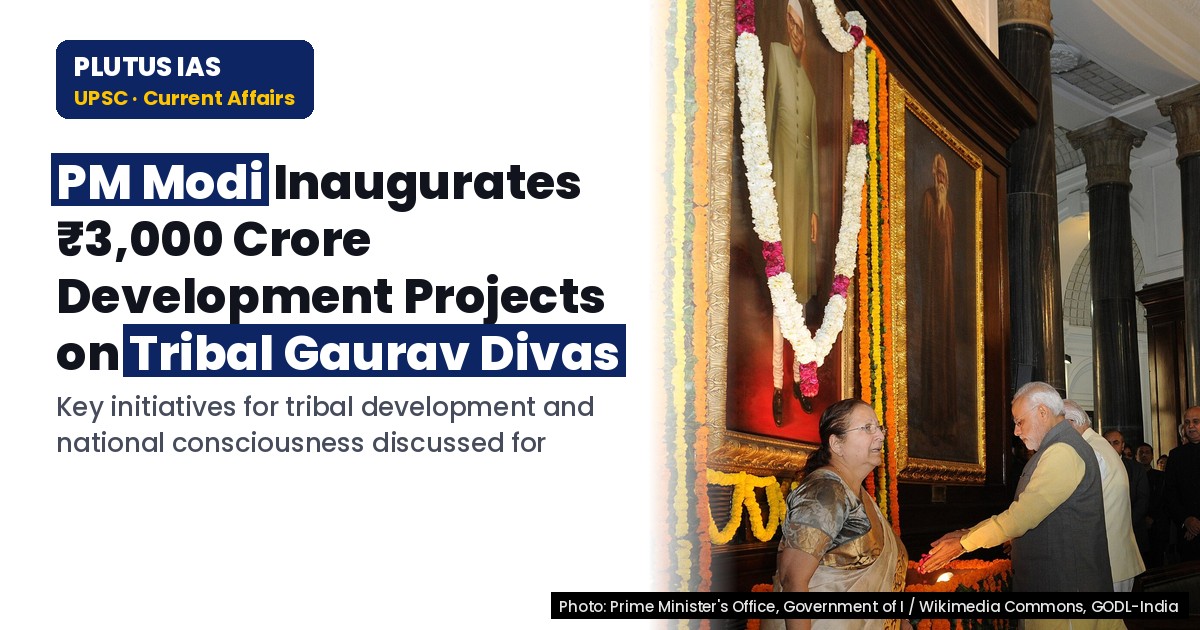
25 Nov Tribal Gaurav Divas: PM Modi’s Address & Development Projects
✎ Tribal Gaurav Diwas, observed on November 15, commemorates Bhagwan Birsa Munda's birth anniversary and celebrates the invaluable contributions and heritage of India's tribal communities, alongside focused developmental…
Subject Relevance — Where This Topic Fits
- GS Paper I — Indian Heritage and Culture, Social Empowerment | GS Paper II — Government Policies and Interventions for Development in various sectors and issues arising out of their design and implementation, Welfare Schemes for Vulnerable Sections of the population by the Centre and States and the Performance of these Schemes | GS Paper III — Challenges to Internal Security through Communication Networks, Role of State and Non-State Actors in Internal Security Challenges
- Prelims: Tribal Gaurav Diwas, Birsa Munda, Aspirational Districts Programme, Naxalism, Tribal Freedom Fighters, Gadchiroli development projects
- Essay: The role of indigenous communities in nation-building and preserving cultural heritage, Development challenges and opportunities in tribal regions of India
Quick Revision: Tribal Gaurav Diwas, observed on November 15, commemorates Bhagwan Birsa Munda’s birth anniversary and celebrates the invaluable contributions and heritage of India’s tribal communities, alongside focused developmental initiatives in tribal-dominated and historically backward regions.
Why is this in the news?
The Prime Minister participated in the Tribal Gaurav Diwas programme in Gadchiroli, Maharashtra, via video conferencing. During the event, he inaugurated and laid the foundation stone for 246 development projects worth approximately ₹3,000 crore. The occasion served to commemorate the rich heritage and contributions of India’s tribal communities, highlighting the national celebration of Tribal Gaurav Diwas, which commenced on November 15, 2021.
Background
- Tribal Gaurav Diwas is observed annually on November 15, coinciding with the birth anniversary of Bhagwan Birsa Munda, a revered tribal freedom fighter.
- The celebration aims to acknowledge the sacrifices of tribal freedom fighters and their role in the independence struggle, promoting awareness about tribal heritage.
- The government has initiated various development programmes specifically targeting tribal-dominated areas, including the Aspirational Districts Programme and Aspirational Blocks Programme.
- Historically, many tribal regions have faced developmental challenges, including issues related to infrastructure, education, health, and economic opportunities.
- Regions like Gadchiroli have also been affected by issues of left-wing extremism, necessitating focused developmental interventions and security measures.
Tribal Gaurav Diwas and Related Initiatives
- Tribal Gaurav Diwas is a national observance dedicated to celebrating the rich cultural heritage, contributions, and valor of India’s tribal communities.
- It is celebrated on November 15 each year, marking the birth anniversary of Bhagwan Birsa Munda, a prominent tribal leader and freedom fighter from the Munda tribe.
- Birsa Munda led the ‘Ulgulan’ (Great Tumult) movement against British colonial rule and exploitative land practices in the late 19th century, advocating for tribal rights and self-governance.
- The observance seeks to educate the public about the significant role tribal communities played in India’s freedom struggle, including figures like Tirot Singh, Sidhu and Kanhu Murmu, Rani Gaidinliu, and Alluri Sitarama Raju.
- Government initiatives in tribal areas include the Aspirational Districts Programme, launched in 2018, which focuses on improving socio-economic indicators in identified backward districts, many of which have significant tribal populations.
- The Aspirational Blocks Programme extends this focus to block-level development, aiming for holistic progress in areas such as health, nutrition, education, agriculture, water resources, financial inclusion, and skill development.
- Development projects often encompass infrastructure development, educational institutions, healthcare facilities, tribal product marketing centres, and rural connectivity to address long-standing developmental deficits.
- Efforts are also directed towards combating left-wing extremism (LWE) by promoting development and integrating affected regions into the national mainstream, thereby addressing root causes of discontent.
Key Features
| Feature | Significance |
|---|---|
| Tribal Pride Day (Janjaatiya Gaurav Divas) | Commemorates the birth anniversary of Bhagwan Birsa Munda on November 15th, celebrating the rich heritage, culture, and contributions of India’s tribal communities. |
| Development Projects Inaugurated/Laid Foundation | Approximately 246 development projects worth nearly INR 3,000 crore in Gadchiroli, Maharashtra, and over 170 tribal development projects worth INR 3,000 crore across various states, focusing on education, health, tribal product marketing, and rural infrastructure. |
| Focus on Aspirational Districts and Blocks | Special campaigns initiated in over 100 Aspirational Districts and 500 Aspirational Blocks, many with significant tribal populations, to address long-standing developmental disparities. |
| PM Krishi Dhan-Dhanya Yojana | Specific attention directed towards 100 agriculturally backward districts under this scheme, indicating a targeted approach to agricultural development in underserved regions. |
| Recognition of Tribal Freedom Fighters | Acknowledgement of numerous tribal heroes and heroines like Tirat Singh, Sido-Kanhu, Govind Guru, Rani Gaidinliu, Tantya Bhil, Alluri Sitarama Raju, and Rani Durgavati, highlighting their pivotal role in India’s freedom struggle. |
Why it Matters
Socio-Cultural Significance
- Reinforces national identity by integrating tribal heritage into mainstream historical narratives, fostering a sense of pride and belonging among tribal communities.
- Promotes cultural preservation and awareness by celebrating tribal traditions, art forms, and languages, thereby enriching India’s diverse cultural fabric.
- Acknowledges the historical contributions of tribal freedom fighters, ensuring their sacrifices are recognized and serve as inspiration for future generations.
Governance and Developmental Significance
- Demonstrates a commitment to inclusive development by focusing on regions and communities that have historically experienced socio-economic marginalization.
- Facilitates targeted interventions in critical sectors such as education, health, and infrastructure through the inauguration and foundation laying of numerous projects.
- Strengthens administrative outreach and policy implementation in remote and tribal-dominated areas, addressing regional imbalances in development.
Political and Strategic Significance
- Contributes to national integration by fostering a sense of shared history and collective identity, transcending regional and ethnic divisions.
- Addresses issues of internal security by promoting development in areas previously affected by left-wing extremism, thereby reducing grievances that can be exploited by insurgent groups.
- Symbolizes a shift towards an indigenous perspective in commemorating national events and heroes, aligning with the principle of ‘swadeshi swabhimaan’ (indigenous self-respect).
Challenges
1. Socio-Economic Disparities
- Despite developmental efforts, significant gaps persist in education, health, and economic opportunities for tribal populations compared to the national average.
- Limited access to quality infrastructure, including roads, electricity, and communication networks, hinders overall development and integration.
UPSC Link: Social Justice: Welfare schemes for vulnerable sections
2. Land Alienation and Resource Exploitation
- Tribal communities often face displacement and loss of traditional land rights due to development projects, mining, and forest policies.
- Exploitation of natural resources in tribal areas can lead to environmental degradation and disruption of traditional livelihoods.
UPSC Link: Governance: Land reforms, Environmental protection
3. Preservation of Culture and Identity
- Modernization and external influences pose challenges to the preservation of unique tribal languages, customs, and traditional knowledge systems.
- Inadequate representation and participation in decision-making processes can lead to policies that do not fully address tribal aspirations.
UPSC Link: Social Justice: Issues relating to development and management of Social Sector/Services relating to Health, Education, Human Resources
4. Left-Wing Extremism (LWE)
- While progress has been made, some tribal areas remain susceptible to LWE influence due to historical grievances, underdevelopment, and lack of state presence.
- Development projects in LWE-affected regions face implementation challenges due to security concerns and disruptions.
UPSC Link: Internal Security: Linkages between development and spread of extremism
Challenges — UPSC Perspective
| Issue | Concern |
|---|---|
| Access to Quality Education | Lower literacy rates and higher dropout rates among tribal children, exacerbated by language barriers and lack of culturally relevant curriculum. |
| Healthcare Access and Outcomes | Poorer health indicators, including higher infant mortality rates and prevalence of malnutrition, due to limited access to primary healthcare facilities and qualified personnel. |
| Economic Marginalization | Dependence on traditional livelihoods, often forest-based, which are susceptible to policy changes and market fluctuations, leading to income insecurity. |
| Infrastructure Deficiencies | Lack of adequate road connectivity, reliable electricity, and digital infrastructure in many tribal areas, impeding economic growth and access to services. |
| Cultural Erosion | Threats to indigenous languages, traditional knowledge, and unique cultural practices due to external influences and insufficient preservation efforts. |
Government Initiatives — Must-Memorise for Prelims
- PM Krishi Dhan-Dhanya Yojana
Way Forward
- Strengthen the implementation of existing tribal welfare schemes by ensuring timely fund disbursement and effective monitoring mechanisms.
- Promote culturally sensitive education and healthcare models that incorporate local languages and traditional practices to improve outcomes.
- Enhance infrastructure development in tribal regions, focusing on last-mile connectivity, digital inclusion, and access to clean energy.
- Empower tribal communities through greater participation in local governance and decision-making processes concerning their land and resources.
- Foster sustainable livelihood opportunities by promoting value addition to forest produce, skill development, and market linkages for tribal products.
- Address land alienation issues by ensuring strict adherence to legal provisions like the Forest Rights Act and PESA Act, protecting tribal land rights.
- Intensify efforts to counter left-wing extremism through a multi-pronged strategy combining security measures with accelerated socio-economic development.
UPSC Value Addition
Keywords for Mains Answer-Writing
Tribal Gaurav Diwas · Birsa Munda · Tribal development · Aspirational Districts Programme · Naxalism · Maoist extremism · Socio-economic upliftment · Cultural heritage preservation · Inclusive growth · Marginalised communities · Sustainable development · Government initiatives
Constitutional & Policy Linkages
- {‘article’: ‘Article 46’, ‘note’: ‘Promotion of educational and economic interests of Scheduled Castes, Scheduled Tribes and other weaker sections.’}
- {‘article’: ‘Article 244’, ‘note’: ‘Administration of Scheduled Areas and Tribal Areas.’}
- {‘article’: ‘Fifth Schedule’, ‘note’: ‘Provisions for administration and control of Scheduled Areas.’}
- {‘article’: ‘Sixth Schedule’, ‘note’: ‘Provisions for administration of Tribal Areas in Assam, Meghalaya, Tripura and Mizoram.’}
Concept Flow
Commemoration of Tribal Pride Day (Janjaatiya Gaurav Divas) → Recognition of tribal heritage and contributions to national history → Focus on developmental disparities in tribal regions → Launch/inauguration of targeted development projects and schemes → Improved socio-economic indicators and infrastructure in tribal areas → Enhanced national integration and cultural preservation
Prelims Practice Questions
Q1. Consider the following statements regarding ‘Tribal Gaurav Diwas’:
1. It is celebrated annually on November 15th to commemorate the birth anniversary of Bhagwan Birsa Munda.
2. The tradition of celebrating Tribal Gaurav Diwas was initiated in 2021.
3. The day aims to recognise the contributions of tribal communities to India’s freedom struggle and preserve their cultural heritage.
How many of the above statements are correct?
- Only one
- Only two
- Only three
- None
Answer: Only three — Statement 1 is correct: Tribal Gaurav Diwas is indeed celebrated on November 15th, Birsa Munda’s birth anniversary. Statement 2 is correct: The tradition was initiated on November 15, 2021. Statement 3 is correct: The day’s objective is to honour tribal contributions and heritage.
Q2. Match the following tribal leaders with their associated movements/regions:
1. Tirot Singh A. Santhal Rebellion
2. Sido-Kanhu B. Khasi Hills
3. Govind Guru C. Ulgulan
4. Birsa Munda D. Mangarh
Which of the following pairs is correctly matched?
- 1-B, 2-A, 3-D, 4-C
- 1-A, 2-B, 3-C, 4-D
- 1-C, 2-D, 3-A, 4-B
- 1-B, 2-D, 3-A, 4-C
Answer: 1-B, 2-A, 3-D, 4-C — Tirot Singh is associated with the struggle in the Khasi Hills. Sido-Kanhu led the Santhal Rebellion. Govind Guru’s followers made sacrifices at Mangarh. Birsa Munda is renowned for the Ulgulan movement.
Mains Practice Question
✍ Discuss the significance of ‘Tribal Gaurav Diwas’ in promoting the socio-economic upliftment and cultural recognition of tribal communities in India. How far have government initiatives, such as the Aspirational Districts Programme, contributed to addressing the developmental disparities faced by these communities? (15 Marks)
Approach: The answer should begin by defining ‘Tribal Gaurav Diwas’ and its historical context, particularly its connection to Bhagwan Birsa Munda and its initiation in 2021. Discuss its significance in terms of acknowledging tribal contributions to the freedom struggle, preserving rich cultural heritage, and fostering national pride. The second part should evaluate the effectiveness of government initiatives, specifically the Aspirational Districts Programme and Aspirational Blocks Programme, in improving indicators like health, education, and infrastructure in tribal-dominated regions. Mention specific projects or schemes (e.g., museums, research institutes, rural infrastructure) if applicable. Conclude with a balanced assessment of achievements and remaining challenges in tribal development and integration.
Source: PIB (Press Information Bureau)
Maharashtra PCS (MPSC) — State PCS Practice
Prelims: Which of the following statements regarding the ‘Tribal Pride Day’ (Janjaatiya Gaurav Divas) event attended by Prime Minister Shri Narendra Modi in Maharashtra is/are correct?
1. The event took place in Gadchiroli district, known for its significant tribal population.
2. The day commemorates the birth anniversary of Bhagwan Birsa Munda.
3. The Prime Minister inaugurated several development projects aimed at tribal welfare during the event.
Choose the correct option:
- A. 1 only
- B. 2 only
- C. 1 and 2 only
- D. 1, 2 and 3
Answer: C. 1 and 2 only — The provided topic only mentions the Prime Minister’s participation in the event in Gadchiroli, Maharashtra. It does not provide information about the inauguration of development projects or the specific commemoration of Bhagwan Birsa Munda, though the latter is generally true for Tribal Pride Day.
Mains: Discuss the significance of celebrating ‘Tribal Pride Day’ (Janjaatiya Gaurav Divas) in a district like Gadchiroli, Maharashtra, considering the state’s tribal demography and the government’s focus on tribal welfare. (150 words)
Generated by AanyaAi for educational purpose.
Related guides on our sites
- Best sociology optional coaching
- Best coaching for sociology optional
- Best sociology optional coaching online
- is sociology good optional

- Tribal Gaurav Divas: PM Modi’s Address & Development Projects - November 25, 2026
- पीएम जनमन योजना: जशपुर में पुल निर्माण से जनजातीय विकास - November 25, 2026
- COP31 Failure: Future of Climate Negotiations & India - November 25, 2026

No Comments