


29 Jul Tribal Ministry & CSIR-NBRI Pact to Protect Endangered Medicinal Plants

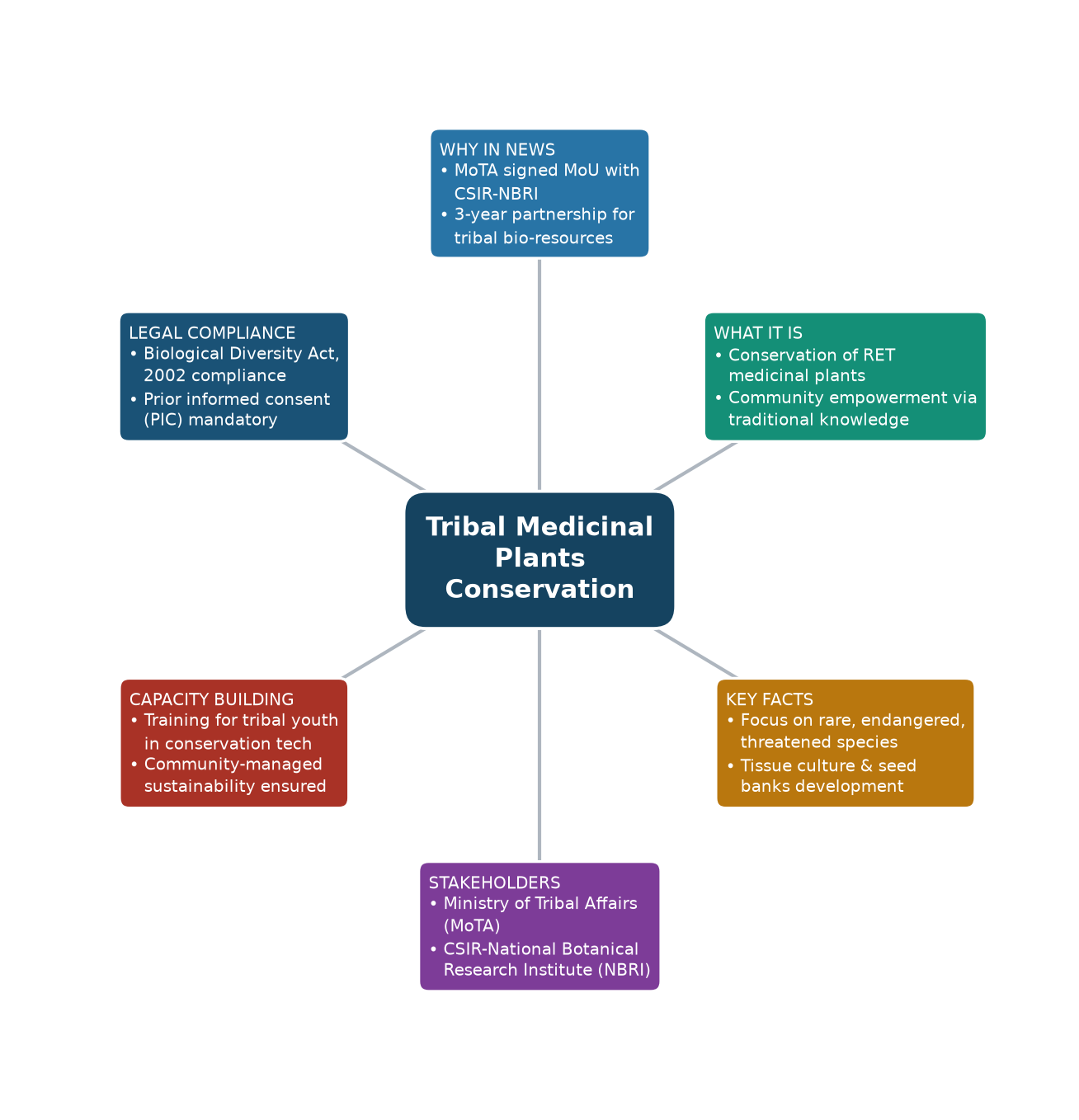
Map & concept mind-map: MoTA-CSIR-NBRI MoU for tribal medicinal plants
Subject Relevance — Where This Topic Fits
- GS Paper III — Environment, Biodiversity, Environmental Conservation | GS Paper III — Science and Technology — Developments and their Applications and Effects in Everyday Life
- Prelims: Biodiversity Act, 2002, Access and Benefit Sharing (ABS), Traditional Knowledge Digital Library (TKDL), CSIR-NBRI, Rare, Endangered and Threatened (RET) species, Community Intellectual Property Rights, Prior Informed Consent (PIC), National Biodiversity Fund
- Essay: Ethical stewardship of natural resources: Balancing conservation, innovation and community rights, Traditional knowledge systems and modern science: A synergy for sustainable development
Quick Revision: The MoTA-CSIR-NBRI MoU exemplifies ethical biodiversity governance by integrating conservation of RET medicinal plants, protection of tribal traditional knowledge, and community empowerment through capacity-building and equitable benefit-sharing.
Why is this in the news?
The Ministry of Tribal Affairs (MoTA) signed a Memorandum of Understanding (MoU) with the Council of Scientific and Industrial Research-National Botanical Research Institute (CSIR-NBRI), Lucknow, on 29 July 2026. This three-year partnership aims to conserve rare, endangered, and threatened (RET) medicinal plant species while empowering tribal communities through the protection of their traditional knowledge. The collaboration integrates community-centric conservation, scientific research, and ethical bioprospecting, setting a precedent for inclusive biodiversity governance in India.
Background
- The Convention on Biological Diversity (CBD), 1992, and its Nagoya Protocol, 2010, mandate equitable sharing of benefits arising from the utilisation of genetic resources, including traditional knowledge.
- India’s Biological Diversity Act, 2002, and the National Biodiversity Authority (NBA) regulate access to biological resources and associated traditional knowledge, ensuring compliance with Prior Informed Consent (PIC) and Mutually Agreed Terms (MAT).
- Tribal communities in India possess extensive traditional knowledge of medicinal plants, which remains undervalued and inadequately protected despite its scientific and economic potential.
- India is home to over 10% of the world’s medicinal plant species, with a significant proportion classified as RET, necessitating targeted conservation efforts.
- The CSIR-NBRI, Lucknow, is a premier institute under the CSIR umbrella, specialising in plant taxonomy, conservation biology, and bioprospecting.
- The MoTA has been actively promoting sustainable livelihoods for tribal communities through schemes like the Van Dhan Vikas Kendra (VDVK) and the Tribal Sub-Plan (TSP).
What is the MoTA-CSIR-NBRI MoU on Conservation of RET Medicinal Plants and Protection of Tribal Traditional Knowledge?
- The MoU is a three-year collaborative framework between the Ministry of Tribal Affairs (MoTA), Government of India, and the CSIR-National Botanical Research Institute (CSIR-NBRI), Lucknow, aimed at conserving rare, endangered, and threatened (RET) medicinal plant species.
- The partnership prioritises community welfare and tribal sovereignty, ensuring that all scientific activities are conducted with the explicit consent and participation of local tribal communities.
- Key focus areas include the development of tissue culture facilities and specialised seed banks for the propagation and conservation of RET medicinal plants.
- Local tribal youth will receive practical training and capacity-building in conservation techniques, ensuring long-term, community-managed sustainability of these species.
- The MoU mandates Prior Informed Consent (PIC) from local Gram Sabhas and tribal communities for all field assessments and research activities, in full compliance with the Biological Diversity Act, 2002.
- Intellectual Property (IP) generated through joint projects will be jointly owned by MoTA and CSIR-NBRI, with benefits shared equitably with contributing tribal communities, either through trusts or direct partnerships.
- Financial benefits from IP will be channelled back to tribal communities via the National or State Biodiversity Fund or dedicated welfare schemes under MoTA.
- The agreement explicitly recognises traditional knowledge as part of the intangible cultural heritage of tribal communities and prohibits unauthorised commercialisation, ensuring strict adherence to Access and Benefit Sharing (ABS) mechanisms.
- The MoU facilitates a bridge between traditional healers and modern botanists through joint thematic programmes, seminars, and exchange initiatives, fostering synergy between indigenous knowledge and scientific research.
Key Features
| Feature | Significance |
|---|---|
| Tripartite MoU between MoTA, CSIR-NBRI and tribal communities | Establishes a legally binding framework for collaborative conservation of RET medicinal plants and protection of traditional knowledge, ensuring community ownership and benefit-sharing. |
| Tissue culture facilities and seed banks for RET species | Enables ex-situ conservation of endangered medicinal plants, reducing pressure on natural habitats and ensuring genetic diversity preservation. |
| Pre-informed consent (PIC) from Gram Sabhas and tribal communities | Mandates ethical compliance with the Biological Diversity Act, 2002, ensuring tribal sovereignty over bio-resources and traditional knowledge. |
| Capacity-building for tribal youth in conservation techniques | Empowers local communities to manage bio-resources sustainably, creating livelihood opportunities linked to conservation. |
| Joint IPR ownership with community trust mechanism | Ensures equitable distribution of benefits from commercialisation of traditional knowledge, aligning with Access and Benefit-Sharing (ABS) provisions under the Nagoya Protocol. |
Why it Matters
Biodiversity Conservation
- Addresses the critical need for conservation of Rare, Endangered and Threatened (RET) medicinal plant species, which are vital for both ecological balance and pharmacological research.
- Integrates ex-situ conservation (tissue culture, seed banks) with in-situ protection, aligning with the National Biodiversity Targets under the Convention on Biological Diversity (CBD).
- Strengthens India’s compliance with the Global Biodiversity Framework (GBF) adopted at COP15, particularly Target 3 (30×30 conservation) and Target 13 (fair and equitable benefit-sharing).
Tribal Empowerment and Livelihoods
- Recognises traditional knowledge as an intangible cultural heritage, ensuring its protection under the UNESCO Convention for the Safeguarding of the Intangible Cultural Heritage.
- Creates sustainable livelihoods for tribal communities through skill development in conservation, research, and value-addition of bio-resources.
- Promotes community-led conservation models, reducing exploitation by external actors and ensuring long-term socio-economic benefits for indigenous populations.
Policy and Legal Synergy
- Harmonises the Biological Diversity Act, 2002, with the Nagoya Protocol on Access and Benefit-Sharing, ensuring legal robustness in traditional knowledge protection.
- Aligns with the National Tribal Policy (2021) and the Forest Rights Act, 2006, by integrating tribal rights and knowledge systems into conservation frameworks.
- Supports the implementation of the National Mission on Biodiversity and Human Well-being, which aims to bridge traditional knowledge with modern science.
Scientific and Technological Advancement
- Fosters interdisciplinary research between ethnobotany and modern biotechnology, enhancing the discovery of novel medicinal compounds from tribal knowledge systems.
- Leverages CSIR-NBRI’s expertise in plant tissue culture and seed banking to develop scalable conservation technologies for RET species.
- Encourages the integration of tribal knowledge into formal scientific research, promoting inclusive innovation in biodiversity conservation.
Challenges
1. Legal and Regulatory Challenges
- Ensuring strict compliance with the Biological Diversity Act, 2002, and the Nagoya Protocol, particularly in documenting and verifying traditional knowledge claims.
- Balancing the protection of traditional knowledge with the need for scientific research, avoiding over-restriction that could hinder innovation.
- Addressing jurisdictional ambiguities between central, state, and local authorities in the implementation of benefit-sharing mechanisms.
UPSC Link: GS3: Conservation, Environmental Pollution & Degradation
2. Community Engagement and Awareness
- Overcoming resistance from tribal communities due to historical exploitation by external entities, necessitating trust-building and transparent governance.
- Ensuring equitable participation of all tribal groups, including marginalised sub-communities, in decision-making and benefit-sharing processes.
- Addressing language and cultural barriers in documenting traditional knowledge to prevent misappropriation or loss of indigenous wisdom.
UPSC Link: GS2: Welfare Schemes for Vulnerable Sections
3. Technological and Infrastructure Gaps
- Limited access to advanced biotechnology infrastructure (e.g., tissue culture labs, seed banks) in remote tribal regions, requiring targeted investments.
- Ensuring the scalability of conservation techniques to cover a wide range of RET species across diverse ecological zones in India.
- Developing low-cost, community-friendly technologies for conservation and value-addition to ensure sustainability without external dependency.
UPSC Link: GS3: Science & Technology
4. Economic and Market Dynamics
- Mitigating the risk of biopiracy and unauthorised commercialisation of traditional knowledge, despite legal frameworks like the Biodiversity Act.
- Ensuring fair pricing and market access for tribal communities in the trade of medicinal plants and derived products, avoiding exploitation by intermediaries.
- Balancing the commercial potential of RET species with conservation priorities to prevent over-harvesting driven by market demand.
UPSC Link: GS3: Indian Economy & Issues Relating to Planning
5. Interdisciplinary Coordination
- Facilitating seamless collaboration between government agencies (MoTA, CSIR), academic institutions, and tribal communities, which often have divergent priorities.
- Integrating traditional knowledge systems with modern scientific research without diluting the cultural integrity of indigenous practices.
- Addressing conflicts between conservation goals and developmental pressures (e.g., mining, infrastructure projects) in tribal regions.
UPSC Link: GS2: Government Policies & Interventions
Challenges — UPSC Perspective
| Issue | Concern |
|---|---|
| Documentation of Traditional Knowledge | Risk of misappropriation or loss due to inadequate records and lack of standardised protocols for recording indigenous practices. |
| Access and Benefit-Sharing (ABS) Mechanisms | Complexity in tracing and distributing benefits equitably among diverse stakeholders, including multiple tribal communities. |
| Infrastructure Deficits in Tribal Regions | Limited availability of advanced biotechnological facilities and trained personnel in remote areas hindering implementation. |
| Legal Ambiguities in IPR | Uncertainty in ownership rights over traditional knowledge, particularly in cases of collective or ancestral practices. |
| Market Exploitation by Intermediaries | High likelihood of exploitation by middlemen in the trade of medicinal plants, reducing benefits to tribal producers. |
| Cultural Erosion and Knowledge Loss | Gradual abandonment of traditional practices due to modernisation, leading to the erosion of valuable indigenous knowledge systems. |
Way Forward
- Establish a **National Tribal Knowledge Repository** to systematically document and digitise traditional medicinal practices, ensuring legal protection and accessibility for research.
- Develop **low-cost, community-managed tissue culture and seed bank units** in tribal regions, leveraging CSIR-NBRI’s expertise to scale up conservation efforts.
- Implement **capacity-building programmes** for tribal youth in ethnobotany, conservation techniques, and entrepreneurship to foster sustainable livelihoods.
- Strengthen **Gram Sabha-level governance mechanisms** to ensure transparent decision-making, benefit-sharing, and conflict resolution in bio-resource management.
- Create **market linkages** for tribal communities to directly access global and domestic markets for medicinal plants and value-added products, bypassing exploitative intermediaries.
- Integrate **traditional knowledge into school curricula** in tribal regions to preserve cultural heritage and promote intergenerational transmission of indigenous wisdom.
- Launch **pilot projects** in biodiversity hotspots (e.g., Western Ghats, Northeast India) to test and refine conservation models before national scaling.
- Establish a **dedicated fund** under the National Biodiversity Fund to finance tribal-led conservation initiatives, ensuring financial sustainability.
UPSC Value Addition
Keywords for Mains Answer-Writing
Tribal Affairs Ministry · CSIR-NBRI MoU · Rare Endangered Threatened (RET) medicinal plants · Traditional Knowledge Digital Library (TKDL) · Biological Diversity Act, 2002 · Prior Informed Consent (PIC) · Access and Benefit Sharing (ABS) · Community-based conservation · Intellectual Property Rights (IPR) · Sustainable livelihoods · National Biodiversity Authority (NBA) · Ethnobotany
Concept Flow
Tribal communities possess **indigenous knowledge systems** → → Government recognises need for **conservation of RET medicinal plants** → → MoTA and CSIR-NBRI sign MoU to **collaborate on conservation and benefit-sharing** → → Framework mandates **PIC from Gram Sabhas** and **community capacity-building** → → Ex-situ conservation (tissue culture, seed banks) **preserves genetic diversity** → → IPR ownership is **jointly held with community trusts** → → Benefits are **reinvested via biodiversity funds** → → Outcome: **Sustainable conservation + tribal empowerment + cultural preservation**
Prelims Practice Questions
Q1. Consider the following statements regarding the MoU signed between the Ministry of Tribal Affairs (MoTA) and CSIR-NBRI:
1. The MoU aims to conserve Rare, Endangered, and Threatened (RET) medicinal plant species.
2. The partnership includes the development of tissue culture facilities and seed banks for conservation.
3. The MoU mandates the mandatory sharing of intellectual property rights (IPR) exclusively with the government agencies.
4. The agreement ensures that local tribal communities receive prior informed consent (PIC) before any research activities commence.
How many of the above statements are correct?
- Only one
- Only two
- Only three
- All four
Answer: Only three — Statements 1, 2, and 4 are correct as per the MoU’s objectives and provisions. Statement 3 is incorrect because IPR ownership is jointly held by MoTA and CSIR-NBRI and shared with contributing tribal communities, not exclusively with government agencies.
Q2. Assertion (A): The Biological Diversity Act, 2002, mandates Prior Informed Consent (PIC) for any research or commercial utilisation of biological resources.
Reason (R): The Act aims to ensure equitable sharing of benefits arising from the utilisation of biological resources.
Options:
A. Both A and R are true, and R is the correct explanation of A.
B. Both A and R are true, but R is not the correct explanation of A.
C. A is true, but R is false.
D. A is false, but R is true.
Answer: ? — Both Assertion (A) and Reason (R) are true. The Biological Diversity Act, 2002, indeed mandates Prior Informed Consent (PIC) for research or commercial utilisation of biological resources (Section 6), and it also ensures equitable benefit-sharing (Section 21), making R the correct explanation of A.
Q3. Match the following terms with their correct descriptions:
Column I:
A. Access and Benefit Sharing (ABS)
B. Traditional Knowledge Digital Library (TKDL)
C. National Biodiversity Authority (NBA)
D. Prior Informed Consent (PIC)
Column II:
1. A mechanism to ensure fair and equitable sharing of benefits arising from the utilisation of genetic resources.
2. A digital repository documenting traditional knowledge to prevent misappropriation.
3. A statutory body regulating access to biological resources and associated knowledge.
4. A requirement for obtaining consent from local communities before accessing their knowledge or resources.
Options:
A. A-1, B-2, C-3, D-4
B. A-2, B-1, C-4, D-3
C. A-3, B-4, C-1, D-2
D. A-4, B-3, C-2, D-1
Answer: ? — The correct matches are: A-1 (ABS ensures fair benefit-sharing), B-2 (TKDL documents traditional knowledge), C-3 (NBA regulates access to biological resources), and D-4 (PIC requires consent from local communities).
Mains Practice Question
✍ Critically analyse the significance of the MoU signed between the Ministry of Tribal Affairs (MoTA) and CSIR-NBRI for the conservation of Rare, Endangered, and Threatened (RET) medicinal plants and the protection of traditional knowledge. How does this initiative align with the provisions of the Biological Diversity Act, 2002, and the National Biodiversity Strategy and Action Plan (NBSAP)? Also, discuss the potential challenges in its implementation. (15 Marks)
Approach: MODEL-ANSWER SKELETON:
1. **Introduction (2 marks)**
– Brief context of the MoU: Tribal Affairs Ministry’s collaboration with CSIR-NBRI to conserve RET medicinal plants and protect traditional knowledge.
– Objectives: Conservation, capacity-building, and sustainable livelihoods for tribal communities.
2. **Alignment with Legal and Policy Frameworks (4 marks)**
– **Biological Diversity Act, 2002**: Highlight key provisions such as:
– Prior Informed Consent (PIC) (Section 6) and its mandatory role in research activities.
– Access and Benefit Sharing (ABS) (Sections 20-22) ensuring equitable benefit-sharing.
– Role of the National Biodiversity Authority (NBA) in regulating access to biological resources.
– **National Biodiversity Strategy and Action Plan (NBSAP)**: Emphasise its focus on community-based conservation, traditional knowledge integration, and sustainable use of biodiversity.
3. **Key Provisions of the MoU (4 marks)**
– Conservation of RET medicinal plants through tissue culture and seed banks.
– Capacity-building for tribal youth in conservation techniques.
– Joint ownership of IPR with benefits shared with tribal communities.
– Integration of traditional knowledge with modern botanical research via joint programmes.
4. **Potential Challenges in Implementation (3 marks)**
– **Legal and Administrative**: Ensuring strict compliance with PIC and ABS provisions; potential conflicts over IPR ownership.
– **Community Engagement**: Sustaining long-term participation of tribal communities; addressing power imbalances in decision-making.
– **Technological and Financial**: Scaling up tissue culture and seed bank facilities; ensuring adequate funding for capacity-building.
– **Cultural Sensitivity**: Balancing scientific research with respect for indigenous knowledge systems.
5. **Conclusion (2 marks)**
– Reiterate the significance of the MoU in bridging traditional knowledge with modern science.
– Emphasise the need for multi-stakeholder collaboration (government, scientists, tribal communities) for successful implementation.
– Highlight the potential for this model to be replicated for other biodiversity hotspots in India.
Source: PIB (Press Information Bureau)
Generated by AanyaAi for educational purpose.

- मद्रास उच्च न्यायालय ने एआईएडीएमके के व्हिप के मामले को खारिज किया, मेकेदातू संशोधन पर तमिलनाडु विधानसभा का फैसला बरकरार - September 23, 2026
- Madras HC Rejects AIADMK Plea Against Mekedatu Resolution Amendment - September 23, 2026
- कर्नाटक में उद्योग-आधारित पाठ्यक्रम तैयार करेगा विशेष समिति: मुख्यमंत्री - September 23, 2026

No Comments