


10 Aug Tribunal Reforms Bill 2026: Key Changes from 2021 Act Explained for UPSC
✎ The Tribunals Reforms Bill, 2026, replaces the 2021 Act by introducing the National Tribunals Commission (NTC) to streamline appointments, and mandate appointments within three months, addressing judicial independence concerns…
Subject Relevance — Where This Topic Fits
- GS Paper II — Polity and Governance | GS Paper III — Administrative Reforms and Good Governance
- Prelims: Tribunals Reforms Act, 2021, National Tribunals Commission (NTC), Madras Bar Association vs Union of India (2025), tribunal appointments and tenure, judicial independence, administrative tribunals, tribunal rationalisation
- Essay: Judicial reforms and the balance between independence and accountability, The role of tribunals in ensuring timely justice
Quick Revision: The Tribunals Reforms Bill, 2026, replaces the 2021 Act by introducing the National Tribunals Commission (NTC) to streamline appointments, and mandate appointments within three months, addressing judicial independence concerns raised by the Supreme Court.
Why is this in the news?
The Lok Sabha’s passage of the Tribunals Reforms Bill, 2026, marks a critical legislative response to the Supreme Court’s 2025 judgment in *Madras Bar Association vs Union of India*, which struck down key provisions of the Tribunals Reforms Act, 2021. The Bill introduces structural reforms, including the establishment of a National Tribunals Commission (NTC), to streamline tribunal administration, enhance transparency in appointments, and address concerns of judicial independence and efficiency in India’s quasi-judicial bodies.
Background
- The Tribunals Reforms Act, 2021, was enacted to rationalise the functioning of tribunals by introducing a uniform framework for appointments, tenure, and service conditions of tribunal Chairpersons and Members.
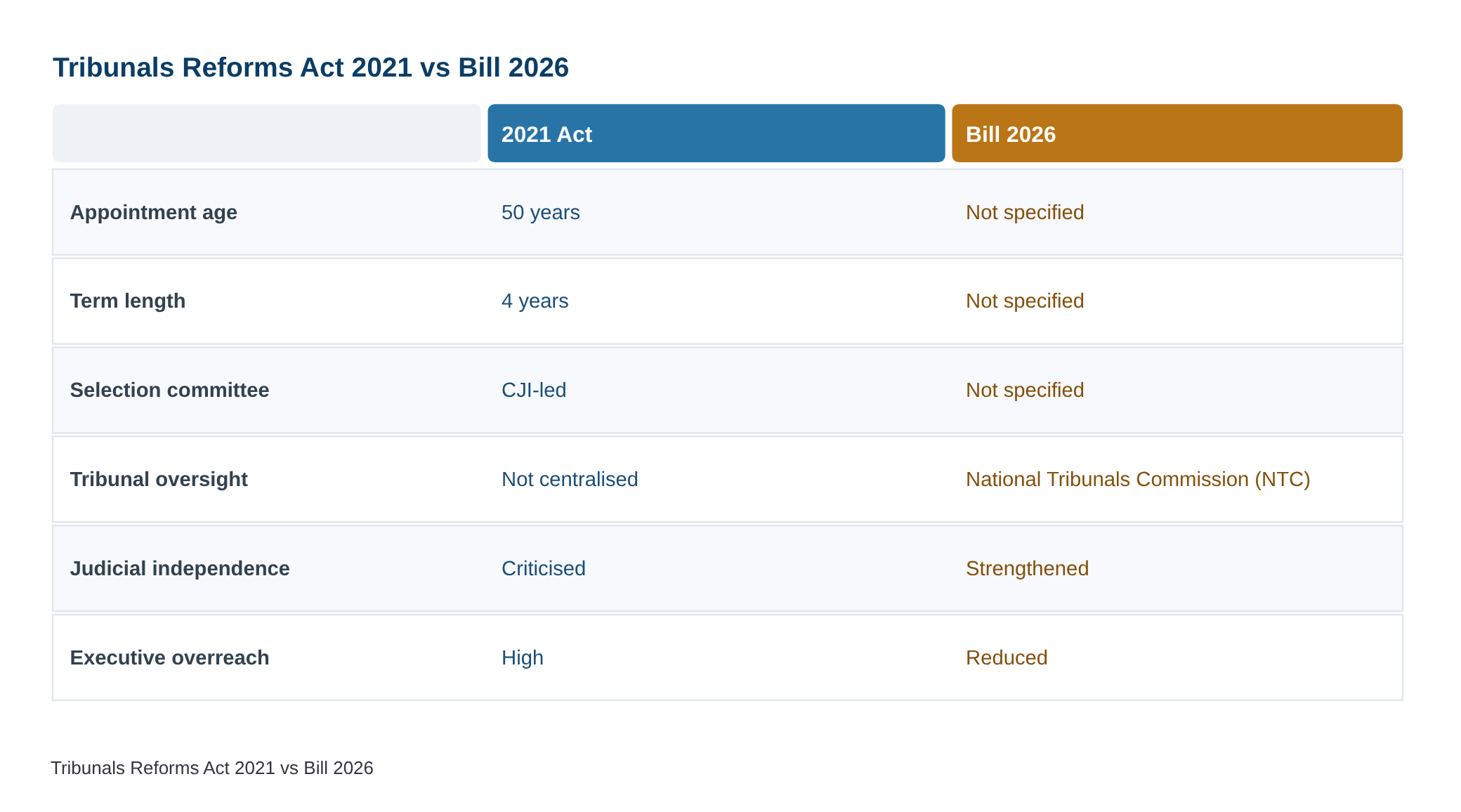
- The 2021 Act prescribed a minimum age of 50 years, a four-year term, and a selection committee headed by the Chief Justice of India (CJI) or a nominated Supreme Court judge, with recommendations for two names per vacancy.
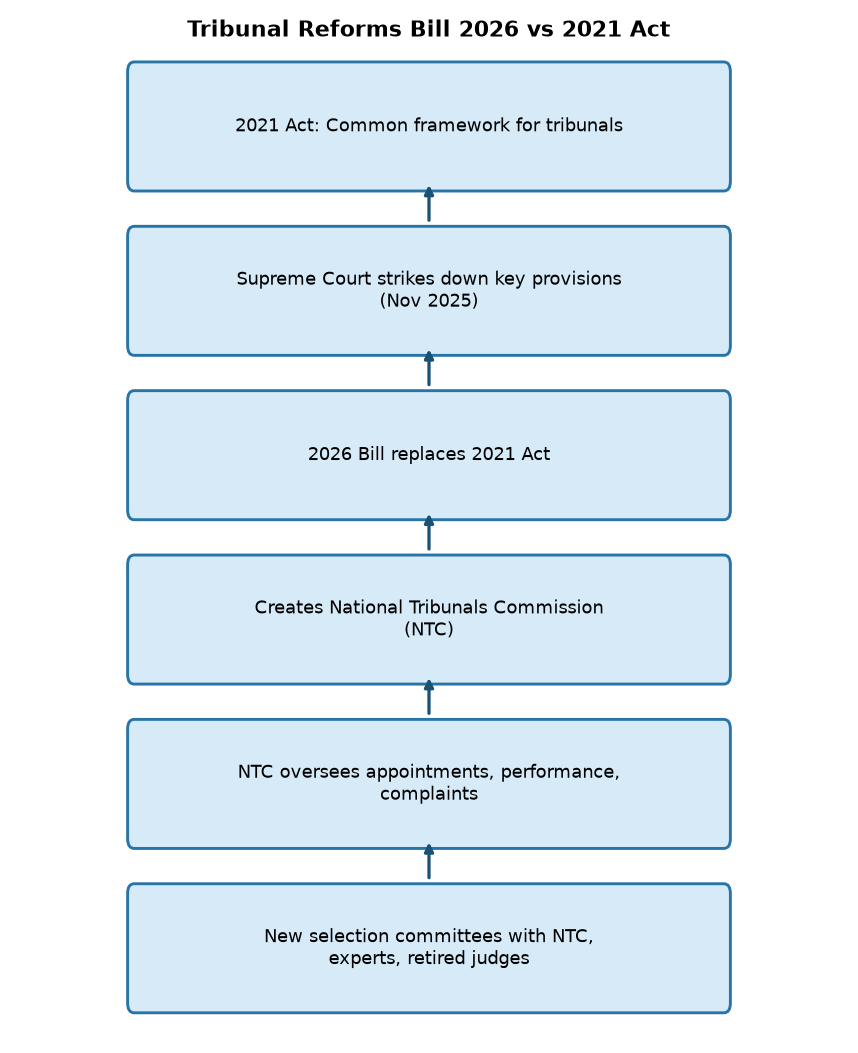
- The Supreme Court, in *Madras Bar Association vs Union of India* (2025), struck down several provisions of the 2021 Act, citing violations of judicial independence and the doctrine of separation of powers.
- The 2021 Act’s abolition of certain tribunals and its restrictive appointment criteria faced criticism for undermining the functional autonomy of tribunals.
- The new Bill, 2026, seeks to replace the 2021 framework while addressing the Supreme Court’s observations and ensuring greater accountability in tribunal administration.
- The Bill is part of broader judicial reforms aimed at improving the efficiency of India’s dispute resolution mechanisms, particularly in sectors like taxation, telecom, and environmental law.
What is the Tribunals Reforms Bill, 2026?
- The Bill introduces a National Tribunals Commission (NTC) as an apex body to oversee the selection, performance review, and accountability of tribunal Chairpersons and Members across India.
- The NTC will consist of five members: a Chairperson, two Judicial Members (to be appointed in consultation with the CJI), and two Technical Members, ensuring a balance between judicial and domain expertise.
- Appointment process: The NTC will constitute Search-cum-Selection Committees, which will include members of the NTC, retired High Court judges, a government secretary, and subject-matter experts to assess candidates.
- Recommendation mechanism: Unlike the 2021 Act, which required two names per vacancy, the 2026 Bill mandates a single suitable candidate with a secondary name on a waiting list, reducing delays in appointments.
- Appointment timeline: The government is now legally bound to make appointments within three months of receiving recommendations, replacing the 2021 Act’s non-binding ‘preferably within three months’ clause.
- Performance review and accountability: The NTC will monitor tribunal performance, handle complaints against members, and maintain a National Tribunals Data Grid for transparency and data-driven governance.
Key Features
| Feature | Significance |
|---|---|
| Establishment of National Tribunals Commission (NTC) | Centralises oversight of tribunal appointments, performance reviews, and grievance redressal, enhancing institutional coherence and reducing ad-hocism in tribunal governance. |
| Revised Selection Committee Composition | Shifts from CJI-led committees to NTC-led panels, incorporating retired High Court judges and domain experts, thereby improving judicial and technical rigour in member selection. |
| Single-Name Recommendation with Waiting List | Replaces dual-name panel system with a primary candidate and a waiting list, streamlining appointments while maintaining flexibility for replacements. |
| Extended Tenure for Members | Increases term from four to five years, providing longer continuity in tribunal functioning and reducing frequent vacancies. |
| Removal and Accountability Provisions | Expands grounds for removal and introduces stricter accountability mechanisms, ensuring higher standards of probity and efficiency among tribunal members. |
Why it Matters
Judicial-Administrative Interface
- Strengthens the interface between the judiciary and executive in tribunal governance, addressing the Supreme Court’s concerns in *Madras Bar Association vs Union of India* (2025) regarding judicial independence.
- Reduces executive overreach by embedding judicial and technical expertise in selection and oversight processes.
Efficiency in Dispute Resolution
- Enhances the operational efficiency of tribunals by centralising administrative functions under the NTC, reducing delays in appointments and performance reviews.
- Improves consistency in tribunal decisions through structured oversight and data-driven performance assessments.
Institutional Credibility
- Restores public confidence in tribunals by addressing the 2021 Act’s deficiencies, which were struck down for undermining judicial independence.
- Promotes transparency in appointments and functioning, aligning with constitutional expectations of fairness and accountability.
Challenges
1. Judicial Independence vs Executive Control
- Risk of executive dominance in the NTC’s composition and functioning, despite judicial consultation requirements, potentially diluting tribunal autonomy.
- Need to balance efficiency with safeguards against political interference in tribunal operations.
UPSC Link: GS2: Judiciary – Independence and Accountability
2. Operationalisation of NTC
- Establishing the NTC as an effective apex body requires substantial administrative and financial resources, posing logistical challenges.
- Ensuring seamless coordination between the NTC and existing tribunals to avoid transitional disruptions.
UPSC Link: GS2: Constitutional and Non-Constitutional Bodies
3. Appointment Backlogs and Vacancies
- Persistent delays in filling tribunal vacancies due to complex selection processes and stringent eligibility criteria.
- Potential exacerbation of case pendency if the new framework fails to expedite appointments.
UPSC Link: GS2: Tribunals – Appointment and Functioning
4. Accountability Mechanisms
- Defining clear metrics for performance reviews and removal of tribunal members remains a challenge, risking subjective or arbitrary decisions.
- Ensuring timely and transparent grievance redressal without compromising the independence of tribunal members.
UPSC Link: GS2: Judicial Review and Accountability
Challenges — UPSC Perspective
| Issue | Concern |
|---|---|
| Executive Dominance | Risk of the NTC becoming an extension of the executive, undermining judicial independence in tribunal governance. |
| Resource Constraints | High administrative and financial costs associated with establishing and sustaining the NTC. |
| Appointment Delays | Complex selection processes may perpetuate vacancies, delaying dispute resolution. |
| Performance Metrics | Lack of standardised criteria for evaluating tribunal performance and member accountability. |
| Transparency Concerns | Potential opacity in selection and review processes, despite the NTC’s oversight role. |
Way Forward
- Constitute the National Tribunals Commission (NTC) expeditiously with balanced representation from the judiciary, executive, and domain experts to ensure credibility.
- Develop transparent, quantifiable performance metrics for tribunals and their members to standardise accountability mechanisms.
- Streamline the selection process by setting strict timelines for appointments and reducing bureaucratic bottlenecks.
- Strengthen grievance redressal mechanisms within the NTC to address complaints against tribunal members promptly and fairly.
- Undertake capacity-building initiatives for tribunal staff to enhance operational efficiency and reduce pendency.
- Monitor the implementation of the new framework through periodic reviews by parliamentary committees or independent audits.
- Ensure judicial consultation in the appointment of NTC members, particularly the Chairperson and Judicial Members, to uphold constitutional principles.
- Promote public awareness campaigns to familiarise stakeholders with the revised tribunal governance structure and its benefits.
UPSC Value Addition
Keywords for Mains Answer-Writing
Tribunal Reforms Bill 2026 · National Tribunals Commission (NTC) · Madras Bar Association vs Union of India (2025) · Tribunals Reforms Act 2021 · appointment and service conditions of tribunal members · judicial independence and accountability · constitutional validity of tribunal reforms · tribunal tenure and age limits · executive-judicial balance in tribunal governance · selection process for tribunal chairpersons and members
Constitutional & Policy Linkages
- Article 50: Separation of Judiciary from Executive (Directive Principle)
- Article 14: Equality before Law and Equal Protection of Laws (Equality Code)
- Article 21: Right to Speedy Trial (Fundamental Right)
- Article 32: Writs for Enforcement of Fundamental Rights (Judicial Remedies)
Concept Flow
Supreme Court strikes down key provisions of the 2021 Act (2025) → Legislative response with Tribunal Reforms Bill, 2026 → 2021 Act’s deficiencies → Introduction of NTC in 2026 Bill to centralise oversight and appointments → CJI-led selection committees (2021) → NTC-led panels with judicial and technical expertise (2026) → Dual-name recommendations (2021) → Single-name with waiting list (2026) to streamline appointments → Four-year tenure (2021) → Five-year tenure (2026) to reduce vacancies and improve continuity → Executive overreach concerns → Judicial consultation in NTC appointments to balance independence and efficiency
Prelims Practice Questions
Q1. Consider the following statements regarding the Tribunals Reforms Bill, 2026:
1. It proposes the creation of a National Tribunals Commission (NTC) to oversee tribunal appointments and performance.
2. The Bill retains the four-year term for tribunal Chairpersons and Members as prescribed in the 2021 Act.
3. The selection committees under the Bill will recommend one suitable candidate along with a name for the waiting list.
4. The Bill requires the government to make appointments within three months of receiving recommendations.
How many of the above statements are correct?
- Only one
- Only two
- Only three
- All
Answer: Only three — Statements 1, 3, and 4 are correct. Statement 2 is incorrect because the Bill increases the tenure to five years, replacing the four-year term under the 2021 Act.
Q2. Assertion (A): The Tribunals Reforms Bill, 2026, introduces a National Tribunals Commission (NTC) to centralize the governance of tribunals.
Reason (R): The 2021 Act did not establish a dedicated body for overseeing tribunal appointments and performance, leading to judicial scrutiny.
Options:
A. Both A and R are true, and R is the correct explanation of A.
B. Both A and R are true, but R is not the correct explanation of A.
C. A is true, but R is false.
D. A is false, but R is true.
Answer: ? — Both the assertion (A) and reason (R) are true. The NTC is a new feature introduced in the 2026 Bill, and the 2021 Act lacked such a centralized body, which contributed to its judicial review in the Madras Bar Association case (2025).
Q3. Match the following provisions of the Tribunals Reforms Act, 2021 and the Tribunals Reforms Bill, 2026:
Column I (Provision) | Column II (Act/Bill)
———————————————–|———————–
1. Minimum age of 50 years for appointment | A. Tribunals Reforms Act, 2021
2. Five-year tenure for Chairpersons and Members| B. Tribunals Reforms Bill, 2026
3. Recommendation of two names for each vacancy | C. Both Acts
4. Creation of National Tribunals Commission | D. Neither Act
- 1-A, 2-B, 3-A, 4-B
- 1-A, 2-B, 3-C, 4-B
- 1-D, 2-A, 3-B, 4-C
- 1-C, 2-B, 3-A, 4-D
Answer: 1-A, 2-B, 3-C, 4-B — 1. Minimum age of 50 years was prescribed in the 2021 Act (A). 2. Five-year tenure is introduced in the 2026 Bill (B). 3. The 2021 Act required two names per vacancy (A), while the 2026 Bill recommends one name with a waiting list (B). 4. The National Tribunals Commission (NTC) is a new feature in the 2026 Bill (B).
Mains Practice Question
✍ The Tribunals Reforms Bill, 2026, seeks to replace the Tribunals Reforms Act, 2021, with a new framework for the appointment, tenure, and functioning of tribunals. Critically examine the constitutional and institutional implications of this reform, with particular reference to judicial independence and executive accountability. Also, analyse how the Bill addresses the concerns raised by the Supreme Court in the Madras Bar Association vs Union of India (2025) judgment. (15 Marks)
Approach: MODEL-ANSWER SKELETON:
1. **Constitutional Context and Judicial Independence**:
– Brief on the constitutional status of tribunals under Articles 323A and 323B (Constitution of India).
– Discuss the doctrine of separation of powers and the need for judicial independence in tribunals.
– Reference the Madras Bar Association vs Union of India (2025) judgment striking down key provisions of the 2021 Act for violating judicial independence.
2. **Key Features of the Tribunals Reforms Bill, 2026**:
– National Tribunals Commission (NTC): Composition (5 members: Chairperson, 2 Judicial Members, 2 Technical Members), appointment process (consultation with CJI for judicial members), and functions (appointment oversight, performance review, complaints handling, National Tribunals Data Grid).
– Selection Process: Change from 2021 Act (CJI-led committee with two names per vacancy) to NTC-led committee (one name + waiting list), inclusion of retired High Court judges and experts.
– Tenure and Age Limits: Five-year tenure replacing four years, retention of upper age limits (70 years for Chairpersons, 67 years for Members), removal of minimum age criterion.
3. **Addressing Concerns from the 2025 Judgment**:
– How the NTC centralises appointment powers, reducing executive discretion and enhancing transparency.
– Committee composition now includes judicial and technical experts, addressing the 2021 Act’s over-reliance on executive-led selection.
– Timeline for appointments (three months) ensures timely filling of vacancies, reducing delays.
4. **Executive Accountability vs. Judicial Independence**:
– Balance between executive oversight (appointment of NTC members by Central Government) and judicial safeguards (consultation with CJI).
– Potential risks: Over-centralisation under NTC, dilution of judicial primacy in appointments, and executive influence in technical member appointments.
5. **Comparative Analysis with Global Practices**:
– Reference to systems like the UK’s Tribunals Service or Australia’s Administrative Appeals Tribunal for comparative insights on tribunal governance.
6. **Conclusion**:
– Assess whether the Bill sufficiently addresses the 2025 judgment’s concerns while maintaining a balance between independence and accountability.
– Suggest further reforms, such as statutory independence for NTC or greater judicial representation in its composition.
Source: Business Standard
Generated by AanyaAi for educational purpose.

- Gurugram’s groundwater extraction exceeds limit by 212%; HC seeks ban - October 4, 2026
- स्वतंत्रता सेनानी श्यामजी कृष्ण वर्मा की जन्म जयंती पर पीएम का श्रद्धांजलि - October 4, 2026
- KWML’s Feasibility Reports for Water Metro in 18 Cities: UPSC & PCS Insights - October 3, 2026

No Comments