


10 Aug Tribunals Reforms Bill 2026: Lok Sabha Passes Key Polity Bill Amid Opposition Protests
✎ The Tribunals Reforms Bill, 2026 seeks to enhance judicial oversight in tribunal appointments and functioning, while the Bankers’ Books Evidence Bill, 2026 modernises evidence laws to align with digital banking, reflecting…
Subject Relevance — Where This Topic Fits
- GS Paper II — Parliament and State Legislatures — Structure, Functioning, Conduct of Business, Powers & Privileges and Issues Arising out of these | GS Paper III — Indian Economy and Issues Relating to Planning, Mobilisation of Resources, Growth, Development and Employment — Banking Sector Reforms, Financial Inclusion, and Digital Economy
- Prelims: Tribunals Reforms Bill 2026, Bankers’ Books Evidence Act, 1891, Finance Act 2017, Article 323B, Article 323A, Judicial Review of Tribunals, Digital Evidence in Banking, Financial Sector Legislative Reforms Commission (FSLRC)
- Essay: The Role of Parliament in Balancing Governance and Accountability: A Study of the Monsoon Session 2026, Reforms in the Judicial-Administrative Interface: Implications for Democracy and Efficiency
Quick Revision: The Tribunals Reforms Bill, 2026 seeks to enhance judicial oversight in tribunal appointments and functioning, while the Bankers’ Books Evidence Bill, 2026 modernises evidence laws to align with digital banking, reflecting India’s evolving legal and financial landscape.
Why is this in the news?
These legislative measures, aimed at streamlining tribunal functioning and modernising banking evidence procedures, have been introduced amid significant parliamentary disruption, reflecting broader debates on institutional autonomy, judicial efficiency, and the digitisation of governance. The passage of these bills assumes salience in the context of India’s evolving legal and financial architecture, particularly as the country accelerates its digital transformation agenda.
Background
- The Constitution of India, through Articles 323A and 323B, empowers Parliament and State Legislatures to establish tribunals for the adjudication of disputes relating to administrative matters and other specified fields.
- The Finance Act, 2017 introduced significant amendments to the functioning of tribunals, including the transfer of administrative and financial control from the respective ministries to the central government, a move that was challenged in the Supreme Court in the case of *Rojer Mathew v. South Indian Bank Ltd.* (2020).
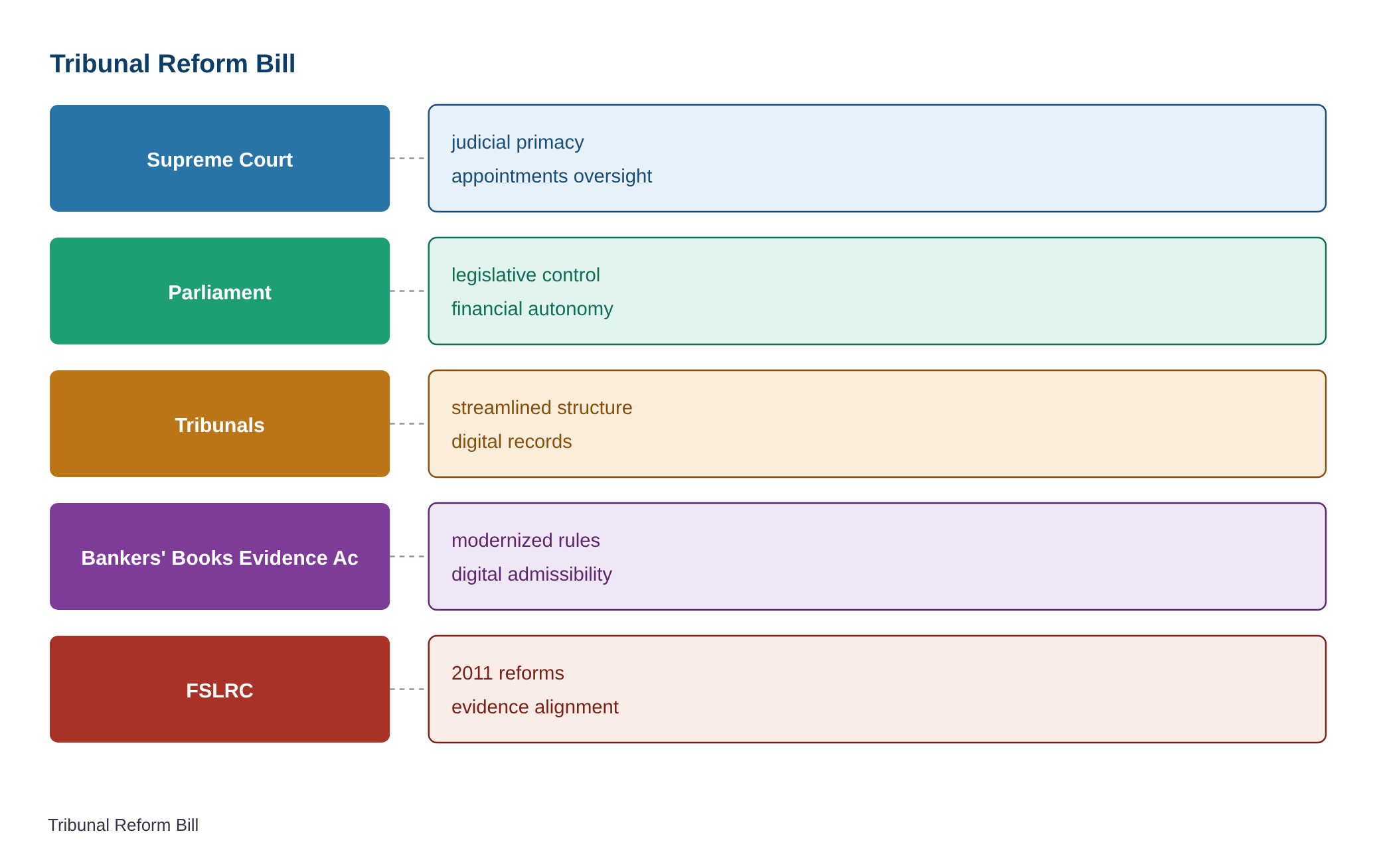
- The Supreme Court, in its judgment, struck down certain provisions of the Finance Act, 2017, and directed the government to reconsider the structure and independence of tribunals, emphasising the need for judicial primacy in tribunal appointments and functioning.
- The Bankers’ Books Evidence Act, 1891, governs the admissibility of bank records as evidence in legal proceedings, a framework that has remained largely unchanged despite the rapid digitisation of banking operations.
- The Financial Sector Legislative Reforms Commission (FSLRC), constituted in 2011, recommended comprehensive reforms in the financial sector, including modernisation of evidence laws to align with digital banking practices.
- Parliamentary disruption during the monsoon session 2026 underscores broader political tensions, with Opposition parties demanding statements on alleged police brutality against student protesters, thereby highlighting the intersection of legislative business and public order concerns.
Key Features of the Tribunals Reforms Bill, 2026 and the Bankers’ Books Evidence Bill, 2026
- **Tribunals Reforms Bill, 2026**: The bill seeks to amend the Finance Act, 2017, to address the Supreme Court’s directives in *Rojer Mathew v. South Indian Bank Ltd.* (2020). It proposes to vest the appointment of tribunal members in a high-powered committee, including the Chief Justice of India or a nominee, to ensure judicial oversight and reduce executive interference. The bill also aims to streamline the appointment process, reduce pendency, and enhance the functional independence of tribunals.
- The bill includes provisions for the merger or abolition of redundant tribunals to reduce multiplicity of forums and improve efficiency in dispute resolution, particularly in sectors like taxation, customs, and service matters.
- It introduces a sunset clause for the tenure of tribunal members, ensuring regular review and accountability, while also mandating the publication of annual reports to enhance transparency.
- The bill aligns with the broader judicial reforms agenda, including the recommendations of the Law Commission of India and the Supreme Court’s emphasis on reducing judicial workload through tribunalisation.
- Critics argue that the bill may not sufficiently insulate tribunals from executive influence, particularly in matters of funding and administrative control, which remain vested with the central government.
- The bill reflects a tension between judicial independence and executive accountability, a recurring theme in India’s institutional reforms discourse.
- **Bankers’ Books Evidence Bill, 2026**: The bill proposes to amend the Bankers’ Books Evidence Act, 1891, to recognise digital records, e-statements, and blockchain-based transactions as admissible evidence in legal proceedings.
- It introduces provisions for the authentication of digital evidence through electronic signatures and audit trails, ensuring the integrity and reliability of banking records in courts.
- The bill addresses challenges posed by the proliferation of digital banking, fintech, and cryptocurrency transactions, which were not envisaged in the original 1891 Act.
- It empowers banking regulators, such as the Reserve Bank of India (RBI), to issue guidelines for the preservation and retrieval of digital records, aligning with global standards like the EU’s eIDAS Regulation and the UNCITRAL Model Law on Electronic Commerce.
- The bill also includes safeguards against misuse, such as penalties for unauthorised access to banking records and mechanisms for redressal of grievances related to digital evidence.
- Critics highlight concerns over data privacy and cybersecurity, particularly in the context of India’s Personal Data Protection Bill, 2023, which is yet to be enacted.
- The bill is seen as a critical enabler for the formalisation of India’s digital economy, particularly in the context of the *Digital India* and *Make in India* initiatives.
Key Features
| Feature | Significance |
|---|---|
| Tribunals Reforms Bill, 2026 | Seeks to rationalise the functioning of tribunals by merging redundant ones, reducing multiplicity of forums, and enhancing efficiency in dispute resolution within the judicial system. |
| Bankers’ Books Evidence Bill | Modernises the legal framework for admissibility of bank records as evidence, aligning with digital banking and ensuring faster resolution of financial disputes while maintaining probity. |
| Opposition walkout in Rajya Sabha | Reflects procedural dissent over legislative priorities, highlighting the challenges of consensus-building in a multi-party parliamentary system. |
| Union Home Minister’s statement on student protests | Addresses allegations of police brutality, underscoring the executive’s accountability in maintaining law and order while balancing democratic rights. |
| Digitisation of banking and economy | Facilitates seamless financial transactions, reduces fraud risks, and enhances transparency, aligning with the government’s broader digital governance agenda. |
Why it Matters
Legislative and Procedural
- The passage of the Tribunals Reforms Bill marks a step toward judicial efficiency by reducing the burden on higher courts and streamlining tribunal structures.
- The Bankers’ Books Evidence Bill modernises evidence laws, ensuring that digital banking records are admissible without undue delay, which is critical for financial sector stability.
- The Opposition’s walkout underscores the importance of parliamentary decorum and the need for constructive debate, even amid political disagreements.
- The adjournment of both Houses reflects procedural disruptions, which may impact the legislative agenda and delay pending bills.
Economic
- Digitisation of banking and financial records reduces transaction costs and improves access to credit, particularly for MSMEs and rural populations.
- Efficient tribunals and dispute resolution mechanisms lower the cost of doing business, attracting investment and fostering economic growth.
- Modernising evidence laws in banking enhances trust in financial institutions, which is vital for capital market stability and investor confidence.
Governance and Accountability
- The Home Minister’s statement on student protests highlights the executive’s responsibility to address allegations of state excesses, reinforcing democratic accountability.
- Parliament’s role in debating such issues ensures public scrutiny and transparency in governance, even amid political polarisation.
- The government’s willingness to discuss contentious issues in Parliament demonstrates a commitment to democratic norms, despite procedural challenges.
Judicial and Administrative Reforms
- Rationalising tribunals reduces judicial redundancy, ensuring faster disposal of cases and reducing pendency in the judicial system.
- The Bankers’ Books Evidence Bill aligns with global best practices in financial evidence laws, ensuring compliance with international standards.
- Streamlining dispute resolution mechanisms through tribunals can alleviate the burden on civil courts, improving access to justice.
Challenges
1. Parliamentary Disruptions and Legislative Delays
- Frequent adjournments due to Opposition walkouts disrupt the legislative process, delaying critical bills and reforms.
- Political polarisation may hinder consensus-building, affecting the passage of key legislations in a timely manner.
- Procedural disruptions can erode public trust in parliamentary institutions, necessitating reforms in legislative conduct.
UPSC Link: Parliament and State Legislatures – Role and Functions
2. Judicial Pendency and Tribunal Rationalisation
- Excessive multiplicity of tribunals leads to overlapping jurisdictions, causing delays and inefficiencies in dispute resolution.
- Lack of standardised procedures across tribunals hampers predictability and consistency in judicial outcomes.
- Inadequate infrastructure and staffing in tribunals exacerbate pendency, undermining the goal of judicial efficiency.
UPSC Link: Judiciary – Structure, Organisation and Functioning
3. Digital Divide and Financial Inclusion
- Uneven access to digital banking infrastructure in rural and remote areas may limit the benefits of digitisation for marginalised communities.
- Cybersecurity risks in digital banking require robust regulatory frameworks to prevent fraud and data breaches.
- Low digital literacy among certain demographics may hinder the adoption of digital financial services, necessitating targeted awareness campaigns.
UPSC Link: Digital Economy – Opportunities and Challenges
4. Accountability in Law Enforcement
- Allegations of police brutality during protests raise concerns about the use of force by law enforcement agencies.
- Ensuring accountability in law enforcement requires transparent investigations, independent oversight, and adherence to human rights standards.
- Balancing law and order with democratic rights remains a persistent challenge for governments, particularly during periods of civil unrest.
UPSC Link: Role of Civil Services in a Democracy
5. Consensus-Building in Multi-Party Systems
- Deep political divisions may impede the passage of critical reforms, even when they are economically or administratively necessary.
- The Opposition’s walkout strategy, while a form of protest, can undermine the legislative process and delay governance outcomes.
- Building cross-party consensus requires sustained dialogue, compromise, and a shared vision for national development.
UPSC Link: Parliamentary Democracy – Challenges and Reforms
Challenges — UPSC Perspective
| Issue | Concern |
|---|---|
| Multiplicity of tribunals | Overlapping jurisdictions leading to inefficiency and delays in dispute resolution. |
| Digital banking adoption | Uneven access to digital infrastructure may exclude marginalised communities from financial services. |
| Parliamentary disruptions | Frequent adjournments and walkouts hinder legislative progress and public trust. |
| Police accountability | Allegations of excessive force during protests necessitate transparent investigations and reforms. |
| Political polarisation | Deep divisions may obstruct consensus-building on critical reforms and governance issues. |
| Judicial pendency | Excessive backlog in tribunals and courts delays justice delivery and erodes public confidence. |
Way Forward
- Institutionalise mechanisms for pre-legislative consultations to reduce procedural disruptions and enhance consensus-building.
- Strengthen the infrastructure and human resources in tribunals to expedite dispute resolution and reduce pendency.
- Accelerate digital inclusion initiatives to ensure equitable access to banking and financial services across all demographics.
- Establish independent oversight bodies to investigate allegations of police excesses and ensure accountability in law enforcement.
- Promote inter-party dialogue to bridge political divides and foster a collaborative legislative environment.
- Enhance transparency in parliamentary proceedings to rebuild public trust in democratic institutions.
- Develop standardised procedures for tribunals to ensure consistency and predictability in judicial outcomes.
- Invest in cybersecurity frameworks to safeguard digital banking systems and protect consumer interests.
UPSC Value Addition
Keywords for Mains Answer-Writing
Tribunals Reforms Bill 2026 · Constitutional validity of tribunals · Article 323A and 323B · Administrative adjudication · Judicial independence · Separation of powers · Lok Sabha and Rajya Sabha proceedings · Parliamentary democracy · Judicial review · Executive-legislative-judicial relations · Bankers’ Books Evidence Bill 2026 · Digital evidence in banking · Digitisation of economy · Financial sector reforms · Parliamentary adjournments · Opposition walkout · Home Minister’s statement on student protests · Police brutality allegations
Concept Flow
Parliamentary disruption due to Opposition walkout → Adjournment of both Houses → Delay in legislative agenda → Impact on economic reforms and governance. → Allegations of police brutality during student protests → Home Minister’s statement in Parliament → Demand for accountability → Executive’s response and public scrutiny. → Digitisation of banking and economy → Passage of Bankers’ Books Evidence Bill → Modernisation of evidence laws → Enhanced financial sector stability. → Multiplicity of tribunals → Passage of Tribunals Reforms Bill → Rationalisation of tribunal structures → Reduction in judicial pendency. → Political polarisation → Opposition’s protest strategies → Challenges in consensus-building → Impact on legislative efficiency and governance outcomes.
Prelims Practice Questions
Q1. Consider the following statements regarding the Tribunals Reforms Bill, 2026:
1. The Bill seeks to merge existing tribunals with existing High Courts.
2. The Bill proposes to reduce the number of tribunals from 26 to 12.
3. The Bill aims to address the issue of pendency of cases in tribunals.
4. The Bill empowers the Central Government to notify the qualifications, terms, and conditions of service of tribunal members.
How many of the above statements are correct?
- Only one
- Only two
- Only three
- All four
Answer: All four — Statements 1, 3, and 4 are correct. Statement 2 is incorrect as the Bill does not explicitly propose reducing the number of tribunals to 12; it focuses on reforms and rationalisation rather than a fixed numerical reduction.
Q2. Assertion (A): The Bankers’ Books Evidence Bill, 2026, seeks to modernise the legal framework governing the admissibility of digital evidence in banking disputes.
Reason (R): The Bill aims to align banking laws with the rapid digitisation of financial transactions and reduce litigation delays.
Options:
A. Both A and R are true, and R is the correct explanation of A.
B. Both A and R are true, but R is not the correct explanation of A.
C. A is true, but R is false.
D. A is false, but R is true.
Answer: ? — Both the Assertion (A) and Reason (R) are true, and R correctly explains A. The Bill is designed to update the legal framework for digital evidence in banking, addressing the challenges posed by digitisation.
Q3. Match the following bills with their respective objectives:
Column I (Bill) Column II (Objective)
1. Tribunals Reforms Bill, 2026 A. Modernise the legal framework for digital evidence in banking
2. Bankers’ Books Evidence Bill, 2026 B. Rationalise and reform the functioning of tribunals
3. Mines and Minerals (Development and Regulation) Amendment Bill, 2026 C. Streamline the auction process for mineral resources
4. Foreign Contribution (Regulation) Amendment Bill, 2026 D. Regulate the receipt and utilisation of foreign contributions
Options:
1-B, 2-A, 3-C, 4-D
1-A, 2-B, 3-C, 4-D
1-C, 2-A, 3-B, 4-D
1-D, 2-C, 3-A, 4-B
Answer: ? — The correct matches are: 1-B (Tribunals Reforms Bill aims to rationalise tribunals), 2-A (Bankers’ Books Evidence Bill modernises digital evidence framework), 3-C (Mines and Minerals Bill streamlines mineral auctions), and 4-D (FCRA Amendment Bill regulates foreign contributions).
Mains Practice Question
✍ Critically examine the constitutional and institutional implications of the Tribunals Reforms Bill, 2026, in the context of the separation of powers and judicial independence. Also, analyse how the Bill addresses the issue of pendency of cases in tribunals. (15 Marks)
Approach: MODEL-ANSWER SKELETON:
1. **Constitutional Framework**:
– Reference to Articles 323A and 323B, which empower Parliament and State Legislatures to establish administrative tribunals.
– Discuss the constitutional validity of tribunals as a mechanism for administrative adjudication, citing the 1976 Swaran Singh case and the 2010 R.K. Jain case.
2. **Separation of Powers and Judicial Independence**:
– Examine the potential conflict between the executive and judiciary, particularly if tribunals are merged with High Courts or if their functioning is controlled by the executive.
– Discuss the principle of judicial independence as enshrined in the Constitution and the potential risks posed by executive control over tribunal appointments and functioning.
3. **Pendency of Cases**:
– Highlight the issue of pendency in tribunals (e.g., data on pending cases in the Income Tax Appellate Tribunal or the Customs, Excise and Service Tax Appellate Tribunal).
– Analyse how the Bill proposes to address pendency, such as through rationalisation, merger of tribunals, or streamlining of procedures.
4. **Critique and Balanced View**:
– Present arguments for the Bill: reducing pendency, improving efficiency, and aligning with digitisation.
– Present counterarguments: potential dilution of judicial independence, lack of transparency in tribunal functioning, and the risk of executive overreach.
5. **Conclusion**:
– Offer a reasoned position on whether the Bill strikes a balance between efficiency and constitutional principles, and suggest safeguards to protect judicial independence.
Source: Hindustan Times
Generated by AanyaAi for educational purpose.


No Comments