


13 Nov Trump’s Iran Endgame: Regime Change as a Measure of Victory
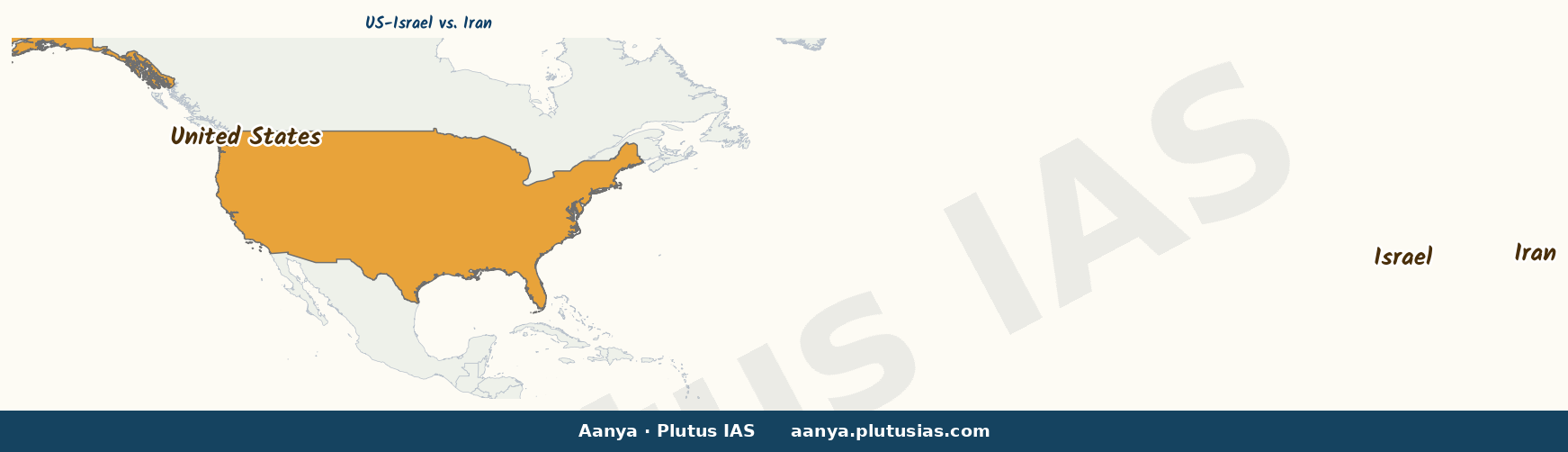
✎ The stated objective of regime change in a sovereign nation by external powers raises significant questions regarding international law, state sovereignty, and regional stability.
Subject Relevance — Where This Topic Fits
- GS Paper II — International Relations: India and its neighborhood- relations; Bilateral, regional and global groupings and agreements involving India and/or affecting India’s interests; Effect of policies and politics of developed and developing countries on India’s interests, Indian diaspora; Important International institutions, agencies and fora – their structure, mandate. | GS Paper III — Security: Linkages between development and spread of extremism; Role of external state and non-state actors in creating challenges to internal security; Challenges to internal security through communication networks, role of media and social networking sites in internal security challenges, basics of cyber security; money-laundering and its prevention.
- Prelims: Iran Nuclear Deal (JCPOA), International Atomic Energy Agency (IAEA), United Nations Security Council (UNSC), Non-Proliferation Treaty (NPT), Middle East Geopolitics, US Foreign Policy, Israel-Iran Relations, Regime Change Policy
- Essay: The evolving landscape of international relations: Challenges to sovereignty and non-interference., Nuclear proliferation and global security: A persistent threat in a multipolar world.
Quick Revision: The stated objective of regime change in a sovereign nation by external powers raises significant questions regarding international law, state sovereignty, and regional stability.
Why is this in the news?
The United States President has articulated a clear objective regarding Iran, stating that the survival of the current Iranian regime beyond his presidency would constitute a ‘defeat’. This declaration, made amidst ongoing military confrontation involving the US and Israel against Iran, signifies a shift in stated policy beyond concerns solely about Iran’s nuclear and missile capabilities, explicitly centering on regime change. This stance has drawn sharp criticism from Tehran, which views it as an encouragement of political destabilisation and interference in its internal affairs.
Background
- Historically, the relationship between the United States and Iran has been fraught with tension, particularly following the 1979 Iranian Revolution, which led to the establishment of the Islamic Republic.
- Concerns regarding Iran’s nuclear programme have been a central point of international dispute, culminating in the Joint Comprehensive Plan of Action (JCPOA) in 2015, an agreement aimed at limiting Iran’s nuclear activities in exchange for sanctions relief.
- The United States withdrew from the JCPOA in 2018 under the first Trump administration, reimposing sanctions and escalating pressure on Iran.
- Israel has consistently viewed Iran as an existential threat, citing its nuclear ambitions, support for regional armed groups, and ideological opposition to Israel’s existence.
- The current geopolitical landscape in the Middle East is characterised by complex alliances and rivalries, with various state and non-state actors contributing to regional instability.
- The principle of non-interference in the internal affairs of sovereign states is a cornerstone of international law, enshrined in the United Nations Charter, though often challenged in practice by geopolitical considerations.
The Principle of Non-Interference in International Relations
- The principle of non-interference dictates that no state has the right to intervene directly or indirectly in the internal or external affairs of another state.
- This principle is a fundamental tenet of international law, enshrined in Article 2(7) of the United Nations Charter, which prohibits the UN from intervening in matters essentially within the domestic jurisdiction of any state.
- It is designed to protect the sovereignty, territorial integrity, and political independence of states, fostering peaceful coexistence and stability in the international system.
- Exceptions to this principle are generally limited to situations sanctioned by the UN Security Council under Chapter VII of the UN Charter, which deals with threats to peace, breaches of peace, and acts of aggression.
- Unilateral interventions, particularly those aimed at regime change, are often viewed as violations of international law and can lead to severe geopolitical repercussions and humanitarian crises.
- The Responsibility to Protect (R2P) doctrine, adopted by the UN in 2005, outlines a state’s responsibility to protect its own population from mass atrocities, and the international community’s responsibility to intervene if a state fails to do so, but this is distinct from unilateral regime change objectives.
- The debate surrounding non-interference often involves balancing state sovereignty with human rights concerns and the prevention of atrocities, creating complex ethical and legal dilemmas for the international community.
Key Features
| Feature | Significance |
|---|---|
| Regime Change Objective | The explicit articulation by the US President of the removal of Iran’s ruling establishment as a measure of success in the ongoing confrontation, moving beyond previous focus solely on nuclear and missile capabilities. |
| US-Israel Joint Military Campaign | The coordinated military operations by the United States and Israel against Iran, indicating a unified strategic approach to addressing perceived threats from the Islamic Republic. |
| Support for Iranian Protests | Public encouragement by the US President for anti-government demonstrators in Iran, urging them to continue their movement and take control of government institutions, signifying external support for internal dissent. |
| Israel’s Existential Threat Perception | Prime Minister Netanyahu’s long-standing view of Iran as an existential threat, encompassing its nuclear programme, regional network of armed groups, and ideological commitment to Israel’s destruction. |
| Cancellation of Diplomatic Engagements | The US President’s decision to cancel meetings with Iranian officials until alleged killings of protesters ceased, indicating a linkage between diplomatic engagement and human rights concerns. |
Why it Matters
Geopolitical Significance
- The explicit pursuit of regime change by major global powers can lead to prolonged regional instability, potentially escalating conflicts and drawing in other state and non-state actors.
- Such policies often result in a realignment of alliances and counter-alliances, impacting the balance of power in critical regions like the Middle East.
- The stated objective of regime change can complicate international diplomatic efforts, making negotiations on other critical issues, such as nuclear non-proliferation, more challenging.
International Law and Sovereignty
- Interventionist rhetoric and actions aimed at regime change raise fundamental questions regarding state sovereignty and the principle of non-interference in internal affairs, as enshrined in international law.
- The encouragement of internal protests by external powers can be perceived as a violation of the UN Charter’s provisions on the territorial integrity and political independence of states.
- Such approaches can set precedents for future interventions, potentially undermining the global order based on sovereign equality.
Humanitarian and Security Implications
- Military campaigns and efforts to destabilize governments can lead to significant humanitarian crises, including displacement, loss of life, and disruption of essential services.
- The escalation of conflict can empower extremist groups and non-state actors, further complicating security dynamics and potentially leading to a rise in terrorism.
- Long-term instability resulting from regime change efforts can impede economic development and social progress, affecting the well-being of civilian populations.
Challenges
1. Violation of International Law
- The principle of non-interference in the internal affairs of sovereign states is a cornerstone of international law and the UN Charter.
- Directly advocating for regime change can be interpreted as a breach of these foundational principles, potentially leading to international condemnation and legal challenges.
UPSC Link: International Relations; International Institutions
2. Regional Destabilisation
- Attempts at regime change often result in prolonged conflict, civil unrest, and the proliferation of armed groups, leading to widespread regional instability.
- This instability can spill over into neighbouring countries, exacerbating existing tensions and creating new security challenges.
UPSC Link: Security Challenges; Geopolitics
3. Humanitarian Crisis
- Military interventions and internal conflicts triggered by regime change efforts frequently lead to severe humanitarian crises, including mass displacement, refugee flows, and civilian casualties.
- Disruption of essential services and infrastructure further compounds the suffering of affected populations.
UPSC Link: Humanitarian Issues; Disaster Management
4. Unintended Consequences
- Efforts to remove existing regimes can lead to unforeseen outcomes, such as the rise of hostile or even more repressive governments, or the emergence of power vacuums exploited by extremist groups.
- The long-term political and social consequences are often difficult to predict and manage, frequently resulting in protracted reconstruction and stabilisation challenges.
UPSC Link: Foreign Policy Analysis; Post-Conflict Reconstruction
5. Erosion of Diplomatic Channels
- An explicit policy of regime change can severely limit diplomatic engagement and negotiation opportunities, as the targeted state may perceive any interaction as a precursor to intervention.
- This can hinder efforts to address other critical issues, such as nuclear proliferation, regional security, and economic cooperation.
UPSC Link: Diplomacy; International Relations
Challenges — UPSC Perspective
| Issue | Concern |
|---|---|
| Iran’s Nuclear Programme | Perceived as an existential threat by Israel and a proliferation risk by the US, despite Iran’s assertions of peaceful intent. |
| Iran’s Missile Capabilities | Development and deployment of ballistic missiles by Iran, viewed as a destabilising factor in the region by the US and Israel. |
| Regional Network of Armed Groups | Iran’s alleged support for various non-state actors and proxy groups across the Middle East, which is seen as undermining regional security and stability. |
| Ideological Commitment to Israel’s Destruction | Israel’s concern regarding Iran’s stated ideological opposition to its existence, which fuels the perception of an existential threat. |
| Internal Political Destabilisation | External encouragement of anti-government protests and calls for regime change, which Tehran views as interference in its sovereign affairs. |
Way Forward
- Prioritise diplomatic engagement and multilateral negotiations to address concerns regarding Iran’s nuclear programme and regional activities, adhering to international frameworks.
- Promote de-escalation of military rhetoric and actions, fostering an environment conducive to dialogue and conflict resolution.
- Support international efforts to uphold the principle of non-interference in the internal affairs of sovereign states, as enshrined in the UN Charter.
- Encourage regional security dialogues and confidence-building measures among Middle Eastern states to address shared security concerns collaboratively.
- Focus on humanitarian aid and support for civilian populations affected by conflict, ensuring access to essential services and protection of human rights.
- Explore avenues for economic cooperation and development in the region to foster stability and reduce incentives for conflict.
- Strengthen international non-proliferation regimes and verification mechanisms to ensure compliance with nuclear commitments by all states.
UPSC Value Addition
Keywords for Mains Answer-Writing
International Relations · Foreign Policy Objectives · National Security · Sovereignty · Non-interference Principle · Nuclear Proliferation · Geopolitical Dynamics · UN Charter · Diplomacy · Sanctions
Concept Flow
US President articulates regime change as a war objective. → Israel shares similar objective, citing existential threat. → US and Israel launch joint military campaign against Iran. → US President publicly encourages Iranian anti-government protests. → Iran accuses US of interference and destabilisation. → International law principles of sovereignty and non-interference are challenged. → Regional geopolitical stability is significantly impacted.
Prelims Practice Questions
Q1. Consider the following statements regarding the principle of non-interference in the internal affairs of states:
1. It is a fundamental principle of international law, enshrined in the United Nations Charter.
2. It prohibits states from intervening in matters falling within the domestic jurisdiction of any other state.
3. The Responsibility to Protect (R2P) doctrine is considered an exception to this principle under specific circumstances.
How many of the above statements are correct?
- Only one
- Only two
- All three
- None
Answer: All three — Statement 1 is correct: The principle of non-interference is a cornerstone of international law, explicitly stated in Article 2(7) of the UN Charter. Statement 2 is correct: It prevents states from dictating or influencing the internal political, economic, or social choices of another sovereign state. Statement 3 is correct: R2P, adopted by the UN in 2005, allows for international intervention in cases of genocide, war crimes, ethnic cleansing, and crimes against humanity, representing a conditional departure from strict non-interference.
Q2. Which of the following international agreements or bodies primarily addresses the issue of nuclear non-proliferation?
- The Kyoto Protocol
- The Treaty on the Non-Proliferation of Nuclear Weapons (NPT)
- The Paris Agreement
- The International Criminal Court (ICC)
Answer: The Treaty on the Non-Proliferation of Nuclear Weapons (NPT) — The Treaty on the Non-Proliferation of Nuclear Weapons (NPT) is a landmark international treaty whose objective is to prevent the spread of nuclear weapons and weapons technology, to foster cooperation in the peaceful uses of nuclear energy, and to further the goal of achieving nuclear disarmament. The other options relate to climate change and international justice.
Mains Practice Question
✍ Examine the principle of non-interference in the internal affairs of sovereign states as a cornerstone of international law. Discuss the implications of external calls for ‘regime change’ on this principle and the stability of the international order. (15 Marks)
Approach: INTRODUCTION: Define the principle of non-interference, citing its basis in the UN Charter (Article 2(7)) and its importance for state sovereignty and international peace.
BODY 1: Elucidate the core tenets of the non-interference principle, including respect for territorial integrity, political independence, and the prohibition of intervention in domestic matters. Discuss its historical evolution and significance in post-colonial international relations.
BODY 2: Analyse the concept of ‘regime change’ as an objective of foreign policy. Discuss how such calls or actions directly contravene the principle of non-interference. Provide examples of historical instances or contemporary debates where this tension is evident.
BODY 3: Discuss the broader implications of external calls for ‘regime change’ on the international order. This should include:
a. Erosion of state sovereignty and international law.
b. Potential for increased regional instability and conflict.
c. Humanitarian consequences and refugee crises.
d. Challenges to multilateralism and the authority of international institutions.
e. The debate around exceptions like the Responsibility to Protect (R2P) and its careful application.
CONCLUSION: Summarise the critical importance of upholding the non-interference principle for a stable, rules-based international order, while acknowledging the complexities and debates surrounding its application in specific contexts.
Source: Times of India
Generated by AanyaAi for educational purpose.
Related guides on our sites
- Best PSIR optional coaching for upsc
- Best PSIR optional teacher for upsc
- Best teacher of PSIR optional for upsc
- Best PSIR optional coaching in delhi for UPSC

- Trump’s Iran Endgame: Regime Change as a Measure of Victory - November 13, 2026
- केरल की ‘जीव-सुयात्रा’ मिशन: सड़क दुर्घटनाओं में कमी लाने का लक्ष्य - November 13, 2026
- Silent Valley Butterfly Survey: Biodiversity & Conservation - November 13, 2026

No Comments