


11 Aug UK Halts Chevening Fellowships 2027-28: Budget Cuts Impact Indian Scholars
✎ Chevening Fellowships are time-bound, mid-career leadership programmes administered by the UK’s FCDO, distinct from degree-based Chevening Scholarships, and are currently undergoing a strategic review that has led to a temporary…
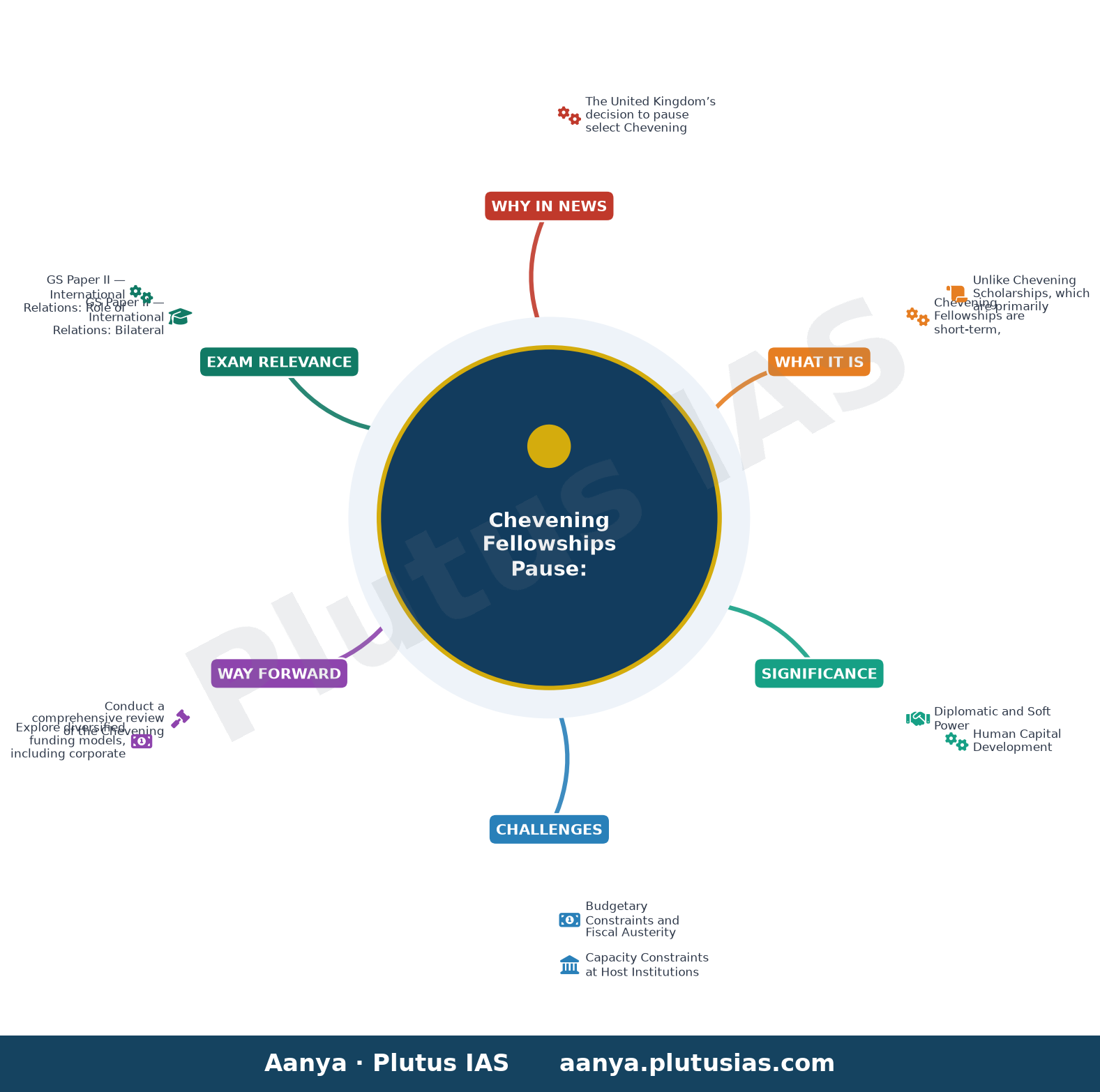
Subject Relevance — Where This Topic Fits
- GS Paper II — International Relations: Bilateral and Multilateral Agreements, Cultural and Educational Exchanges | GS Paper II — International Relations: Role of External State and Non-State Actors in Promoting Education and Skill Development
- Prelims: Chevening Scholarships, Foreign, Commonwealth and Development Office (FCDO), CRISP Fellowship, Chevening Cyber Security Fellowship, Chevening South Asia Journalism Programme (SAJP), University of Oxford, Cranfield University, University of Westminster, Gurukul Fellowship, Mid-career professional fellowships
- Essay: The role of international fellowships in fostering global intellectual capital and diplomatic soft power, Balancing fiscal prudence with strategic investments in human capital development
Quick Revision: Chevening Fellowships are time-bound, mid-career leadership programmes administered by the UK’s FCDO, distinct from degree-based Chevening Scholarships, and are currently undergoing a strategic review that has led to a temporary pause of select programmes for 2027-28.
Why is this in the news?
The United Kingdom’s decision to pause select Chevening Fellowships for the year 2027-28 underscores the intersection of fiscal policy and international educational diplomacy. This development is significant for Indian aspirants and professionals reliant on such fellowships for mid-career advancement, while also reflecting broader trends in public funding for international exchange initiatives.
Background
- The Chevening programme, administered by the UK’s Foreign, Commonwealth and Development Office (FCDO), is a flagship global scholarship and fellowship initiative aimed at nurturing mid-career professionals from over 160 countries, including India.
- In the financial year 2025-26, the FCDO allocated £59.4 million to Chevening, though a public breakdown of funding between scholarships and fellowships remains unavailable.
- Chevening Fellowships are distinct from Chevening Scholarships, which remain open and are not affected by the current pause; fellowships target mid-career professionals for short-term, high-impact programmes.
- The CRISP Fellowship, hosted at the University of Oxford, focuses on science, research, and innovation leadership, particularly for professionals from India and Sri Lanka.
- The Chevening Cyber Security Fellowship, delivered at Cranfield University, addresses critical skills gaps in cybersecurity, with participation open to Indians and citizens of the Western Balkans.
- The South Asia Journalism Programme (SAJP), hosted by the University of Westminster, fosters regional journalistic collaboration among professionals from India, Pakistan, Sri Lanka, Bangladesh, Afghanistan, and the Maldives.
What are Chevening Fellowships?
- Chevening Fellowships are short-term, high-impact leadership development programmes designed for mid-career professionals, administered by the UK’s FCDO under the Chevening brand.
- Unlike Chevening Scholarships, which are primarily degree-based, fellowships are non-degree programmes focused on skill enhancement, policy exposure, and professional networking.
- The fellowships are hosted at prestigious UK institutions such as the University of Oxford, Cranfield University, and the University of Westminster, ensuring academic rigour and industry relevance.
- Programmes like CRISP (Chevening Research, Science and Innovation Leadership Fellowship) target professionals in science, research, and innovation sectors, fostering cross-border collaboration and knowledge exchange.
- The Cyber Security Fellowship addresses critical gaps in cybersecurity expertise, aligning with global and regional security priorities, particularly in light of rising cyber threats and digital transformation.
- The South Asia Journalism Programme (SAJP) promotes regional media collaboration, fostering dialogue and understanding among journalists from South Asian countries, including conflict-affected regions.
- The Gurukul Fellowship, another flagship programme, targets mid-career professionals across sectors such as government, media, and civil society, hosted at the University of Oxford.
- Chevening Fellowships are designed to align with the UK’s broader diplomatic and developmental objectives, including soft power projection, capacity building, and fostering long-term professional networks.
Key Features
| Feature | Significance |
|---|---|
| Chevening CRISP Fellowship | A 12-week programme hosted by the University of Oxford, targeting mid-career scientists, researchers, and entrepreneurs from India and Sri Lanka to foster innovation and leadership in science and technology. |
| Chevening Cyber Security Fellowship | A 10-week programme delivered at Cranfield University (part of the U.K. Defence Academy), aimed at professionals from India and Western Balkans to enhance cybersecurity capabilities. |
| Chevening South Asia Journalism Programme (SAJP) | An eight-week programme hosted by the University of Westminster, bringing together mid-career journalists from South Asian nations (India, Pakistan, Sri Lanka, Bangladesh, Afghanistan, Maldives) to promote regional media collaboration. |
| Chevening Gurukul Fellowship | A 12-week programme at the University of Oxford for mid-career Indian professionals across government, media, and civil society, focusing on leadership and sectoral expertise. |
| Funding Allocation (FY 2025-26) | The U.K.’s Foreign, Commonwealth and Development Office (FCDO) allocated £59.4 million to the Chevening programme, though the public breakdown between scholarships and fellowships remains undisclosed. |
Why it Matters
Diplomatic and Soft Power
- The Chevening programme serves as a key instrument of the U.K.’s soft power diplomacy, fostering long-term professional networks and cultural exchanges between the U.K. and partner nations, including India.
- Pausing fellowships may temporarily reduce the U.K.’s influence in scientific, cybersecurity, and journalistic domains across South Asia, particularly in India, where the programme has significant participation from tier-2 and tier-3 cities.
- The programme’s focus on mid-career professionals ensures sustained engagement with emerging leaders, reinforcing bilateral and regional collaborations.
Human Capital Development
- The fellowships contribute to human capital development by providing targeted training in high-demand sectors such as cybersecurity, scientific innovation, and journalism, aligning with global skill requirements.
- The CRISP and Cyber Security Fellowships address critical gaps in research, entrepreneurship, and cybersecurity expertise, particularly in India, where digital transformation and technological innovation are priorities.
- The SAJP strengthens regional media ecosystems by fostering cross-border journalistic collaboration, which is vital for addressing shared challenges such as misinformation and regional stability.
Institutional Partnerships
- The programme leverages partnerships with prestigious U.K. institutions (University of Oxford, Cranfield University, University of Westminster) to deliver high-quality, specialised training, enhancing the credibility of the fellowships.
- Host universities benefit from international exposure, research collaborations, and access to a global talent pool, reinforcing the U.K.’s position as a hub for higher education and professional development.
- The exploration of industry sponsorship for fellowships (e.g., CRISP, Cyber Security) indicates a shift toward diversifying funding sources, reducing reliance on public budgets.
Geopolitical and Regional Dynamics
- The SAJP’s focus on South Asia aligns with the U.K.’s strategic interest in maintaining influence in the region amid geopolitical shifts, including the rise of China and evolving U.S.-U.K. relations.
- The programme’s inclusion of Afghanistan and Pakistan, despite regional tensions, underscores its role in fostering dialogue and professional networks across conflict lines.
- The pause in fellowships may create temporary gaps in regional cooperation, particularly in journalism and cybersecurity, where cross-border collaboration is essential.
Challenges
1. Budgetary Constraints and Fiscal Austerity
- The U.K. government’s decision to pause fellowships is driven by likely budget cuts, reflecting broader fiscal austerity measures and prioritisation of core diplomatic and development objectives.
- The allocation of £59.4 million to Chevening in FY 2025-26, while substantial, may not be sufficient to sustain all programmes without reallocation or additional funding streams.
- The lack of public transparency in the funding split between scholarships and fellowships complicates assessments of programme sustainability and resource allocation.
UPSC Link: GS-II: International Relations, Soft Power
2. Capacity Constraints at Host Institutions
- The SAJP’s pause is attributed to capacity constraints at the University of Westminster, highlighting challenges in scaling programmes without compromising quality or operational feasibility.
- Host universities may face logistical, administrative, or resource limitations in accommodating fluctuating numbers of fellows, particularly for short-term, high-intensity programmes.
- The pause underscores the need for long-term planning in institutional partnerships to ensure programme continuity and resilience against external shocks.
UPSC Link: GS-II: International Relations, Higher Education
3. Dependency on Public Funding and Need for Diversification
- The programme’s heavy reliance on government funding (FCDO) makes it vulnerable to budgetary fluctuations, necessitating exploration of alternative funding models such as corporate sponsorship or alumni contributions.
- The U.K. government’s interest in industry sponsorship for fellowships (e.g., CRISP, Cyber Security) reflects a broader trend toward public-private partnerships in international education and training programmes.
- The success of such diversification efforts depends on the willingness of private sector entities to invest in long-term human capital development, which may not always align with short-term profit motives.
UPSC Link: GS-III: Economic Development, Public-Private Partnerships
4. Geopolitical and Regional Instability
- The SAJP’s focus on South Asia, including Afghanistan and Pakistan, exposes the programme to geopolitical risks, such as regional conflicts, political instability, or visa restrictions, which may disrupt participation or delivery.
- The pause in fellowships could temporarily reduce the U.K.’s ability to engage with regional stakeholders, particularly in journalism and cybersecurity, where cross-border collaboration is critical.
- The programme’s role in fostering dialogue across conflict lines may be undermined if geopolitical tensions escalate, limiting its impact on regional stability.
UPSC Link: GS-II: International Relations, Regional Cooperation
5. Monitoring and Evaluation of Programme Impact
- The pause provides an opportunity to reassess the effectiveness of the Chevening fellowship portfolio, particularly in measuring long-term outcomes such as alumni contributions to their fields or bilateral relations.
- The lack of public data on the funding split between scholarships and fellowships hinders evidence-based policymaking and transparency in resource allocation.
- A robust monitoring and evaluation framework is essential to justify public investment in such programmes and ensure they deliver tangible benefits to participants and partner nations.
UPSC Link: GS-II: International Relations, Programme Evaluation
Challenges — UPSC Perspective
| Issue | Concern |
|---|---|
| Budgetary cuts | Reduced funding may lead to programme downsizing or discontinuation, affecting human capital development and diplomatic engagement. |
| Capacity constraints at host institutions | Logistical and operational challenges may prevent the smooth delivery of programmes, particularly for short-term fellowships. |
| Dependency on public funding | Vulnerability to fiscal austerity measures and lack of diversified funding sources threaten programme sustainability. |
| Geopolitical risks in South Asia | Regional instability or conflicts may disrupt participation or the programme’s ability to foster cross-border collaboration. |
| Lack of transparency in funding allocation | Insufficient public data on resource distribution complicates assessments of programme efficiency and impact. |
| Need for long-term planning | Short-term pauses may undermine the continuity and effectiveness of programmes that rely on sustained engagement with fellows. |
Way Forward
- Conduct a comprehensive review of the Chevening fellowship portfolio to assess the impact of paused programmes and identify areas for reform or consolidation.
- Explore diversified funding models, including corporate sponsorship, alumni contributions, and public-private partnerships, to reduce reliance on government budgets.
- Strengthen institutional partnerships with host universities to address capacity constraints and ensure programme delivery aligns with quality standards.
- Enhance transparency in funding allocation and programme evaluation to provide stakeholders with clear metrics on outcomes and resource utilisation.
- Develop a long-term strategy for programme continuity, including contingency plans for geopolitical disruptions or budgetary fluctuations.
- Engage alumni networks to foster peer learning, mentorship, and advocacy for the Chevening programme, leveraging their contributions to sustain engagement.
- Align fellowship objectives with global and regional priorities, such as digital transformation, cybersecurity, and media literacy, to enhance relevance and impact.
- Collaborate with international organisations (e.g., UNESCO, UN) to integrate Chevening fellowships into broader capacity-building initiatives, ensuring coherence with global development agendas.
UPSC Value Addition
Keywords for Mains Answer-Writing
Chevening Fellowships · Foreign, Commonwealth and Development Office (FCDO) · Public Diplomacy · Soft Power · International Scholarships · Mid-career Professional Development · UK-India Educational Cooperation · Fellowship Portfolio Review · Capacity Constraints in Higher Education · International Cooperation in Science and Innovation
Concept Flow
U.K. fiscal austerity measures → Reduced allocation to FCDO → Decision to pause Chevening fellowships → Impact on programme delivery and participant engagement. → Capacity constraints at host universities → Logistical challenges in programme delivery → Pause in fellowships (e.g., SAJP) → Temporary disruption in regional collaboration. → Dependency on public funding → Vulnerability to budget cuts → Exploration of corporate sponsorship → Shift toward public-private partnerships. → Geopolitical instability in South Asia → Disruptions in cross-border collaboration → Pause in SAJP → Reduced regional engagement and dialogue. → Lack of transparency in funding allocation → Insufficient public data → Difficulty in assessing programme efficiency → Need for robust monitoring and evaluation. → Review of fellowship portfolio → Identification of underperforming programmes → Consolidation or reform → Enhanced programme impact and sustainability.
Prelims Practice Questions
Q1. Consider the following statements regarding the Chevening Fellowships:
1. The Chevening Research, Science and Innovation Leadership Fellowship (CRISP) is hosted by the University of Oxford.
2. The Chevening Cyber Security Fellowship is delivered at Cranfield University, part of the U.K.’s Defence Academy.
3. The Chevening South Asia Journalism Programme (SAJP) is exclusively for journalists from India.
How many of the above statements are correct?
- Only one
- Only two
- All three
- None
Answer: Only two — Statement 1 and 2 are correct as per the article. Statement 3 is incorrect because SAJP includes journalists from India, Pakistan, Sri Lanka, Bangladesh, Afghanistan, and the Maldives.
Q2. Assertion (A): The Chevening Fellowships are funded entirely by the U.K. government through the Foreign, Commonwealth and Development Office (FCDO).
Reason (R): The FCDO allocated £59.4 million to Chevening in the financial year 2025-26, as per data tabled in the U.K. Parliament.
- Both A and R are true, and R is the correct explanation of A
- Both A and R are true, but R is NOT the correct explanation of A
- A is true, but R is false
- A is false, but R is true
Answer: A is true, but R is false — A is true as Chevening is funded by the FCDO, but R does not explain the entirety of the funding mechanism, as corporate partner income and university partnerships also contribute.
Q3. Match the following Chevening Fellowships with their respective host institutions:
Column I (Fellowship) Column II (Host Institution)
A. Chevening Research, Science and Innovation Leadership Fellowship (CRISP) 1. Cranfield University
B. Chevening Cyber Security Fellowship 2. University of Westminster
C. Chevening South Asia Journalism Programme (SAJP) 3. University of Oxford
- A-3, B-1, C-2; A-1, B-3, C-2; A-2, B-1, C-3; A-3, B-2, C-1
- answer_options_index_for_matching_grid_is_irrelevant_here
- answer_list_index_is_irrelevant
- format_irrelevant
Answer: ? — CRISP is hosted by the University of Oxford, the Cyber Security Fellowship by Cranfield University, and SAJP by the University of Westminster.
Mains Practice Question
✍ The temporary suspension of select Chevening Fellowships by the U.K. government reflects a broader trend of re-evaluating public diplomacy instruments in response to fiscal constraints and institutional capacity challenges. Critically analyse the significance of such fellowships in fostering international cooperation, with particular reference to their role in science, innovation, and journalism. Also, examine the potential long-term implications for recipient countries like India. (15 Marks)
Approach: MODEL-ANSWER SKELETON:
1. **Introduction (2 marks)**
– Define Chevening Fellowships as flagship U.K. public diplomacy tools aimed at mid-career professionals.
– Mention their objectives: fostering cross-border knowledge exchange, professional networking, and institutional capacity-building.
2. **Role in International Cooperation (5 marks)**
– **Soft Power and Public Diplomacy**: Explain how fellowships enhance the U.K.’s global influence by creating long-term professional and academic linkages (e.g., CRISP for science/innovation, SAJP for journalism).
– **Science and Innovation (CRISP)**: Highlight the fellowship’s focus on Indo-UK collaboration in research and entrepreneurship, citing examples of past fellows or institutions involved (e.g., University of Oxford).
– **Journalism (SAJP)**: Discuss its role in promoting regional media cooperation and professional standards across South Asia, despite geopolitical tensions.
– **Cybersecurity**: Emphasise the strategic importance of fostering expertise in cybersecurity, especially given global threats.
3. **Fiscal and Institutional Constraints (4 marks)**
– **Budgetary Pressures**: Acknowledge the U.K.’s fiscal constraints (£59.4 million allocation in 2025-26) and the need for portfolio review to ensure efficiency and impact.
– **Capacity Constraints**: Explain how host institutions (e.g., University of Westminster) may face limitations in accommodating fellows, necessitating temporary pauses.
– **Alternative Funding**: Discuss the exploration of industry sponsorship (e.g., corporate partners) as a sustainable model.
4. **Long-Term Implications for India (4 marks)**
– **Impact on Mid-Career Professionals**: Highlight the disruption for Indian professionals, particularly from tier-2/3 cities, who rely on such fellowships for career advancement.
– **Institutional Gaps**: Discuss how the pause may affect Indo-UK collaborations in science, innovation, and journalism, potentially leading to a loss of momentum in bilateral initiatives.
– **Strategic Alternatives**: Suggest potential Indian responses, such as leveraging domestic schemes (e.g., Ramanujan Fellowship, INSPIRE) or exploring partnerships with other countries (e.g., Australia’s Endeavour Scholarships).
5. **Conclusion (2 marks)**
– Summarise the dual challenge of fiscal prudence and the enduring value of public diplomacy tools.
– Emphasise the need for a balanced approach that sustains international cooperation while addressing domestic constraints.
Source: The Hindu
Generated by AanyaAi for educational purpose.

- Gurugram’s groundwater extraction exceeds limit by 212%; HC seeks ban - October 4, 2026
- स्वतंत्रता सेनानी श्यामजी कृष्ण वर्मा की जन्म जयंती पर पीएम का श्रद्धांजलि - October 4, 2026
- KWML’s Feasibility Reports for Water Metro in 18 Cities: UPSC & PCS Insights - October 3, 2026

No Comments