


18 Sep UN Report Warns: Gender Equality 171 Years Away at Current Pace
✎ At the current rate of progress, achieving gender equality under SDG 5 will require 171 years, with none of the 2030 targets on track; systemic barriers persist in political representation, economic participation, legal…
Subject Relevance — Where This Topic Fits
- GS Paper II — International Organisations, Reports, and Agreements | GS Paper III — Inclusive Growth and Associated Issues | GS Paper IV — Role of Civil Services in Ensuring Gender Equality
- Prelims: Sustainable Development Goals (SDGs), SDG 5, Gender Snapshot 2026, UN Women, Female Genital Mutilation (FGM), Female Labour Force Participation, Gender Budgeting, Women’s Political Representation, Violence Against Women
- Essay: The Imperative of Gender Equality in Achieving Sustainable Development, Institutional Mechanisms and the Erosion of Public Policy Priorities
Quick Revision: At the current rate of progress, achieving gender equality under SDG 5 will require 171 years, with none of the 2030 targets on track; systemic barriers persist in political representation, economic participation, legal protections, and social norms, compounded by declining institutional funding and capacity.
Why is this in the news?
The United Nations’ Gender Snapshot 2026 report, released in September 2026, highlights the severe stagnation in global progress toward gender equality, with none of the targets under Sustainable Development Goal 5 (SDG 5) on track for achievement by 2030. The report underscores systemic barriers in political representation, economic participation, legal protections, and social norms, alongside a concerning decline in institutional support and funding for gender equality initiatives. This development is critical for UPSC aspirants as it intersects with governance, public policy, international commitments, and the socio-economic dimensions of inclusive development.
Background
- Sustainable Development Goal 5 (SDG 5), adopted under the 2030 Agenda for Sustainable Development, aims to achieve gender equality and empower all women and girls through targets such as eliminating discrimination, ending gender-based violence, ensuring women’s full and effective participation in leadership, and guaranteeing economic and property rights.
- Historically, gender equality has been a cornerstone of international human rights frameworks, including the Convention on the Elimination of All Forms of Discrimination Against Women (CEDAW, 1979) and the Beijing Platform for Action (1995), which established normative standards for state obligations.
- Institutional mechanisms for gender equality, such as national machineries for women (e.g., National Commission for Women in India), UN Women, and gender focal points in government ministries, have been established to implement, monitor, and advocate for gender-responsive policies.
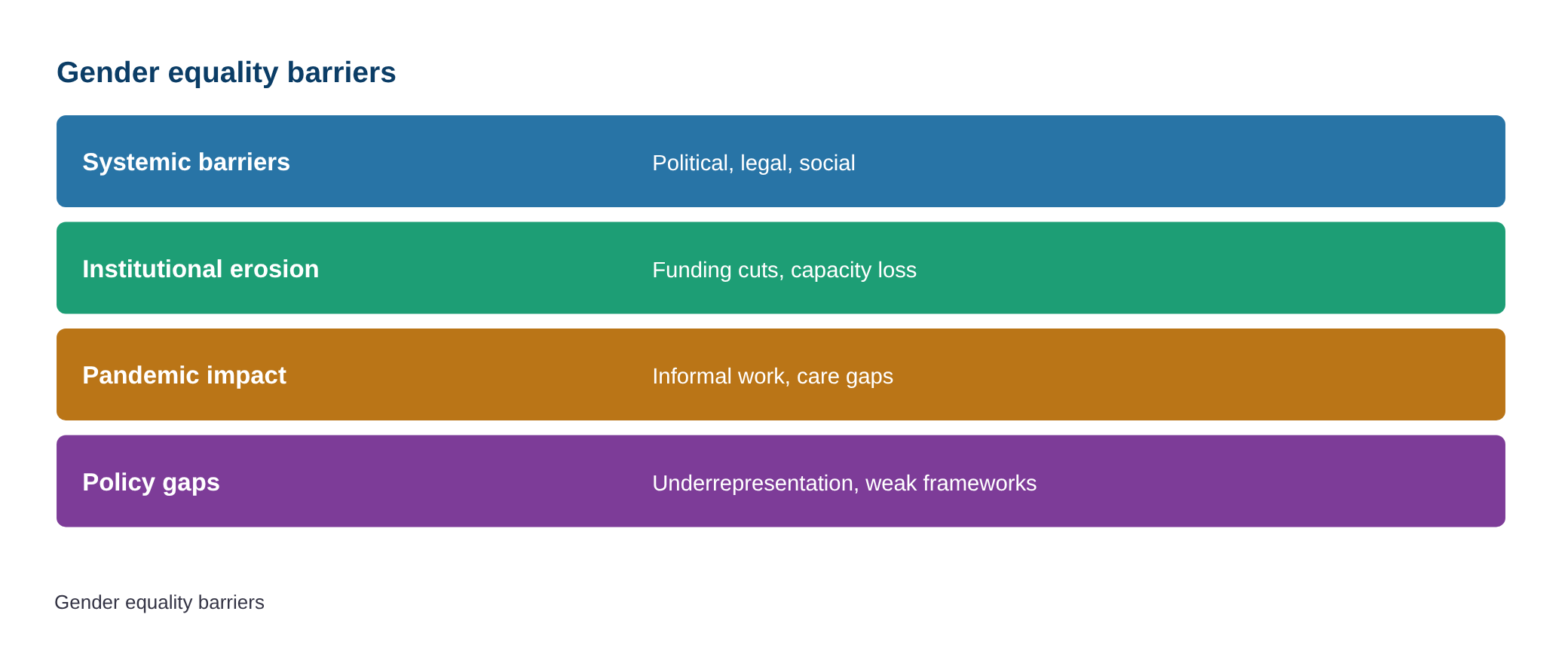
- Global funding for gender equality programmes has faced significant cuts in recent years, exacerbating the erosion of institutional capacity to address systemic inequalities.
- The COVID-19 pandemic and subsequent economic disruptions disproportionately impacted women, particularly in informal employment, unpaid care work, and access to essential services, further widening existing gender gaps.
What is Gender Equality and SDG 5?
- Gender equality refers to the equal rights, responsibilities, and opportunities of women, men, girls, and boys in all spheres of life, including political, economic, social, and cultural domains, ensuring that their interests, needs, and priorities are equitably addressed.
- SDG 5 is one of the 17 Sustainable Development Goals adopted by UN member states in 2015, with the overarching objective of achieving gender equality and empowering all women and girls by 2030 through nine specific targets.
- Key targets of SDG 5 include: (a) ending all forms of discrimination against women and girls; (b) eliminating gender-based violence, including trafficking, sexual exploitation, and harmful practices such as child marriage and female genital mutilation (FGM); (c) ensuring women’s full and effective participation in leadership at all levels of decision-making; (d) guaranteeing universal access to sexual and reproductive health and rights; and (e) promoting economic rights, including equal opportunities for leadership in the workplace and access to land and financial resources.
- The SDG 5 framework is underpinned by the principle of intersectionality, recognising that gender inequality intersects with other forms of discrimination, such as caste, class, race, ethnicity, disability, and sexual orientation, necessitating targeted and inclusive policy responses.
- Progress toward SDG 5 is monitored through global indicators, including the Gender Development Index (GDI), Gender Inequality Index (GII), and the Social Institutions and Gender Index (SIGI), which assess disparities in health, education, economic participation, and institutional frameworks.
- Legal frameworks, such as CEDAW, require states to adopt measures to eliminate discrimination, including constitutional guarantees, legislative reforms, and administrative policies, while also addressing structural barriers in customary and religious laws.
- Institutional mechanisms for gender equality operate at multiple levels: global (e.g., UN Women), regional (e.g., ASEAN Commission on the Promotion and Protection of the Rights of Women and Children), national (e.g., National Commission for Women), and sub-national (e.g., state-level women’s commissions).
- The effectiveness of these mechanisms depends on adequate funding, political will, data systems for gender analysis, and the integration of gender perspectives into all government policies and programmes (gender mainstreaming).
Key Features
| Feature | Significance |
|---|---|
| Global Gender Snapshot 2026 | Provides a comprehensive assessment of progress toward SDG 5, highlighting systemic gaps in gender equality across political, economic, and social domains. |
| Political Leadership Imbalance | Demonstrates the underrepresentation of women in decision-making roles, with 6 in 7 countries led by men, undermining democratic principles of equal participation. |
| Economic Participation Barriers | Reveals structural obstacles such as high electoral costs, violence in public life, and sectoral segregation that exclude women from economic and political power structures. |
| Legal Inequality Gaps | Documents the absence of full legal equality in any country and persistent legal barriers, particularly in land rights and governance participation. |
| Funding Deficits for Gender Equality | Highlights the erosion of institutional mechanisms and development aid cuts, reducing capacity to address gender-based violence, discrimination, and systemic barriers. |
Why it Matters
Democratic Governance
- Gender equality is a cornerstone of inclusive governance; persistent underrepresentation of women in leadership roles weakens democratic legitimacy and human rights frameworks.
- Systemic barriers to women’s political participation distort representation, leading to policies that may not address the needs of half the population.
- Concentration of power in male-dominated institutions exacerbates inequality in decision-making on security, finance, and law, undermining equitable policy outcomes.
Economic Development
- Women’s economic participation is critical for GDP growth; barriers such as restricted land rights and sectoral segregation limit productivity and innovation.
- Legal and social discrimination against women reduces human capital development, constraining economic diversification and inclusive growth.
- Violence and discrimination against women impose significant economic costs, including healthcare expenses and lost productivity.
Social Justice
- Gender-based violence, child marriage, and female genital mutilation violate fundamental rights and perpetuate cycles of poverty and marginalisation.
- Unequal access to justice and legal protections reinforces structural discrimination, particularly for marginalised groups such as Dalit women, tribal women, and women with disabilities.
- Cultural norms and harmful practices remain entrenched due to weak enforcement of laws and inadequate institutional support.
International Commitments
- The report underscores the failure to meet SDG 5 targets by 2030, reflecting broader challenges in achieving the 2030 Agenda for Sustainable Development.
- Weakening institutional mechanisms for gender equality contradicts global commitments under the Beijing Platform for Action and CEDAW.
- Reduced funding for gender equality programmes undermines multilateral efforts to address systemic discrimination and violence.
Challenges
1. Systemic Underrepresentation in Leadership
- Women constitute less than 20% of CEOs globally and fewer than 20% of the highest courts, limiting diverse perspectives in economic and judicial decision-making.
- Sectoral segregation steers women away from portfolios with high economic and security impact, such as finance and defence ministries.
- High costs of electoral participation and violence in public life deter women from entering politics, reinforcing male dominance in governance.
UPSC Link: GS-II: Representation of Women
2. Legal and Institutional Gaps
- No country has achieved full legal equality, with 51% of 131 countries studied exhibiting significant legal gaps in gender equality.
- Nearly two-thirds of countries provide inadequate or no legal protection for women’s land rights, restricting economic autonomy.
- Fewer than 30% of nations ensure joint land registration or women’s participation in land governance, exacerbating rural poverty.
UPSC Link: GS-II: Constitutional Provisions for Equality
3. Gender-Based Violence and Harmful Practices
- Nearly one in five girls is married before age 18, with forced marriage persisting in conflict and post-conflict regions.
- An estimated 230 million women and girls are survivors of female genital mutilation, primarily in Sub-Saharan Africa and parts of the Middle East.
- One in three women globally has experienced partner or sexual violence, with 316 million women experiencing physical or sexual violence by an intimate partner in the past year.
UPSC Link: GS-I: Social Issues and GS-II: Women’s Rights
4. Erosion of Institutional Mechanisms
- One in four gender equality institutions has seen budget cuts over the past two years, reducing capacity to implement programmes and policies.
- One in three institutions has experienced a reduction in institutional power, weakening enforcement of laws and policies on gender equality.
- 42% of UN entities report a weakening of gender equality efforts due to funding cuts, undermining global advocacy and support.
UPSC Link: GS-II: Role of Institutions
5. Economic Participation Barriers
- Women face systemic barriers in accessing credit, property rights, and formal employment, limiting economic mobility and entrepreneurship.
- Sectoral segregation confines women to low-paying and informal sectors, perpetuating wage gaps and economic dependency.
- Lack of legal protections for land rights restricts women’s ability to leverage assets for economic independence and agricultural productivity.
UPSC Link: GS-III: Inclusive Growth and Women
Challenges — UPSC Perspective
| Issue | Concern |
|---|---|
| Political Participation | Underrepresentation of women in leadership roles, high costs of electoral participation, and violence in public life deter political engagement. |
| Legal Equality | Absence of full legal equality in any country and persistent gaps in land rights and governance participation undermine women’s rights. |
| Gender-Based Violence | High prevalence of forced marriage, female genital mutilation, and intimate partner violence violates fundamental rights and perpetuates inequality. |
| Institutional Weakening | Budget cuts and erosion of institutional power reduce capacity to address gender inequality and enforce protective laws. |
| Economic Barriers | Restricted access to land rights, credit, and formal employment limits women’s economic autonomy and productivity. |
| Funding Deficits | Reduced development aid and institutional funding for gender equality programmes hinder progress toward SDG 5 targets. |
Way Forward
- Strengthen institutional mechanisms for gender equality by ensuring adequate funding and operational autonomy for national commissions and UN entities.
- Enforce existing laws on land rights, violence against women, and political participation through capacity-building of judiciary and law enforcement agencies.
- Expand affirmative action policies to increase women’s representation in political leadership, corporate boards, and judicial institutions.
- Integrate gender-responsive budgeting in all government programmes to ensure equitable allocation of resources and accountability.
- Promote multi-stakeholder partnerships involving civil society, private sector, and international organisations to address systemic barriers.
- Enhance data collection and monitoring systems to track progress on SDG 5 indicators and identify gaps in implementation.
- Invest in education and awareness programmes to challenge harmful social norms and promote gender equality from early stages.
- Leverage technology and digital platforms to improve women’s access to information, financial services, and political participation.
UPSC Value Addition
Keywords for Mains Answer-Writing
Gender equality · Sustainable Development Goal 5 · UN Gender Snapshot 2026 · Women’s political representation · Gender-based violence · Female Genital Mutilation (FGM) · Child marriage · Legal equality for women · Gender budgeting · Institutional mechanisms for gender equality · UN Women · Constitutional provisions on gender equality · Women’s land rights · Economic empowerment of women · Systemic barriers to women’s participation
Constitutional & Policy Linkages
- Article 14: Right to Equality
- Article 15: Prohibition of Discrimination
- Article 16: Equality of Opportunity in Public Employment
- Article 21: Right to Life and Personal Liberty
- Article 39(d): Equal pay for equal work
- Article 42: Provision for Just and Humane Conditions of Work
Concept Flow
Persistent gender stereotypes and harmful social norms → Underrepresentation of women in leadership and decision-making roles → Systemic barriers in political participation and economic empowerment → Legal and institutional gaps in addressing discrimination and violence → Erosion of funding and weakening of gender equality institutions → Failure to meet SDG 5 targets by 2030 → Reinforcement of inequality through policy and societal structures
Prelims Practice Questions
Q1. Consider the following statements regarding the Sustainable Development Goal 5 (SDG 5):
1. SDG 5 aims to achieve gender equality and empower all women and girls.
2. One of the targets under SDG 5 is to eliminate all forms of violence against women and girls.
3. SDG 5 includes a target to ensure universal access to sexual and reproductive health and rights.
4. The UN Gender Snapshot 2026 reports that all indicators under SDG 5 are on track to be met by 2030.
How many of the above statements are correct?
- Only one
- Only two
- Only three
- All four
Answer: Only three — Statements 1, 2, and 3 are correct as they align with the official SDG 5 targets. Statement 4 is incorrect because the UN Gender Snapshot 2026 explicitly states that no indicator under SDG 5 is on track to be met by 2030.
Q2. Assertion (A): Female Genital Mutilation (FGM) is a harmful practice that violates the bodily integrity and human rights of women and girls.
Reason (R): The UN Gender Snapshot 2026 reports that an estimated 230 million women and girls worldwide are survivors of FGM.
Options:
A. Both A and R are true, and R is the correct explanation of A.
B. Both A and R are true, but R is not the correct explanation of A.
C. A is true, but R is false.
D. A is false, but R is true.
Answer: ? — Both A and R are true. FGM is widely recognized as a violation of human rights and bodily integrity. The statistic in R provides empirical evidence supporting the harm caused by FGM, but it does not directly explain why FGM is a violation of rights; it merely quantifies its prevalence.
Q3. Match the following initiatives with their respective objectives:
Column I (Initiative) | Column II (Objective)
1. Gender Snapshot 2026 | A. To provide legal protection for women’s land rights
2. SDG 5 | B. To assess global progress toward gender equality
3. UN Women | C. To promote gender equality and empower women and girls
4. Prohibition of Child Marriage Act, 2006 | D. To advocate for women’s rights and gender equality globally
Options:
1-B, 2-C, 3-D, 4-A
1-A, 2-B, 3-C, 4-D
1-D, 2-A, 3-B, 4-C
1-C, 2-D, 3-A, 4-B
Answer: ? — The correct matches are: 1-B (Gender Snapshot 2026 assesses global progress toward gender equality), 2-C (SDG 5 aims to promote gender equality and empower women and girls), 3-D (UN Women advocates for women’s rights and gender equality globally), and 4-A (The Prohibition of Child Marriage Act, 2006 provides legal protection to prevent child marriage).
Mains Practice Question
✍ The United Nations Gender Snapshot 2026 reveals that gender equality remains woefully off track, with no Sustainable Development Goal 5 (SDG 5) indicator on course to be achieved by 2030. Critically examine the systemic barriers to women’s political participation and economic empowerment in India, with reference to constitutional provisions, legislative frameworks, and judicial interventions. Also, discuss the role of institutional mechanisms in addressing these challenges. (15 Marks)
Approach: MODEL-ANSWER SKELETON:
1. **Introduction (2 marks)**: Define SDG 5 and its targets. Highlight the key findings of the UN Gender Snapshot 2026 regarding the global and national progress on gender equality.
2. **Systemic Barriers to Political Participation (4 marks)**:
– Constitutional provisions: Article 14 (Right to Equality), Article 15(3) (Special provisions for women), Article 326 (Adult suffrage), and Article 243D (Reservation for women in Panchayats and Municipalities).
– Legislative frameworks: The Representation of the People Act, 1951; The Women’s Reservation Bill (pending); The Prohibition of Child Marriage Act, 2006.
– Judicial interventions: Landmark judgments such as *Vishaka Guidelines* (1997) on sexual harassment at workplace, *Indira Jaising v. Union of India* (2017) on women’s representation in the judiciary, and *Lily Thomas v. Union of India* (2013) on disqualification of convicted legislators.
– Systemic issues: Violence against women in public life, financial constraints, and socio-cultural norms.
3. **Economic Empowerment Challenges (4 marks)**:
– Constitutional provisions: Article 19(1)(g) (Right to practice any profession), Article 21 (Right to livelihood), and Directive Principles of State Policy (Articles 38, 39, 41, 42, 43, 46).
– Legislative frameworks: The Maternity Benefit (Amendment) Act, 2017; The Sexual Harassment of Women at Workplace (Prevention, Prohibition and Redressal) Act, 2013; The Equal Remuneration Act, 1976.
– Judicial interventions: *Vishaka Guidelines* (1997), *Indian Young Lawyers Association v. State of Kerala* (2018) (Sabrimala judgment), and *Anuj Garg v. Hotel Association of India* (2007) on gender discrimination.
– Economic barriers: Wage gaps, limited access to land and property rights, and lack of representation in leadership roles.
4. **Role of Institutional Mechanisms (3 marks)**:
– National Commission for Women (NCW): Functions, powers, and limitations.
– Ministry of Women and Child Development: Schemes such as Beti Bachao Beti Padhao, Mahila Shakti Kendra, and One Stop Centre Scheme.
– State-level mechanisms: State Commissions for Women and District Level Committees.
– Challenges: Underfunding, lack of autonomy, and limited enforcement capacity.
5. **Conclusion (2 marks)**: Summarize the key findings and suggest a balanced approach, including strengthening institutional mechanisms, enhancing judicial interventions, and promoting socio-cultural change to achieve gender equality.
Source: news.un.org
Generated by AanyaAi for educational purpose.
Related guides on our sites
- Current affairs for upsc 2026
- Best PSIR optional coaching for upsc
- Best economics optional coaching for upsc
- Best PSIR optional teacher for upsc

- बॉम्बे हाईकोर्ट ने गणेशोत्सव में ध्वनि एवं वायु प्रदूषण पर उठाई चिंता - September 22, 2026
- Bombay HC Raps Noise, Air Pollution During Ganeshotsav: Key UPSC Perspective - September 22, 2026
- जल जीवन मिशन 2.0: कुशल कार्यबल निर्माण के लिए पहली वर्चुअल सम्मेलन आयोजित - September 22, 2026

No Comments