


29 Jul UN warns: Climate disasters at ‘nightmare’ levels due to fossil fuels
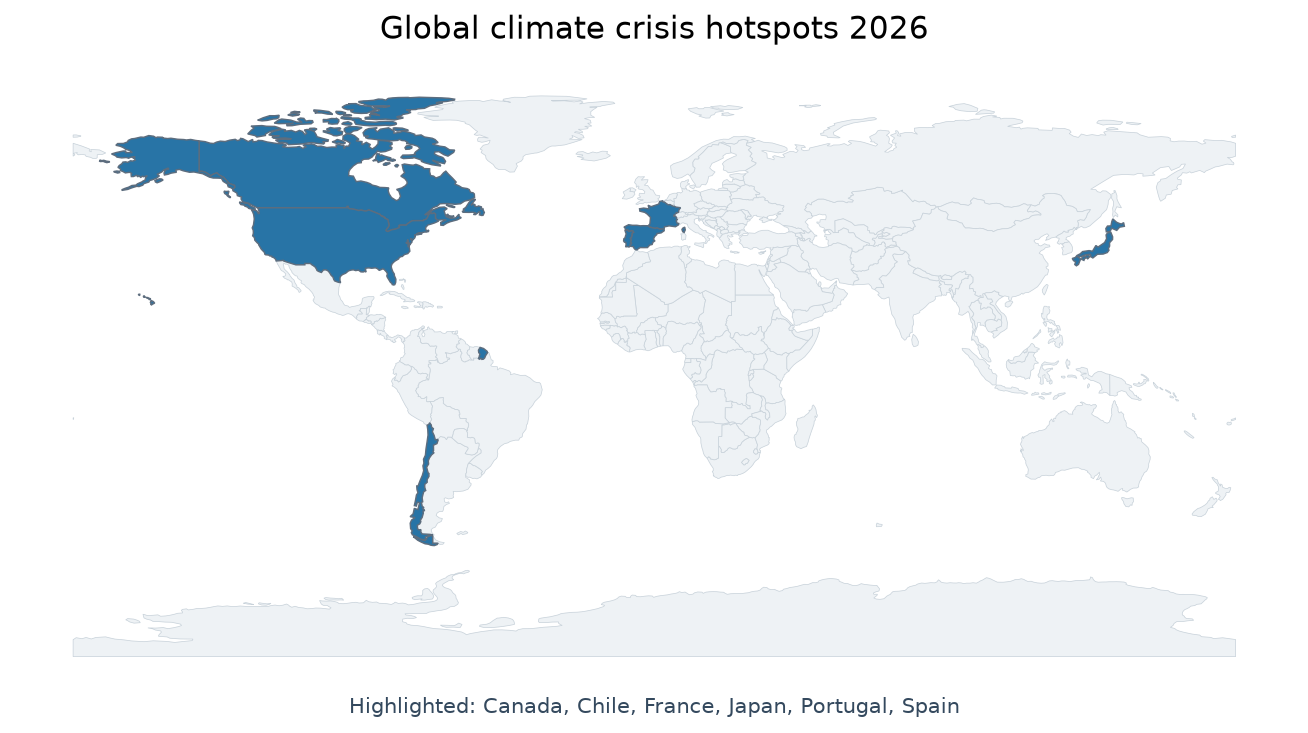
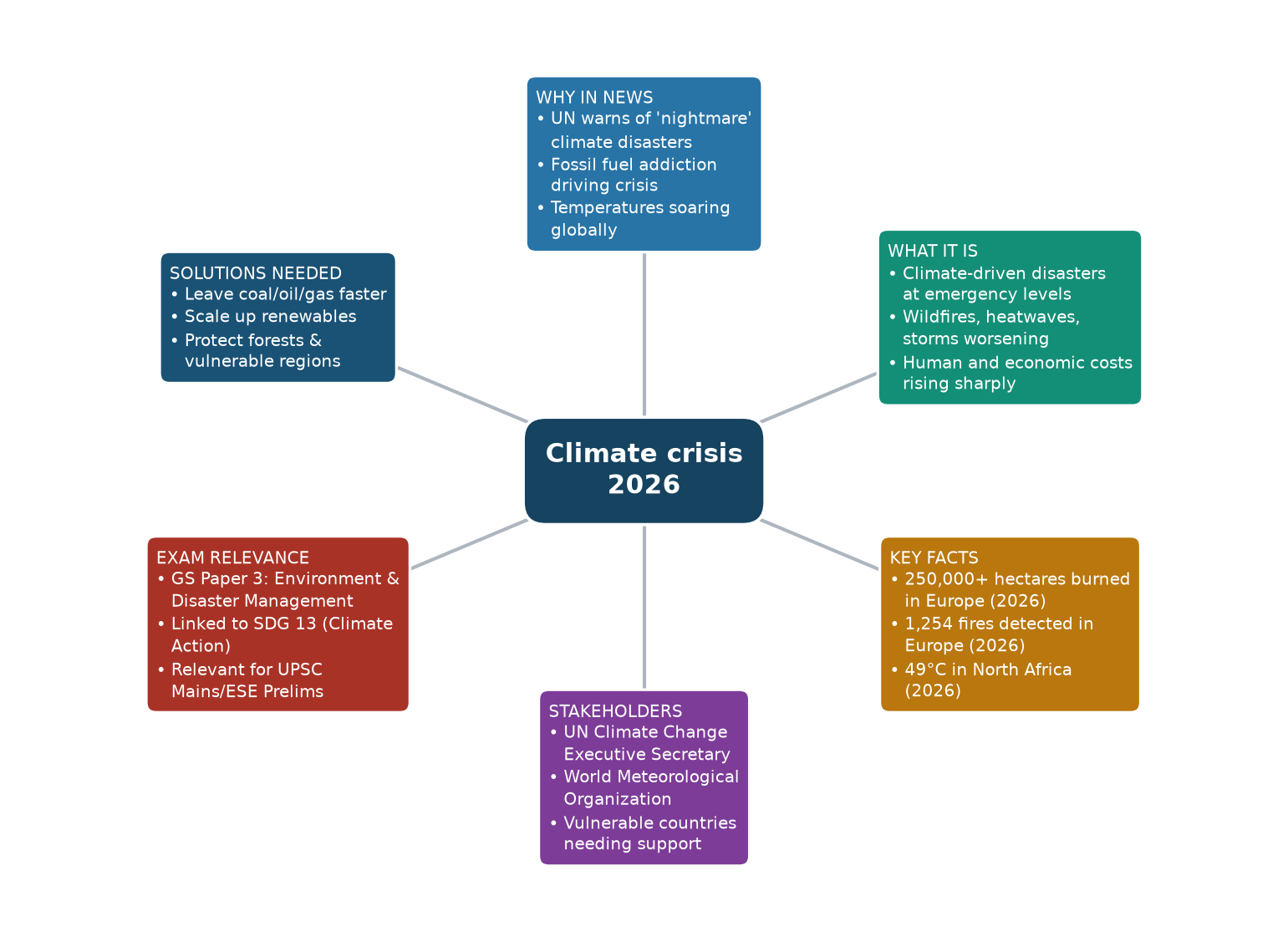
Map & concept mind-map: Global climate crisis hotspots 2026
Subject Relevance — Where This Topic Fits
- GS Paper III — Environment, Conservation, Environmental Pollution and Degradation
- Prelims: Climate change, Global warming, Fossil fuel dependence, Renewable energy transition, Wildfires, Heatwaves, Early Warnings for All Initiative, UNFCCC
- Essay: Climate change as a defining challenge of the 21st century, The cost of inaction: Human and economic dimensions of environmental neglect
Quick Revision: The global climate crisis is driven by fossil fuel dependence, necessitating an accelerated transition to renewable energy and robust early warning systems to mitigate escalating human and economic costs.
Why is this in the news?
The statement by the UN Climate Change Executive Secretary Simon Stiell on 28 July 2026 underscores the unprecedented scale of climate-driven disasters globally, including record-breaking wildfires in Europe, extreme heatwaves in North Africa and Japan, and severe storms in Chile. This alarm highlights the immediate human and economic costs of delayed action on fossil fuel phase-out and insufficient adaptation measures, reinforcing the urgency for accelerated renewable energy adoption and robust early warning systems.
Background
- The Intergovernmental Panel on Climate Change (IPCC) has consistently warned that human-induced global warming, primarily driven by fossil fuel combustion, has intensified extreme weather events, including heatwaves, droughts, floods, and wildfires.
- The Paris Agreement (2015) sets a global goal to limit temperature rise to well below 2°C, preferably to 1.5°C, above pre-industrial levels, yet current Nationally Determined Contributions (NDCs) remain insufficient to meet this target.
- The World Meteorological Organization (WMO) has documented a rise in the frequency and intensity of climate-related disasters, with 2023 and 2026 witnessing unprecedented wildfire activity and smoke dispersion across continents.
- The UN’s ‘Early Warnings for All’ initiative aims to ensure that every person on Earth is protected by early warning systems against hazardous weather, climate, and water-related events by 2027.
- Fossil fuel dependence remains entrenched, with global energy systems still deriving over 80% of primary energy from coal, oil, and gas, despite the rapid growth of renewable energy sources.
- Vulnerable nations, particularly Small Island Developing States (SIDS) and Least Developed Countries (LDCs), face disproportionate impacts from climate change, exacerbating existing socio-economic inequalities.
What is the Global Climate Crisis?
- The global climate crisis refers to the accelerating changes in Earth’s climate system, primarily driven by anthropogenic greenhouse gas (GHG) emissions, leading to widespread environmental, economic, and social disruptions.
- Key manifestations include rising global temperatures, melting glaciers and polar ice, sea-level rise, increased frequency of extreme weather events (e.g., heatwaves, floods, droughts, and wildfires), and disruptions to ecosystems and biodiversity.
- The crisis is exacerbated by feedback loops, such as the release of methane from thawing permafrost and reduced albedo effects from melting ice, which amplify warming trends.
- Human activities, particularly the combustion of fossil fuels (coal, oil, and gas), deforestation, and industrial processes, are the primary drivers of climate change, as confirmed by the IPCC’s Sixth Assessment Report (2021-2023).
- The economic costs of climate change are substantial, encompassing direct damages from disasters, loss of agricultural productivity, infrastructure destruction, and long-term impacts on public health and labor productivity.
- The climate crisis disproportionately affects vulnerable populations, including indigenous communities, low-income groups, and regions with limited adaptive capacity, deepening global inequalities.
- Mitigation strategies focus on reducing GHG emissions through transitions to renewable energy, energy efficiency, sustainable agriculture, and carbon pricing mechanisms.
- Adaptation measures aim to enhance resilience by improving infrastructure, early warning systems, ecosystem restoration, and community-based disaster risk reduction.
Key Features
| Feature | Significance |
|---|---|
| Record-breaking wildfires in Europe (2026) | Demonstrates the intensification of climate-driven disasters, with over 250,000 hectares burned and 1,254 fires detected, necessitating mass evacuations and economic disruptions. |
| Extreme heatwaves in North Africa (49°C) | Poses severe threats to human health, agricultural productivity, and critical infrastructure such as hospitals and power systems, exacerbating socio-economic vulnerabilities. |
| Prolonged heatwaves in Japan (40°C streak) | Highlights the increasing frequency and duration of extreme weather events, with implications for public health, energy demand, and urban resilience. |
| Wildfire smoke pollution (Canada to the US) | Showcases transboundary environmental impacts, where smoke from wildfires travels thousands of kilometres, affecting air quality and public health across regions and continents. |
| Early Warnings for All Initiative (WMO) | Aims to standardise frameworks for monitoring, forecasting, and cross-border data sharing to mitigate wildfire smoke threats and protect lives and ecosystems. |
Why it Matters
Economic Implications
- Economic losses from wildfires and heatwaves in Europe and North Africa are reaching national emergency levels, straining regional and national budgets.
- Disruptions to agriculture, tourism, and supply chains due to extreme weather events amplify economic vulnerabilities in affected regions.
- Healthcare systems face increased burdens from heat-related illnesses and respiratory issues caused by wildfire smoke, escalating public expenditure.
Environmental Consequences
- Accelerated deforestation and ecosystem degradation due to wildfires reduce biodiversity and carbon sinks, exacerbating climate change feedback loops.
- Prolonged heatwaves and droughts degrade soil quality and water resources, threatening food security and ecological stability.
- Transboundary air pollution from wildfire smoke undermines regional environmental governance and public health standards.
Geopolitical and Strategic Dimensions
- Climate-induced disasters intensify migration pressures, straining international cooperation and border management systems.
- Vulnerable nations, particularly in the Global South, require financial and technological support to adapt to climate impacts, highlighting North-South equity concerns.
- Energy security concerns arise as reliance on fossil fuels exacerbates climate vulnerabilities, necessitating a transition to renewable energy sources.
Public Health and Social Equity
- Marginalised communities, including indigenous populations and low-income groups, bear disproportionate burdens from climate disasters due to limited adaptive capacities.
- Heat-related mortality and morbidity rates rise sharply during extreme heatwaves, particularly among vulnerable populations such as the elderly and outdoor workers.
- Air pollution from wildfires exacerbates respiratory diseases, disproportionately affecting children and individuals with pre-existing health conditions.
Scientific and Technological Advancements
- Advancements in early warning systems and climate modelling are critical for predicting and mitigating the impacts of wildfires and extreme weather events.
- International collaboration in data sharing and technological innovation enhances the effectiveness of climate adaptation and disaster response strategies.
- Research into climate resilience and sustainable land management practices is essential for reducing the frequency and intensity of climate-driven disasters.
Challenges
1. Accelerating Transition from Fossil Fuels
- Global dependence on coal, oil, and gas remains a primary driver of climate change, necessitating urgent policy interventions to reduce emissions.
- Economic and political resistance from fossil fuel-dependent industries and regions slows the transition to renewable energy sources.
- Limited technological and financial resources in developing nations hinder their ability to invest in clean energy infrastructure.
UPSC Link: GS III: Climate Change
2. Enhancing Climate Adaptation and Resilience
- Insufficient investment in climate adaptation measures leaves vulnerable communities exposed to escalating climate risks.
- Lack of standardised frameworks for cross-border data sharing and early warning systems delays effective disaster response.
- Inadequate integration of climate resilience into urban planning and infrastructure development exacerbates vulnerability to extreme weather events.
UPSC Link: GS III: Disaster Management
3. Addressing Transboundary Environmental Impacts
- Wildfire smoke and other transboundary pollutants require coordinated international efforts to monitor, forecast, and mitigate their impacts.
- Differences in environmental regulations and enforcement across nations complicate efforts to address global environmental challenges.
- Limited awareness and preparedness among communities and governments hinder effective responses to transboundary environmental threats.
UPSC Link: GS II: International Relations
4. Ensuring Equitable Climate Finance
- Developed nations’ commitments to provide climate finance to vulnerable countries remain unmet, exacerbating global inequality.
- Complex bureaucratic processes and conditionalities in climate finance disbursement delay critical adaptation and mitigation efforts.
- Limited access to climate finance for small island states and least developed countries (LDCs) increases their vulnerability to climate impacts.
UPSC Link: GS II: Global Groupings
5. Strengthening Climate Governance and Policy
- Inadequate implementation of existing climate policies and agreements undermines global efforts to mitigate climate change.
- Political and economic priorities often overshadow climate action, leading to inconsistent and insufficient policy responses.
- Lack of coordination among national, regional, and international bodies hampers the effectiveness of climate governance.
UPSC Link: GS II: Important International Institutions
Challenges — UPSC Perspective
| Issue | Concern |
|---|---|
| Fossil fuel dependence | Delays the transition to renewable energy, exacerbating climate change and increasing vulnerability to climate disasters. |
| Limited climate adaptation funding | Leaves vulnerable communities exposed to escalating climate risks, particularly in developing nations. |
| Transboundary pollution (wildfire smoke) | Requires coordinated international efforts to monitor and mitigate impacts, complicating disaster response. |
| Inequitable climate finance distribution | Exacerbates global inequality, leaving small island states and LDCs disproportionately vulnerable. |
| Inadequate early warning systems | Delays critical disaster response efforts, increasing human and economic losses. |
| Political resistance to climate action | Undermines policy implementation and delays the transition to sustainable energy sources. |
Way Forward
- Accelerate the phase-out of coal, oil, and gas through policy incentives, carbon pricing, and investment in renewable energy infrastructure.
- Strengthen international cooperation to enhance cross-border data sharing, early warning systems, and coordinated disaster response mechanisms.
- Increase climate finance commitments from developed nations to support adaptation and mitigation efforts in vulnerable countries.
- Integrate climate resilience into urban planning, infrastructure development, and land-use policies to reduce vulnerability to extreme weather events.
- Promote sustainable land management practices, including reforestation and fire prevention, to reduce the frequency and intensity of wildfires.
- Enhance public awareness and preparedness through education campaigns, community-based disaster risk reduction, and early warning dissemination.
- Invest in research and innovation to improve climate modelling, early warning systems, and technologies for climate adaptation and mitigation.
UPSC Value Addition
Keywords for Mains Answer-Writing
Climate change impacts · Fossil fuel phase-out · Global warming · Wildfire management · Heatwave disasters · Renewable energy transition · Climate emergency · UNFCCC commitments · Early warning systems · Cross-border environmental threats
Concept Flow
Greenhouse gas emissions from fossil fuel combustion → Global temperature rise and climate change → Increased frequency and intensity of extreme weather events (heatwaves, wildfires, storms) → Escalation of climate-driven disasters (wildfires, heatwaves, floods) → Transboundary environmental impacts (wildfire smoke pollution) → Socio-economic disruptions (health crises, economic losses, migration pressures) → Urgent need for climate adaptation and mitigation measures.
Prelims Practice Questions
Q1. Consider the following statements regarding the UN Climate Change Executive Secretary’s recent warning on climate disasters: 1) The warning highlights the increasing frequency and intensity of climate-driven disasters due to fossil fuel dependence. 2) The statement emphasizes the need for immediate scaling up of renewable energy and accelerated phase-out of coal, oil, and gas. 3) The UN official cited record-breaking wildfires in Europe and North Africa as examples of climate emergency. Which of the above statements are correct?
- Only 1 and 2
- Only 2 and 3
- Only 1 and 3
- All 1, 2 and 3
Answer: All 1, 2 and 3 — All three statements accurately reflect the UN official’s warning. Statement 1 aligns with the assertion that climate-driven disasters are worsening due to fossil fuel dependence. Statement 2 matches the call for rapid scaling of renewables and phase-out of fossil fuels. Statement 3 is supported by the cited examples of wildfires in Europe and extreme temperatures in North Africa.
Q2. Which of the following initiatives is being advanced by the World Meteorological Organization (WMO) to mitigate the impacts of wildfire smoke?
- National Afforestation Programme
- Early Warnings for All initiative
- National Mission for Clean Ganga
- National Solar Mission
Answer: Early Warnings for All initiative — The WMO is advancing the ‘Early Warnings for All’ initiative, which focuses on reliable monitoring, forecasting, cross-border data sharing, and early warnings to protect lives and ecosystems from wildfire smoke and other climate-related threats.
Mains Practice Question
✍ Analyze the socio-economic and environmental implications of the accelerating climate crisis, citing recent global events. Discuss the role of international cooperation in addressing these challenges, with reference to the UNFCCC framework and India’s climate commitments.
Approach: Begin by outlining the socio-economic impacts of climate disasters such as wildfires, heatwaves, and storms, supported by recent examples from Europe, North Africa, and Japan. Highlight the environmental degradation and public health crises, including air quality deterioration and strain on infrastructure. Examine the UNFCCC framework’s role in fostering international cooperation, emphasizing the need for standardized frameworks and cross-border data sharing. Conclude with India’s climate commitments under the Paris Agreement and its domestic policies, such as the National Action Plan on Climate Change, to underscore the importance of a multi-lateral and national approach in mitigating climate risks.
Source: news.un.org
Generated by AanyaAi for educational purpose.

- तमिलनाडु: राज्यपाल अरलेकर ने निजी विश्वविद्यालय संशोधन विधेयक पर मांगी स्पष्टीकरण - September 18, 2026
- सुप्रीम कोर्ट ने एनटीए के अपग्रेडेड नीट परीक्षा सिस्टम का निरीक्षण करने पर विचार किया - September 18, 2026
- Supreme Court to Inspect NTA’s Upgraded NEET Exam System for Leak Prevention - September 18, 2026

No Comments