


21 Jul Union Budget 2026-27: ₹2.28 Lakh Crore for Rural Development Schemes
Subject Relevance — Where This Topic Fits
- GS Paper II — Governance, Transparency and Accountability | GS Paper III — Agriculture, Rural Development and Land Reforms
- Prelims: Budget Estimates (BE) 2026-27, National Social Assistance Programme (NSAP), Digital India Land Records Modernisation Programme (DILRMP), Rural Development Ministry, Union Budget Allocation, Utilisation Certificates, Fund Flow Mechanism
- Essay: The role of fiscal federalism in India’s rural development: Challenges and opportunities, Digital transformation in governance: Balancing efficiency and equity
Quick Revision: The Budget Estimates for 2026-27 allocate ₹2,28,768.81 crore to the Department of Rural Development, with funds released to states/UTs only after strict compliance with utilisation guidelines and verification of ground-level needs.
Why is this in the news?
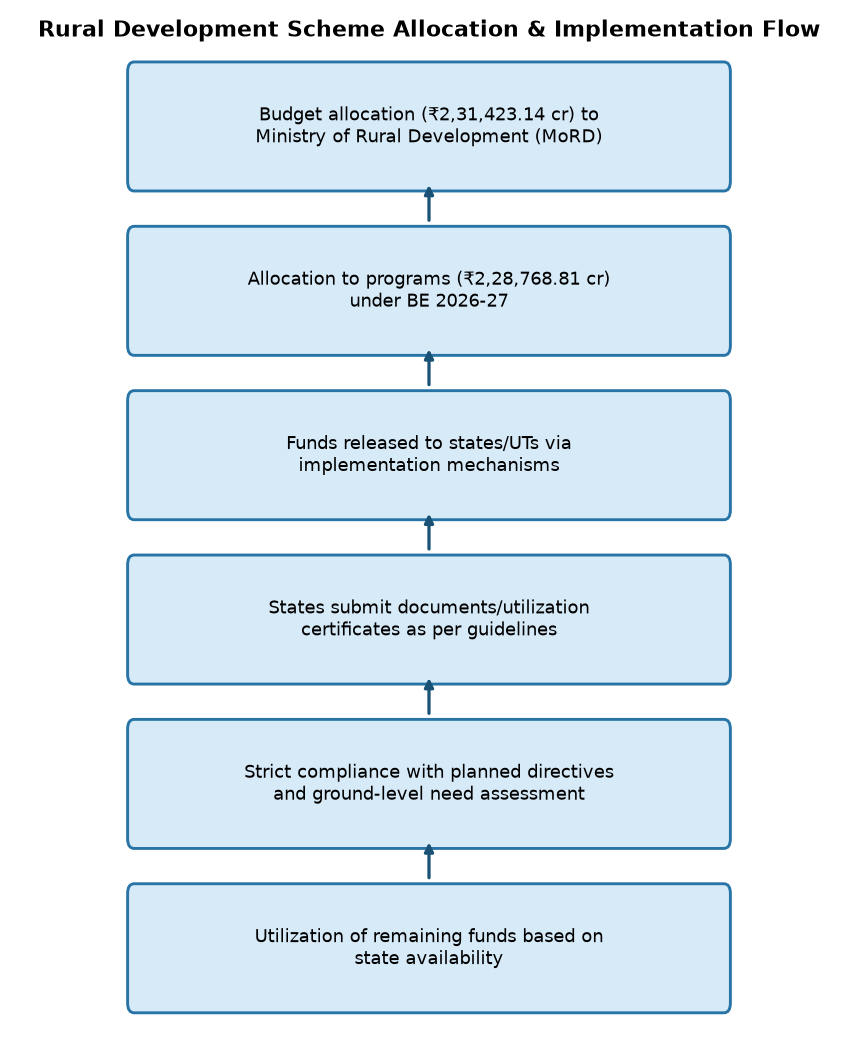
The Press Information Bureau (PIB) release dated 21 July 2026 highlights the allocation of ₹2,31,423.14 crore under the Budget Estimates (BE) for 2026-27 for the Ministry of Rural Development, with ₹2,28,768.81 crore earmarked specifically for the Department of Rural Development. This allocation underscores the government’s commitment to rural development while also detailing the procedural mechanisms for fund disbursement, utilisation, and compliance, which are critical for aspirants to understand the intersection of fiscal policy, governance, and rural welfare.
Background
- The Ministry of Rural Development (MoRD) is the nodal agency for implementing rural development programmes in India, functioning under the aegis of the Union Government.
- Rural development schemes in India are designed to address multi-dimensional challenges such as poverty alleviation, infrastructure gaps, land record digitisation, and social security.
- The Budget Estimates (BE) for 2026-27 reflect the government’s fiscal priorities, with significant allocations directed towards rural development to bridge urban-rural disparities.
- Funds under rural development schemes are released to states and Union Territories through a structured implementation mechanism, ensuring accountability and transparency.
- The National Social Assistance Programme (NSAP) and Digital India Land Records Modernisation Programme (DILRMP) are flagship initiatives under the MoRD, aimed at social security and land record reforms, respectively.
- The release of funds is contingent upon the submission of utilisation certificates and adherence to prescribed guidelines, reflecting the principles of cooperative federalism and fiscal discipline.
What are the key rural development programmes and their implementation mechanisms under the Ministry of Rural Development?
- **National Social Assistance Programme (NSAP)**: A centrally sponsored scheme providing financial assistance to Below Poverty Line (BPL) households in the form of old-age pensions, widow pensions, and disability pensions.
- **Digital India Land Records Modernisation Programme (DILRMP)**: A centrally funded initiative aimed at modernising land records through digitisation, reducing disputes, and enhancing transparency in land governance. It integrates technologies such as GIS, satellite imagery, and blockchain for secure land records.
- **Fund Allocation and Release Mechanism**: The Budget Estimates (BE) for 2026-27 allocate funds to the MoRD, which are then disbursed to states/UTs based on project-specific requirements. Funds are released only after the submission of utilisation certificates, adherence to guidelines, and verification of actual ground-level needs.
- **Utilisation Certificates and Compliance**: States/UTs must submit utilisation certificates to the central government, certifying that funds have been utilised as per the approved guidelines. This ensures financial accountability and prevents misuse of funds.
- **Role of State Governments**: State governments act as implementing agencies for rural development schemes, with the central government providing financial and technical support. The devolution of funds is guided by the principles of fiscal federalism and cooperative governance.
- **Monitoring and Evaluation**: The MoRD employs a multi-tiered monitoring system, including field-level assessments, third-party audits, and digital dashboards, to track the progress and impact of rural development schemes.
- **Focus on Land Records Modernisation**: DILRMP is a critical component of rural development, addressing issues of land disputes, fraud, and inefficient land records, which are essential for agricultural productivity and rural economic growth.
- **Social Security and Inclusion**: NSAP and other social welfare schemes under the MoRD aim to provide a safety net for vulnerable sections of society, ensuring inclusive growth and reducing rural poverty.
Key Features
| Feature | Significance |
|---|---|
| Budget Allocation (BE 2026-27) | A total allocation of ₹2,31,423.14 crore to the Ministry of Rural Development, with ₹2,28,768.81 crore earmarked for the Department of Rural Development, underscores the government’s prioritisation of rural infrastructure and welfare. |
| State-wise Allocation Mechanism | Funds are released to states/UTs through designated implementation mechanisms, ensuring adherence to utilisation certificates, utilisation of pre-allocated funds, and compliance with scheme guidelines. |
| National Social Assistance Programme (NSAP) | A centrally sponsored scheme providing financial assistance to the elderly, widows, and disabled, implemented in the Union Territory of Delhi as per the announcement. |
| Digital India Land Records Modernisation Programme (DILRMP) | A technology-driven initiative to digitise land records, enhance transparency, and reduce disputes, operational in Delhi as highlighted in the press release. |
| Monitoring and Compliance Framework | Strict monitoring includes submission of utilisation certificates, adherence to guidelines, and assessment of ground-level requirements to ensure efficient fund utilisation. |
Why it Matters
Economic Implications
- The substantial budget allocation reflects the government’s commitment to reducing rural-urban disparities and fostering inclusive growth through targeted welfare and infrastructure development.
- Efficient fund utilisation under schemes like NSAP and DILRMP can enhance social security nets and land governance, thereby improving rural productivity and economic stability.
- The emphasis on utilisation certificates and compliance mechanisms ensures fiscal discipline, reducing leakages and enhancing the credibility of rural development expenditures.
Strategic Importance
- Rural development is a critical component of India’s long-term economic strategy, particularly in addressing agrarian distress, unemployment, and migration pressures.
- Digitisation of land records (DILRMP) strengthens property rights, facilitates access to credit, and reduces litigation, which is essential for agricultural and non-agricultural investments.
- The inclusion of Delhi in NSAP and DILRMP highlights the government’s intent to extend welfare and governance reforms to Union Territories, ensuring uniform policy implementation.
Social and Governance Dimensions
- NSAP provides a safety net for vulnerable sections, aligning with constitutional directives under Article 41 (Right to Public Assistance) and Directive Principles of State Policy.
- DILRMP enhances transparency in land records, reducing corruption and improving governance, which is crucial for rural land markets and dispute resolution.
- The monitoring framework ensures that funds reach intended beneficiaries, addressing historical challenges of exclusion and inefficiency in rural welfare schemes.
Challenges
1. Implementation Bottlenecks
- Delayed submission of utilisation certificates and non-compliance with guidelines may hinder fund disbursement, leading to underutilisation of allocated budgets.
- Inadequate capacity at the state/UT level to manage digitisation projects (DILRMP) could result in suboptimal outcomes, particularly in technologically lagging regions.
- Ensuring last-mile delivery of welfare benefits under NSAP requires robust grievance redressal mechanisms and real-time monitoring, which remains a persistent challenge.
UPSC Link: GS-II: Welfare Schemes
2. Fiscal Federalism Issues
- The lack of state/UT-wise allocation details in the budget announcement may obscure disparities in fund utilisation and hinder equitable resource distribution.
- Centre-state coordination challenges in implementing schemes like DILRMP could lead to delays, particularly in states with weak administrative infrastructure.
- Variations in utilisation patterns across states may reflect structural inefficiencies, necessitating tailored interventions to address localised bottlenecks.
UPSC Link: GS-II: Federalism
3. Technology and Digital Divide
- The success of DILRMP hinges on the availability of digital infrastructure and skilled personnel, which may be lacking in remote rural areas.
- Cybersecurity risks and data privacy concerns in digitised land records systems require robust safeguards to prevent misuse and ensure citizen trust.
- Digital literacy gaps among rural populations may impede the adoption of technology-driven schemes, necessitating targeted awareness campaigns.
UPSC Link: GS-III: Science & Tech
4. Monitoring and Accountability Gaps
- The effectiveness of the monitoring framework depends on the quality of utilisation certificates and third-party audits, which may be compromised by vested interests.
- Lack of real-time data integration across states/UTs could delay decision-making and reduce the responsiveness of welfare delivery systems.
- Weak grievance redressal mechanisms may erode public trust in rural development schemes, particularly among marginalised communities.
UPSC Link: GS-II: Governance
Challenges — UPSC Perspective
| Issue | Concern |
|---|---|
| Delayed Utilisation Certificates | Leads to fund freezes and underutilisation of allocated budgets, undermining scheme effectiveness. |
| State Capacity Constraints | Inadequate administrative and technical capacity in states may hinder the implementation of digitisation and welfare schemes. |
| Digital Divide | Limited access to digital infrastructure and literacy in rural areas may exclude intended beneficiaries from technology-driven schemes. |
| Centre-State Coordination Gaps | Poor inter-governmental coordination may result in delays, duplication, or gaps in scheme implementation. |
| Monitoring and Audit Deficiencies | Weak oversight mechanisms may allow leakages, corruption, or inefficiencies to persist unchecked. |
| Last-Mile Delivery Challenges | Inefficient grievance redressal and beneficiary identification systems may prevent welfare benefits from reaching the most vulnerable. |
Government Initiatives — Must-Memorise for Prelims
- National Social Assistance Programme (NSAP)
- Digital India Land Records Modernisation Programme (DILRMP)
Way Forward
- Strengthen state-level capacity for DILRMP implementation through targeted training programmes and infrastructure support to ensure seamless digitisation of land records.
- Establish a real-time monitoring dashboard for NSAP and DILRMP to track fund utilisation, beneficiary reach, and compliance with guidelines, enabling data-driven decision-making.
- Introduce mandatory third-party audits for all rural development schemes to enhance transparency and accountability in fund utilisation.
- Expand digital literacy initiatives in rural areas to bridge the digital divide and ensure equitable access to technology-driven schemes.
- Simplify the process for submission of utilisation certificates and streamline grievance redressal mechanisms to reduce delays and improve beneficiary satisfaction.
- Promote inter-state knowledge-sharing platforms to facilitate best practices in rural development, particularly in digitisation and welfare delivery.
- Enhance coordination between the Centre and states through regular review meetings and joint monitoring committees to address implementation bottlenecks.
- Conduct periodic impact assessments of NSAP and DILRMP to identify gaps and recalibrate strategies for maximum social and economic impact.
UPSC Value Addition
Keywords for Mains Answer-Writing
Rural Development Budget 2026-27 · National Social Assistance Programme · Digital India Land Records Modernisation Programme · Devolution of Funds to States · Utilisation Certificates in Centrally Sponsored Schemes · Pradhan Mantri Awas Yojana-Gramin · Mahatma Gandhi National Rural Employment Guarantee Scheme · Rural Infrastructure Development Fund · Fiscal Federalism in India · E-Governance in Rural Development · Union Budget Allocation Mechanisms · Social Security Schemes for Rural Poor
Constitutional & Policy Linkages
- Article 41 (Right to Public Assistance) – Ensures social security nets for vulnerable sections under NSAP.
Concept Flow
Budget Allocation (BE 2026-27) → Fund Release Mechanism → State/UT Implementation → Utilisation Certificates & Compliance → Beneficiary Reach → Social and Economic Impact → Digitisation of Land Records (DILRMP) → Transparency & Reduced Disputes → Enhanced Land Markets → Rural Investment & Productivity → Welfare Schemes (NSAP) → Financial Assistance to Vulnerable Groups → Poverty Alleviation & Social Security → Inclusive Growth → Monitoring Framework → Compliance & Accountability → Reduced Leakages → Efficient Resource Utilisation → Sustainable Development → Centre-State Coordination → Policy Implementation → Uniform Welfare Delivery → Reduced Regional Disparities
Prelims Practice Questions
Q1. With reference to the Budget Estimates (BE) 2026-27 for the Ministry of Rural Development, which of the following statements is correct?
- A. The entire allocation of ₹2,31,423.14 crore is directly distributed to states/UTs on a per capita basis.
- B. The allocation includes ₹2,28,768.81 crore specifically for the Ministry of Rural Development, distributed through programme-wise mechanisms.
- C. Funds are released to states/UTs without any requirement of utilisation certificates or compliance checks.
- D. The allocation is made state/UT-wise, with no flexibility for programme-specific disbursement.
Answer: B. The allocation includes ₹2,28,768.81 crore specifically for the Ministry of Rural Development, distributed through programme-wise mechanisms. — The BE 2026-27 allocates ₹2,31,423.14 crore to the Ministry of Rural Development, of which ₹2,28,768.81 crore is earmarked for the Department of Rural Development. Funds are released through programme-specific mechanisms, not on a per capita basis, and utilisation certificates are mandatory for compliance.
Q2. Which of the following rural development schemes is implemented in the Union Territory of Delhi as per the given press release?
- A. Pradhan Mantri Kisan Samman Nidhi
- B. National Social Assistance Programme
- C. Deendayal Antyodaya Yojana-National Rural Livelihood Mission
- D. Sansad Adarsh Gram Yojana
Answer: B. National Social Assistance Programme — The press release explicitly states that the National Social Assistance Programme (NSAP) and the Digital India Land Records Modernisation Programme (DILRMP) are implemented in the Union Territory of Delhi.
Q3. The utilisation of funds under Centrally Sponsored Schemes (CSS) for rural development is contingent upon which of the following?
- A. Submission of utilisation certificates and adherence to scheme guidelines
- B. Prior approval from the NITI Aayog for fund release
- C. Mandatory co-financing by state governments at 50% of the total allocation
- D. Direct release of funds to gram panchayats without state intervention
Answer: A. Submission of utilisation certificates and adherence to scheme guidelines — Funds under CSS for rural development are released to states/UTs only after submission of utilisation certificates and strict compliance with scheme guidelines, as outlined in the press release.
Mains Practice Question
✍ Critically examine the fiscal federalism framework governing the allocation and utilisation of funds for rural development schemes in India. How does the Budget Estimates (BE) 2026-27 for the Ministry of Rural Development reflect the principles of cooperative federalism while ensuring accountability in fund utilisation?
Approach: Begin by defining fiscal federalism and its relevance to rural development in India. Analyse the BE 2026-27 allocation mechanism, highlighting the programme-wise disbursement and the role of utilisation certificates in ensuring accountability. Discuss the principles of cooperative federalism, such as shared responsibility and resource pooling, as reflected in the allocation. Critically evaluate the challenges in balancing flexibility for states with the need for strict compliance, citing examples like the National Social Assistance Programme (NSAP) and the Digital India Land Records Modernisation Programme (DILRMP). Conclude with suggestions for improving the efficiency of fund utilisation while maintaining fiscal discipline.
Source: PIB (Press Information Bureau)
Generated by AanyaAi for educational purpose.

- मध्य प्रदेश: हाईकोर्ट ने बलात्कार मामले में आरोपी को डीएनए सबूत के आधार पर किया दोषमुक्त - September 21, 2026
- MP High Court Acquits Rape Convict Due to Negative DNA Evidence - September 21, 2026
- Odisha Launches Shree Jagannath Darshan Yojana for Senior Citizens Pilgrimage - September 21, 2026

No Comments