


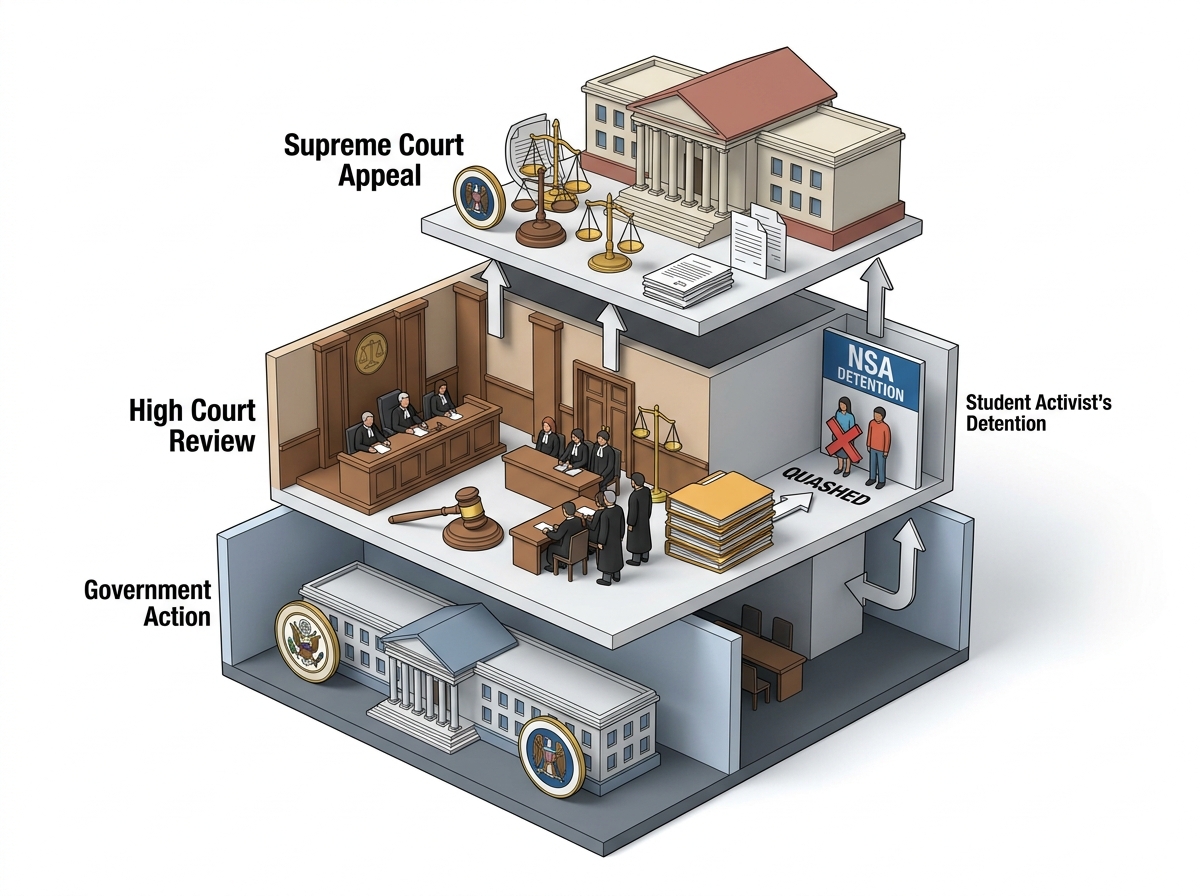
09 Sep UP Challenges HC Order Quashing NSA Detention of Student Activist in SC
✎ Preventive detention under the NSA is an exceptional measure requiring strict adherence to constitutional safeguards; judicial scrutiny ensures that executive discretion does not infringe upon fundamental rights.
Subject Relevance — Where This Topic Fits
- GS Paper II — Fundamental Rights and Directive Principles of State Policy | GS Paper III — Role of Judiciary and Executive in Governance
- Prelims: National Security Act (NSA), 1980, Habeas Corpus, Article 21 (Right to Life and Personal Liberty), Article 22 (Preventive Detention), Supreme Court’s Special Leave Petition (SLP), Allahabad High Court, Compensation for wrongful detention, Freedom of Speech and Expression (Article 19(1)(a))
- Essay: Judicial Activism vs. Executive Discretion: Balancing National Security and Civil Liberties, Preventive Detention Laws: A Necessary Evil or a Tool of Oppression?
Quick Revision: Preventive detention under the NSA is an exceptional measure requiring strict adherence to constitutional safeguards; judicial scrutiny ensures that executive discretion does not infringe upon fundamental rights.
Why is this in the news?
The Uttar Pradesh government has approached the Supreme Court challenging the Allahabad High Court’s order quashing the detention of a student activist under the National Security Act (NSA) and directing compensation of ₹5 lakh to be recovered from the salaries of district officials. This case underscores the judiciary’s role in scrutinising executive actions under preventive detention laws, particularly where claims of national security are pitted against constitutional rights to liberty and free expression.
Background
- The National Security Act (NSA), 1980, empowers the state to detain individuals without trial for up to 12 months to prevent actions prejudicial to national security or public order.
- Preventive detention is an exception to the general rule of requiring a trial for criminal offences, justified by the need to prevent harm before it occurs.
- The Allahabad High Court, in its order, emphasised that detention under the NSA must be strictly in accordance with constitutional safeguards, including the right to a fair and speedy trial.
- The case arose from labour unrest in Gautam Buddha Nagar in April 2026, where the state government alleged the activist’s role in inciting violence, though the High Court found no material evidence to support this claim.
- The High Court’s direction to recover compensation from officials reflects judicial recognition of accountability in cases of arbitrary detention.
- The Supreme Court’s eventual adjudication will clarify the balance between executive discretion in preventive detention and judicial oversight of fundamental rights.
What is Preventive Detention under the National Security Act (NSA), 1980?
- The NSA, enacted in 1980, allows detention of individuals without trial for up to 12 months if the government is satisfied that such detention is necessary to prevent actions prejudicial to national security or public order.
- Detention orders are issued by the District Magistrate or State Government and are subject to review by an Advisory Board comprising High Court judges.
- Preventive detention is distinct from punitive detention (post-conviction imprisonment) and is justified on the grounds of preventing potential harm rather than punishing past acts.
- The Supreme Court has repeatedly held that preventive detention must be resorted to sparingly and only when absolutely necessary, with strict adherence to procedural safeguards.
- The Allahabad High Court’s order in this case reiterates that detention under the NSA cannot be used as a substitute for regular criminal proceedings or to stifle dissent.
- The High Court’s direction to recover compensation from officials highlights the principle of accountability in cases of wrongful detention, aligning with the constitutional guarantee of Article 21.
Key Features
| Feature | Significance |
|---|---|
| National Security Act (NSA), 1980 | A preventive detention statute empowering the state to detain individuals without trial to prevent actions prejudicial to national security or public order, subject to judicial review. |
| Habeas Corpus Petition | A constitutional remedy under Article 32/226 to secure the release of a person unlawfully detained, ensuring adherence to due process and fundamental rights. |
| Judicial Review of Administrative Action | The constitutional principle that empowers higher courts to examine the legality of executive decisions, ensuring accountability and adherence to the rule of law. |
| Compensation for Illegal Detention | Judicial remedy for violation of Article 21 (Right to Life and Personal Liberty), reinforcing state accountability for arbitrary executive actions. |
| Freedom of Speech and Expression (Article 19(1)(a)) | A fundamental right whose boundaries are tested when state actions under preventive detention statutes intersect with dissent and protest. |
Why it Matters
Legal and Constitutional Significance
- The Allahabad High Court’s order underscores the judiciary’s role in curbing executive overreach under preventive detention statutes, particularly the NSA, which is often criticised for its potential misuse against dissent.
- The judgment reinforces the principle that preventive detention cannot be used as a substitute for regular criminal procedure, especially where the alleged offence does not meet the threshold of ‘national security’ or ‘public order’ disruption.
- The directive to recover compensation from officials, including the District Magistrate and SHO, establishes a precedent for administrative accountability in cases of illegal detention, aligning with the doctrine of constitutional torts.
- The case highlights the tension between state authority to maintain public order and the fundamental rights of citizens, particularly during protests and labour unrest, necessitating a balanced approach.
Governance and Institutional Implications
- The Uttar Pradesh government’s appeal to the Supreme Court reflects the executive’s recourse to higher judicial scrutiny when lower courts strike down its actions, a routine feature in governance disputes.
- The case exemplifies the judiciary’s capacity to act as a check on executive discretion, particularly in matters involving civil liberties and preventive detention, which are prone to abuse.
- The recovery of compensation from officials may deter arbitrary use of preventive detention, though it also raises questions about the chilling effect on bureaucratic decision-making.
- The matter arose from labour unrest, underscoring the need for state mechanisms to address grievances through dialogue rather than coercive measures, to prevent escalation into violence.
Judicial Precedents and Evolving Jurisprudence
- The Allahabad High Court’s reasoning aligns with the Supreme Court’s jurisprudence on preventive detention, which requires material facts and not mere suspicion to justify detention under the NSA.
- The judgment reinforces the principle that the NSA cannot be invoked to suppress dissent or protest, unless there is clear evidence of incitement to violence or a conspiracy to disrupt public order.
- The case adds to the body of jurisprudence on compensation for illegal detention, a remedy increasingly recognised under Article 21 and common law principles of constitutional torts.
Challenges
1. Preventive Detention and Executive Overreach
- The NSA’s broad and subjective provisions create scope for misuse against activists, journalists, and protesters, particularly during civil unrest.
- The executive’s reliance on preventive detention during protests risks escalating tensions rather than addressing grievances through dialogue or legal recourse.
- The lack of a time-bound review mechanism for NSA detentions exacerbates concerns about prolonged incarceration without trial, violating the principle of ‘procedure established by law’.
- The chilling effect on free speech and assembly, where individuals may refrain from participating in protests due to fear of detention under the NSA.
UPSC Link: GS-II: Fundamental Rights and DPSP
2. Judicial Review and Separation of Powers
- The judiciary’s role in reviewing executive actions under preventive detention statutes must balance security concerns with civil liberties, avoiding judicial activism or excessive deference to the executive.
- The Allahabad High Court’s order, while protecting rights, raises questions about the scope of judicial intervention in matters of public order, where the executive often claims superior expertise.
- The recovery of compensation from officials may deter proactive governance but could also lead to risk-averse decision-making, affecting administrative efficiency.
UPSC Link: GS-II: Judiciary and Judicial Review
3. Compensation and Administrative Accountability
- The directive to recover compensation from officials, including the District Magistrate, introduces a novel mechanism for holding the bureaucracy accountable for illegal detention.
- However, the recovery of compensation from officials may not address systemic issues in preventive detention practices, which require structural reforms rather than punitive measures.
- The financial burden on officials could discourage proactive governance, particularly in high-risk areas like law and order, where discretionary decisions are often necessary.
UPSC Link: GS-IV: Ethics and Governance
4. Labour Unrest and State Response
- The case highlights the state’s failure to address labour grievances through dialogue, leading to protests that escalated into violence, necessitating coercive measures like preventive detention.
- The executive’s response to labour unrest often prioritises suppression over resolution, exacerbating industrial disputes and undermining trust in state institutions.
- The judiciary’s intervention in such cases underscores the need for institutional mechanisms to address grievances before they escalate, such as labour commissions or mediation cells.
UPSC Link: GS-III: Indian Economy and Labour Issues
5. Freedom of Speech and Protest Rights
- The NSA’s invocation during protests raises concerns about the state’s commitment to protecting freedom of speech and assembly, which are essential for a vibrant democracy.
- The lack of clear guidelines on the distinction between dissent and incitement to violence creates ambiguity, leading to arbitrary detentions and suppression of legitimate protest.
- The judiciary’s role in delineating these boundaries is critical to prevent the misuse of preventive detention statutes against activists and protesters.
UPSC Link: GS-II: Fundamental Rights
Challenges — UPSC Perspective
| Issue | Concern |
|---|---|
| Broad NSA Provisions | Risk of misuse against dissent, activists, and protesters due to subjective grounds of detention. |
| Executive Overreach | Tendency to rely on preventive detention during protests, escalating tensions rather than addressing grievances. |
| Judicial Review Constraints | Balancing security concerns with civil liberties while avoiding judicial activism or excessive deference to the executive. |
| Compensation Mechanism | Potential chilling effect on administrative efficiency and risk-averse decision-making by officials. |
| Labour Unrest Management | State’s failure to address grievances through dialogue, leading to escalation and coercive measures. |
| Freedom of Speech Boundaries | Ambiguity in distinguishing dissent from incitement to violence, risking suppression of legitimate protest. |
Way Forward
- Strengthen the **National Security Act (NSA) review mechanism** by introducing mandatory judicial review within 48 hours of detention, with periodic reviews every 30 days to prevent prolonged incarceration without trial.
- Establish **independent oversight committees** at the district and state levels to scrutinise detention orders under the NSA, comprising retired judges, civil society representatives, and legal experts.
- Formulate **clear guidelines** for state authorities on the invocation of the NSA, distinguishing between dissent and incitement to violence, and ensuring adherence to constitutional principles.
- Promote **alternative dispute resolution mechanisms** for labour unrest, such as labour commissions or mediation cells, to address grievances before they escalate into protests or violence.
- Enhance **training programmes** for police and district magistrates on the constitutional limits of preventive detention, emphasising the balance between public order and fundamental rights.
- Encourage **proactive dialogue** between the state and protesting groups to address grievances, reducing reliance on coercive measures like preventive detention.
- Expand **legal aid services** for detainees under the NSA, ensuring access to counsel and timely judicial review to prevent arbitrary detention.
- Conduct **periodic audits** of NSA detentions by the National Human Rights Commission (NHRC) or state human rights commissions to identify patterns of misuse and recommend systemic reforms.
UPSC Value Addition
Keywords for Mains Answer-Writing
National Security Act, 1980 · Article 21 of the Constitution · Habeas Corpus · Right to Personal Liberty · Procedural Safeguards · Judicial Review · Executive Discretion vs Judicial Scrutiny · Compensation for Wrongful Detention · Supreme Court of India · Allahabad High Court · Fundamental Rights · Due Process of Law · State Action and Accountability · Freedom of Speech and Expression · Administrative Accountability · Judicial Activism in Detention Cases
Constitutional & Policy Linkages
- {‘Article 21’: ‘Right to Life and Personal Liberty’}
- {‘Article 19(1)(a)’: ‘Freedom of Speech and Expression’}
- {‘Article 22’: ‘Protection against arrest and detention in certain cases’}
- {‘Article 32’: ‘Right to Constitutional Remedies’}
- {‘Article 226’: ‘Power of High Courts to issue writs’}
Concept Flow
Labour unrest in Gautam Buddha Nagar (April 2026) → Protests over low wages and working conditions → Alleged role of student activist in escalating tensions → State invokes NSA for detention → Habeas corpus petition filed → Allahabad HC quashes detention, awards compensation → State challenges HC order in Supreme Court → Judicial scrutiny of executive action under NSA → Broader debate on preventive detention and civil liberties.
Prelims Practice Questions
Q1. Consider the following statements regarding the National Security Act (NSA), 1980:
1. The NSA empowers the Central Government or State Governments to detain a person to prevent him from acting in any manner prejudicial to the defence of India, the relations of India with foreign powers or the security of India.
2. The maximum period of detention under the NSA is 12 months.
3. The detaining authority is required to communicate the grounds of detention to the detenu within 5 days of the detention order.
4. The detention order can be reviewed by a committee comprising a High Court judge.
How many of the above statements are correct?
- Only one
- Only two
- Only three
- All
Answer: Only three — Statements 1 and 3 are correct. Statement 2 is incorrect as the maximum period of detention under the NSA is 12 months but can be extended. Statement 4 is incorrect as the review committee under the NSA consists of a government-appointed officer, not necessarily a High Court judge.
Q2. Assertion (A): The Supreme Court of India has the power to grant compensation for wrongful detention under the National Security Act (NSA), 1980.
Reason (R): The Constitution of India, under Article 32, empowers the Supreme Court to issue directions or orders or writs for the enforcement of any of the rights conferred by Part III of the Constitution.
Options:
A. Both A and R are true, and R is the correct explanation of A.
B. Both A and R are true, but R is not the correct explanation of A.
C. A is true, but R is false.
D. A is false, but R is true.
Answer: ? — Both the Assertion (A) and Reason (R) are true. The Supreme Court, under Article 32, can grant compensation for wrongful detention as part of its power to enforce fundamental rights. However, the power to grant compensation is not explicitly mentioned in the NSA but is derived from the Supreme Court’s constitutional jurisdiction.
Q3. Match the following provisions of the Constitution of India with their corresponding articles:
Column I (Provision)
A. Protection of life and personal liberty
B. Right to move the Supreme Court for enforcement of rights
C. Protection against arrest and detention in certain cases
D. Equality before law
Column II (Article)
1. Article 14
2. Article 21
3. Article 32
4. Article 22
Options:
A. A-2, B-3, C-4, D-1
B. A-1, B-2, C-3, D-4
C. A-3, B-4, C-1, D-2
D. A-4, B-1, C-2, D-3
Answer: ? — The correct match is: A-2 (Article 21: Protection of life and personal liberty), B-3 (Article 32: Right to move the Supreme Court for enforcement of rights), C-4 (Article 22: Protection against arrest and detention in certain cases), D-1 (Article 14: Equality before law).
Mains Practice Question
✍ The invocation of the National Security Act (NSA), 1980, against individuals engaged in legitimate protest or dissent raises critical questions about the balance between executive discretion and judicial scrutiny in matters of personal liberty. Critically examine the constitutional and statutory safeguards against arbitrary detention under the NSA, with particular reference to the recent Allahabad High Court judgment quashing the NSA detention of a student activist. Also, analyse the implications of such judicial interventions for administrative accountability in India. (15 Marks)
Approach: MODEL-ANSWER SKELETON:
1. **Introduction (2 marks)**: Define the NSA, 1980, and its purpose (preventive detention for national security). State the constitutional context: Article 21 (Right to Life and Personal Liberty) and Article 22 (Protection against arrest and detention). Highlight the tension between executive power and judicial review.
2. **Constitutional and Statutory Safeguards (5 marks)**:
– **Article 22(5)**: Mandates communication of grounds of detention to the detenu within 5 days.
– **Article 22(6)**: Excludes the right to be informed of the grounds of detention from judicial review.
– **Judicial Review under Article 32/226**: Courts can examine the legality of detention orders.
– **Procedural Safeguards**: Detention must be based on ‘satisfaction of the authority’ (subjective satisfaction) but must not be arbitrary or mala fide.
– **Judicial Precedents**: Cite *A.K. Roy v. Union of India* (1982) on the scope of judicial review under the NSA.
3. **Analysis of the Allahabad High Court Judgment (4 marks)**:
– **Facts**: Detention of a student activist under NSA quashed for violating Article 21 (right to liberty). Court held grounds of detention were speculative, repetitive, and lacked material evidence.
– **Legal Reasoning**: Court emphasized that NSA detention is an exception, not a substitute for regular bail. Highlighted the failure of the state to prove incitement to violence.
– **Compensation Order**: Rs 5 lakh compensation and recovery from officials’ salaries (accountability mechanism).
4. **Administrative Accountability and Implications (4 marks)**:
– **Accountability Mechanisms**: Role of courts in ensuring executive accountability (writ jurisdiction, compensation orders).
– **Chilling Effect on Dissent**: Discuss how arbitrary NSA detentions may suppress legitimate protest (Article 19(1)(a) and (c)).
– **Executive-Judiciary Balance**: Need for proportionality in invoking NSA; courts as guardians of fundamental rights.
– **Conclusion**: Judicial interventions strengthen constitutional democracy but must balance security concerns with civil liberties.
Source: orissapost.com
Generated by AanyaAi for educational purpose.
Related guides on our sites
- Current affairs for upsc 2026
- Best PSIR optional coaching for upsc
- Best Law optional coaching for upsc
- Best PSIR optional teacher for upsc

- Gurugram’s groundwater extraction exceeds limit by 212%; HC seeks ban - October 4, 2026
- स्वतंत्रता सेनानी श्यामजी कृष्ण वर्मा की जन्म जयंती पर पीएम का श्रद्धांजलि - October 4, 2026
- KWML’s Feasibility Reports for Water Metro in 18 Cities: UPSC & PCS Insights - October 3, 2026

No Comments