


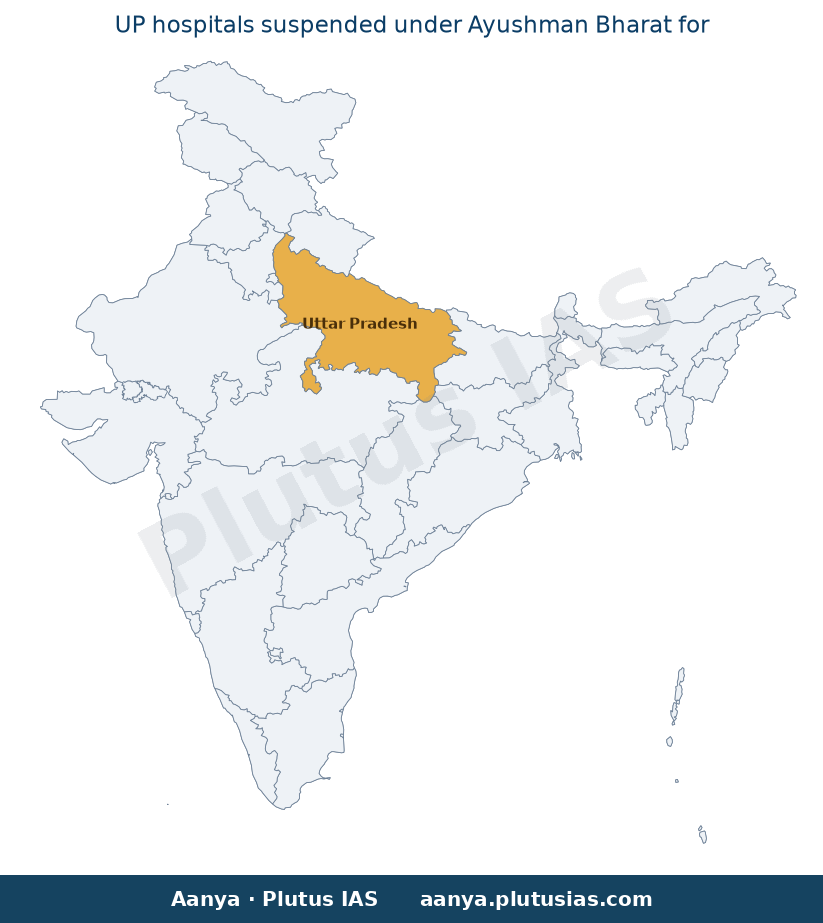
11 Aug UP Suspends 148 Hospitals Under Ayushman Bharat for Fire Safety Violations
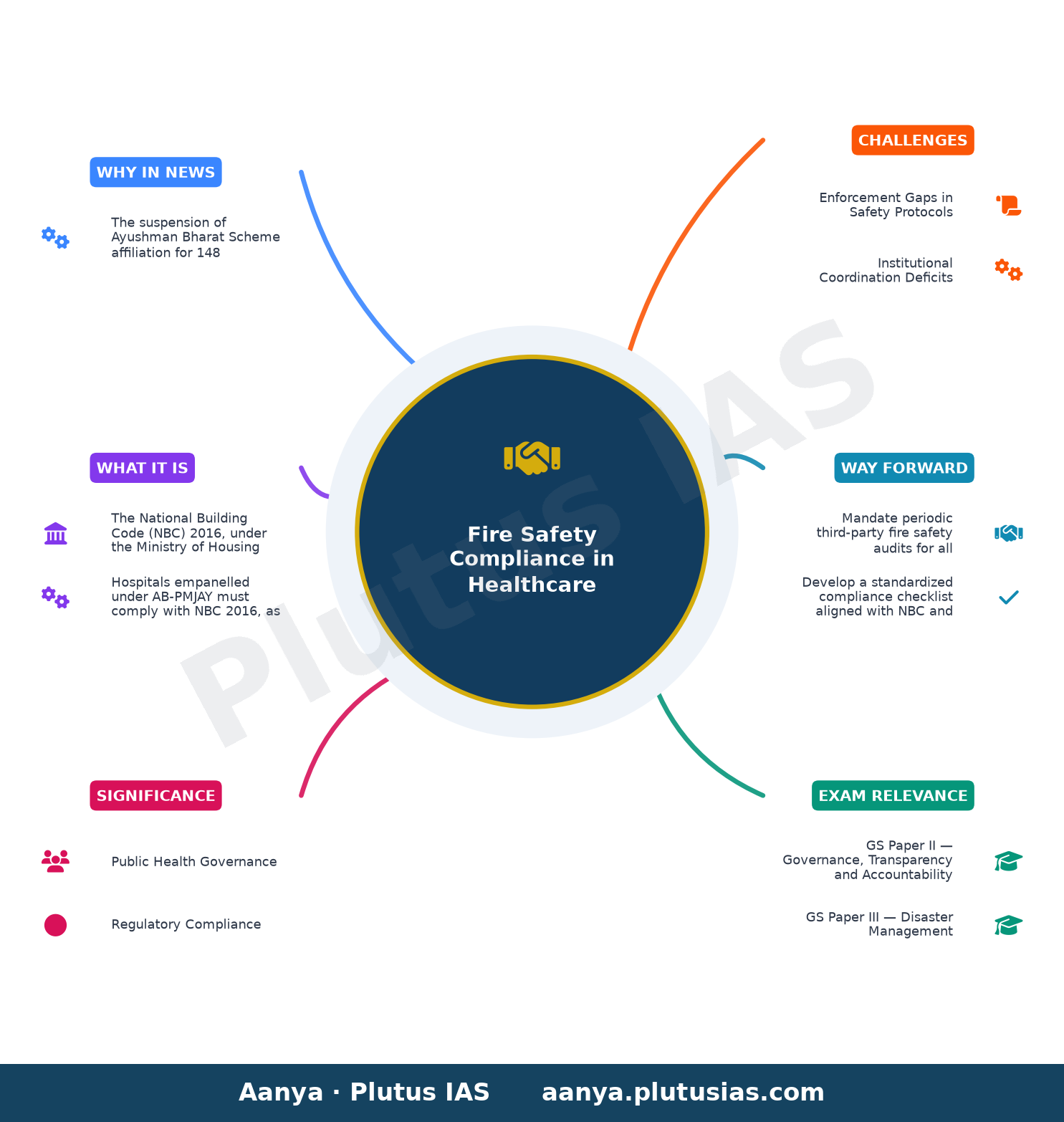
✎ Fire safety compliance for hospitals under AB-PMJAY is governed by NBC 2016, with non-compliance leading to temporary suspension of empanelment until verified rectification.
Subject Relevance — Where This Topic Fits
- GS Paper II — Governance, Transparency and Accountability | GS Paper III — Disaster Management
- Prelims: Fire Safety Norms, Ayushman Bharat Pradhan Mantri Jan Arogya Yojana (AB-PMJAY), National Building Code (NBC) 2016, Fire Safety Audit, Healthcare Infrastructure Regulation
- Essay: Role of Regulatory Mechanisms in Public Health Safety, Balancing Healthcare Accessibility with Safety Standards
Quick Revision: Fire safety compliance for hospitals under AB-PMJAY is governed by NBC 2016, with non-compliance leading to temporary suspension of empanelment until verified rectification.
Why is this in the news?
The suspension of Ayushman Bharat Scheme affiliation for 148 hospitals in Uttar Pradesh, following fire safety audit deficiencies, underscores the critical intersection of public health service delivery and mandatory safety compliance. This action reflects a governance response to systemic risks in healthcare infrastructure, particularly in the aftermath of fire-related incidents, and highlights the procedural framework for ensuring adherence to safety norms in institutions empanelled under national health schemes.
Background
- The National Building Code (NBC) 2016, issued by the Bureau of Indian Standards (BIS), mandates fire safety provisions for all public buildings, including hospitals, to mitigate risks of fire hazards.
- The Ayushman Bharat Pradhan Mantri Jan Arogya Yojana (AB-PMJAY), launched in 2018, is a centrally sponsored health insurance scheme providing financial protection to vulnerable populations for secondary and tertiary care.
- Empanelment of hospitals under AB-PMJAY requires compliance with multiple regulatory standards, including fire safety, structural integrity, and emergency preparedness.
- Institutions failing to meet these standards are subject to suspension or derecognition, as per the operational guidelines of the scheme.
- The recent enforcement action in Uttar Pradesh follows a state-wide audit of healthcare facilities post-incident reviews, indicating a proactive governance approach to risk mitigation.
Fire Safety Norms in Healthcare Facilities and Ayushman Bharat Scheme Compliance
- The National Building Code (NBC) 2016, under the Ministry of Housing and Urban Affairs, prescribes comprehensive fire safety guidelines for hospitals, including fire-resistant construction materials, emergency exits, fire alarms, and trained personnel for fire drills.
- Hospitals empanelled under AB-PMJAY must comply with NBC 2016, as stipulated in the scheme’s operational guidelines, to ensure patient safety and continuity of services.
- Compliance verification involves initial self-assessment by hospitals, followed by government-conducted audits and, where necessary, third-party evaluations to ensure objectivity.
- Non-compliance triggers corrective action plans, with suspension of empanelment as a last resort to prevent service disruption while addressing deficiencies.
- The suspension of affiliation under AB-PMJAY is a temporary measure; reinstatement occurs only after verified rectification of all identified fire safety gaps and submission of compliance certificates.
- This enforcement mechanism aligns with the broader objectives of the Disaster Management Act, 2005, which mandates preparedness for natural and man-made disasters in critical infrastructure.
- The incident highlights the role of state-level agencies in enforcing central schemes, ensuring that local governance mechanisms align with national safety standards.
- Long-term implications include improved accountability in healthcare infrastructure management, reduced liability risks, and enhanced public trust in government health services.
Key Features
| Feature | Significance |
|---|---|
| Third-party fire safety audit | Ensures unbiased assessment of compliance with National Building Code (NBC) and National Disaster Management Authority (NDMA) guidelines. |
| Suspension of Ayushman Bharat empanelment | Acts as a deterrent and enforces accountability for non-compliance with fire safety norms in healthcare facilities. |
| Immediate corrective directives | Facilitates expeditious remediation of identified gaps to prevent recurrence of fire hazards. |
| State Health Agency (SACHIJ) oversight | Demonstrates institutional mechanism for monitoring and enforcing safety standards across public and private hospitals. |
Why it Matters
Public Health Governance
- Highlights the critical role of fire safety in healthcare infrastructure to safeguard patient and staff lives.
- Emphasizes the integration of safety protocols within health service delivery under Ayushman Bharat.
Regulatory Compliance
- Reinforces the mandatory adherence to the National Building Code (Part 4: Fire and Life Safety) and NDMA guidelines.
- Demonstrates the enforcement of statutory safety provisions in healthcare establishments.
Risk Mitigation
- Prevents potential fire-related disasters in hospitals, which could lead to mass casualties and operational disruptions.
- Protects the financial and reputational integrity of healthcare institutions by avoiding penalties and legal liabilities.
Challenges
1. Enforcement Gaps in Safety Protocols
- Persistent non-compliance despite existing regulations indicates systemic issues in monitoring and implementation.
- Delays in remediation due to bureaucratic or logistical hurdles can exacerbate risks.
- Resource constraints in smaller hospitals may hinder full compliance with safety standards.
UPSC Link: GS3: Disaster Management
2. Institutional Coordination Deficits
- Need for seamless collaboration between state agencies, local authorities, and hospital managements.
- Lack of standardized audit protocols can lead to inconsistent enforcement across regions.
UPSC Link: GS2: Centre-State Relations
3. Public Awareness and Training
- Inadequate fire safety drills and staff training in healthcare facilities contribute to vulnerabilities.
- Patients and visitors often remain unaware of emergency protocols in hospitals.
UPSC Link: GS3: Disaster Management
Challenges — UPSC Perspective
| Issue | Concern |
|---|---|
| Delayed remediation | Prolongs exposure to fire hazards in high-risk environments. |
| Inconsistent audit quality | Third-party audits may vary in rigor, leading to uneven enforcement. |
| Resource disparities | Smaller hospitals lack funds or technical expertise for full compliance. |
| Regulatory fragmentation | Overlapping jurisdictions between state and central agencies create confusion. |
Way Forward
- Mandate periodic third-party fire safety audits for all healthcare facilities, with real-time reporting to state agencies.
- Develop a standardized compliance checklist aligned with NBC and NDMA guidelines for uniform enforcement.
- Establish a dedicated state-level fire safety cell within SACHIJ to oversee monitoring and grievance redressal.
- Conduct mandatory fire safety drills and staff training programs in all empanelled hospitals.
- Create a public dashboard to display compliance status of hospitals, enhancing transparency and accountability.
- Introduce financial incentives for hospitals achieving full compliance, alongside penalties for non-adherence.
- Collaborate with National Disaster Response Force (NDRF) to conduct mock drills and capacity-building exercises.
UPSC Value Addition
Keywords for Mains Answer-Writing
Ayushman Bharat Scheme · Fire Safety Norms in Hospitals · Healthcare Infrastructure Regulation · Ayushman Bharat Health Accounts · National Health Authority · Hospital Accreditation and Compliance · Public Health Infrastructure · Healthcare Governance · Fire Safety Audit · Third-Party Audits in Healthcare · Ayushman Bharat Pradhan Mantri Jan Arogya Yojana · Healthcare Quality Assurance
Concept Flow
Fire safety audit identifies non-compliance in hospitals → State Health Agency (SACHIJ) issues corrective directives → Third-party re-audit confirms deficiencies → Ayushman Bharat empanelment suspended for non-compliant hospitals → Remediation process initiated with timelines for restoration → Re-audit and re-empanelment upon compliance verification
Prelims Practice Questions
Q1. Consider the following statements regarding the Ayushman Bharat Pradhan Mantri Jan Arogya Yojana (AB-PMJAY):
1. AB-PMJAY is a centrally sponsored scheme that provides health coverage to vulnerable sections of society.
2. The scheme is implemented by the National Health Authority (NHA) under the Ministry of Health and Family Welfare.
3. Hospitals empanelled under AB-PMJAY are exempt from compliance with fire safety norms as they are healthcare facilities.
4. The scheme aims to cover secondary and tertiary care hospitalization for the bottom 40% of the population.
How many of the above statements are correct?
- Only one
- Only two
- Only three
- All
Answer: Only three — Statements 1, 2, and 4 are correct. Statement 3 is incorrect as hospitals empanelled under AB-PMJAY must comply with all statutory norms, including fire safety regulations.
Q2. Assertion (A): The National Health Authority (NHA) is the apex body responsible for the implementation of the Ayushman Bharat Pradhan Mantri Jan Arogya Yojana (AB-PMJAY).
Reason (R): The NHA operates under the administrative control of the Ministry of Health and Family Welfare, Government of India.
Codes:
A. Both A and R are true, and R is the correct explanation of A.
B. Both A and R are true, but R is NOT the correct explanation of A.
C. A is true, but R is false.
D. A is false, but R is true.
- A
- B
- C
- D
Answer: A — Both Assertion (A) and Reason (R) are true, and R correctly explains A, as the NHA is indeed the implementing agency under the Ministry of Health and Family Welfare.
Mains Practice Question
✍ Critically examine the regulatory framework governing fire safety compliance in healthcare facilities empanelled under the Ayushman Bharat Pradhan Mantri Jan Arogya Yojana (AB-PMJAY). In your answer, discuss the role of third-party audits, the consequences of non-compliance, and the implications for public health governance. (15 Marks)
Approach: MODEL-ANSWER SKELETON:
1. **Regulatory Framework for Fire Safety in Healthcare Facilities:**
– Reference the **National Building Code of India (NBC) 2016**, **Fire Safety Regulations under the Factories Act, 1948**, and **State-specific Fire Safety Rules** (e.g., Uttar Pradesh Fire Prevention and Life Safety Measures Act, 2005).
– Highlight the **mandatory provisions** such as fire-resistant construction, emergency exits, fire alarms, and periodic inspections.
2. **Ayushman Bharat PMJAY and Healthcare Facility Compliance:**
– **NHA Guidelines (2018-2024):** Emphasize that empanelment under AB-PMJAY requires strict adherence to **fire safety norms** as a prerequisite for eligibility.
– **Third-Party Audits:** Discuss the **mandate for independent audits** (e.g., by certified agencies like **Bureau of Indian Standards (BIS)** or **National Fire Service College**) to ensure objective compliance assessment.
3. **Consequences of Non-Compliance:**
– **Suspension of Empanelment:** Reference the **NHA’s power to suspend or delist hospitals** failing fire safety audits (as seen in the Uttar Pradesh case where 148 hospitals were delisted).
– **Legal Liability:** Cite **Section 304A of the Indian Penal Code (IPC)** for negligence leading to loss of life, and **Disaster Management Act, 2005** for accountability.
4. **Public Health Governance Implications:**
– **Accountability of State Agencies:** Discuss the role of **State Health Departments** and **District Disaster Management Authorities** in enforcing compliance.
– **Data-Driven Oversight:** Highlight the need for **centralized digital monitoring** (e.g., **Ayushman Bharat Health Accounts**) to track compliance across states.
5. **Critical Analysis and Way Forward:**
– **Challenges:** Cite **resource constraints** in rural/remote hospitals, **lack of standardized audit protocols**, and **corruption risks** in third-party audits.
– **Recommendations:** Propose **mandatory fire safety training for hospital staff**, **integration with the National Disaster Management Plan**, and **public grievance redressal mechanisms**.
6. **Balanced View:**
– Acknowledge that while **strict enforcement** is necessary, **one-size-fits-all policies** may not address ground realities (e.g., older hospitals with structural limitations).
Source: amarujala.com
Generated by AanyaAi for educational purpose.

- Gurugram’s groundwater extraction exceeds limit by 212%; HC seeks ban - October 4, 2026
- स्वतंत्रता सेनानी श्यामजी कृष्ण वर्मा की जन्म जयंती पर पीएम का श्रद्धांजलि - October 4, 2026
- KWML’s Feasibility Reports for Water Metro in 18 Cities: UPSC & PCS Insights - October 3, 2026

No Comments