


22 Jul UPSC 2026: PMKVY 4.0 Review Highlights Demand-Driven Skill Development
Subject Relevance — Where This Topic Fits
- GS Paper III — Economy (Skill Development and Employment, Labour Reforms, Inclusive Growth) | GS Paper II — Governance (Public Policy, Skill Ecosystem, Decentralised Governance)
- Prelims: PMKVY, Skill Impact Bond, NSDC, RPL, AJNIFM, Skill Outcome Fund, Decentralised Skill Planning, AI, Cyber Security, Semiconductor, 5G, IoT, Drone Technology, Green Hydrogen, Additive Manufacturing
- Essay: The Role of Skill Development in India’s Demographic Dividend, Bridging the Skill Gap: A Catalyst for Sustainable Employment and Economic Growth
Quick Revision: PMKVY is India’s demand-driven skill certification scheme, evolving from certification-focused training to outcome-based employment generation, with measurable impacts on wage increments, retention, and industry alignment, particularly in futuristic sectors like AI, cybersecurity, and green house.
Why is this in the news?
The Ministry of Skill Development and Entrepreneurship (MSDE) conducted a comprehensive review of the Pradhan Mantri Kaushal Vikas Yojana (PMKVY) in July 2026, highlighting its evolution into a demand-driven, industry-aligned, and outcome-focused skill development initiative. The review underscored the launch of the Skill Outcome Fund with a corpus of ₹530 crore to enhance sustainable employment outcomes, the expansion of futuristic sectors like AI, cybersecurity, and green house, and the measurable impact of PMKVY training on employment rates, particularly among women and marginalised groups.
Background
- Launched in 2015 under the Ministry of Skill Development and Entrepreneurship (MSDE), PMKVY is India’s flagship outcome-based skill certification scheme aimed at aligning workforce skills with industry demands.
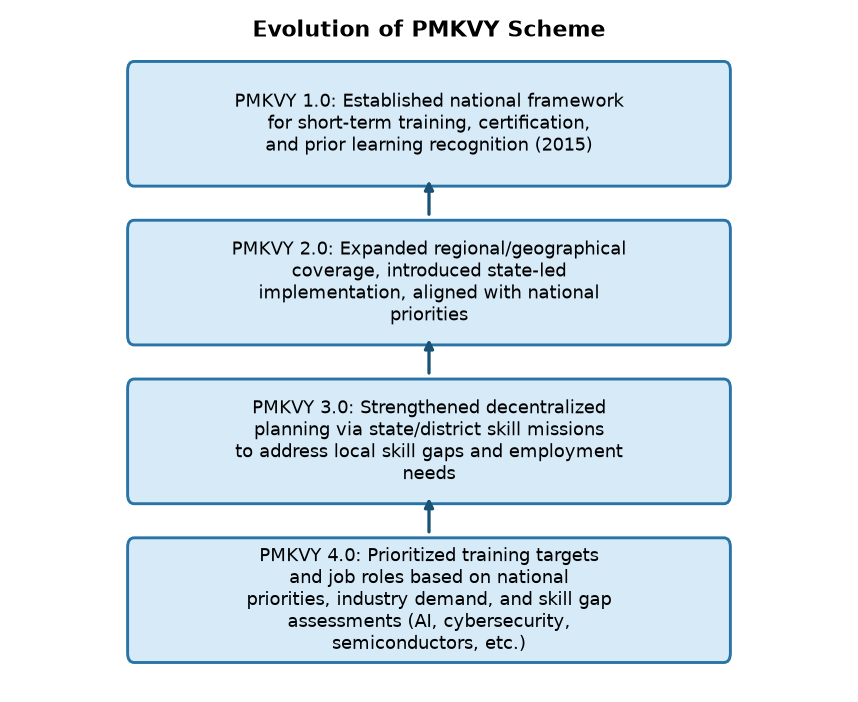
- The scheme has undergone four iterations (PMKVY 1.0 to 4.0), progressively enhancing decentralisation, industry integration, and outcome measurement through state-led and district-level skill committees.
- PMKVY 4.0 prioritises futuristic sectors such as artificial intelligence, cybersecurity, semiconductors, 5G, IoT, drone technology, green house, and additive manufacturing, aligning with India’s National Education Policy (NEP) 2020 and Atmanirbhar Bharat initiatives.
- The Skill Impact Bond, launched by the National Skill Development Corporation (NSDC), targets 50,000 youth (60% women) over four years, focusing on sustainable employment outcomes rather than mere certification.
- Independent evaluations by NITI Aayog (2020) and IIPA (PMKVY 2.0) have consistently demonstrated the scheme’s positive impact on employment, wage increments, and skill retention.
- The Skill Outcome Fund, operationalised by NSDC under MSDE, aims to mobilise ₹530 crore to support two lakh youth through industry-aligned skilling, entrepreneurship, and sustainable livelihoods.
What is the Pradhan Mantri Kaushal Vikas Yojana (PMKVY)?
- PMKVY is a Centrally Sponsored Scheme (CSS) under the Ministry of Skill Development and Entrepreneurship (MSDE), designed to provide industry-relevant skill training to Indian youth, thereby enhancing their employability and productivity.
- The scheme operates on a demand-driven model, where training targets and job roles are identified based on industry demand, skill gap assessments, and regional workforce requirements, ensuring alignment with national development priorities.
- PMKVY 4.0 introduces a decentralised planning framework through State Skill Development Missions (SSDMs) and District Skill Committees (DSCs), enabling grassroots-level identification of local skill gaps and employment opportunities.
- The scheme encompasses multiple components, including Short-Term Training (STT), Recognition of Prior Learning (RPL), and Special Projects, with a focus on measurable employment, income, and retention outcomes.
- PMKVY prioritises futuristic and emerging sectors such as AI, cybersecurity, semiconductors, 5G, IoT, drone technology, green house, and additive manufacturing, aligning with India’s technological and green transition goals.
- The Skill Impact Bond, a results-based financing mechanism, incentivises training partners to achieve sustainable employment outcomes, with at least 60% of beneficiaries being women, thereby promoting gender inclusivity.
- The Skill Outcome Fund, established with a ₹530 crore corpus, aims to support two lakh youth through innovative financing models, including skill vouchers, entrepreneurship-based models, and outcome-linked disbursements.
- PMKVY is implemented by the National Skill Development Corporation (NSDC) in collaboration with Sector Skill Councils (SSCs), training partners, and industry stakeholders, ensuring quality assurance and accountability.
Key Features
| Feature | Significance |
|---|---|
| Demand-driven and industry-aligned training | Ensures relevance of skills to evolving job market, reducing skill mismatches and enhancing employability |
| Decentralised planning via State Skill Missions and District Skill Committees | Tailors interventions to local labour market needs, improving contextual effectiveness and reducing regional disparities |
| Recognition of Prior Learning (RPL) | Validates informal skills, provides certification pathways for existing workers, and improves wage outcomes for certified individuals |
| Skill Impact Bond (2022–2026) | Introduces outcome-based financing, linking payments to measurable employment and retention metrics, with 60% participation from women |
| Skill Outcomes Fund (2026) | Leverages public-private partnerships to scale sustainable livelihood models, integrating CSR and philanthropic capital for long-term impact |
| Focus on futuristic sectors (AI, 5G, semiconductors, green skills) | Aligns skill development with national strategic priorities and emerging technological domains, ensuring future-ready workforce |
| Independent third-party evaluations (NITI Aayog, IIPA, AJNIFM) | Ensures evidence-based policy refinement, accountability, and transparency in programme outcomes |
Why it Matters
Economic
- Reduces structural unemployment by aligning skill supply with industry demand, enhancing labour productivity and economic growth
- Enhances formalisation of the workforce through certification and RPL, contributing to higher tax compliance and social security coverage
- Promotes inclusive growth by prioritising women and marginalised groups in skill development initiatives
Strategic
- Supports India’s ambition to become a global hub for high-tech manufacturing and services through targeted skill interventions
- Facilitates integration with national missions such as Atmanirbhar Bharat and Digital India by developing relevant competencies
- Strengthens self-reliance in critical technologies (semiconductors, AI, 5G) through specialised training programmes
Social
- Improves income mobility and livelihood security by linking training to sustainable employment and entrepreneurship
- Reduces informality in the labour market by recognising and certifying existing skills of informal workers
- Enhances gender equity in the workforce through targeted inclusion in skill development programmes
Governance
- Demonstrates a shift from input-based to outcome-based governance in skill development, ensuring accountability and measurable impact
- Strengthens inter-governmental coordination via State Skill Missions and District Skill Committees, fostering cooperative federalism
- Institutionalises evidence-based policymaking through regular third-party evaluations and data-driven decision-making
Challenges
1. Quality Assurance and Standardisation
- Variation in training quality across sectors and geographies due to diverse implementing partners and certification bodies
- Need for robust accreditation mechanisms to ensure consistency in training standards and outcomes
UPSC Link: GS3: Skill Development
2. Industry-Academia Collaboration Gaps
- Limited alignment between vocational training curricula and industry requirements, leading to skill mismatches
- Insufficient participation of industry in curriculum design, internships, and apprenticeship programmes
UPSC Link: GS3: Skill Development
3. Inclusivity and Accessibility
- Barriers to participation for women, persons with disabilities, and marginalised communities due to socio-economic constraints
- Urban-rural divide in access to skill development infrastructure and opportunities
UPSC Link: GS1: Social Justice
4. Outcome Measurement and Accountability
- Challenges in tracking long-term employment and income outcomes post-training, particularly in informal sectors
- Need for stronger data systems to monitor programme effectiveness and ensure transparency
UPSC Link: GS3: Skill Development
5. Sustainability of Employment Outcomes
- Risk of trained candidates re-entering informal or low-paying jobs due to lack of job creation in targeted sectors
- Need for stronger linkages with entrepreneurship and self-employment ecosystems
UPSC Link: GS3: Skill Development
6. Funding and Resource Mobilisation
- Dependence on government and CSR funding limits scalability and innovation in skill development programmes
- Need for diversified financing models, including impact bonds and outcome-based funding
UPSC Link: GS3: Skill Development
Challenges — UPSC Perspective
| Issue | Concern |
|---|---|
| Training quality variability | Inconsistent standards across sectors and geographies |
| Industry engagement deficit | Limited alignment between training and job market needs |
| Inclusivity barriers | Low participation of women and marginalised groups |
| Outcome tracking gaps | Difficulty in measuring long-term employment and income impacts |
| Sustainability of placements | Risk of trained candidates returning to informal work |
| Funding constraints | Limited scalability due to reliance on public and CSR funds |
Government Initiatives — Must-Memorise for Prelims
- Pradhan Mantri Kaushal Vikas Yojana (PMKVY) 1.0, 2.0, 3.0, 4.0
- Skill Impact Bond (2022–2026)
- Skill Outcomes Fund (2026)
- Recognition of Prior Learning (RPL)
Way Forward
- Strengthen industry-academia partnerships through mandatory internships, apprenticeships, and curriculum co-design
- Expand decentralised planning by empowering State Skill Missions and District Skill Committees with greater autonomy and resources
- Enhance inclusivity by designing gender-responsive and disability-inclusive training programmes with targeted outreach
- Improve outcome measurement through robust data systems, including digital tracking of employment and income trajectories
- Promote entrepreneurship by integrating skill development with access to credit, mentorship, and market linkages
- Diversify funding sources through impact bonds, outcome-based financing, and corporate social responsibility collaborations
- Institutionalise third-party evaluations to ensure continuous improvement and accountability in programme delivery
- Align skill development with emerging technologies (AI, semiconductors, green skills) through specialised training hubs and industry collaborations
UPSC Value Addition
Keywords for Mains Answer-Writing
Pradhan Mantri Kaushal Vikas Yojana (PMKVY) · Skill India Mission · National Skill Development Corporation (NSDC) · Skill Impact Bond · Skill Outcome Fund · District Skill Committees · State Skill Missions · Recognition of Prior Learning (RPL) · Demand-driven skilling · Future-ready job roles · Employability outcomes · Third-party impact assessment · Skill Voucher · Skill financing mechanisms · Green skilling · Emerging technologies (AI, 5G, IoT, drones, semiconductors)
Prelims Practice Questions
Q1. Which of the following components was NOT a feature of PMKVY 1.0?
- Establishment of a National Framework for short-term training, certification, and recognition of prior learning
- Decentralised planning through State Skill Missions and District Skill Committees
- Industry-aligned skill development initiatives
- Focus on certification and employability outcomes
Answer: Decentralised planning through State Skill Missions and District Skill Committees — PMKVY 1.0 (2015) established the National Framework for short-term training, certification, and recognition of prior learning (RPL). Decentralised planning through State Skill Missions and District Skill Committees was introduced in PMKVY 3.0, not 1.0.
Q2. The Skill Impact Bond, launched under PMKVY, aims to benefit approximately how many youth over a four-year period?
- 25,000
- 50,000
- 75,000
- 1,00,000
Answer: 50,000 — The Skill Impact Bond, implemented by NSDC, was designed to benefit 50,000 youth over four years, with a minimum of 60% women.
Q3. Which of the following is NOT a focus area under PMKVY 4.0 for future-ready job roles?
- Artificial Intelligence
- Cyber Security
- Green Hydrogen
- Blockchain Technology
Answer: Blockchain Technology — PMKVY 4.0 prioritises job roles in AI, cyber security, semiconductors, 5G, IoT, drone technology, green hydrogen, and additive manufacturing. Blockchain Technology is not explicitly mentioned.
Q4. As per a third-party impact assessment of PMKVY 4.0 by AJNIFM, what was the increase in the combined share of employed and self-employed participants after PMKVY training?
- 12.2 percentage points
- 18.8 percentage points
- 24.5 percentage points
- 30.1 percentage points
Answer: 18.8 percentage points — The AJNIFM assessment found that the combined share of employed and self-employed participants increased from 26.6% before training to 45.4% after training, reflecting an 18.8 percentage point rise.
Mains Practice Question
✍ Critically examine the evolution of the Pradhan Mantri Kaushal Vikas Yojana (PMKVY) from its inception to PMKVY 4.0. How has the scheme addressed the challenges of demand-driven skilling, employability outcomes, and sustainability in the Indian labour market?
Approach: Begin by outlining the four phases of PMKVY (1.0 to 4.0), highlighting key structural and operational changes such as the shift from input-based to outcome-based frameworks, decentralisation, and industry alignment. Discuss the introduction of instruments like the Skill Impact Bond and Skill Outcome Fund, and their role in ensuring measurable employment and income outcomes. Analyse the impact assessment data (e.g., AJNIFM report) to substantiate improvements in employability. Conclude with challenges such as regional disparities, quality assurance, and the need for continuous third-party evaluations to ensure the scheme’s relevance and effectiveness in meeting India’s evolving skill demands.
Source: PIB (Press Information Bureau)
Generated by AanyaAi for educational purpose.

- पूर्व आईएएस अधिकारी हत्या मामले में आईएएस एसोसिएशन की मुख्यमंत्री से मुलाकात - October 23, 2026
- UPSC Exam: Rare Glimpse of Ritwik Ghatak’s Cinematic Legacy at 4-Day Festival - October 23, 2026
- आरबीआई ने सूरि फ्रेंड्स यूनियन सहकारी बैंक पर निदेशों का विस्तार किया, जानिए क्या है पूरा मामला - October 23, 2026

No Comments