


07 Sep UPSC 2026: भारत की ब्लू इकॉनमी में RAS & बायोफ्लॉक तकनीक की भूमिका
✎ Recirculatory Aquaculture Systems (RAS) and Biofloc Technology are advanced aquaculture methods that enable high-density, resource-efficient, and environmentally sustainable fish farming by recirculating water and utilising…
Subject Relevance — Where This Topic Fits
- GS Paper III — Agriculture, Food Processing and Related Industries | GS Paper III — Environment, Conservation and Climate Change | GS Paper III — Science and Technology — Developments and their Applications and Effects in Everyday Life | GS Paper III — Economic Development and Employment | GS Paper III — Infrastructure — Energy, Ports, Roads, Airports, Railways
- Prelims: Blue Economy, Aquaculture, Recirculatory Aquaculture System (RAS), Biofloc Technology, Pradhan Mantri Matsya Sampada Yojana (PMMSY), Fisheries and Aquaculture Infrastructure Development Fund (FIDF), Marine Exports, Food and Nutritional Security, Sustainable Livelihoods, Resource Efficiency, Circular Economy
- Essay: The Role of Technology in Sustainable Development: A Case Study of India’s Blue Economy, From Subsistence to Self-Reliance: Transforming India’s Fisheries Sector
Quick Revision: Recirculatory Aquaculture Systems (RAS) and Biofloc Technology are advanced aquaculture methods that enable high-density, resource-efficient, and environmentally sustainable fish farming by recirculating water and utilising microbial processes to enhance productivity and reduce waste.
Why is this in the news?
A press release by the Ministry of Fisheries, Animal Husbandry and Dairying highlights the strategic importance of modern fisheries and aquaculture in India’s economic growth, particularly through the adoption of advanced technologies such as Recirculatory Aquaculture Systems (RAS) and Biofloc technology. This development is framed within the broader vision of the Blue Economy, aiming to enhance food security, rural prosperity, export earnings, and sustainability. The announcement underscores the role of public investment and policy interventions in driving this transformation, with a focus on resource efficiency, technological innovation, and global competitiveness.
Background
- The fisheries sector supports the livelihoods of nearly 30 million fishermen and fish farmers and generates employment across the value chain, including production, processing, marketing, and exports.
- The sector has witnessed a significant increase in public investment, with cumulative approvals of over ₹39,272 crore since 2015 under various schemes aimed at modernising infrastructure, adopting technology, and improving market access.
- India’s annual fish production has more than doubled from 95.79 lakh tonnes in 2013-14 to a projected 198 lakh tonnes in 2024-25, driven primarily by inland fisheries and aquaculture.
- Marine food exports have surged from ₹30,213 crore in 2013-14 to an estimated ₹73,890 crore in 2025-26, reflecting India’s growing competitiveness in global seafood markets despite trade challenges.
- The Blue Economy, encompassing sustainable utilisation of ocean resources, is a key pillar of India’s economic strategy.
What are Recirculatory Aquaculture Systems (RAS) and Biofloc Technology?
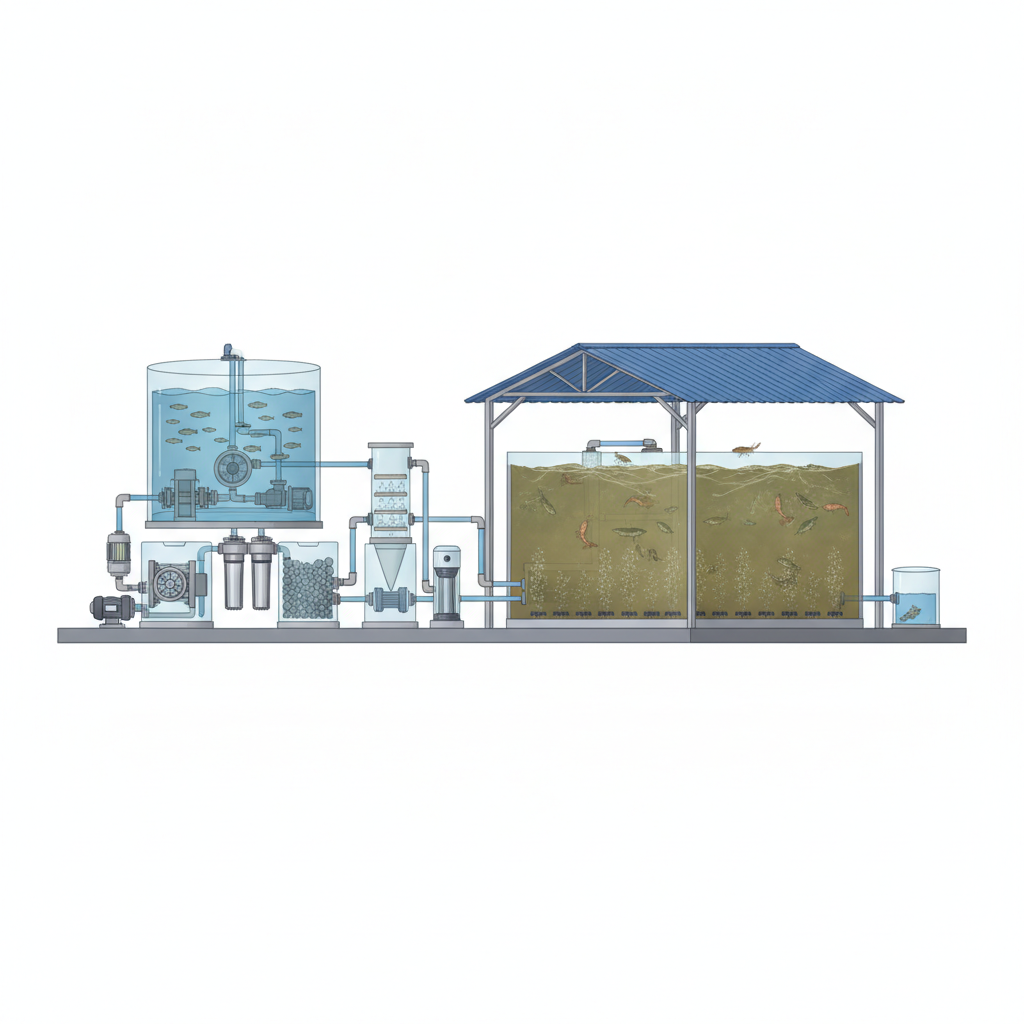
- Recirculatory Aquaculture Systems (RAS) are closed-loop aquaculture systems that recirculate and treat water to maintain optimal conditions for fish growth.
- RAS enables high-density fish farming in controlled environments, minimising environmental impact and allowing for year-round production, independent of seasonal variations.
- Biofloc Technology utilises beneficial microorganisms to improve water quality by converting waste metabolites (such as ammonia) into microbial protein, which serves as a supplementary feed for fish, thereby reducing feed costs and enhancing growth rates.
- Biofloc systems create a symbiotic environment where fish, bacteria, and algae coexist, improving nutrient recycling and reducing the need for water exchange, which is particularly advantageous in water-scarce regions.
- Both RAS and Biofloc technologies enhance the sustainability of aquaculture by reducing reliance on natural water bodies, lowering effluent discharge, and improving resource efficiency.
- These technologies are scalable and adaptable to diverse agro-climatic conditions, making them viable for both rural and urban settings, including proximity to consumption and export hubs.
- The integration of RAS and Biofloc with modern practices such as cage culture and integrated multi-trophic aquaculture (IMTA) further strengthens the sector’s resilience and productivity.
- The adoption of these technologies is being promoted under the Pradhan Mantri Matsya Sampada Yojana (PMMSY), which aims to double fish production and exports while ensuring sustainability and inclusivity.
Key Features
| Feature | Significance |
|---|---|
| Recirculatory Aquaculture System (RAS) | Enables controlled-environment fish farming with 90–95% water recycling, reducing resource use and enabling urban/export-hub proximity. |
| Biofloc Technology | Utilises beneficial microorganisms to improve water quality and support fish growth, expanding aquaculture feasibility in diverse agro-climatic conditions. |
| Kej Culture | Cage-based aquaculture in open water bodies, enhancing productivity without additional land use. |
| Pradhan Mantri Matsya Sampada Yojana (PMMSY) | Central scheme providing financial and technical support for adopting advanced aquaculture technologies and infrastructure modernization. |
| Cumulative Investment (₹39,272 crore) | Strengthened production systems, modernised infrastructure, and improved market access, driving sectoral growth and global competitiveness. |
Why it Matters
Economic Growth and Employment
- Supports livelihoods of ~3 crore fishers and fish farmers through a vast value chain spanning production, processing, marketing, and exports.
- Contributes to rural prosperity by integrating aquaculture with allied sectors such as feed manufacturing and cold chain logistics.
- Doubled annual fish production from 95.79 lakh tonnes (2013-14) to 198 lakh tonnes (2024-25), reflecting sectoral resilience and scalability.
Food and Nutritional Security
- Enhances domestic availability of affordable protein, addressing malnutrition through increased fish consumption.
- Supports India’s commitment to Sustainable Development Goal 2 (Zero Hunger) by diversifying protein sources.
- Promotes inclusive growth by integrating small and marginal fish farmers into high-value aquaculture value chains.
Export Competitiveness and Forex Earnings
- India is the world’s second-largest fish producer, contributing ~8% to global fish production.
- Marine food exports surged from ₹30,213 crore (2013-14) to ₹73,890 crore (2025-26), demonstrating global market acceptance.
- Achieved export growth despite rising trade barriers, underscoring the sector’s adaptability and quality compliance.
Sustainability and Blue Economy
- Advances India’s Blue Economy vision by promoting resource-efficient, low-carbon aquaculture systems.
- RAS and Biofloc technologies reduce water usage and environmental footprint, aligning with circular economy principles.
- Enhances coastal and inland water resource utilisation while maintaining ecological balance.
Technological Modernisation
- Transition from traditional to high-tech aquaculture systems (RAS, Biofloc, Kej Culture) improves productivity and profitability.
- Facilitates precision farming through real-time monitoring of water quality, feed efficiency, and fish health.
- Reduces dependency on natural fish stocks, mitigating overfishing risks and ensuring long-term resource sustainability.
Challenges
1. Technological Adoption Barriers
- High initial capital investment and operational costs for RAS and Biofloc systems limit accessibility for small-scale farmers.
- Lack of standardised training and technical expertise in emerging aquaculture technologies among fish farmers.
- Dependence on imported equipment and inputs increases vulnerability to global supply chain disruptions.
UPSC Link: GS3: Technology Missions
2. Infrastructure and Logistics Gaps
- Inadequate cold chain and storage facilities lead to post-harvest losses, particularly in remote and coastal regions.
- Limited connectivity between aquaculture hubs and export markets increases transportation costs and delays.
- Underdeveloped processing and value-addition infrastructure reduces export competitiveness.
UPSC Link: GS3: Infrastructure
3. Environmental and Regulatory Concerns
- Risk of water pollution and disease outbreaks in high-density aquaculture systems without stringent biosecurity measures.
- Regulatory gaps in land-use policies for aquaculture in inland water bodies and coastal zones.
- Need for harmonised environmental impact assessments for large-scale aquaculture projects.
UPSC Link: GS3: Environmental Governance
4. Market Access and Trade Barriers
- Non-tariff barriers such as sanitary and phytosanitary (SPS) measures in export markets pose compliance challenges.
- Fluctuations in global demand and price volatility affect farmer incomes and sectoral planning.
- Limited branding and marketing of Indian aquaculture products in international markets.
UPSC Link: GS2: International Trade
5. Climate Change Vulnerabilities
- Increased frequency of extreme weather events (cyclones, floods) threatens coastal aquaculture infrastructure.
- Rising sea levels and salinity intrusion in coastal zones may disrupt traditional aquaculture practices.
- Temperature fluctuations and ocean acidification impact fish health and productivity.
UPSC Link: GS3: Climate Change
6. Financial Inclusion and Credit Access
- Small and marginal fish farmers face difficulties in accessing institutional credit due to lack of collateral.
- High risk perception among banks and financial institutions limits investment in aquaculture ventures.
- Need for innovative financing models such as aquaculture-specific insurance and microfinance schemes.
UPSC Link: GS3: Financial Inclusion
Challenges — UPSC Perspective
| Issue | Concern |
|---|---|
| High capital cost | Limits adoption of RAS and Biofloc systems among small farmers. |
| Skill gaps | Insufficient technical training in modern aquaculture practices. |
| Post-harvest losses | Inadequate cold chain and processing infrastructure. |
| Regulatory ambiguity | Unclear land-use and environmental norms for aquaculture expansion. |
| Trade compliance | Stringent SPS measures in export markets. |
| Climate risks | Increased vulnerability to extreme weather events. |
Government Initiatives — Must-Memorise for Prelims
- Pradhan Mantri Matsya Sampada Yojana (PMMSY)
Way Forward
- Scale up PMMSY funding for RAS and Biofloc adoption, with targeted subsidies for small and marginal farmers.
- Develop integrated cold chain and processing hubs in aquaculture clusters to reduce post-harvest losses.
- Strengthen vocational training and extension services for modern aquaculture technologies.
- Enhance research and development in indigenous RAS and Biofloc systems to reduce import dependency.
- Establish aquaculture-specific insurance schemes to mitigate climate and market risks.
- Promote public-private partnerships for large-scale aquaculture infrastructure projects.
- Harmonise environmental regulations and land-use policies for sustainable aquaculture expansion.
- Launch global marketing campaigns to enhance brand visibility of Indian aquaculture products.
UPSC Value Addition
Keywords for Mains Answer-Writing
Blue Economy · Pradhan Mantri Matsya Sampada Yojana (PMMSY) · Recirculatory Aquaculture System (RAS) · Biofloc Technology · Aquaculture · Fisheries Sector · Resource Efficiency · Sustainable Livelihoods · Food and Nutritional Security · Export Competitiveness · Circular Economy · Fisheries Infrastructure · Technological Intervention in Agriculture · Atmanirbhar Bharat · Developed India Vision 2047
Concept Flow
Policy support (PMMSY, Blue Revolution) → Increased public investment → Adoption of RAS and Biofloc technologies → Expansion of aquaculture production → Growth in fish output and exports → Enhanced rural livelihoods and food security → Strengthened Blue Economy contribution.
Prelims Practice Questions
Q1. Consider the following statements regarding the Pradhan Mantri Matsya Sampada Yojana (PMMSY):
1. PMMSY was launched in 2020 with a total investment outlay of ₹20,050 crore.
2. The scheme aims to enhance fish production by 22 million metric tonnes by 2024-25.
3. PMMSY includes components for aquaculture promotion, infrastructure development, and technology adoption.
4. The scheme is implemented by the Ministry of Agriculture and Farmers’ Welfare.
How many of the above statements are correct?
- Only one
- Only two
- Only three
- All four
Answer: Only three — Statements 1, 2, and 3 are correct. Statement 4 is incorrect as PMMSY is implemented by the Ministry of Fisheries, Animal Husbandry and Dairying.
Q2. Assertion (A): Recirculatory Aquaculture Systems (RAS) enable fish farming in controlled environments with minimal water usage.
Reason (R): RAS recycles 90–95% of water, making it a resource-efficient aquaculture technology.
Options:
A. Both A and R are true, and R is the correct explanation of A.
B. Both A and R are true, but R is not the correct explanation of A.
C. A is true, but R is false.
D. A is false, but R is true.
Answer: ? — Both Assertion (A) and Reason (R) are true, and Reason (R) correctly explains Assertion (A). RAS recirculates water, reducing dependency on freshwater and enhancing resource efficiency.
Q3. Match the following technologies with their respective descriptions:
Column I (Technology) Column II (Description)
1. Recirculatory Aquaculture System (RAS) A. Uses beneficial microorganisms to improve water quality and support fish growth
2. Biofloc Technology B. Maintains optimal growth conditions through water treatment and recirculation systems
3. Cage Culture C. Involves rearing fish in floating enclosures in open water bodies
4. Integrated Multi-Trophic Aquaculture (IMTA) D. Combines multiple aquatic species to optimize resource use and reduce waste
- 1; B
- 2; A
- 3; C
- 4; D
Answer: ? — RAS (1) relies on water treatment and recirculation (B). Biofloc (2) uses microorganisms (A). Cage culture (3) involves floating enclosures (C). IMTA (4) integrates multiple species (D).
Mains Practice Question
✍ The adoption of advanced aquaculture technologies such as Recirculatory Aquaculture Systems (RAS) and Biofloc Technology is pivotal to India’s vision of achieving a USD 10 trillion economy by 2030 and a developed nation status by 2047. In this context, critically examine the role of these technologies in transforming India’s fisheries sector into a globally competitive, sustainable, and resource-efficient industry. (15 Marks)
Approach: MODEL-ANSWER SKELETON:
1. **Introduction (2 Marks)**: Define Blue Economy and its significance for India; highlight the fisheries sector’s contribution to GDP, employment, and export earnings. Mention the PMMSY and its objectives.
2. **Role of RAS and Biofloc Technology (6 Marks)**:
– **RAS**: Explain the mechanism (water treatment, recirculation, 90–95% water efficiency), advantages (controlled environment, reduced land/water use, urban proximity), and limitations (high capital cost, energy intensity).
– **Biofloc**: Describe the process (microbial flocs, water quality improvement, feed efficiency), benefits (reduced water exchange, lower feed costs, higher stocking density), and constraints (technical expertise, initial setup cost).
– **Synergy**: How these technologies complement each other in creating a circular aquaculture ecosystem.
3. **Impact on Sustainability and Competitiveness (4 Marks)**:
– **Resource Efficiency**: Reduction in water and land footprint; alignment with circular economy principles.
– **Export Competitiveness**: Compliance with global standards (e.g., EU, US FDA), traceability, and reduced antibiotic use.
– **Livelihoods**: Creation of skilled jobs, entrepreneurship opportunities, and backward-forward linkages in rural areas.
– **Data**: Reference growth in fish production (198 lakh tonnes in 2024-25) and export earnings (₹73,890 crore in 2025-26).
4. **Challenges and Policy Interventions (3 Marks)**:
– **Challenges**: High initial investment, lack of awareness, need for technical training, energy costs, and regulatory hurdles.
– **Policy Support**: Role of PMMSY (₹39,272 crore investment), infrastructure development (cold chains, processing units), and R&D initiatives (ICAR-CMFRI, state fisheries universities).
– **Way Forward**: Public-private partnerships, subsidies for small farmers, integration with agri-allied sectors, and adoption of AI/IoT for monitoring.
5. **Conclusion (2 Marks)**: Summarize the transformative potential of RAS and Biofloc in achieving self-reliance in fisheries, ensuring food security, and positioning India as a global leader in sustainable aquaculture.
Source: PIB (Press Information Bureau)
Generated by AanyaAi for educational purpose.
Related guides on our sites
- How to prepare for GS paper 1 for UPSC CSE mains exam
- Best RAS coaching in Delhi
- Best UPSC coaching for IFOS exam
- Best geography optional coaching

- यूपीएससी तैयारी: विशेष अभियान 6 के लिए समर्पित वेब-पोर्टल का शुभारंभ करेंगे केंद्रीय मंत्री - September 15, 2026
- Union Minister to Launch Special Campaign 6 Web-Portal on 16 Sept 2026 - September 15, 2026
- UPSC Civil Services (Main) Examination 2026 — Tamil Literature Paper I: Question Paper | Plutus IAS - September 15, 2026

No Comments