


11 Aug UPSC Alert: ₹10,000 Cr Scheme to Boost India’s Container Manufacturing for Trade Growth
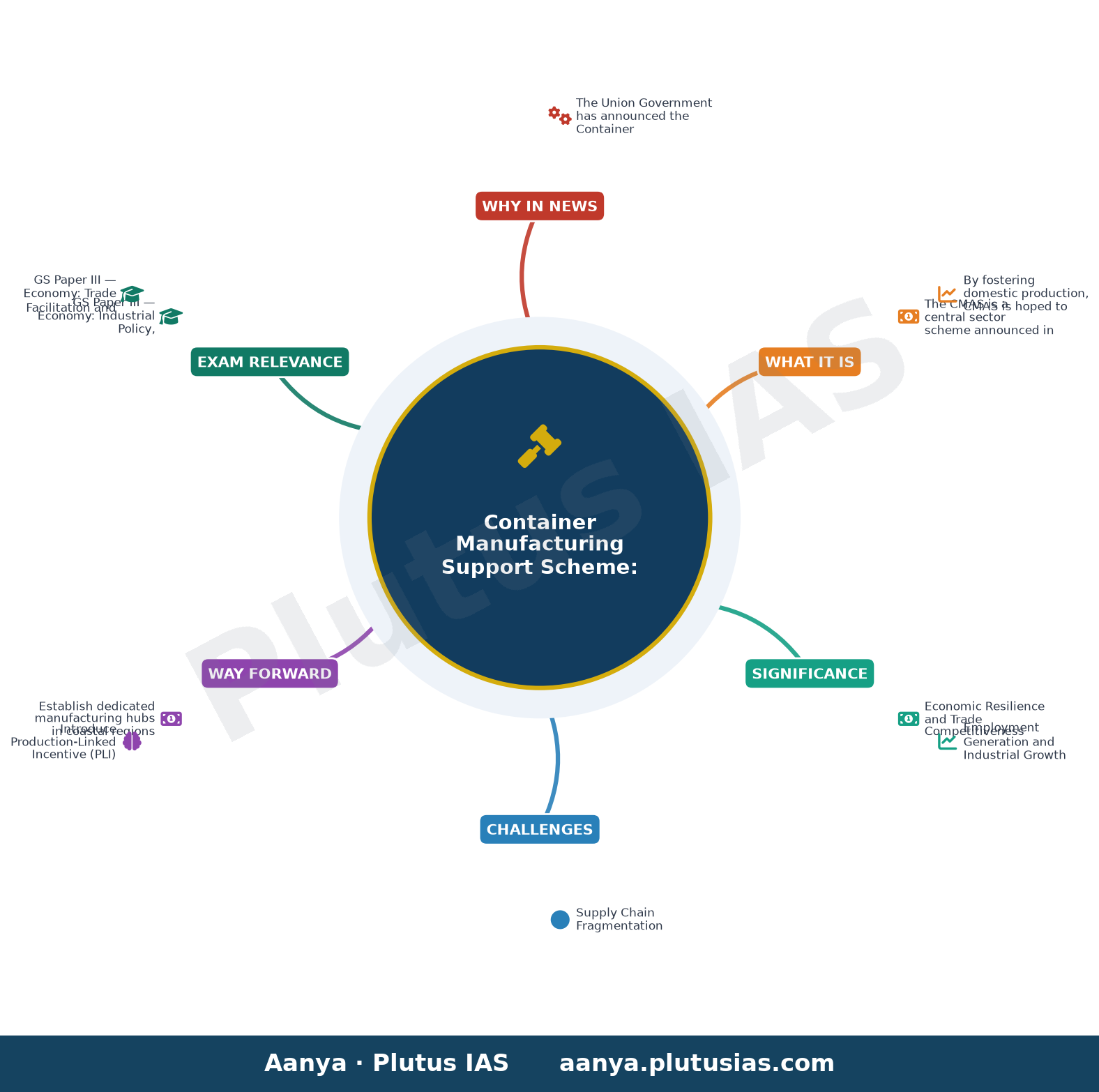
✎ The Container Manufacturing Support Scheme (CMAS) aims to transform India from a net importer of containers to a self-reliant hub, thereby enhancing maritime logistics resilience and reducing freight cost volatility.
Subject Relevance — Where This Topic Fits
- GS Paper III — Economy: Industrial Policy, Manufacturing Sector, Logistics Infrastructure | GS Paper III — Economy: Trade Facilitation and Supply Chain Resilience | GS Paper III — Economy: Make in India and Production-Linked Incentive Schemes
- Prelims: Containerization, ISO containers, Twenty-foot Equivalent Unit (TEU), Maritime Amrit Kaal Vision 2047, Logistics Efficiency Enhancement, Supply Chain Resilience, Freight Rate Volatility, Multi-modal Logistics, PLI Schemes, UNCTAD
- Essay: India’s journey from import dependency to self-reliance in strategic logistics assets, The role of maritime infrastructure in shaping India’s global trade competitiveness
Quick Revision: The Container Manufacturing Support Scheme (CMAS) aims to transform India from a net importer of containers to a self-reliant hub, thereby enhancing maritime logistics resilience and reducing freight cost volatility.
Why is this in the news?
The Union Government has announced the Container Manufacturing Support Scheme (CMAS) with a budgetary outlay of ₹10,000 crore to catalyse domestic container production, reduce import dependence, and enhance India’s maritime logistics resilience amid rising global trade disruptions and freight volatility. The initiative aligns with broader policy frameworks such as ‘Make in India’, the Maritime Amrit Kaal Vision 2047, and the National Logistics Policy, aiming to establish a globally competitive container manufacturing ecosystem by 2030.
Background
- Maritime transport underpins approximately 80% of global merchandise trade by volume and two-thirds by value, as per UNCTAD, making container logistics a critical enabler of international commerce.
- Recent geopolitical tensions, supply chain disruptions, and shifting shipping routes have exposed vulnerabilities in global logistics networks, leading to freight rate volatility and operational inefficiencies.
- India’s EXIM trade has grown significantly, yet domestic container manufacturing remains underdeveloped, resulting in annual imports of nearly 2 million empty containers for repositioning and demand fulfilment, exposing the economy to global market fluctuations.
- The absence of a robust domestic container manufacturing base constrains India’s ability to integrate seamlessly into global value chains and increases logistics costs, undermining trade competitiveness.
- The government’s Maritime Amrit Kaal Vision 2047 envisions a technologically advanced, self-reliant maritime sector capable of supporting India’s ambition to become a $5 trillion economy by 2030.
What is the Container Manufacturing Support Scheme (CMAS)?
- The CMAS is a central sector scheme announced in Union Budget 2026–27 with a financial outlay of ₹10,000 crore to develop a competitive domestic container manufacturing industry.
- By fostering domestic production, CMAS is hoped to generate direct and indirect employment across the container value chain, including manufacturing, logistics, and allied services.
Key Features
| Feature | Significance |
|---|---|
| Financial Outlay of ₹10,000 crore | Provides targeted fiscal support over five years to establish and expand domestic container manufacturing capacity, reducing reliance on imports. |
| Target Capacity of 7.5 lakh TEUs annually | Aims to scale domestic production from existing levels to meet projected demand, enhancing supply chain resilience and reducing freight-rate volatility exposure. |
| Incentivisation of Greenfield and Brownfield Projects | Encourages establishment of new manufacturing units and expansion of existing facilities, fostering industrial growth and technological upgradation in the sector. |
| Integration with Maritime Amrit Kaal Vision 2047 | Aligns with India’s long-term maritime strategy to enhance self-reliance in critical logistics infrastructure, supporting trade competitiveness. |
| Focus on ISO-Compliant Standardised Containers | Ensures compatibility with global shipping networks, facilitating seamless intermodal transport and reducing logistical bottlenecks. |
Why it Matters
Economic Resilience and Trade Competitiveness
- Reduces India’s dependence on imported containers, mitigating exposure to global supply chain disruptions and freight-rate volatility.
Employment Generation and Industrial Growth
- Stimulates job creation in manufacturing, logistics, and ancillary industries, contributing to formal employment generation.
Supply Chain Security and Strategic Autonomy
- Enhances India’s strategic autonomy in maritime logistics by strengthening domestic manufacturing capabilities for critical infrastructure.
Alignment with Global Trade Trends
- Supports India’s growing role in international trade by ensuring availability of standardised containers for seamless cargo movement.
Fiscal Multiplier Effect
- Promotes ancillary industries such as steel, engineering, and logistics, creating secondary economic benefits across the value chain.
Challenges
1. Supply Chain Fragmentation
- Fragmented domestic supply chains for raw materials (e.g., steel) may lead to cost inefficiencies and delays in container production.
- upsc_link: “National Logistics Policy 2022”
Challenges — UPSC Perspective
| Issue | Concern |
|---|---|
| Capital Intensity | High initial investment required for plant and machinery, posing entry barriers for new players. |
| Technology Adoption | Limited domestic expertise in advanced manufacturing processes may hinder quality and scalability. |
| Global Market Dynamics | Established international manufacturers may outcompete domestic firms on cost and quality. |
| Infrastructure Gaps | Inadequate port and transport infrastructure can delay container movement and increase operational costs. |
| Regulatory Compliance | Stringent environmental and safety norms may increase compliance costs and project timelines. |
| Raw Material Dependence | Reliance on imported steel and other inputs may expose manufacturers to global price volatility. |
Way Forward
- Establish dedicated manufacturing hubs in coastal regions with proximity to ports to reduce logistics costs and enhance supply chain efficiency.
- Introduce Production-Linked Incentive (PLI) schemes tailored for container manufacturing to attract investment and promote technological upgradation.
- Develop skill development programmes in collaboration with industry to address the shortage of trained manpower in precision engineering.
- Strengthen port infrastructure under the Sagarmala Programme to ensure seamless container movement and reduce turnaround times.
- Promote research and development in lightweight, durable, and eco-friendly container materials to enhance competitiveness.
- Facilitate public-private partnerships (PPPs) for technology transfer and joint ventures with global container manufacturers.
- Implement a phased import substitution strategy to gradually reduce reliance on imported containers while scaling domestic production.
UPSC Value Addition
Keywords for Mains Answer-Writing
Container Manufacturing Support Scheme (CMAS) · Maritime India Vision 2047 · Make in India initiative · Logistics Efficiency Enhancement · UNCTAD trade statistics · ISO container standards · Maritime supply chain resilience · Domestic manufacturing for critical infrastructure · Multimodal Logistics Parks · Freight rate volatility and supply chain disruptions
Concept Flow
Rising global trade dependence on containerised logistics → Increased demand for standardised containers → India’s import dependency on containers → Supply chain vulnerabilities and freight-rate volatility → Government announces CMAS with ₹10,000 crore outlay → Target to scale domestic production to 7.5 lakh TEUs annually → Employment generation and industrial growth → Enhanced maritime logistics resilience → Alignment with Maritime Amrit Kaal Vision 2047 → Long-term trade competitiveness and strategic autonomy
Prelims Practice Questions
Q1. Consider the following statements regarding the Container Manufacturing Support Scheme (CMAS):
1. The scheme aims to establish a globally competitive domestic container manufacturing ecosystem.
2. It seeks to reduce import dependence in the maritime logistics sector.
3. The scheme is part of the Maritime India Vision 2047 initiative.
4. The scheme provides financial support for the establishment of new manufacturing facilities only, not for the expansion of existing units.
How many of the above statements are correct?
- Only one
- Only two
- Only three
- All four
Answer: Only three — Statements 1, 2, and 3 are correct as they align with the stated objectives of CMAS, Maritime India Vision 2047, and the goal of reducing import dependence. Statement 4 is incorrect because the scheme supports both new facilities and the expansion of existing units.
Q2. Assertion (A): The Container Manufacturing Support Scheme (CMAS) is designed to address the volatility in freight rates and supply chain disruptions in maritime logistics.
Reason (R): The scheme aims to enhance domestic manufacturing capacity to meet the growing demand for containers, thereby reducing reliance on imported containers.
Options:
A. Both A and R are true, and R is the correct explanation of A.
B. Both A and R are true, but R is not the correct explanation of A.
C. A is true, but R is false.
D. A is false, but R is true.
- A
- B
- C
- D
Answer: B — Both the Assertion (A) and Reason (R) are true. The CMAS directly addresses freight rate volatility and supply chain disruptions by enhancing domestic manufacturing capacity, making R the correct explanation of A.
Q3. Match the following initiatives with their respective objectives:
Column I (Initiative)
A. Container Manufacturing Support Scheme (CMAS)
B. Maritime India Vision 2047
C. Multimodal Logistics Development
D. Make in India
Column II (Objective)
1. To promote domestic manufacturing across sectors, including critical infrastructure like containers
2. To develop a robust and integrated logistics network combining multiple modes of transport
3. To establish India as a global maritime hub by 2047
4. To enhance domestic container manufacturing capacity and reduce import dependence
Options:
A-1, B-3, C-2, D-4
A-4, B-3, C-2, D-1
A-2, B-4, C-1, D-3
A-3, B-2, C-4, D-1
- A-1, B-3, C-2, D-4
- A-4, B-3, C-2, D-1
- A-2, B-4, C-1, D-3
- A-3, B-2, C-4, D-1
Answer: A-4, B-3, C-2, D-1 — The correct matches are: A (CMAS) with 4 (enhance domestic container manufacturing), B (Maritime India Vision 2047) with 3 (establish India as a global maritime hub), C (Multimodal Logistics Development) with 2 (integrated logistics network), and D (Make in India) with 1 (promote domestic manufacturing across sectors).
Mains Practice Question
✍ The Container Manufacturing Support Scheme (CMAS) represents a strategic intervention to address critical vulnerabilities in India’s maritime logistics ecosystem. Critically examine the rationale behind this scheme, its alignment with broader national policies, and the potential challenges in its implementation. Also, discuss the implications for India’s trade competitiveness and supply chain resilience. (15 Marks)
Approach: MODEL-ANSWER SKELETON:
1. **Rationale for CMAS**:
– Highlight India’s dependence on imported containers (~20 lakh TEUs annually) and its vulnerability to global supply chain disruptions, freight rate volatility, and geopolitical tensions (cite UNCTAD data on 80% of global trade being containerized).
– Emphasize the strategic importance of maritime logistics in India’s trade competitiveness, given that ~80% of global trade by volume and ~66% by value is containerized.
2. **Alignment with National Policies**:
– Link CMAS to ‘Make in India’ (promoting domestic manufacturing), Maritime India Vision 2047 (establishing India as a global maritime hub), and Multimodal Logistics Development (integrating transport modes).
– Mention the scheme’s role in reducing import dependence and enhancing self-reliance in critical infrastructure.
3. **Implementation Challenges**:
– **Technological and Capital Intensity**: Container manufacturing requires high capital investment, advanced technology, and skilled labor; India’s current capacity is ~75,000 TEUs (target: 7.5 lakh TEUs).
– **Market Dynamics**: Competition from established global manufacturers (e.g., China, Europe) and the need to meet ISO standards for intermodal transport.
– **Policy Coordination**: Ensuring seamless integration with port infrastructure, customs, and trade facilitation measures.
– **Environmental and Sustainability Concerns**: Addressing the carbon footprint of steel-based container manufacturing and promoting green logistics.
4. **Implications for Trade Competitiveness and Supply Chain Resilience**:
– **Cost Efficiency**: Reduced reliance on imports could lower logistics costs and improve price competitiveness for Indian exports.
– **Supply Chain Resilience**: Enhanced domestic capacity would mitigate disruptions caused by global shocks (e.g., COVID-19, Suez Canal blockages).
– **Job Creation**: The scheme aims to generate significant employment in manufacturing, logistics, and allied sectors (~80,000 crore market potential).
– **Geopolitical Leverage**: Strengthening domestic capabilities could reduce India’s vulnerability to trade restrictions or sanctions affecting container supply chains.
5. **Balanced View**:
– Acknowledge the scheme’s potential to transform India’s maritime logistics but also note the risks of over-reliance on subsidies, the need for continuous innovation, and the importance of global standards compliance.
6. **Conclusion**:
– Summarize CMAS as a forward-looking initiative that aligns with India’s long-term trade and maritime goals, while emphasizing the need for sustained policy support, R&D investment, and stakeholder collaboration.
Source: PIB (Press Information Bureau)
Generated by AanyaAi for educational purpose.

- Gurugram’s groundwater extraction exceeds limit by 212%; HC seeks ban - October 4, 2026
- स्वतंत्रता सेनानी श्यामजी कृष्ण वर्मा की जन्म जयंती पर पीएम का श्रद्धांजलि - October 4, 2026
- KWML’s Feasibility Reports for Water Metro in 18 Cities: UPSC & PCS Insights - October 3, 2026

No Comments