


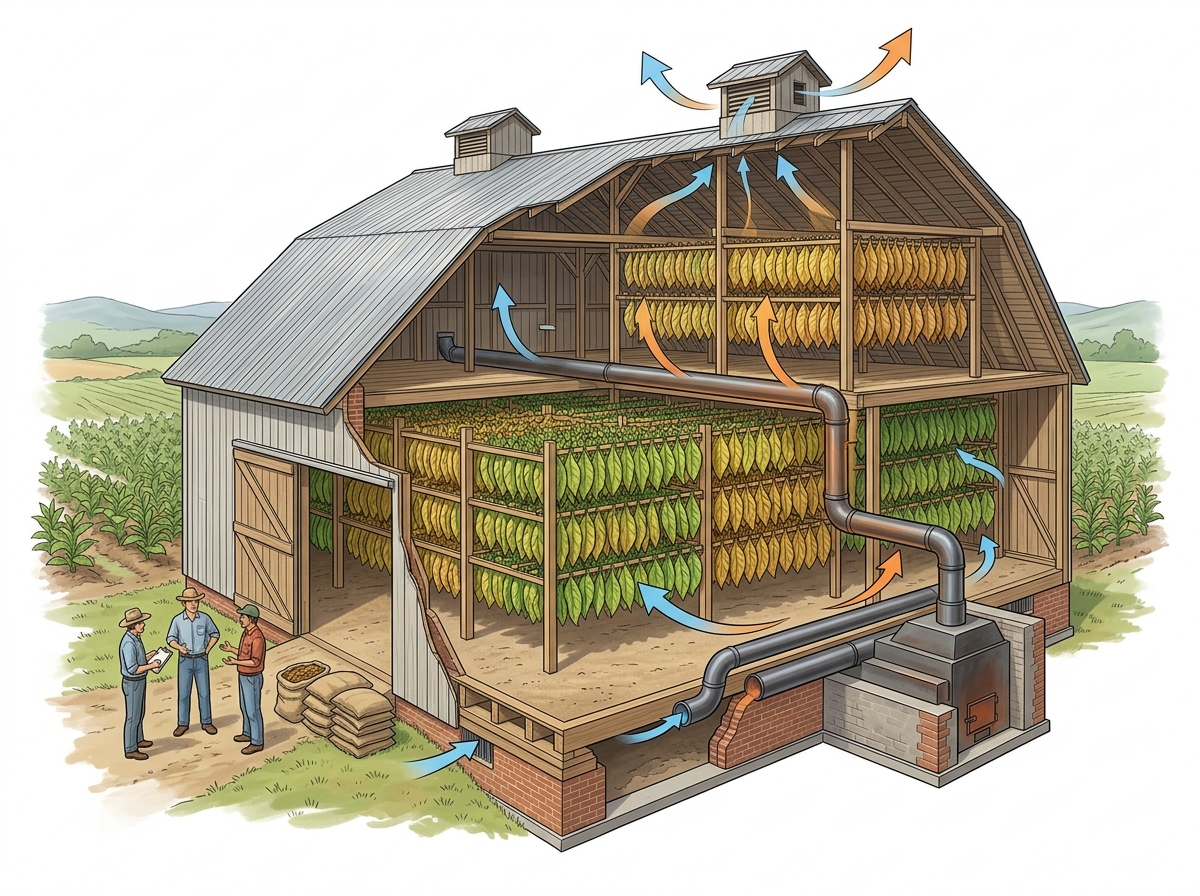
26 Sep UPSC Alert: ₹50,000 Interest-Free Loan for FCV Tobacco Farmers in Andhra Pradesh
✎ The Interest-Free Working Capital Assistance Scheme for FCV tobacco farmers in Andhra Pradesh provides ₹50,000 per barn as interest-free working capital support via DBT to address liquidity gaps and ensure farm sustainability.
Subject Relevance — Where This Topic Fits
- GS Paper III — Agriculture | GS Paper III — Issues related to Direct and Indirect Farm Subsidies and Minimum Support Prices | GS Paper III — Food Processing and Related Industries
- Prelims: FCV tobacco, Working Capital Assistance Scheme, Direct Benefit Transfer (DBT), Minimum Support Price (MSP), Agricultural credit, Primary Agricultural Credit Societies (PACS), Kisan Credit Card (KCC)
- Essay: Agricultural distress and policy interventions, Role of government in ensuring farm profitability and market stability
Quick Revision: The Interest-Free Working Capital Assistance Scheme for FCV tobacco farmers in Andhra Pradesh provides ₹50,000 per barn as interest-free working capital support via DBT to address liquidity gaps and ensure farm sustainability.
Why is this in the news?
The Press Information Bureau (PIB) released an official announcement on 25 September 2026 detailing the approval of a one-time interest-free loan of ₹50,000 per barn for FCV (Flue-Cured Virginia) tobacco farmers in Andhra Pradesh under the ‘Interest-Free Working Capital Assistance Scheme’. This initiative aims to provide immediate financial relief to approximately 44,000 farmers amid evolving global tobacco market dynamics, ensuring timely access to working capital for household needs, institutional loan repayment, and agricultural input procurement.
Background
- FCV tobacco is a high-value commercial crop primarily cultivated in Andhra Pradesh and Karnataka, contributing significantly to India’s tobacco export basket.
- The global tobacco market is influenced by shifting demand patterns, geopolitical events, and trade policies, which directly impact the pricing and marketing conditions for Indian FCV tobacco.
- The 2025–26 FCV tobacco auction in Andhra Pradesh commenced on 25 March 2026, with approximately 100 million kilograms auctioned to date, reflecting the sector’s scale and economic importance.
- Agricultural credit access in India is facilitated through institutional mechanisms such as Primary Agricultural Credit Societies (PACS) and commercial banks, but small and marginal farmers often face liquidity constraints post-harvest.
- Direct Benefit Transfer (DBT) has emerged as a key instrument for delivering agricultural subsidies and welfare benefits directly to farmers’ bank accounts, reducing leakages and ensuring timeliness.
- The Government of India has periodically introduced sector-specific financial assistance schemes to address price volatility, market disruptions, and liquidity gaps in high-risk commercial crops.
What is the Interest-Free Working Capital Assistance Scheme for FCV Tobacco Farmers?
- The scheme provides a one-time interest-free loan of ₹50,000 per barn to FCV tobacco farmers in Andhra Pradesh to address immediate working capital needs.
- The financial assistance is proposed to be disbursed directly to farmers’ bank accounts via Direct Benefit Transfer (DBT), ensuring transparency and timeliness.
- The scheme targets approximately 44,000 farmers and entails a total financial outlay of ₹220 crore, aimed at alleviating liquidity stress during the post-harvest period.
- The primary objectives include enabling farmers to meet household expenses, repay institutional loans, procure agricultural inputs for the next season, and reduce dependence on informal credit sources.
- The assistance is structured as working capital support rather than a subsidy, emphasizing its role in sustaining farm operations and market participation.
- The initiative reflects the government’s commitment to stabilizing income for commercial crop farmers amid global market volatilities, particularly in export-oriented sectors like tobacco.
- The scheme is part of a multi-pronged approach to strengthen the FCV tobacco sector, involving consultations with exporters, buyers, farmers, and other stakeholders to enhance market linkages and export competitiveness.
Key Features
| Feature | Significance |
|---|---|
| Interest-free working capital assistance | Provides immediate liquidity to FCV tobacco growers without debt burden, addressing cash-flow constraints during market volatility. |
| Direct Benefit Transfer (DBT) mechanism | Ensures transparent and timely disbursement of ₹50,000 per barn directly to farmers’ accounts, minimizing leakages. |
| Targeted coverage of 44,000 farmers | Focuses on a specific agricultural sub-sector (FCV tobacco) in Andhra Pradesh, addressing sectoral distress. |
| Financial outlay of ₹220 crore | Demonstrates government commitment to agricultural credit support and sectoral resilience. |
| Alignment with global market dynamics | Acknowledges volatility in international tobacco trade due to geopolitical and demand shifts, ensuring domestic supply chain stability. |
Why it Matters
Agricultural Credit and Liquidity
- Mitigates seasonal liquidity gaps for FCV tobacco farmers, enabling continuity in production and marketing cycles.
- Reduces reliance on informal credit sources, thereby lowering debt traps and financial vulnerability.
- Supports working capital needs for input procurement, household expenses, and institutional debt repayment.
Sectoral Resilience in Export-Oriented Agriculture
- Strengthens India’s position in the global FCV tobacco market by ensuring stable supply and farmer income security.
- Facilitates export competitiveness through timely financial support, reducing production disruptions.
- Encourages long-term investment in FCV tobacco cultivation by stabilizing farmer incomes.
Policy Coherence with Trade and Market Stability
- Complements broader trade facilitation measures aimed at enhancing market access and export promotion.
- Responds to global market uncertainties (e.g., geopolitical tensions, demand shifts) affecting tobacco trade.
- Aligns with India’s agricultural export promotion policies under schemes like the Agricultural and Processed Food Products Export Development Authority (APEDA).
Institutional Mechanisms for Agricultural Support
- Demonstrates the efficacy of direct benefit transfer (DBT) in agricultural credit delivery, reducing intermediation costs.
- Highlights the role of targeted financial interventions in addressing sector-specific distress.
- Reinforces the government’s role in providing safety nets for farmers in volatile commodity markets.
Challenges
1. Volatility in Global Tobacco Markets
- Fluctuations in international demand and geopolitical factors (e.g., trade restrictions, currency volatility) impact FCV tobacco prices and farmer incomes.
- Dependence on export markets exposes farmers to external shocks, necessitating policy buffers like the interest-free loan scheme.
UPSC Link: GS3: Agricultural Marketing & Trade
2. Liquidity Constraints in Smallholder Farming
- Small and marginal farmers often lack access to formal credit, leading to reliance on high-interest private loans.
- Seasonal income disparities create cash-flow gaps, particularly during the post-harvest period.
UPSC Link: GS3: Farm Credit & Agricultural Finance
3. Market Access and Price Discovery Challenges
- Limited bargaining power of small farmers in price negotiations with traders and exporters.
- Need for robust market infrastructure to ensure fair price realization and reduce post-harvest losses.
UPSC Link: GS3: Agricultural Marketing & Supply Chain
4. Climate and Input Cost Vulnerabilities
- FCV tobacco cultivation is sensitive to climatic conditions, with erratic rainfall or pest infestations affecting yields.
- Rising input costs (e.g., fertilizers, labor) squeeze profit margins, necessitating financial support mechanisms.
UPSC Link: GS3: Agricultural Inputs & Climate Resilience
5. Policy Implementation and Outreach Gaps
- Ensuring last-mile delivery of financial assistance to all eligible farmers, particularly in remote areas.
- Monitoring the effective utilization of funds to prevent diversion or misuse.
UPSC Link: GS2: Governance & Service Delivery
Challenges — UPSC Perspective
| Issue | Concern |
|---|---|
| Price volatility in global markets | Exposure to international trade dynamics affects farmer income stability. |
| Limited access to formal credit | Small farmers face high-interest debt traps due to lack of institutional support. |
| Post-harvest liquidity gaps | Delayed payments from traders or exporters create cash-flow problems. |
| Climate-induced yield risks | Erratic weather patterns threaten FCV tobacco production and incomes. |
| Market power asymmetry | Farmers lack bargaining power in price negotiations with bulk buyers. |
| Policy outreach challenges | Ensuring equitable distribution of financial assistance across regions and farmer categories. |
Way Forward
- Strengthen market linkage programs to connect farmers with exporters and reduce post-harvest losses.
- Expand financial literacy initiatives to enhance farmers’ awareness of institutional credit options.
- Develop climate-resilient farming practices for FCV tobacco to mitigate yield risks.
- Enhance price discovery mechanisms through electronic trading platforms and minimum support price (MSP) considerations.
- Integrate FCV tobacco farmers into Farmer Producer Organizations (FPOs) to improve collective bargaining power.
- Monitor the impact of the ₹220 crore assistance to assess its effectiveness in stabilizing farmer incomes.
- Collaborate with global buyers to secure long-term contracts, reducing exposure to market volatility.
- Promote diversification within the tobacco sector to reduce dependence on a single crop.
UPSC Value Addition
Keywords for Mains Answer-Writing
FCV tobacco cultivation · Farmers’ welfare schemes · Interest-free working capital assistance · Direct Benefit Transfer (DBT) · Agricultural credit and liquidity · Commodity market volatility · Export-oriented agriculture · Agricultural marketing reforms · Andhra Pradesh agriculture · Karnataka agriculture · Farmers’ distress mitigation · Agricultural finance mechanisms · Rural credit access · Crop-specific subsidies · Agricultural trade facilitation
Concept Flow
Global market volatility in tobacco trade → Reduced demand and price fluctuations → Farmer income instability and liquidity gaps. → Agricultural credit access challenges → Reliance on informal loans and debt traps → Policy intervention via interest-free working capital assistance. → Direct Benefit Transfer (DBT) mechanism → Timely disbursement of ₹50,000 per barn → Immediate liquidity for farmers. → Stabilization of farmer incomes → Continuity in production and marketing cycles → Enhanced export competitiveness. → Sectoral resilience in FCV tobacco → Long-term investment in cultivation → Sustainable livelihoods for farmers. → Policy coherence with trade facilitation → Alignment with APEDA and export promotion policies → Strengthened agricultural value chains.
Prelims Practice Questions
Q1. Consider the following statements regarding the ‘Interest-Free Working Capital Assistance Scheme’ for FCV tobacco farmers in Andhra Pradesh:
1. The scheme provides ₹50,000 per barn as interest-free working capital assistance.
2. The financial assistance is disbursed directly through Direct Benefit Transfer (DBT).
3. The scheme covers approximately 44,000 farmers and involves a total outlay of ₹220 crore.
4. The scheme is applicable only to farmers in Karnataka.
How many of the above statements are correct?
- Only one
- Only two
- Only three
- All
Answer: Only three — Statements 1, 2, and 3 are correct as per the PIB release. Statement 4 is incorrect because the scheme is specifically for Andhra Pradesh FCV tobacco farmers.
Q2. Assertion (A): The Government of India’s interest-free working capital assistance to FCV tobacco farmers aims to mitigate liquidity constraints arising from global market volatility.
Reason (R): FCV tobacco cultivation is primarily concentrated in Andhra Pradesh and Karnataka, and the scheme seeks to strengthen the sector by ensuring timely financial support to farmers.
Options:
A. Both A and R are true, and R is the correct explanation of A.
B. Both A and R are true, but R is NOT the correct explanation of A.
C. A is true, but R is false.
D. A is false, but R is true.
Answer: ? — Both A and R are true, and R correctly explains A. The scheme’s objective is to address liquidity issues due to volatile global markets by providing timely financial support to farmers in the FCV tobacco sector.
Q3. Match the following agricultural schemes with their respective objectives:
Column I (Scheme) Column II (Objective)
A. Interest-Free Working Capital Assistance 1. Providing subsidised credit to farmers
B. Kisan Credit Card (KCC) 2. Enhancing liquidity for FCV tobacco farmers
C. PM-KISAN 3. Direct income support to landholding farmers
D. Soil Health Card Scheme 4. Promoting soil health and fertility
Select the correct match:
- A-2, B-1, C-3, D-4
- A-1, B-2, C-3, D-4
- A-4, B-1, C-2, D-3
- A-3, B-4, C-1, D-2
Answer: A-2, B-1, C-3, D-4 — The correct matches are: A-2 (Interest-Free Working Capital Assistance for FCV tobacco farmers), B-1 (Kisan Credit Card provides subsidised credit), C-3 (PM-KISAN provides direct income support), and D-4 (Soil Health Card promotes soil health).
Mains Practice Question
✍ The Government of India has recently approved an interest-free working capital assistance scheme for FCV tobacco farmers in Andhra Pradesh, providing ₹50,000 per barn through Direct Benefit Transfer (DBT). Critically examine the rationale behind this scheme and analyse its potential impact on the agricultural credit ecosystem in India. Also, discuss the challenges in implementing such targeted welfare measures for specific agricultural commodities. (15 Marks)
Approach: MODEL-ANSWER SKELETON:
1. **Rationale Behind the Scheme (4 Marks)**
– **Market Volatility and Liquidity Constraints**: Explain how global demand shifts, geopolitical events, and trade policies disrupt commodity markets (e.g., FCV tobacco), leading to delayed payments and liquidity crises for farmers.
– **Sector-Specific Distress**: Highlight the concentration of FCV tobacco cultivation in Andhra Pradesh and Karnataka and the vulnerability of small and marginal farmers to price fluctuations.
– **Policy Objective**: Link the scheme to broader agricultural credit reforms (e.g., Kisan Credit Card, PM-KISAN) and the government’s commitment to ensuring timely financial support to mitigate distress.
– **Direct Benefit Transfer (DBT)**: Emphasise the efficiency of DBT in reducing leakages and ensuring targeted delivery of benefits.
2. **Impact on the Agricultural Credit Ecosystem (5 Marks)**
– **Positive Outcomes**:
– **Liquidity Enhancement**: The scheme provides immediate working capital, reducing reliance on informal credit sources (e.g., moneylenders) and institutional loan defaults.
– **Credit Culture**: Encourages formal credit uptake among small farmers by demonstrating the benefits of institutional support.
– **Market Stabilisation**: Supports farmers in meeting household and input costs, indirectly stabilising supply chains.
– **Potential Challenges**:
– **Targeting Precision**: Risk of exclusion errors if beneficiary identification (e.g., barn-wise allocation) is not accurate.
– **Scalability**: Difficulty in replicating the model for other commodities due to sector-specific dynamics.
– **Fiscal Sustainability**: Long-term viability of interest-free credit models given budgetary constraints.
– **Comparative Analysis**: Contrast with existing schemes like Kisan Credit Card (subsidised interest) or PM-KISAN (unconditional income support) to highlight unique features.
3. **Challenges in Implementation (4 Marks)**
– **Data Management**: Reliance on accurate barn-wise records for disbursement (e.g., integration with land records or e-NAM).
– **Awareness and Outreach**: Ensuring farmers understand the scheme’s benefits and eligibility criteria.
– **Coordination Gaps**: Multi-stakeholder coordination (e.g., agriculture department, banks, and commodity boards) required for seamless implementation.
– **Monitoring and Evaluation**: Need for robust MIS to track disbursements and assess impact on farmers’ welfare.
4. **Conclusion (2 Marks)**
– Summarise the scheme’s potential to address liquidity crises in volatile commodity markets while acknowledging implementation challenges.
– Suggest measures such as integrating the scheme with broader agricultural credit reforms or expanding it to other high-risk crops.
Source: PIB (Press Information Bureau)
Andhra Pradesh PCS (APPSC) — State PCS Practice
Prelims: As per recent government approval, what is the one-time interest-free loan amount sanctioned for FCV tobacco growers in Andhra Pradesh to address their financial distress?
- ₹25,000
- ₹50,000
- ₹75,000
- ₹1,00,000
Answer: ₹50,000 — The Andhra Pradesh government approved a one-time interest-free loan of ₹50,000 per barn for FCV tobacco growers to mitigate financial challenges.
Mains: Discuss the significance of the government’s decision to provide a one-time interest-free loan to FCV tobacco growers in Andhra Pradesh. Analyze its potential impact on the state’s agricultural economy and the livelihoods of tobacco farmers.
Generated by AanyaAi for educational purpose.
Related guides on our sites
- Current affairs for upsc 2026
- How to prepare for GS paper 1 for UPSC CSE mains exam
- Best UPSC coaching for IFOS exam
- Best agriculture optional coaching

- यूक्रेन का रोबोट सेना अभियान: युद्ध में मानव हानि कम करने की रणनीति - September 27, 2026
- Ukraine’s ‘Army of Robots’: A Game-Changer for UPSC Mains 2026 Polity & Governance - September 27, 2026
- रूस ने भारत-ब्राजील को दिया UNSC स्थायी सदस्यता का समर्थन, जर्मनी-जापान विरोध में - September 27, 2026

No Comments