


28 Jul UPSC Alert: ₹25,938 Cr PLI Scheme for Auto Industry Approved
Subject Relevance — Where This Topic Fits
- GS Paper III — Indian Economy and issues relating to Planning, Mobilization of Resources, Growth, Development and Employment | GS Paper III — Effects of Liberalization on the Economy, Changes in Industrial Policy and their Effects on Industrial Growth
- Prelims: Production-Linked Incentive (PLI) Scheme, Advanced Automotive Technology (AAT), Sintered Rare Earth Permanent Magnets, PM E-DRIVE Scheme, Automotive Testing Agencies
- Essay: India’s Manufacturing Competitiveness in the Global Automotive Industry, Role of PLI Schemes in Achieving Atmanirbhar Bharat
Quick Revision: The PLI-Auto scheme aims to enhance India’s automotive manufacturing competitiveness by incentivizing the production of advanced automotive technologies, with a budgetary outlay of ₹25,938 crore and a focus on electric vehicles, hydrogen fuel cells, and critical components like sintered rare earth permanent magnets.
Why is this in the news?
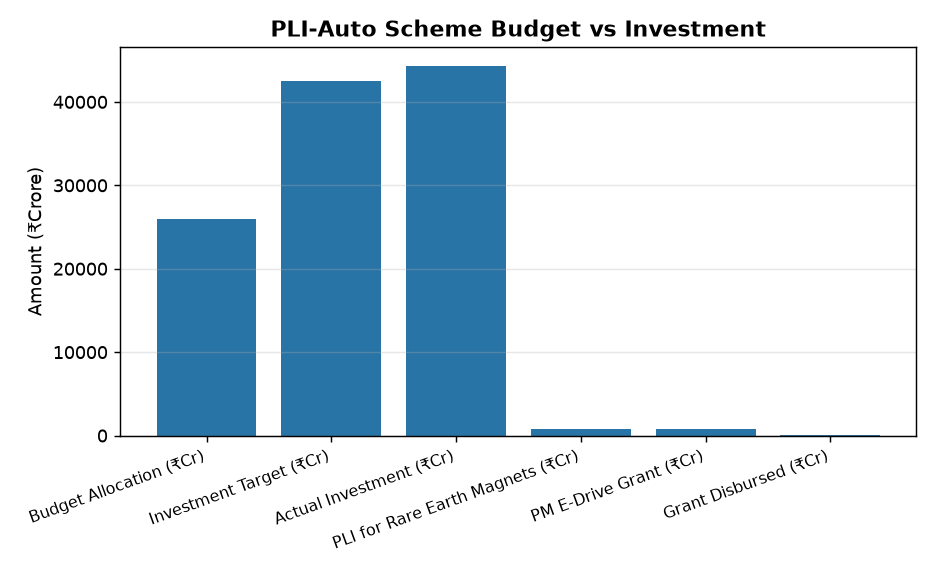
The Union Government has approved the Production-Linked Incentive (PLI) Scheme for the Automobile and Auto Component Industry (PLI-Auto) with a budgetary outlay of ₹25,938 crore. This initiative, notified on 23 September 2021, aims to enhance India’s manufacturing capabilities in advanced automotive products. As of 31 March 2026, approved applicants have reported investments of ₹44,326 crore against a target of ₹42,500 crore, indicating robust progress. Additionally, the scheme includes provisions for sintered rare earth permanent magnets and the upgradation of automotive testing agencies under the PM E-Drive Scheme, with ₹780 crore allocated and ₹16.63 crore disbursed to date.
Background
- The PLI scheme was introduced in 2020 as part of the Atmanirbhar Bharat Abhiyan to boost domestic manufacturing and reduce import dependence across key sectors, including automobiles.
- The automobile sector contributes approximately 7.1% to India’s GDP and 49% to the manufacturing GDP, making it a critical driver of economic growth and employment.
- India is the world’s fourth-largest automobile market and the largest manufacturer of two-wheelers, with a strong export base for auto components.
- The global shift toward electric vehicles (EVs) and advanced automotive technologies necessitates strategic investments to enhance India’s competitiveness in high-value manufacturing.
- The PLI-Auto scheme is aligned with the National Automotive Policy and the FAME-II scheme to promote sustainable mobility and indigenous innovation.
- The scheme leverages India’s demographic dividend and growing middle class to position the country as a global manufacturing hub for automobiles and auto components.
What is the PLI-Auto Scheme?
- The PLI-Auto scheme is a financial incentive program designed to encourage large-scale manufacturing of advanced automotive products in India, including electric vehicles (EVs), hydrogen fuel cell vehicles, and components for these technologies.
- The scheme offers a production-linked incentive of up to 18% on incremental sales of eligible products over a five-year period, subject to a cap of ₹25,938 crore.
- Eligible applicants include domestic and global automotive manufacturers and component suppliers who commit to investing in India’s automotive ecosystem.
- The scheme prioritizes the production of advanced automotive technologies (AAT), such as battery electric vehicles (BEVs), hydrogen-powered vehicles, and connected mobility solutions.
- Incentives are disbursed based on incremental production volumes, ensuring that the scheme rewards actual manufacturing growth rather than mere investment commitments.
- The scheme includes a sub-component for sintered rare earth permanent magnets, which are critical for electric motors and other high-performance automotive applications.
- Under the PM E-Drive Scheme, the scheme allocates ₹780 crore to upgrade automotive testing agencies, ensuring compliance with international safety and emission standards.
Key Features
| Feature | Significance |
|---|---|
| Budgetary Outlay of ₹25,938 Crore | Allocates fiscal resources to incentivise advanced automotive manufacturing, aligning with the ‘Atmanirbhar Bharat’ vision and reducing import dependence in high-value components. |
| Investment Target Achievement (₹44,326 Crore vs ₹42,500 Crore) | Demonstrates robust industry participation and validates the scheme’s efficacy in mobilising private capital for domestic production of advanced automotive technologies. |
| Focus on Advanced Automotive Products (AAT) | Targets high-technology segments such as electric vehicles, hydrogen fuel cells, and connected mobility solutions, ensuring India’s competitiveness in next-generation automotive innovation. |
| Sintered Rare Earth Permanent Magnets Scheme | Supports indigenous production of critical materials for electric motors and EVs, reducing reliance on imports from China and enhancing supply chain resilience. |
| PM E-Drive Scheme (₹780 Crore) | Provides capital grants for upgrading automotive testing infrastructure, ensuring compliance with global safety and emission standards, and fostering R&D capabilities. |
Why it Matters
Economic
- Enhances India’s manufacturing competitiveness by incentivising large-scale investments in advanced automotive technologies, potentially increasing the sector’s contribution to GDP.
- Reduces import dependency for high-value components (e.g., batteries, sensors, and permanent magnets), improving the trade balance and current account dynamics.
- Stimulates ancillary industries (e.g., steel, electronics, and chemicals) through backward linkages, creating employment and fostering industrial clusters.
Strategic
- Bolsters India’s position in the global automotive supply chain by promoting indigenous production of critical technologies, including EVs and hydrogen-powered vehicles.
- Mitigates geopolitical risks associated with concentrated supply chains (e.g., rare earth magnets) by developing domestic manufacturing capabilities.
- Supports the ‘Make in India’ and ‘Net Zero by 2070’ commitments by accelerating the transition to cleaner and more sustainable automotive technologies.
Industrial Policy
- Demonstrates the efficacy of Production-Linked Incentive (PLI) schemes in achieving industrial deepening and technology upgradation, setting a precedent for other sectors.
- Encourages public-private partnerships (PPPs) in R&D and infrastructure development, particularly in testing and certification facilities.
- Aligns with the National Manufacturing Policy (2011) and the Automotive Mission Plan (2016-2026) to position India as a global manufacturing hub.
Environmental
- Promotes the adoption of electric and hydrogen-powered vehicles, contributing to the reduction of vehicular emissions and aligning with India’s climate commitments under the Paris Agreement.
- Supports the development of cleaner manufacturing processes through incentives for advanced technologies, reducing the carbon footprint of the automotive industry.
Challenges
1. Supply Chain Fragmentation
- Heavy reliance on imported critical components (e.g., semiconductors, rare earth materials) poses risks to production continuity and cost competitiveness.
- Limited domestic capacity for high-precision manufacturing of advanced automotive components necessitates continued import dependence in the short to medium term.
UPSC Link: GS3: Industrial Policy, Supply Chain Resilience
2. Technological Lag in EVs and Batteries
- India lags behind global leaders (e.g., China, South Korea) in battery technology, cell manufacturing, and recycling infrastructure, hindering the rapid adoption of EVs.
- High costs of imported battery packs (accounting for ~40% of EV cost) reduce affordability and competitiveness of domestically manufactured EVs.
UPSC Link: GS3: Science & Technology, EV Ecosystem
3. Infrastructure Bottlenecks
- Inadequate charging infrastructure and grid capacity constrain the growth of the EV ecosystem, particularly in tier-2 and tier-3 cities.
- Limited testing and certification facilities for advanced automotive technologies delay product commercialisation and compliance with global standards.
UPSC Link: GS3: Infrastructure, EV Policy
4. Skilled Labour Shortage
- Shortage of skilled manpower in advanced manufacturing, robotics, and AI-driven automotive technologies impedes the realisation of PLI scheme objectives.
- Vocational training and upskilling programmes must be scaled to meet industry demands for high-technology roles.
UPSC Link: GS2: Skill Development, Employment
5. Policy Coherence and Implementation Gaps
- Overlapping schemes (e.g., PLI-Auto, FAME-II) and inconsistent policy signals may dilute the impact of incentives and create confusion among investors.
- Bureaucratic delays in approvals and disbursement of incentives under the PLI scheme can deter participation from global manufacturers.
UPSC Link: GS2: Governance, Policy Implementation
Challenges — UPSC Perspective
| Issue | Concern |
|---|---|
| Import Dependence | Critical components like semiconductors and rare earth magnets are predominantly imported, exposing the sector to geopolitical and supply chain risks. |
| High EV Battery Costs | Battery packs account for ~40% of EV costs; limited domestic manufacturing keeps prices high, reducing affordability. |
| Charging Infrastructure Deficit | Inadequate public charging stations and grid capacity constrain EV adoption, particularly outside metropolitan areas. |
| Skilled Labour Gap | Shortage of technicians trained in advanced manufacturing, robotics, and AI-driven automotive technologies delays industry growth. |
| Policy Overlap | Competing incentives under schemes like FAME-II and PLI-Auto may lead to inefficiencies and investor confusion. |
| Testing Infrastructure Gaps | Limited automotive testing facilities delay compliance with global safety and emission standards, affecting export competitiveness. |
Government Initiatives — Must-Memorise for Prelims
- Production-Linked Incentive (PLI) Scheme for Automobile and Auto Components Industry (PLI-Auto)
- Production-Linked Incentive (PLI) Scheme for Advance Chemistry Cell (ACC) Battery Storage
- Faster Adoption and Manufacturing of Electric Vehicles (FAME-II)
- National Mission on Transformative Mobility and Battery Storage
- PM E-Drive Scheme
Way Forward
- Accelerate domestic manufacturing of critical components (e.g., batteries, permanent magnets) through targeted PLI schemes and R&D grants to reduce import dependence.
- Expand and upgrade testing and certification infrastructure under the PM E-Drive Scheme to ensure compliance with global standards and enhance export competitiveness.
- Develop a national strategy for EV battery recycling to address environmental concerns and reduce raw material costs through circular economy practices.
- Scale up vocational training programmes in collaboration with industry to address the skilled labour shortage in advanced automotive manufacturing.
- Harmonise overlapping schemes (e.g., PLI-Auto, FAME-II) to avoid duplication and ensure policy coherence, providing a clear and predictable incentive framework for investors.
- Incentivise public-private partnerships (PPPs) for the development of charging infrastructure, particularly in rural and semi-urban areas, to support equitable EV adoption.
- Promote R&D collaborations between industry, academia, and government institutions to develop indigenous technologies for EVs, hydrogen fuel cells, and connected mobility solutions.
UPSC Value Addition
Keywords for Mains Answer-Writing
Production-Linked Incentive Scheme (PLI) for Automobile and Auto Components · Advanced Automotive Products (AAT) · Self-Reliance in Manufacturing · Rare Earth Permanent Magnets · PM E-DRIVE Scheme · Automotive Testing Agencies · Capital Expenditure Subsidy · Fiscal Incentives for Green Mobility · Make in India in Automobile Sector · Investment Targets and Achievements · Sintered Rare Earth Magnets · Supply Chain Resilience · Indigenous Manufacturing of EV Components · Union Budget Allocation for PLI Schemes
Concept Flow
Government approval of PLI-Auto scheme (₹25,938 Crore) → Incentivises investment in advanced automotive manufacturing → Industry responds with ₹44,326 Crore investment (exceeding ₹42,500 Crore target) → Enhances domestic production capacity → Reduces import dependence for critical components → Supports ‘Atmanirbhar Bharat’ and climate commitments → Drives employment, GDP growth, and technological upgradation.
Prelims Practice Questions
Q1. Consider the following statements regarding the PLI Scheme for Automobile and Auto Components (PLI-Auto):
1. The scheme was approved by the Government of India on 23 September 2021.
2. The total budgetary outlay for the scheme is ₹25,938 crore.
3. The scheme aims to enhance India’s manufacturing capabilities for Advanced Automotive Products (AAT).
4. The scheme does not cover the production of sintered rare earth permanent magnets.
Which of the statements given above are correct?
- 1, 2 and 3 only
- 2, 3 and 4 only
- 1, 3 and 4 only
- 1, 2, 3 and 4
Answer: 1, 2 and 3 only — Statements 1, 2, and 3 are correct as per the official PIB release. Statement 4 is incorrect because the scheme does include provisions for sintered rare earth permanent magnets, as indicated by the Request for Proposal (RFP) published on 20 March 2026.
Q2. Which of the following is NOT a component of the PLI Scheme for Automobile and Auto Components (PLI-Auto)?
- Capital expenditure subsidy for upgrading automotive testing agencies under PM E-DRIVE Scheme
- Production-linked incentives for the manufacture of sintered rare earth permanent magnets
- Direct cash transfers to consumers for purchasing electric vehicles
- Budgetary support for enhancing manufacturing capabilities of advanced automotive products
Answer: Direct cash transfers to consumers for purchasing electric vehicles — The PLI-Auto scheme does not include direct cash transfers to consumers for purchasing electric vehicles. It primarily focuses on incentives for manufacturers, subsidies for testing agencies, and support for specific advanced automotive components like rare earth magnets.
Mains Practice Question
✍ Critically examine the role of the Production-Linked Incentive (PLI) Scheme for Automobile and Auto Components in India’s quest for self-reliance in the automotive sector. How does the scheme align with the broader objectives of the ‘Make in India’ initiative and the transition towards green mobility? Substantiate your answer with reference to the scheme’s objectives, budgetary allocations, and recent developments.
Approach: Begin by outlining the key objectives of the PLI-Auto scheme, including its focus on Advanced Automotive Products (AAT) and indigenous manufacturing. Discuss the budgetary outlay of ₹25,938 crore and the reported investments of ₹44,326 crore against a target of ₹42,500 crore, highlighting the scheme’s success in attracting investments. Explain how the scheme supports the ‘Make in India’ initiative by enhancing domestic manufacturing capabilities and reducing import dependence. Additionally, analyze the scheme’s role in promoting green mobility, particularly through the PM E-DRIVE initiative and the inclusion of sintered rare earth permanent magnets, which are critical for electric vehicle (EV) components. Conclude by assessing the scheme’s potential to foster supply chain resilience and its alignment with India’s broader industrial and environmental goals.
Source: PIB (Press Information Bureau)
Generated by AanyaAi for educational purpose.


No Comments