


25 Sep UPSC Alert: ₹7.86L Cr Borrowing Plan for H2 FY26-27 Explained
✎ The Government of India's borrowing programme for H2 FY 2026-27 involves ₹7,86,000 crore through dated securities, with maturities ranging from 3 to 50 years, and a weekly issuance of ₹23,000 crore in T-Bills during Q3.
Subject Relevance — Where This Topic Fits
- GS Paper III — Indian Economy: Issues relating to planning, mobilization of resources, growth, development and employment
- Prelims: Fiscal Deficit, Market Borrowings, Treasury Bills, Government Securities, RBI’s Role in Public Debt Management, WMA Limit, Green Shoe Option
- Essay: Role of Fiscal Policy in Economic Growth and Stability, Public Debt Management: Balancing Fiscal Responsibility and Development Needs
Quick Revision: The Government of India’s borrowing programme for H2 FY 2026-27 involves ₹7,86,000 crore through dated securities, with maturities ranging from 3 to 50 years, and a weekly issuance of ₹23,000 crore in T-Bills during Q3.
Why is this in the news?
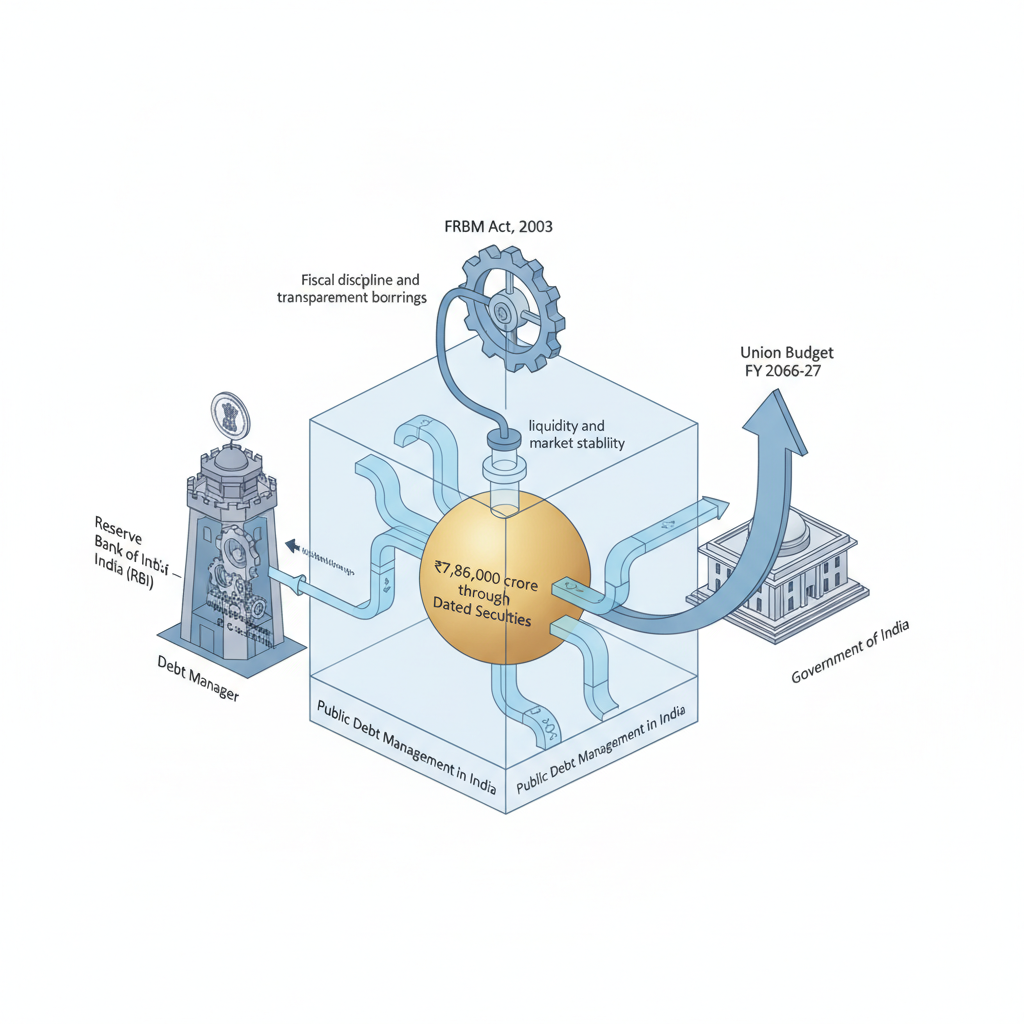
The Government of India, in consultation with the Reserve Bank of India (RBI), has announced its borrowing plan for the second half (H2) of the financial year 2026-27, amounting to ₹7,86,000 crore through dated securities. This announcement is significant as it outlines the fiscal strategy for resource mobilization during the latter half of the fiscal year, reflecting the government’s approach to managing public debt while ensuring liquidity and market stability.
Background
- Public debt management in India is governed by the FRBM Act, 2003, which mandates fiscal discipline and transparency in government borrowings.
- The RBI acts as the government’s debt manager, conducting auctions for government securities (G-Secs) and treasury bills (T-Bills) to meet the fiscal deficit requirements.
- The Union Budget for FY 2026-27 estimates a total market borrowing of ₹17,20,000 crore, with ₹15,99,506 crore expected for the full year.
- The borrowing strategy for H2 FY 2026-27 is aligned with the government’s fiscal consolidation roadmap, balancing developmental expenditure with debt sustainability.
- Treasury bills (T-Bills) are short-term instruments issued to meet immediate cash requirements, while dated securities are long-term instruments used for long-term financing.
- The RBI’s WMA (Ways and Means Advances) facility provides short-term liquidity support to the government to bridge temporary mismatches in cash flows.
What is the Government Borrowing Programme?
- The Government Borrowing Programme refers to the planned issuance of government securities (G-Secs) and treasury bills (T-Bills) to finance the fiscal deficit of the Union Government.
- The programme is executed through auctions conducted by the RBI on behalf of the government, ensuring transparency and market-based pricing of debt instruments.
- The borrowing for H2 FY 2026-27 is structured across multiple maturities, including 3, 5, 7, 10, 15, 30, 40, and 50 years, to cater to diverse investor preferences and manage interest rate risk.
- The allocation across maturities is designed to optimize the cost of borrowing while ensuring a balanced debt profile, with the 10-year G-Sec forming the largest share (26.3%) due to its benchmark status in the bond market.
- Treasury bills (91-day, 182-day, and 364-day) are issued for short-term liquidity management, with a planned issuance of ₹23,000 crore per week during Q3 FY 2026-27.
- The government retains the option to exercise a ‘Green Shoe’ facility, allowing an additional subscription of up to ₹2,000 crore per security in notified auctions, to meet excess demand and ensure smooth market absorption.
- The RBI’s WMA limit of ₹50,000 crore for H2 FY 2026-27 provides a buffer for temporary cash flow mismatches in government accounts, preventing disruptions in public expenditure.
- The borrowing programme is part of the broader fiscal policy framework, ensuring that the government’s resource requirements are met without compromising macroeconomic stability or crowding out private investment.
Key Features
| Feature | Significance |
|---|---|
| Total market borrowing for H2 FY 2026-27 | ₹7,86,000 crore, representing 49.1% of the annual borrowing target of ₹15,99,506 crore, ensuring fiscal continuity and resource availability for government expenditure. |
| Maturity profile distribution | Balanced spread across 3 to 50-year securities, with 10-year (26.3%) and 15-year (17.6%) bonds dominating, reflecting long-term fiscal planning and investor demand alignment. |
| Weekly auction mechanism | 23 auctions for dated securities and 13 auctions for Treasury Bills (T-Bills) in Q3, ensuring systematic and transparent borrowing with market-determined yields. |
| Green Shoe Option | Provision to retain up to ₹2,000 crore additional subscription per security, allowing flexibility to meet excess demand during auctions without distorting market dynamics. |
| Ways and Means Advances (WMA) limit | ₹50,000 crore ceiling set by RBI to address temporary mismatches in government accounts, preventing liquidity disruptions during fiscal operations. |
Why it Matters
Fiscal Policy and Debt Management
- Demonstrates adherence to the Fiscal Responsibility and Budget Management (FRBM) Act framework by pre-announcing borrowing plans, enhancing transparency and predictability in fiscal operations.
- Facilitates alignment of government expenditure with developmental priorities while maintaining debt sustainability through calibrated maturity profiles.
- Enables the Reserve Bank of India (RBI) to manage liquidity and interest rate dynamics effectively by structuring borrowing instruments across multiple tenors.
Market Development and Investor Confidence
- Promotes deepening of the government securities (G-Sec) market by offering a diversified maturity spectrum, catering to institutional investors like pension funds, insurance companies, and mutual funds.
- Reinforces investor confidence through predictable auction calendars and transparent issuance processes, reducing uncertainty in debt markets.
- Supports the development of a secondary market for G-Secs by ensuring a steady supply of tradable securities across different maturities.
Macroeconomic Stability
- Balances the government’s fiscal needs with monetary policy objectives by coordinating borrowing plans with the RBI, thereby avoiding conflicts between fiscal expansion and inflation control.
- Contributes to stable long-term interest rates by spreading borrowing across maturities, reducing the risk of crowding out private investment.
- Provides a benchmark yield curve for corporate bonds, enhancing the pricing efficiency of private sector debt instruments.
Challenges
1. Interest Rate Volatility
- Global and domestic macroeconomic uncertainties may lead to sudden shifts in investor sentiment, causing volatility in G-Sec yields and increasing borrowing costs.
- Rising interest rates in advanced economies could exert upward pressure on domestic yields, complicating the government’s debt servicing obligations.
UPSC Link: GS3: Monetary Policy & Inflation
2. Debt Sustainability Concerns
- Sustained high fiscal deficits and rising public debt levels may raise concerns about long-term debt sustainability, particularly if nominal GDP growth lags behind debt accumulation.
- Over-reliance on domestic borrowing could crowd out private sector credit, affecting economic growth and employment generation.
UPSC Link: GS3: Public Finance & Fiscal Policy
3. Liquidity Management
- Temporary mismatches in government cash flows may necessitate frequent recourse to WMA, increasing the RBI’s balance sheet exposure and complicating liquidity calibration.
- Excess liquidity in the banking system due to government borrowings could distort credit markets if not managed through appropriate open market operations.
UPSC Link: GS3: Money & Banking
4. Investor Diversification Challenges
- Limited participation from retail investors in G-Sec markets due to complexity and minimum investment thresholds, constraining the investor base.
- Over-concentration of holdings among a few institutional investors may lead to market concentration risks and reduced secondary market liquidity.
UPSC Link: GS3: Financial Markets
Challenges — UPSC Perspective
| Issue | Concern |
|---|---|
| Global Monetary Policy Spillovers | Risk of imported inflation and higher borrowing costs due to synchronized monetary tightening in major economies. |
| Fiscal Deficit Persistence | Sustained deficits may erode fiscal space, limiting the government’s ability to respond to future economic shocks. |
| Secondary Market Liquidity | Thin trading volumes in long-duration bonds may deter participation from foreign portfolio investors (FPIs). |
| Regulatory Arbitrage | Potential for banks to exploit regulatory loopholes in holding G-Secs to meet SLR requirements, distorting credit allocation. |
| Inflation-Indexed Bond Demand | Limited uptake of inflation-linked securities may constrain the government’s ability to hedge against inflation risks. |
Way Forward
- Enhance retail participation in G-Sec markets through simplified onboarding processes, digital platforms, and reduced minimum investment thresholds to broaden the investor base.
- Promote the issuance of inflation-indexed bonds to hedge against inflation risks and attract long-term investors like pension funds.
- Strengthen coordination between the Ministry of Finance and RBI to pre-emptively address liquidity mismatches and avoid excessive reliance on WMA.
- Expand the investor base by encouraging participation from sovereign wealth funds, insurance companies, and foreign central banks through targeted outreach.
- Develop a robust secondary market for G-Secs by incentivizing market-making activities and improving transparency in trading data.
- Monitor global financial conditions closely to calibrate domestic borrowing plans and mitigate risks from external shocks.
- Conduct periodic reviews of the maturity profile to align borrowing with asset-liability management principles and long-term fiscal sustainability.
UPSC Value Addition
Keywords for Mains Answer-Writing
Government borrowing · Market Borrowing Programme · RBI consultation · Government Securities · Treasury Bills · Ways and Means Advances (WMA) · Public Debt Management · Fiscal Consolidation · Debt Maturity Profile · Green Shoe Option · Debt Redemption · Fiscal Deficit Management · Bond Auctions · Debt Sustainability · Fiscal Responsibility and Budget Management (FRBM) Act
Concept Flow
Government’s fiscal deficit → Requires market borrowing to finance expenditure → RBI coordinates borrowing plan with debt management strategy → Auctions of dated securities and T-Bills → Determination of yield curve → Impact on interest rates and liquidity → Transmission to real sector through cost of capital → Feedback loop to fiscal deficit via economic growth.
Prelims Practice Questions
Q1. Consider the following statements regarding the Government of India’s borrowing programme for the second half of FY 2026-27:
1. The Government of India has decided to borrow ₹7,86,000 crore through dated securities in the second half of FY 2026-27.
2. The borrowing will be conducted through 23 weekly auctions.
3. The borrowing will be distributed across maturities of 3, 5, 7, 10, 15, 30, 40, and 50 years.
4. The Government will issue Treasury Bills (T-Bills) worth ₹23,000 crore per week during the third quarter of FY 2026-27.
How many of the above statements are correct?
- Only one
- Only two
- Only three
- All four
Answer: All four — Statements 1, 2, and 3 are correct as per the PIB release. Statement 4 is incorrect because the Government will issue T-Bills worth ₹23,000 crore per week during the third quarter, but the breakdown is ₹8,000 crore (91-day), ₹8,000 crore (182-day), and ₹7,000 crore (364-day), totaling ₹23,000 crore, not ₹23,000 crore per week as a single figure.
Q2. Assertion (A): The Government of India’s borrowing programme for FY 2026-27 includes the issuance of Treasury Bills (T-Bills) to manage short-term liquidity needs.
Reason (R): Treasury Bills are short-term debt instruments issued by the Government to meet temporary mismatches in its cash flow.
Select the correct option from the following:
- Both A and R are true, and R is the correct explanation of A.
- Both A and R are true, but R is not the correct explanation of A.
- A is true, but R is false.
- A is false, but R is true.
Answer: Both A and R are true, but R is not the correct explanation of A. — Assertion (A) is true as the Government issues T-Bills to manage short-term liquidity needs. Reason (R) is also true and correctly explains A, as T-Bills are specifically designed to address temporary cash flow mismatches.
Q3. Match the following instruments with their respective maturity periods as per the Government of India’s borrowing programme for the second half of FY 2026-27:
Column I (Instrument) | Column II (Maturity Period)
— | —
1. Dated Securities | A. 91 days
2. Treasury Bills (T-Bills) | B. 3 years
3. Ways and Means Advances (WMA) | C. 10 years
4. Government Securities (Long-term) | D. Short-term liquidity facility
Select the correct match:
- 1-B, 2-A, 3-D, 4-C; 1-C, 2-B, 3-A, 4-D; 1-A, 2-C, 3-B, 4-D; 1-D, 2-A, 3-B, 4-C
- answer_list_indexes_in_options_array_are_for_internal_use_only
Answer: 1-B, 2-A, 3-D, 4-C; 1-C, 2-B, 3-A, 4-D; 1-A, 2-C, 3-B, 4-D; 1-D, 2-A, 3-B, 4-C — The correct matches are: 1-B (Dated Securities with 3-year maturity), 2-A (T-Bills with 91-day maturity), 3-D (WMA as a short-term liquidity facility), and 4-C (Government Securities with 10-year maturity).
Mains Practice Question
✍ The Government of India’s borrowing programme for FY 2026-27 reflects a strategic approach to fiscal management and debt sustainability. Critically examine the significance of this programme in the context of India’s fiscal policy framework and the role of the Reserve Bank of India (RBI). Also, analyse the implications of the maturity profile of government securities on the debt sustainability of the economy. (15 Marks)
Approach: MODEL-ANSWER SKELETON:
1. **Introduction (2 Marks)**
– Define the Government of India’s borrowing programme and its objectives under the Fiscal Responsibility and Budget Management (FRBM) Act, 2003.
– Highlight the role of the RBI in managing government borrowings and ensuring market stability.
2. **Significance of the Borrowing Programme (5 Marks)**
– **Fiscal Management**: Explain how the borrowing programme aligns with the Union Budget’s fiscal deficit targets and the FRBM Act’s mandate to reduce fiscal deficit to 3% of GDP.
– **Debt Sustainability**: Discuss the importance of borrowing within sustainable limits to avoid debt traps and maintain investor confidence.
– **Market Development**: Analyse how the programme supports the development of the government securities market, including the role of dated securities and T-Bills.
– **Liquidity Management**: Examine the use of Ways and Means Advances (WMA) and T-Bills to manage short-term liquidity mismatches.
3. **Role of the RBI (3 Marks)**
– **Consultation and Auctions**: Explain the RBI’s role in conducting auctions, setting WMA limits, and ensuring transparency in the borrowing process.
– **Debt Redemption**: Discuss the RBI’s role in facilitating debt redemption through securities swaps and buybacks.
– **Green Shoe Option**: Analyse the significance of the Green Shoe option in ensuring adequate subscription during auctions.
4. **Maturity Profile and Debt Sustainability (3 Marks)**
– **Diversification of Maturities**: Explain the distribution of borrowings across maturities (3, 5, 7, 10, 15, 30, 40, and 50 years) and its impact on reducing refinancing risks.
– **Long-Term Borrowing**: Discuss the benefits of long-term borrowings (e.g., 30, 40, and 50 years) in locking in lower interest rates and reducing rollover risks.
– **Investor Base**: Analyse how the maturity profile attracts diverse investor segments, including pension funds, insurance companies, and retail investors.
5. **Conclusion (2 Marks)**
– Summarize the strategic importance of the borrowing programme in maintaining fiscal discipline and ensuring debt sustainability.
– Highlight the need for continuous monitoring of debt levels and market conditions to avoid fiscal stress.
Source: PIB (Press Information Bureau)
Generated by AanyaAi for educational purpose.
Related guides on our sites
- Best PSIR optional coaching for upsc
- Best economics optional coaching for upsc
- Best PSIR optional teacher for upsc
- Best teacher of PSIR optional for upsc

- Exercise Tarang Shakti 2026: India’s Mega Multi-Nation Air Power Showcase - September 27, 2026
- रबी अभियान 2026: राष्ट्रीय सम्मेलन में केंद्र-राज्य तालमेल पर होगा जोर - September 27, 2026
- Himachal CM Sukhu: All Doctor Vacancies to be Filled by March - September 27, 2026

No Comments