


07 Aug UPSC Alert: 48 Projects Approved Under Bulk Drugs PLI Scheme for Self-Reliance in Pharma
✎ The PLI Scheme for bulk drugs incentivises domestic production of APIs and KSMs through performance-linked subsidies, reducing import dependency and strengthening India’s pharmaceutical self-reliance.
Subject Relevance — Where This Topic Fits
- GS Paper II — Government Policies and Interventions for Development in various sectors | GS Paper III — Indian Economy and Issues Relating to Planning, Mobilisation of Resources, Growth, Development and Employment | GS Paper III — Effects of Liberalisation, Privatisation and Globalisation on Industry | GS Paper III — Science and Technology — Developments and their Applications and Effects in Everyday Life
- Prelims: Production-Linked Incentive (PLI) Scheme, Active Pharmaceutical Ingredients (APIs), Key Starting Materials (KSMs), Drug Intermediates (DI), Import substitution, Pharmaceutical Policy 2020, Make in India, Atmanirbhar Bharat
- Essay: India’s pharmaceutical self-reliance: Balancing global supply chains and domestic innovation, The role of government incentives in fostering industrial growth and reducing import dependency
Quick Revision: The PLI Scheme for bulk drugs incentivises domestic production of APIs and KSMs through performance-linked subsidies, reducing import dependency and strengthening India’s pharmaceutical self-reliance.
Why is this in the news?
On 7 August 2026, the Department of Pharmaceuticals, Government of India, released official data highlighting the progress of the Production-Linked Incentive (PLI) Scheme for bulk drugs. As of March 2026, 48 projects have been approved under the scheme with a sanctioned outlay of ₹6,940 crore, of which ₹87.70 crore in incentives has been disbursed. The scheme has catalysed investments of ₹5,070.45 crore against a committed ₹4,329.95 crore, and 18 APIs/KSMs/DIs have started commercial production, reducing reliance on imports for critical pharmaceutical inputs.
Background
- India is the world’s third-largest pharmaceutical market by volume and ranks 14th by value, yet remains heavily dependent on imports for Active Pharmaceutical Ingredients (APIs) and Key Starting Materials (KSMs), with over 70% of these inputs imported, primarily from China.
- The COVID-19 pandemic exposed vulnerabilities in global supply chains, prompting the Government of India to prioritise self-reliance in pharmaceutical manufacturing under the ‘Atmanirbhar Bharat’ initiative.
- The PLI Scheme for bulk drugs was launched in March 2020 as part of a broader ₹1.46 lakh crore PLI scheme for 10 key sectors, aimed at boosting domestic production and reducing import dependence in critical industries.
- Under the scheme, incentives are disbursed based on actual production and sales, ensuring that only genuine capacity addition is rewarded.
What is the Production-Linked Incentive (PLI) Scheme for Bulk Drugs?
- The PLI Scheme for bulk drugs is a central sector scheme launched by the Ministry of Chemicals and Fertilizers, Government of India, to incentivise domestic manufacturing of APIs, KSMs, and drug intermediates.
- The scheme offers financial incentives ranging from 10% to 20% of incremental sales over a five-year period, subject to a ceiling of ₹6,940 crore, to eligible manufacturers based on their production and sales performance.
- Eligibility is determined by the applicant’s investment in plant and machinery, with a minimum investment threshold of ₹10 crore for micro, small, and medium enterprises (MSMEs) and ₹50 crore for large enterprises.
- The scheme operates on a first-come-first-served basis, with applications evaluated by the Project Management Agency (PMA) appointed by the Department of Pharmaceuticals.
- Incentives are disbursed annually based on audited production and sales data, ensuring transparency and accountability in the utilisation of public funds.
- The scheme is aligned with the broader ‘Make in India’ and ‘Atmanirbhar Bharat’ initiatives, aiming to position India as a global hub for pharmaceutical manufacturing.
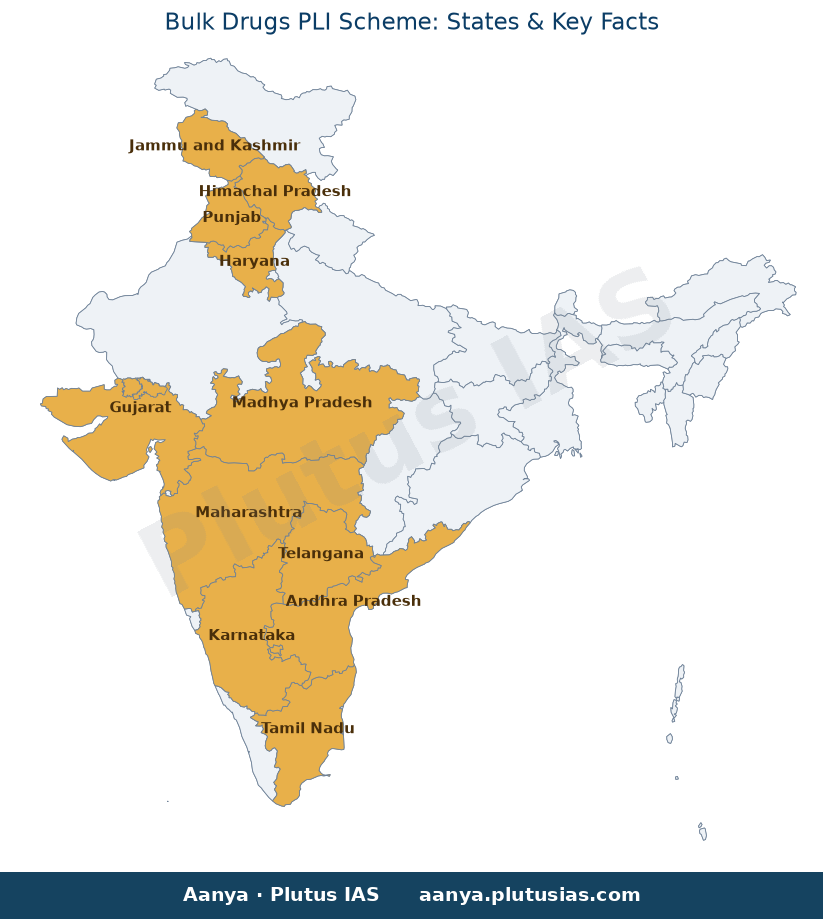
- As of March 2026, 48 projects have been approved across 11 states/UTs, with investments exceeding ₹5,000 crore and production of 18 APIs/KSMs/DIs already underway.
Key Features
| Feature | Significance |
|---|---|
| Approved Projects | 48 projects sanctioned under the PLI scheme for bulk drugs, demonstrating government commitment to domestic pharmaceutical production. |
| Financial Outlay | ₹6,940 crore sanctioned with ₹87.70 crore already disbursed as incentives by March 2026. |
| Investment Mobilisation | ₹5,070.45 crore invested against a committed ₹4,329.95 crore, indicating strong private sector participation. |
| Production Capacity | 28 APIs/KSMs/DIs with established production capacity, reducing import dependence for critical pharmaceutical inputs. |
| State-wise Distribution | Concentration in Andhra Pradesh (10 projects, ₹2,676 crore investment) and Gujarat (8 projects, ₹407.3 crore investment), reflecting regional industrial policy focus. |
Why it Matters
Economic
- Reduces import dependency for 18 critical APIs, including Penicillin G, Dexamethasone, and Atorvastatin, thereby saving foreign exchange reserves.
- Enhances value addition in the pharmaceutical sector, moving from bulk drug imports to domestic production of finished formulations.
- Stimulates ancillary industries (e.g., chemical intermediates, packaging) through backward linkages, creating employment in tier-2/3 cities.
Strategic
- Strengthens India’s position as the ‘Pharmacy of the World’ by securing supply chains for essential medicines, especially post-COVID-19 global disruptions.
- Mitigates geopolitical risks associated with reliance on a few dominant API suppliers (e.g., China), ensuring self-sufficiency in critical healthcare inputs.
- Supports the ‘Atmanirbhar Bharat’ vision by fostering indigenous innovation and reducing vulnerability to external shocks in pharmaceutical manufacturing.
Industrial Policy
- Aligns with the Production-Linked Incentive (PLI) scheme’s broader objective of enhancing India’s manufacturing competitiveness in high-value sectors.
- Demonstrates a targeted approach to address sectoral bottlenecks (e.g., high capital costs, regulatory hurdles) in bulk drug production.
- Encourages public-private partnerships (PPPs) through shared risk models, as seen in the ₹6,940 crore outlay and investment commitments.
Healthcare System
- Ensures uninterrupted supply of affordable medicines by reducing reliance on imported APIs, which often face price volatility and supply chain disruptions.
- Supports the National Health Mission (NHM) and Ayushman Bharat by stabilising the availability of essential drugs in government procurement systems.
- Facilitates the production of generic medicines, thereby lowering healthcare costs for the public and improving access to treatment.
Challenges
1. Regulatory and Compliance Hurdles
- Stringent environmental norms for chemical manufacturing may delay project approvals, particularly in states with high pollution control board scrutiny.
- Delays in obtaining environmental clearances (EC) and consent to establish (CTE) can stall investments, as seen in some states like Haryana and Jammu & Kashmir.
UPSC Link: Environmental Impact Assessment (EIA) Notification 2006
2. Infrastructure Gaps
- Inadequate logistics and cold-chain infrastructure in rural/remote areas may hinder the distribution of bulk drugs to formulation units.
- Limited access to high-purity water and power supply in certain states (e.g., Himachal Pradesh) increases operational costs for API manufacturers.
UPSC Link: PM Gati Shakti National Master Plan
3. Technological and Skill Constraints
- Shortage of skilled labour in advanced chemical synthesis and fermentation processes may limit the scalability of approved projects.
- High dependence on imported technology for high-value APIs (e.g., Meropenem) poses a risk to long-term self-reliance in R&D.
UPSC Link: Skill India Mission
4. Market Competition
- Price erosion due to oversupply in the global API market (e.g., China’s dominance) may reduce profitability for Indian manufacturers.
- Competition from low-cost producers in other countries (e.g., Vietnam, Indonesia) could undermine the PLI scheme’s incentives if not managed through quality standards.
UPSC Link: Competition Act, 2002
5. Financial Viability
- High initial capital expenditure (CAPEX) for API plants (e.g., ₹1,745.7 crore in Andhra Pradesh) may deter small and medium enterprises (SMEs) from participation.
- Volatility in raw material prices (e.g., crude oil derivatives) can squeeze profit margins, especially for projects with long gestation periods.
UPSC Link: Credit Guarantee Fund Scheme for MSMEs
Challenges — UPSC Perspective
| Issue | Concern |
|---|---|
| Environmental Clearances | Delays in EC/CTE approvals due to stringent norms, particularly in states like Haryana and Jammu & Kashmir. |
| Logistics Bottlenecks | Inadequate cold-chain and transport infrastructure in rural areas affecting distribution of bulk drugs. |
| Skill Shortage | Lack of trained personnel in advanced chemical synthesis and fermentation processes. |
| Global Competition | Price erosion from oversupply in the global API market, especially from China and Vietnam. |
| Financial Sustainability | High CAPEX and raw material price volatility threaten long-term profitability of projects. |
| Regulatory Fragmentation | Inconsistent implementation of environmental and industrial policies across states. |
Government Initiatives — Must-Memorise for Prelims
- Production-Linked Incentive (PLI) Scheme for Pharmaceuticals (Bulk Drugs)
- Pharma Vision 2024 (Department of Pharmaceuticals, Government of India)
- Scheme for Promotion of Medical Device Parks (under PLI framework)
Way Forward
- Accelerate environmental clearances for pending projects through single-window clearance mechanisms under the EIA Notification 2006.
- Invest in dedicated logistics corridors (e.g., Dedicated Freight Corridors) and cold-chain infrastructure to support API distribution.
- Expand skill development programs in chemical engineering and pharmaceutical technology under the Skill India Mission, with industry partnerships.
- Enhance R&D incentives for high-value APIs (e.g., biologics) to reduce dependence on imported technology and foster innovation.
- Strengthen price monitoring mechanisms to prevent unfair competition from low-cost imports while ensuring affordability of essential medicines.
- Implement state-specific industrial policies to address regional disparities in infrastructure and regulatory compliance.
- Promote PPP models for shared infrastructure (e.g., common effluent treatment plants) to reduce compliance costs for SMEs.
- Establish a dedicated fund under the PLI scheme to provide interest subsidies or guarantees for high-risk, long-gestation projects.
UPSC Value Addition
Keywords for Mains Answer-Writing
Production-Linked Incentive Scheme for bulk drugs · Active Pharmaceutical Ingredients (APIs) · Key Starting Materials (KSM) · Drug intermediates (DI) · Pharmaceutical manufacturing self-reliance · Atmanirbhar Bharat in pharmaceuticals · Import substitution in critical drugs · PLI scheme operationalisation · Domestic pharmaceutical capacity building · Critical drug security
Concept Flow
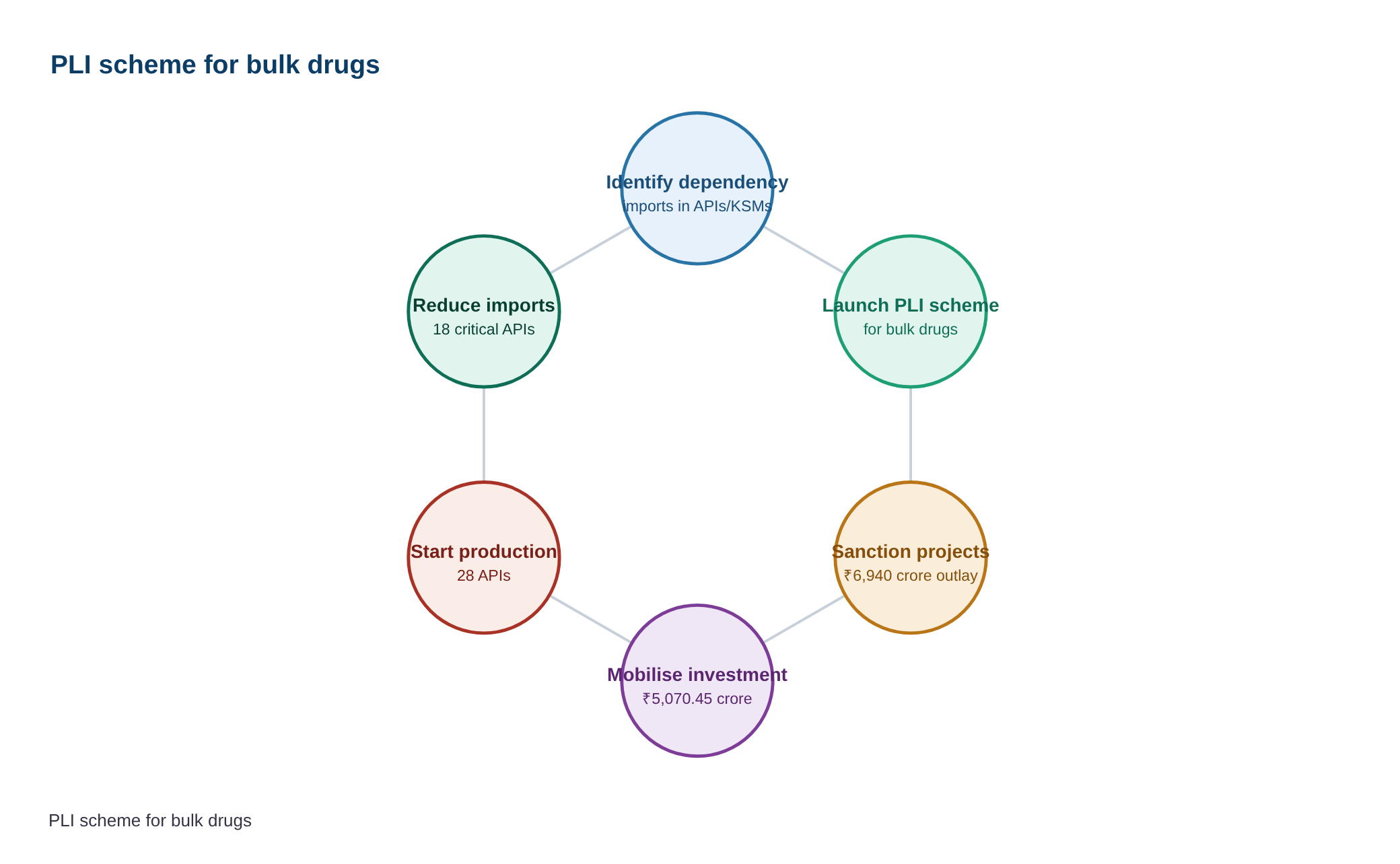
Government identifies import dependency in APIs/KSMs → Launches PLI scheme for bulk drugs → Invites applications from domestic manufacturers → Sanctions 48 projects with ₹6,940 crore outlay → Projects mobilise ₹5,070.45 crore investment → Establish production capacity for 28 APIs → Reduce import reliance for 18 critical APIs → Strengthen ‘Atmanirbhar Bharat’ in pharmaceutical sector.
Prelims Practice Questions
Q1. Consider the following statements regarding the Production-Linked Incentive (PLI) Scheme for bulk drugs:
1. The scheme aims to promote domestic production of Active Pharmaceutical Ingredients (APIs).
2. It provides financial incentives linked to incremental sales of eligible products.
3. The scheme covers only fermentation-based APIs and excludes chemical synthesis-based APIs.
4. The scheme has been notified by the Ministry of Chemicals and Fertilizers.
How many of the above statements are correct?
- Only one
- Only two
- Only three
- All four
Answer: Only three — Statements 1, 2, and 4 are correct. Statement 3 is incorrect as the scheme covers both fermentation-based and chemical synthesis-based APIs, as evidenced by the inclusion of products like Atorvastatin and Diclofenac Sodium.
Q2. Assertion (A): The PLI Scheme for bulk drugs is designed to reduce India’s dependence on imported Active Pharmaceutical Ingredients (APIs).
Reason (R): The scheme provides production-linked incentives to domestic manufacturers of APIs, thereby enhancing domestic production capacity.
Options:
A. Both A and R are true, and R is the correct explanation of A.
B. Both A and R are true, but R is not the correct explanation of A.
C. A is true, but R is false.
D. A is false, but R is true.
Answer: ? — Both the Assertion (A) and Reason (R) are true, and R correctly explains A. The scheme’s primary objective is to reduce import dependence by incentivizing domestic production of APIs.
Q3. Match the following Active Pharmaceutical Ingredients (APIs) with their respective categories as per the PLI Scheme for bulk drugs:
Column I (API) Column II (Category)
A. Penicillin G 1. Fermentation-based KSM
B. Atorvastatin 2. Chemical synthesis-based API
C. Dexamethasone 3. Fermentation-based API
D. Cyclohexane Diacetic Acid (CDA) 4. Chemical synthesis-based KSM
Options:
A. A-1, B-2, C-3, D-4
B. A-3, B-2, C-1, D-4
C. A-1, B-4, C-3, D-2
D. A-2, B-1, C-4, D-3
- A
- B
- C
- D
Answer: A — Penicillin G and Dexamethasone are fermentation-based APIs (A-1, C-3). Atorvastatin is a chemical synthesis-based API (B-2). Cyclohexane Diacetic Acid (CDA) is a chemical synthesis-based KSM (D-4).
Mains Practice Question
✍ Critically examine the significance of the Production-Linked Incentive (PLI) Scheme for bulk drugs in achieving self-reliance in India’s pharmaceutical sector. Also, assess the challenges in its implementation and suggest measures for its effective operationalisation. (15 Marks)
Approach: Define the PLI Scheme for bulk drugs and its objectives (self-reliance, import substitution, domestic capacity building). Highlight the scheme’s design: financial outlay (₹6,940 crore), approved projects (48), and products covered (41 APIs/KSMs/DIs). Discuss achievements: investment mobilised (₹5,070.45 crore), production capacity created, and reduction in import dependence (e.g., Penicillin G, Atorvastatin, Dexamethasone). Analyse challenges: regional disparities in project approvals (e.g., Andhra Pradesh vs. Haryana/J&K), slow commercialisation (10 projects yet to achieve production), and regulatory hurdles. Suggest measures: streamline approval processes, enhance state-level coordination, incentivise R&D for novel APIs, and strengthen infrastructure in lagging states. Conclude with a balanced view: the scheme is a step toward Atmanirbhar Bharat but requires sustained efforts to address structural bottlenecks.
Source: PIB (Press Information Bureau)
Generated by AanyaAi for educational purpose.

- यूपीएससी/पीसीएस के लिए दूरसंचार विनिर्माण में निवेश: ग्वालियर टीएमजेड के अवसर - September 23, 2026
- Bengaluru Investor Meet: ₹5,500 Cr Investment Proposed for Gwalior Telecom Manufacturing Zone - September 23, 2026
- एल नीनो: दुनिया के सामने जलवायु अनुकूलन की चुनौती - September 23, 2026

No Comments