


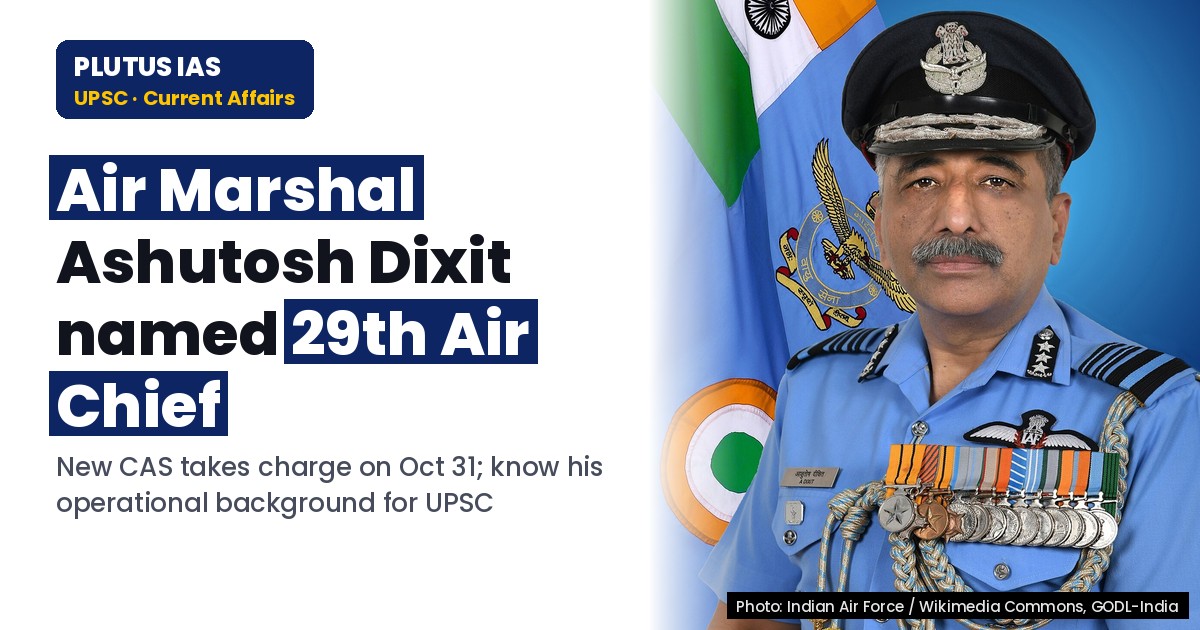
07 Oct UPSC Alert: Air Marshal Ashutosh Dixit Appointed New Air Chief
✎ The appointment of Air Marshal Ashutosh Dixit as the 29th Chief of the Air Staff (CAS) of the Indian Air Force (IAF), effective from 31 October 2026, assumes significance in the context of institutional continuity, operational…
Subject Relevance — Where This Topic Fits
- GS Paper III — Security: Defence Organisation and Military Leadership
- Prelims: Chief of the Air Staff (CAS), Integrated Defence Staff (IDS), Chiefs of Staff Committee (CISC), National Defence Academy (NDA), Defence Services Staff College, National Defence College, Param Vishisht Seva Medal (PVSM), Ati Vishisht Seva Medal (AVSM), Vishisht Seva Medal (VSM), Vayu Sena Medal (VM)
- Essay: Leadership in Crisis: The Role of Institutional Continuity in National Security
Why is this in the news?
The appointment of Air Marshal Ashutosh Dixit as the 29th Chief of the Air Staff (CAS) of the Indian Air Force (IAF), effective from 31 October 2026, assumes significance in the context of institutional continuity, operational preparedness, and the evolving doctrinal imperatives of the IAF. This transition marks the culmination of a distinguished career, characterised by extensive operational experience, command of critical air bases, and leadership in integrated defence structures, thereby underscoring the importance of institutional memory and strategic continuity in national security governance.
Background
- The Indian Air Force (IAF) operates under the aegis of the Ministry of Defence (MoD), with the Chief of the Air Staff (CAS) serving as the professional head of the IAF and the principal military advisor to the Government of India on aerial warfare and air power strategy.
- The CAS is appointed by the Government of India from among serving Air Marshals, typically after consultation with the Chiefs of Staff Committee and the Ministry of Defence, ensuring a merit-based selection process aligned with operational exigencies.
- The IAF follows a hierarchical command structure, with the CAS at the apex, followed by the Vice Chief of the Air Staff (VCAS), and regional air commands (Western, Eastern, Southern, South Western, Training, and Maintenance) under designated Air Officers Commanding-in-Chief (AOC-in-C).
- The Integrated Defence Staff (IDS), headed by the Chief of Defence Staff (CDS), facilitates jointness among the three services, with the Chiefs of Staff Committee (CISC) serving as a key advisory body for inter-service coordination.
- The IAF’s operational doctrine has evolved to address multi-domain threats, including air superiority, precision strikes, electronic warfare, and support to joint operations, necessitating leadership with diverse operational exposure.
What is the role of the Chief of the Air Staff (CAS)?
- The CAS is the professional head of the Indian Air Force and the principal military advisor to the Government of India on matters pertaining to air power, aerial warfare, and the operational readiness of the IAF.
- The CAS exercises command over the IAF through the Vice Chief of the Air Staff (VCAS) and the regional air commands, ensuring the execution of operational plans and strategic objectives.
- As a member of the Chiefs of Staff Committee (CISC), the CAS contributes to joint military planning, inter-service coordination, and the formulation of the Armed Forces’ doctrinal framework.
- The CAS plays a pivotal role in the acquisition, induction, and operationalisation of advanced aerospace assets, including fighter aircraft, transport planes, and aerial refuelling systems, thereby shaping the IAF’s modernisation trajectory.
- The CAS is responsible for the professional development of IAF personnel, including training, promotion policies, and the implementation of welfare measures to sustain operational efficiency.
- In crisis situations, the CAS provides strategic advice to the Government of India, including options for air operations, contingency planning, and the deployment of IAF assets in support of national security objectives.
- The CAS also serves as a member of the National Security Council (NSC) Secretariat, contributing to the formulation of national security policies and the assessment of emerging threats.
- The appointment of the CAS is governed by the Air Force Act, 1950, and the rules framed thereunder, ensuring transparency and adherence to meritocratic principles in the selection process.
Key Features
| Feature | Significance |
|---|---|
| Appointment of Air Chief Marshal Ashutosh Dixit | Represents the continuity of institutional leadership in the Indian Air Force, ensuring operational stability and strategic continuity in air defence capabilities. |
| Operational Experience (3,500+ flight hours) | Demonstrates hands-on expertise in diverse aircraft, including fighter jets (Mirage-2000, MiG variants, Tejas) and transport aircraft (IL-78), critical for modern aerial warfare and logistical support. |
| Leadership in Integrated Defence Staff (HQ IDS) | Highlights experience in inter-service coordination, essential for joint military operations and integrated theatre commands under the Agnipath reforms. |
| Command Roles in Western and Southern Sectors | Indicates operational command over frontline fighter bases and training establishments, vital for air superiority and pilot training infrastructure. |
| Decorations (PVSM, AVSM, VM, VSM) | Signifies recognition of meritorious and distinguished service, reflecting adherence to professional excellence and institutional values. |
Why it Matters
Institutional Continuity and Professionalism
- The appointment underscores the Indian Air Force’s adherence to meritocracy and institutional hierarchy, ensuring seamless transition of command and operational preparedness.
- Dixit’s four-decade tenure exemplifies the longevity and depth of expertise within the armed forces, reinforcing the principle of ‘service before self.’
- The selection process aligns with the Armed Forces Headquarters Civil Services Rules, 1968, which govern senior appointments in the military.
Operational Preparedness and Modernisation
- With experience in frontline fighter bases and integrated command structures, Dixit is positioned to oversee the IAF’s modernisation agenda, including induction of indigenous platforms like the Tejas and future fighter programs.
- His background in experimental test piloting and flight instruction is critical for evaluating next-generation aircraft and enhancing pilot training standards.
- The appointment occurs amid ongoing reforms under the Agnipath scheme, which aims to restructure the armed forces’ human resource policies for a younger, agile force.
Strategic Coordination and Jointmanship
- Dixit’s role in the Chiefs of Staff Committee (CISC) at HQ IDS highlights the importance of inter-service synergy, particularly in the context of India’s evolving theatre command framework.
- His experience in regional commands (Western and Southern Sectors) is relevant to India’s air defence strategy, including border security and maritime domain awareness.
National Security and Crisis Response
- Dixit’s participation in operations such as Operation Safed Sagar (Kargil War) and Operation Raksak (counter-insurgency) underscores the IAF’s role in national security contingencies.
- His leadership in exercises like Operation Sindhur reflects the IAF’s preparedness for high-intensity warfare and multi-domain operations.
Challenges
1. Modernisation of the Indian Air Force
- Accelerating the induction of indigenous fighter jets (LCA Tejas, AMCA) and advanced systems to replace ageing fleets like the MiG-21 and Jaguar.
- Balancing budgetary constraints with the need for high-technology platforms, including fifth-generation fighter aircraft and unmanned aerial systems.
- Enhancing maintenance, repair, and overhaul (MRO) infrastructure to reduce dependence on foreign suppliers for critical spares.
UPSC Link: Chapter 3, Security: Challenges and Responses (Mains GS-3)
2. Integration of Theatre Commands
- Implementing the proposed integrated theatre commands to unify the Army, Navy, and Air Force under unified operational control for enhanced joint operations.
- Addressing inter-service rivalries and bureaucratic hurdles in restructuring command hierarchies.
- Ensuring seamless coordination between theatre commands and civil authorities during crisis management.
UPSC Link: Chapter 10, National Security Architecture (Mains GS-2)
3. Human Resource Reforms (Agnipath Scheme)
- Managing the transition to a younger, short-service military while maintaining operational readiness and institutional memory.
- Addressing concerns over job security for Agniveers post-retirement and their integration into civil society.
- Ensuring adequate training and skill development for Agniveers to meet the technical demands of modern warfare.
UPSC Link: Chapter 3, Security: Challenges and Responses (Mains GS-3)
4. Border Security and Air Dominance
- Maintaining air superiority along the Line of Actual Control (LAC) and Line of Control (LoC) amid ongoing border tensions with China and Pakistan.
- Strengthening early warning systems, air defence networks, and electronic warfare capabilities to counter emerging threats.
- Enhancing the IAF’s role in maritime security, including anti-submarine warfare and surveillance in the Indian Ocean Region.
UPSC Link: Chapter 7, Internal Security (Mains GS-3)
5. Cyber and Space Domain Integration
- Integrating cyber warfare capabilities into air operations to counter threats in the electromagnetic spectrum.
- Developing space-based surveillance and communication systems to support real-time command and control.
- Ensuring resilience against cyber-attacks on critical military infrastructure.
UPSC Link: Chapter 10, National Security Architecture (Mains GS-2)
Challenges — UPSC Perspective
| Issue | Concern |
|---|---|
| Indigenisation of Defence Production | Over-reliance on foreign suppliers for critical components and platforms, leading to supply chain vulnerabilities. |
| Ageing Combat Fleet | Depletion of operational readiness due to obsolescence of legacy aircraft like the MiG-21 and Jaguar. |
| Budgetary Constraints | Limited fiscal space for modernisation amid competing demands from other sectors of national security. |
| Technological Disruption | Rapid advancements in drone warfare, hypersonic missiles, and AI-driven systems require constant upskilling and investment. |
| Civil-Military Coordination | Ensuring seamless integration of military operations with civil authorities during crises, including disaster management. |
Way Forward
- Accelerate the induction of indigenous fighter jets (LCA Tejas Mk1A, LCA Tejas Mk2, AMCA) to replace ageing fleets and enhance operational readiness.
- Strengthen the Maintenance, Repair, and Overhaul (MRO) infrastructure for critical aircraft components to reduce import dependence.
- Finalise the framework for integrated theatre commands, ensuring clear delineation of roles and responsibilities among the three services.
- Enhance pilot training programs, including simulator-based training and advanced flight instruction, to prepare for next-generation warfare.
- Invest in cyber and space domain capabilities, including electronic warfare suites and satellite-based surveillance systems.
- Address human resource challenges under the Agnipath scheme by providing robust post-retirement support and skill development programs for Agniveers.
- Strengthen border infrastructure and air defence networks along the LAC and LoC to counter emerging threats and ensure air dominance.
- Promote research and development in defence technologies through partnerships with DRDO, academia, and private sector entities.
UPSC Value Addition
Keywords for Mains Answer-Writing
Indian Air Force · Chief of Air Staff · Indian Armed Forces hierarchy · Integrated Defence Staff · Air Officer Commanding-in-Chief · National Defence Academy · Defence Services Staff College · National Defence College · Paramilitary operations · Operational command structure · Promotion and tenure of service chiefs · PVSM, AVSM, VM, VSM awards · Fighter aircraft operations · Defence procurement and indigenisation · Strategic command and control · Defence reforms and modernisation
Constitutional & Policy Linkages
- [‘Article 33’, ‘Empowers Parliament to restrict or abrogate fundamental rights of armed forces personnel in the interest of discipline and efficiency.’]
- [‘Article 53’, ‘Vests the supreme command of the Defence Forces in the President of India, exercised through the Council of Ministers.’]
- [‘Article 74’, ‘Provides for the Council of Ministers to aid and advise the President in the exercise of constitutional functions, including defence matters.’]
Concept Flow
Appointment of Air Chief Marshal Ashutosh Dixit → Ensures continuity in IAF leadership → Maintains operational stability and strategic preparedness. → Dixit’s extensive operational and command experience → Enhances IAF’s ability to execute high-intensity warfare and joint operations. → Modernisation of the IAF under Dixit’s leadership → Focus on indigenisation (LCA Tejas, AMCA) and MRO infrastructure → Reduces import dependence. → Implementation of Agnipath scheme → Restructures human resource policies → Aims for a younger, agile force while addressing post-retirement integration. → Integration of theatre commands → Unifies Army, Navy, and Air Force under unified operational control → Enhances jointmanship and crisis response. → Strengthening cyber and space domain capabilities → Addresses emerging threats in electromagnetic spectrum and space warfare. → Enhanced border infrastructure and air defence networks → Ensures air dominance along LAC and LoC amid ongoing tensions.
Prelims Practice Questions
Q1. Consider the following statements regarding the appointment of the Chief of Air Staff (CAS) in the Indian Air Force:
1. The CAS is appointed by the President of India based on the recommendation of the Prime Minister.
2. The CAS holds a tenure of three years or until the age of 62, whichever is earlier.
3. The CAS is the highest-ranking officer in the Indian Air Force and is responsible for the operational command of the Air Force.
How many of the above statements are correct?
- Only one
- Only two
- All three
- None
Answer: All three — Statement 1 is correct as the CAS is appointed by the President on the advice of the Union Council of Ministers. Statement 2 is incorrect as the tenure of the CAS is three years or until the age of 62, whichever is earlier, but the exact tenure is determined by the government. Statement 3 is correct as the CAS is the highest-ranking officer responsible for operational command.
Q2. Assertion (A): The Integrated Defence Staff (IDS) under the Chief of Defence Staff (CDS) is responsible for the coordination and integration of the three services.
Reason (R): The IDS was established to streamline the operational command and control of the Indian Armed Forces.
Options:
A. Both A and R are true, and R is the correct explanation of A.
B. Both A and R are true, but R is NOT the correct explanation of A.
C. A is true, but R is false.
D. A is false, but R is true.
Answer: ? — Assertion (A) is correct as the IDS, headed by the CDS, coordinates the three services. Reason (R) is also correct and directly explains the purpose of the IDS in streamlining command and control.
Q3. Match the following gallantry awards with their respective descriptions:
Column I (Awards) | Column II (Descriptions)
—————–|———————-
A. Param Vishisht Seva Medal (PVSM) | 1. Awarded for distinguished service of a high order
B. Ati Vishisht Seva Medal (AVSM) | 2. Awarded for exceptional service of a high order
C. Vishisht Seva Medal (VSM) | 3. Awarded for meritorious service
D. Yudh Seva Medal (YSM) | 4. Awarded for distinguished service in an operational context
Options:
1. A-2, B-1, C-3, D-4
2. A-1, B-2, C-3, D-4
3. A-2, B-1, C-4, D-3
4. A-1, B-3, C-2, D-4
Answer: ? — The correct match is: A (PVSM) – 2 (exceptional service of a high order), B (AVSM) – 1 (distinguished service of a high order), C (VSM) – 3 (meritorious service), D (YSM) – 4 (distinguished service in an operational context).
Mains Practice Question
✍ The appointment of the Chief of Air Staff (CAS) in the Indian Air Force is governed by a structured process involving seniority, operational experience, and institutional requirements. Critically examine the role of the CAS within the broader framework of India’s defence command structure. Also, discuss the significance of the Integrated Defence Staff (IDS) in enhancing jointness among the three services. (15 Marks)
Approach: MODEL-ANSWER SKELETON:
1. **Role of the Chief of Air Staff (CAS)**
– **Operational Command**: The CAS is the highest-ranking officer of the Indian Air Force (IAF) and serves as the principal advisor to the government on air force matters. The CAS is responsible for the operational command, control, and administration of the IAF, including force modernisation, training, and strategic planning.
– **Tenure and Appointment**: The CAS is appointed by the President of India on the advice of the Union Council of Ministers. The tenure is typically three years or until the age of 62, whichever is earlier, as per government directives. The appointment is based on seniority, operational experience, and institutional requirements.
– **Strategic Leadership**: The CAS plays a pivotal role in formulating air power doctrines, participating in joint military exercises, and coordinating with allied forces. The CAS also represents the IAF in high-level defence committees, including the Chiefs of Staff Committee (COSC) and the Defence Acquisition Council (DAC).
2. **Defence Command Structure and the CAS**
– **Hierarchy**: The IAF operates under a hierarchical command structure, with the CAS at the apex, followed by the Vice Chief of Air Staff (VCAS), Principal Staff Officers (PSOs), and operational commands (e.g., Western Air Command, Southern Air Command).
– **Jointness and Integration**: The CAS collaborates with the Chiefs of the Army and Navy to ensure jointness in operations, logistics, and training. The CAS also participates in the formulation of the Integrated Capability Development Plan (ICDP) and the Long Term Integrated Perspective Plan (LTIPP) for defence modernisation.
3. **Significance of the Integrated Defence Staff (IDS)**
– **Establishment and Mandate**: The IDS was established in 2001 under the Chief of Defence Staff (CDS) to promote jointness among the three services. The IDS acts as the principal organisation for integrating the operational, logistics, and administrative functions of the Army, Navy, and Air Force.
– **Functions**: The IDS coordinates joint operations, formulates joint doctrines, and manages defence procurement. It also oversees the implementation of the CDS’s directives, including the creation of theatre commands (e.g., the Andaman and Nicobar Command, the Strategic Forces Command).
– **Enhancing Jointness**: The IDS plays a critical role in breaking down service-specific silos, ensuring interoperability, and optimising resource utilisation. It facilitates the seamless integration of air, land, and maritime domains in joint military operations.
4. **Challenges and Way Forward**
– **Challenges**: Despite the establishment of the IDS, challenges persist in achieving full jointness due to service-specific cultures, competing priorities, and bureaucratic hurdles. The CAS, as a key stakeholder, must balance the operational needs of the IAF with the broader goals of jointness.
– **Reforms**: The creation of theatre commands (e.g., the Air Defence Command, Maritime Theatre Command) under the CDS’s leadership is a significant step toward enhancing jointness. The CAS’s role in these reforms is crucial for ensuring the IAF’s seamless integration into the theatre command structure.
5. **Conclusion**:
– The CAS is a linchpin in India’s defence command structure, responsible for the operational readiness and strategic leadership of the IAF. The IDS, under the CDS, serves as a critical enabler for jointness, ensuring that the three services operate as a cohesive force. The evolving geopolitical landscape and the need for modernisation underscore the importance of the CAS’s role and the IDS’s functions in safeguarding India’s national security interests.
Source: PIB (Press Information Bureau)
Generated by AanyaAi for educational purpose.
Related guides on our sites
- Current affairs for upsc 2026
- How to prepare for GS paper 1 for UPSC CSE mains exam
- Best UPSC coaching for IFOS exam
- Best mentorship programme for upsc

- UPSC Alert: Air Marshal Ashutosh Dixit Appointed New Air Chief - October 7, 2026
- तमिलनाडु में रेत खनन घोटाले: मद्रास हाईकोर्ट में ED के 2024 पत्र पर चुनौती, जानिए पूरा मामला - October 7, 2026
- Supreme Court to Review Split Verdict on CEC Appointment Law - October 7, 2026

No Comments