


07 Aug UPSC Alert: Allahabad HC Rejects Zero-Mark Petition, Raises Legal Education Concerns
✎ Judicial review of academic evaluations is permissible only in cases of procedural impropriety or malafide intent, not for subjective assessments of merit, as reiterated by the Allahabad High Court in the zero-marks case.
Subject Relevance — Where This Topic Fits
- GS Paper II — Judiciary and Constitutional Framework | GS Paper IV — Ethics in Public Institutions
- Prelims: Judicial Review, Bar Council of India (BCI), Legal Education Standards, Right to Information (RTI) Act, Academic Evaluation Norms
- Essay: The Role of Judiciary in Upholding Academic Integrity, Challenges in Legal Education: A Systemic Perspective
Quick Revision: Judicial review of academic evaluations is permissible only in cases of procedural impropriety or malafide intent, not for subjective assessments of merit, as reiterated by the Allahabad High Court in the zero-marks case.
Why is this in the news?
The Allahabad High Court dismissed a petition filed by a BA LLB student who was awarded zero marks in the subject ‘Biodiversity Protection Law’ for the ninth semester. While upholding the examiner’s decision, the Court expressed grave concern over the state of legal education in India, highlighting systemic deficiencies in academic evaluation and institutional accountability. The judgment underscores the judiciary’s role in ensuring transparency and fairness in higher education while deferring to institutional autonomy where no procedural impropriety is established.
Background
- The case pertains to a BA LLB student from Allahabad who scored zero marks in the subject ‘Biodiversity Protection Law’ during the ninth semester of their five-year integrated law programme.
- The student approached the High Court after exhausting internal remedies, including a request for re-evaluation under the Right to Information (RTI) Act and subsequent appeals to the university, which yielded no redressal.
- The High Court’s intervention was sought to challenge the examiner’s assessment, which the petitioner claimed was erroneous despite their claim of having answered all questions.
- The Court examined the original answer booklet and question paper, noting the absence of legal reasoning, coherence, or substantive analysis in the responses.
- The ruling reaffirms the principle that judicial review of academic evaluations is limited to cases involving procedural impropriety, arbitrariness, or malafide intent, and does not extend to subjective assessments of merit.
- The Court directed the Bar Council of India (BCI) to review the academic and infrastructural standards of the concerned institution and the Law Commission of India to study and recommend reforms in legal education standards.
Legal Education in India: Regulatory Framework and Challenges
- The **Bar Council of India (BCI)** is the statutory body established under the Advocates Act, 1961, responsible for regulating legal education and professional standards for advocates in India.
- Legal education in India is governed by the **Legal Education Rules, 2008**, framed under the Advocates Act, which mandate minimum standards for law colleges, including faculty qualifications, infrastructure, and curriculum design.
- The **All India Bar Examination (AIBE)** is a mandatory examination conducted by the BCI to assess the capability of advocates to practice law in India, ensuring a baseline competency standard.
- The **University Grants Commission (UGC)** and **National Assessment and Accreditation Council (NAAC)** also play a role in accrediting law institutions, though their oversight is often criticised for being inadequate in ensuring academic rigour.
- The **Law Commission of India**, a non-statutory body, periodically reviews legal education and recommends reforms, though its suggestions are not binding on institutions or the BCI.
- Challenges in legal education include **commercialisation of law colleges**, **lack of standardised assessment mechanisms**, **inadequate faculty training**, and **mismatch between curriculum and industry needs**.
- The **National Education Policy (NEP) 2020** proposes integrating multidisciplinary approaches in legal education and promoting experiential learning, though its implementation remains uneven across institutions.
- Judicial interventions in academic disputes, such as the Allahabad High Court ruling, highlight the tension between **judicial activism** and **institutional autonomy**, particularly in matters of academic evaluation.
Key Features
| Feature | Significance |
|---|---|
| Judicial review of academic evaluation | Establishes the limited scope of judicial intervention in academic disputes, reinforcing the principle of institutional autonomy in higher education assessment. |
| Zero-mark allocation in legal education | Highlights systemic deficiencies in evaluation standards, particularly in specialised law subjects like Biodiversity Protection Law. |
| Institutional accountability | Exposes the role of law schools in maintaining academic rigour and the Bar Council of India’s oversight responsibilities. |
| Right to Information (RTI) utilisation | Demonstrates the application of RTI in academic transparency, though its effectiveness is contingent on institutional responsiveness. |
| Judicial concern over legal education standards | Reflects the judiciary’s proactive stance in addressing systemic flaws in legal pedagogy and evaluation mechanisms. |
Why it Matters
Judicial-Executive Interface
- Reaffirms the separation of powers by restricting judicial interference in academic evaluations unless procedural illegality is proven.
- Encourages judicial oversight of regulatory bodies (Bar Council of India, Law Commission of India) to enforce educational standards.
- Sets a precedent for future cases involving academic grievances in professional education.
Legal Education Ecosystem
- Exposes the inadequacy of pedagogical methods in niche law subjects, necessitating curriculum reforms.
- Underscores the need for standardised evaluation criteria in legal education to ensure uniformity and fairness.
- Highlights the role of regulatory bodies in monitoring institutional compliance with academic norms.
Student Rights and Accountability
- Reinforces the importance of transparent evaluation processes and institutional responsiveness to student grievances.
- Illustrates the limitations of RTI in resolving academic disputes without institutional cooperation.
- Emphasises the need for grievance redressal mechanisms within universities to prevent judicial recourse.
Challenges
1. Decline in Legal Education Standards
- Inconsistent evaluation criteria across law schools leading to arbitrary grading, particularly in specialised subjects.
- Lack of standardised pedagogical approaches in emerging legal domains like environmental law.
- Inadequate regulatory oversight by the Bar Council of India and Law Commission of India in enforcing quality benchmarks.
UPSC Link: GS Paper 2: Governance, Regulatory Bodies
2. Judicial Overreach vs. Institutional Autonomy
- Risk of judicial intervention in academic matters undermining institutional autonomy.
- Need for clear guidelines on the scope of judicial review in educational disputes.
- Balancing student rights with the sanctity of academic evaluation processes.
UPSC Link: GS Paper 2: Separation of Powers
3. Transparency and Accountability in Evaluation
- Inadequate transparency in grading mechanisms, leading to student dissatisfaction and legal disputes.
- Lack of robust grievance redressal systems within universities to address evaluation discrepancies.
- Over-reliance on RTI without institutional mechanisms to enforce corrective actions.
UPSC Link: GS Paper 2: RTI Act, 2005
4. Pedagogical Deficiencies in Legal Education
- Insufficient focus on practical training and interdisciplinary approaches in legal education.
- Overemphasis on rote learning in specialised subjects like Biodiversity Protection Law.
- Need for faculty development programmes to enhance teaching methodologies.
UPSC Link: GS Paper 2: Education Policy
5. Regulatory Gaps in Professional Education
- Bar Council of India’s limited capacity to monitor and enforce quality standards across law schools.
- Law Commission of India’s role in recommending reforms remains advisory without binding enforcement.
- Absence of a unified national framework for legal education evaluation.
UPSC Link: GS Paper 2: Regulatory Authorities
Challenges — UPSC Perspective
| Issue | Concern |
|---|---|
| Arbitrary grading in law schools | Lack of standardised evaluation criteria leads to inconsistent and unfair assessment. |
| Inadequate pedagogical methods | Over-reliance on rote learning in niche legal subjects hampers critical thinking. |
| Regulatory oversight failures | Bar Council of India and Law Commission lack enforceable mechanisms to ensure quality. |
| Judicial intervention ambiguity | Unclear boundaries for judicial review in academic disputes risk undermining institutional autonomy. |
| Transparency deficits in evaluation | Insufficient disclosure of grading criteria and processes fuels student grievances. |
Way Forward
- Bar Council of India should formulate standardised evaluation guidelines for law schools, particularly in specialised subjects.
- Law Commission of India must conduct a comprehensive review of legal education standards and recommend binding reforms.
- Universities should establish transparent grievance redressal mechanisms for academic disputes, including independent evaluation panels.
- Faculty development programmes must be mandated to enhance teaching methodologies in legal education.
- Regulatory bodies should conduct periodic audits of law schools to assess compliance with academic and infrastructural standards.
- Students should be educated on the limitations of judicial intervention in academic matters to manage expectations.
- Collaboration between law schools and regulatory bodies to develop a national framework for legal education evaluation.
- Promote interdisciplinary approaches in legal education to bridge gaps in niche subjects like environmental law.
UPSC Value Addition
Keywords for Mains Answer-Writing
Legal Education in India · Bar Council of India · Law Commission of India · Judicial Review in Academic Evaluation · Zero Marks in Law Examinations · Judicial Intervention in Examination Disputes · Quality Assurance in Legal Education · Judicial Standards for Academic Integrity · Legal Education Reforms · Judicial Activism in Education
Concept Flow
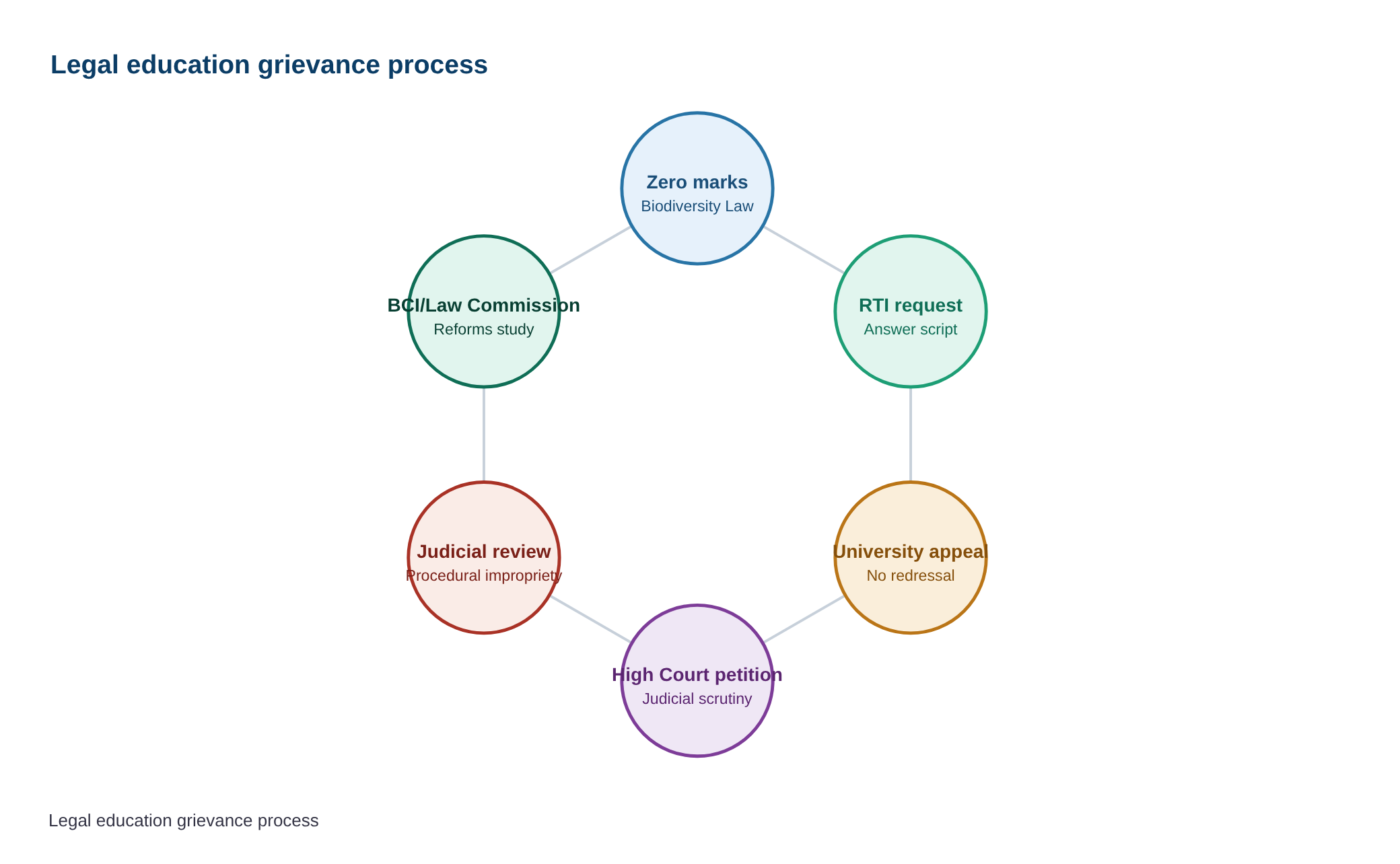
Zero-mark allocation in Biodiversity Protection Law → Student’s RTI request for answer script → University’s failure to address grievance → High Court petition → Judicial scrutiny of evaluation process → Concern over legal education standards → Call for regulatory reforms → Broader debate on academic accountability.
Prelims Practice Questions
Q1. Consider the following statements regarding the Bar Council of India (BCI):
1. The BCI is a statutory body established under the Advocates Act, 1961.
2. It has the power to frame rules for legal education and professional standards.
3. The BCI can directly interfere in the academic evaluation process of law students.
4. The BCI is responsible for the registration of advocates in India.
How many of the above statements are correct?
- Only one
- Only two
- Only three
- All four
Answer: Only three — Statements 1, 2, and 4 are correct as per the Advocates Act, 1961. Statement 3 is incorrect because the BCI does not directly interfere in academic evaluation; such matters fall under the jurisdiction of educational institutions and courts.
Q2. Assertion (A): The High Court of Allahabad, in the given case, held that judicial intervention in academic evaluation is permissible only if there is arbitrariness or malafide intent.
Reason (R): The Indian Constitution empowers the judiciary to intervene in all administrative and academic matters of educational institutions to ensure fairness.
In the context of the above statements, which of the following is correct?
- Both A and R are true, and R is the correct explanation of A
- Both A and R are true, but R is NOT the correct explanation of A
- A is true, but R is false
- A is false, but R is true
Answer: A is true, but R is false — The assertion (A) is correct as the High Court ruled that judicial intervention is limited to cases of arbitrariness or malafide intent. However, the reason (R) is incorrect because the judiciary does not intervene in all academic matters; it acts within constitutional and legal boundaries.
Q3. Match the following bodies with their respective functions in the context of legal education in India:
Column I (Body) Column II (Function)
A. Bar Council of India (BCI) 1. Framing syllabus and curriculum for legal education
B. University Grants Commission (UGC) 2. Registration of advocates and setting professional standards
C. Law Commission of India 3. Recommendations for reforms in legal education and justice delivery
D. All India Bar Examination (AIBE) 4. Conducting a national-level examination for law graduates
Select the correct match:
- A-2, B-1, C-3, D-4
- A-1, B-2, C-3, D-4
- A-4, B-3, C-2, D-1
- A-2, B-4, C-1, D-3
Answer: A-2, B-1, C-3, D-4 — A-2: BCI registers advocates and sets professional standards; B-1: UGC frames syllabus and curriculum; C-3: Law Commission recommends reforms; D-4: AIBE conducts a national examination for law graduates.
Mains Practice Question
✍ The High Court of Allahabad, in a recent judgment, dismissed a petition filed by a law student who had scored zero marks in the subject of Biodiversity Protection Law, while expressing grave concern over the state of legal education in India. Critically examine the role of judicial institutions in ensuring academic integrity and quality assurance in legal education. Also, analyse the constitutional and statutory framework governing legal education in India. (15 Marks)
Approach: MODEL-ANSWER SKELETON:
1. **Introduction (2 Marks)**
– Briefly state the context: Allahabad High Court’s judgment and its concerns over legal education.
– Define legal education and its importance in the justice delivery system.
2. **Judicial Role in Academic Integrity (4 Marks)**
– **Judicial Review in Examination Disputes**: Explain the scope of judicial intervention in academic evaluation (e.g., arbitrariness, malafide intent, violation of principles of natural justice). Cite relevant case laws such as *T.M.A. Pai Foundation v. State of Karnataka* (2002) and *P.A. Inamdar v. State of Maharashtra* (2005).
– **Limits of Judicial Intervention**: Highlight that courts cannot substitute their judgment for academic evaluation unless there is a clear violation of legal or constitutional principles.
3. **Constitutional and Statutory Framework for Legal Education (5 Marks)**
– **Advocates Act, 1961**: Role of the Bar Council of India (BCI) in regulating legal education, setting standards, and conducting the All India Bar Examination (AIBE).
– **University Grants Commission (UGC) Regulations**: UGC’s role in framing syllabus, curriculum, and ensuring quality in higher education institutions.
– **Law Commission of India**: Its mandate to recommend reforms in legal education and justice delivery systems.
– **Judicial Standards**: Reference to the Supreme Court’s observations in *Vineet Kumar v. Union of India* (2022) on the need for reforms in legal education.
4. **Challenges in Legal Education (2 Marks)**
– **Quality Assurance**: Issues such as lack of standardized curriculum, inadequate faculty, and poor infrastructure in law schools.
– **Judicial Concerns**: The Allahabad High Court’s observations on the need for systemic reforms and accountability in legal education.
5. **Conclusion (2 Marks)**
– Summarize the balance between judicial intervention and institutional autonomy.
– Emphasize the need for collaborative efforts between the judiciary, BCI, UGC, and Law Commission to improve legal education standards.
**Key Points to Include**:
– Articles 21, 21A, and 38 of the Constitution (right to education and dignity).
– BCI’s *Rules of Legal Education, 2008* and *Legal Education Rules, 2020*.
– UGC’s *Minimum Standards of Instruction for the Grant of the First Degree in Law, 2010*.
– Recent reports by the Law Commission on legal education reforms.
Source: amarujala.com
Generated by AanyaAi for educational purpose.

- राज्यसभा उपचुनाव उत्तराखंड: 16 अक्तूबर को मतदान, जानें पूरा कार्यक्रम और महत्व - September 22, 2026
- राज्यसभा उपचुनाव उत्तराखंड: 16 अक्टूबर को मतदान, जानें प्रक्रिया और महत्व - September 22, 2026
- चार राज्यों में विधान परिषद चुनाव: निर्वाचन आयोग ने जारी की तिथियां, कब होगा मतदान? - September 22, 2026

No Comments