


01 Nov UPSC Alert: Coal Ministry’s Star Rating Awards for Mining Excellence
✎ The Star Rating Policy for Coal Mines is a performance-driven assessment framework administered by the Coal Controller’s Organisation to rank mines on operational efficiency, environmental sustainability, occupational health and…
Subject Relevance — Where This Topic Fits
- GS Paper III — Environment, Economic Development, and Infrastructure
- Prelims: Star Rating Policy for Coal Mines, Coal Controller’s Organisation (CCO), Sustainable Mining Practices, Public Sector Undertakings (PSUs) in Coal Sector, Environmental Management in Mining, Occupational Health and Safety in Mining
- Essay: Balancing Economic Development with Environmental Sustainability: The Case of India’s Coal Sector, Institutional Mechanisms for Promoting Excellence in Public Sector Enterprises
Quick Revision: The Star Rating Policy for Coal Mines is a performance-driven assessment framework administered by the Coal Controller’s Organisation to rank mines on operational efficiency, environmental sustainability, occupational health and safety, technological adoption, and social responsibility, with awards given annually to recognise excellence.
Why is this in the news?
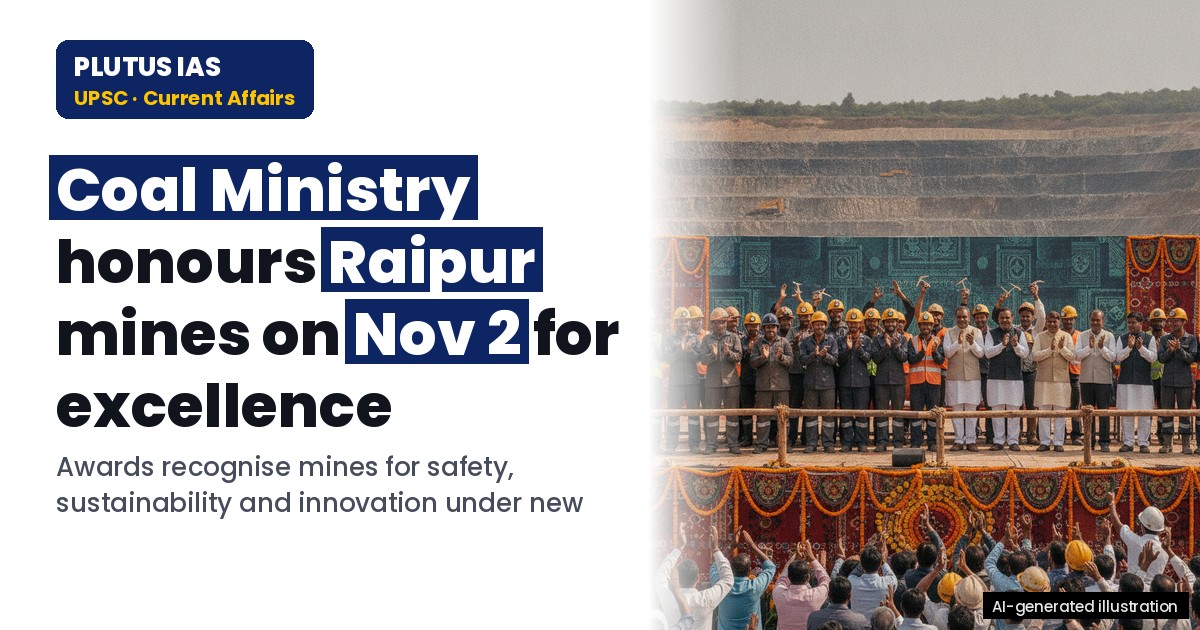
The Union Ministry of Coal is set to organise the Star Rating Awards ceremony on 2 November 2026 in Raipur, Chhattisgarh, to recognise and celebrate outstanding achievements in India’s coal and lignite mining sector. The awards, based on a transparent and performance-driven assessment framework, honour mines that excel in operational efficiency, environmental sustainability, occupational health and safety, technological adoption, and responsible resource management. This initiative underscores the government’s commitment to fostering scientific, safe, and sustainable mining practices while reinforcing the coal sector’s contribution to energy security and economic growth.
Background
- The coal sector remains a critical pillar of India’s energy mix, contributing approximately 55% to the country’s primary commercial energy supply.
- India is the world’s second-largest coal producer, with an annual output of over 800 million tonnes, primarily from public sector undertakings (PSUs) such as Coal India Limited (CIL) and its subsidiaries.
- The Star Rating Policy for Coal Mines was introduced to institutionalise a culture of continuous improvement, transparency, and accountability in mining operations.
- The assessment framework is administered by the Coal Controller’s Organisation (CCO), an attached office of the Ministry of Coal, under the provisions of the Coal Mines (Conservation and Development) Act, 1974.
- The policy aligns with India’s commitments under international frameworks such as the Paris Agreement and the Sustainable Development Goals (SDGs), particularly SDG 7 (Affordable and Clean Energy) and SDG 12 (Responsible Consumption and Production).
- Chhattisgarh, a major coal-producing state, accounts for nearly 20% of India’s total coal production, making it a strategic location for such recognition events.
What is the Star Rating Policy for Coal Mines?
- The Star Rating Policy is a performance assessment framework introduced by the Ministry of Coal to evaluate and rank coal and lignite mines on multiple parameters, including operational efficiency, technological adoption, occupational health and safety, environmental management, sustainable development, rehabilitation, and community welfare initiatives.
- The assessment is conducted annually by the Coal Controller’s Organisation (CCO), which deploys trained evaluators to conduct on-site inspections and verify compliance with prescribed standards.
- Mines are rated on a five-star scale, with five stars representing the highest level of performance and zero stars indicating non-compliance with basic requirements.
- The evaluation criteria encompass 12 key performance indicators (KPIs) grouped under five broad domains: operational excellence, environmental stewardship, occupational safety, technological innovation, and social responsibility.
- The policy incentivises mines to adopt best practices by recognising top performers through public awards, thereby fostering healthy competition and driving sector-wide improvements.
- The Star Rating Awards serve as a platform to highlight innovations in mining technology, such as the use of drones for surveying, IoT-based monitoring systems, and AI-driven predictive maintenance.
- The framework integrates India’s legal and regulatory obligations, including the Environment Protection Act, 1986, the Forest Conservation Act, 1980, and the Mines Act, 1952, ensuring alignment with national environmental and labour laws.
- The policy also mandates adherence to the National Mineral Policy, 2019, which emphasises sustainable mining, resource efficiency, and the welfare of mining-affected communities.
Key Features
| Feature | Significance |
|---|---|
| Star Rating Policy for Coal/Lignite Mines | Establishes a transparent, performance-based framework to evaluate and incentivize operational excellence, environmental stewardship, and worker safety in mining operations. |
| Multi-Criteria Assessment | Evaluates mines across operational efficiency, technological adoption, occupational health and safety, environmental management, sustainable development, rehabilitation, and community welfare. |
| Independent Verification | Ratings are determined by assessors appointed by the Coal Controller Organisation, ensuring credibility and reducing subjective bias. |
| Public Recognition Mechanism | Awards serve as a formal platform to acknowledge and celebrate best practices, fostering a culture of continuous improvement and innovation in the sector. |
| Alignment with National Objectives | Supports India’s energy security by promoting scientific, safe, and environmentally responsible mining practices. |
Why it Matters
Economic & Strategic
- Enhances the efficiency and productivity of coal and lignite mining, critical for India’s energy security and industrial growth.
- Encourages adoption of advanced technologies, reducing operational costs and improving resource utilisation.
- Strengthens the competitiveness of India’s mining sector in the global market through demonstrated compliance with international standards.
Environmental
- Promotes sustainable mining practices by incentivising compliance with environmental regulations and adoption of green technologies.
- Reduces ecological footprint through structured assessment of rehabilitation and restoration initiatives.
- Aligns with India’s commitments under international environmental agreements, such as the Paris Agreement.
Social & Governance
- Improves occupational health and safety standards, reducing workplace accidents and fatalities in the mining sector.
- Fosters community engagement by recognising initiatives that prioritise local welfare and inclusive development.
- Enhances transparency and accountability in mining operations through a structured, data-driven evaluation process.
Policy & Institutional
- Demonstrates the effectiveness of performance-based governance models in public sector undertakings (PSUs).
- Serves as a model for other resource-based industries to adopt similar rating mechanisms for sustainability and compliance.
- Reinforces the role of regulatory bodies like the Coal Controller Organisation in standardising industry practices.
Challenges
1. Environmental Degradation in Mining
- Unsustainable mining practices can lead to soil erosion, water pollution, and loss of biodiversity.
- Regulatory compliance remains inconsistent across states, necessitating stronger enforcement mechanisms.
- Balancing economic imperatives with ecological sustainability remains a persistent challenge.
UPSC Link: GS3: Environmental Impact Assessment
2. Occupational Health & Safety Risks
- Mining is inherently hazardous, with risks of accidents, respiratory diseases, and fatalities.
- Ensuring adherence to safety protocols requires continuous training and monitoring.
- The informal sector in mining often lacks access to safety equipment and healthcare facilities.
UPSC Link: GS3: Occupational Safety and Health
3. Technological Lag in Mining Operations
- Adoption of modern mining technologies (e.g., automation, AI-driven analytics) is uneven across PSUs and private players.
- High capital costs deter small and medium-scale miners from investing in advanced equipment.
- Skill gaps persist, requiring targeted capacity-building initiatives.
UPSC Link: GS3: Science and Technology in Mining
4. Community Displacement & Rehabilitation
- Mining projects often lead to displacement of local communities, necessitating fair compensation and resettlement.
- Inadequate implementation of rehabilitation policies exacerbates social tensions and resistance to mining projects.
- Grievance redressal mechanisms remain weak, delaying project clearances.
UPSC Link: GS2: Land Acquisition and Rehabilitation
5. Regulatory & Compliance Bottlenecks
- Fragmented regulatory frameworks across states create confusion and delays in project approvals.
- Overlapping jurisdictions between central and state authorities hinder effective enforcement.
- Corruption and bureaucratic red tape persist in licensing and inspection processes.
UPSC Link: GS2: Regulatory Framework for Mining
Challenges — UPSC Perspective
| Issue | Concern |
|---|---|
| Environmental Compliance | Inconsistent enforcement of environmental norms across states leads to ecological degradation. |
| Worker Safety | High incidence of accidents and occupational diseases due to inadequate safety protocols. |
| Technological Adoption | Slow integration of automation and digital tools limits operational efficiency. |
| Community Resistance | Displacement and inadequate rehabilitation measures fuel opposition to mining projects. |
| Regulatory Delays | Complex approval processes and bureaucratic hurdles delay project implementation. |
| Resource Depletion | Unsustainable extraction practices threaten long-term availability of coal and lignite reserves. |
Way Forward
- Strengthen the Star Rating Policy by incorporating real-time monitoring and AI-driven analytics for objective assessments.
- Expand capacity-building programs for mining professionals to enhance technological adoption and safety protocols.
- Streamline regulatory processes by establishing a unified digital platform for clearances and inspections.
- Enhance community engagement through mandatory social impact assessments and participatory rehabilitation planning.
- Promote public-private partnerships to accelerate the deployment of green technologies in mining operations.
- Institute mandatory third-party audits for environmental compliance and occupational health standards.
- Develop a national database of mining accidents and violations to identify systemic gaps and inform policy reforms.
- Integrate the Star Rating Policy with other sustainability frameworks (e.g., ESG reporting) to align with global best practices.
UPSC Value Addition
Keywords for Mains Answer-Writing
Star Rating Policy for Coal and Lignite Mines · Sustainable Mining Practices · Operational Efficiency in Mining · Environmental Management in Coal Sector · Occupational Health and Safety in Mining · Technology Adoption in Coal Mining · Corporate Social Responsibility in Mining · Public Sector Undertakings in Coal Sector · Energy Security through Coal Mining · Regulatory Framework for Mining Sector · Stakeholder Inclusion in Mining Governance · Life Cycle Management of Mining Resources
Concept Flow
Performance assessment of coal/lignite mines → Star Rating Policy implementation → Independent verification by Coal Controller Organisation → Recognition of top-performing mines → Incentivisation of best practices → Sector-wide adoption of sustainable and efficient mining methods → Enhanced energy security and environmental stewardship.
Prelims Practice Questions
Q1. Consider the following statements regarding the Star Rating Policy for Coal and Lignite Mines in India:
1. The policy assesses coal and lignite mines based on operational efficiency, environmental sustainability, occupational health and safety, and technological advancement.
2. The rating system ranges from five stars to zero stars.
3. The assessment is conducted by the Coal Controller’s Organisation.
4. The policy was introduced under the Mines Act, 1952.
How many of the above statements are correct?
- Only one
- Only two
- Only three
- All
Answer: All — Statements 1, 2, and 3 are correct. Statement 4 is incorrect as the Star Rating Policy is a recent initiative by the Ministry of Coal and not mandated under the Mines Act, 1952.
Q2. Assertion (A): The Star Rating Policy for coal and lignite mines aims to promote sustainable mining practices.
Reason (R): The policy includes parameters such as environmental management, occupational health and safety, and technological advancement in its assessment framework.
In the context of the above two statements, which one of the following is correct?
- Both A and R are true, and R is the correct explanation of A
- Both A and R are true, but R is not the correct explanation of A
- A is true, but R is false
- A is false, but R is true
Answer: Both A and R are true, but R is not the correct explanation of A — Both the assertion and reason are true. The Star Rating Policy explicitly includes environmental management, occupational health and safety, and technological advancement as key parameters, making R the correct explanation for A.
Q3. Match the following parameters of the Star Rating Policy for coal and lignite mines with their respective descriptions:
Column I (Parameter) | Column II (Description)
1. Operational Efficiency | A. Adoption of advanced technologies to enhance productivity and reduce costs
2. Environmental Management | B. Ensuring the welfare of local communities and rehabilitation of displaced persons
3. Occupational Health and Safety | C. Minimising environmental impact through waste management and pollution control
4. Corporate Social Responsibility | D. Optimising resource utilisation and reducing operational downtime
Select the correct match:
- 1-D, 2-C, 3-A, 4-B
- 1-A, 2-B, 3-C, 4-D
- 1-B, 2-D, 3-A, 3-C
- 1-D, 2-A, 3-C, 4-B
Answer: 1-D, 2-C, 3-A, 4-B — The correct matches are: 1-D (Operational Efficiency), 2-C (Environmental Management), 3-A (Occupational Health and Safety), and 4-B (Corporate Social Responsibility).
Mains Practice Question
✍ The Star Rating Policy for coal and lignite mines represents a paradigm shift in the governance of India’s mining sector by institutionalising performance-based regulation. Critically examine the policy’s objectives, operational framework, and its potential to balance economic imperatives with environmental and social sustainability. Also, analyse the challenges in its implementation and suggest measures to enhance its efficacy. (15 Marks)
Approach: MODEL-ANSWER SKELETON:
1. **Introduction (2 Marks)**
– Briefly define the Star Rating Policy for coal and lignite mines and its launch context (2024-25 assessment cycle).
– State its overarching goal: to institutionalise a performance-based regulatory framework that incentivises excellence in operational efficiency, environmental sustainability, occupational health and safety, and technological advancement.
2. **Objectives of the Policy (3 Marks)**
– **Economic Imperatives**: Enhance productivity, reduce operational costs, and ensure energy security through efficient coal and lignite mining.
– **Environmental Sustainability**: Promote adherence to environmental norms (e.g., waste management, pollution control, carbon footprint reduction) as mandated under the Environment Protection Act, 1986 and the Forest (Conservation) Act, 1980.
– **Social Sustainability**: Ensure occupational health and safety (OHS) compliance under the Mines Act, 1952 and the Factories Act, 1948, and address corporate social responsibility (CSR) through community welfare and rehabilitation measures.
– **Technological Advancement**: Encourage adoption of modern mining technologies (e.g., automation, AI-driven monitoring, renewable energy integration) to improve efficiency and reduce environmental impact.
3. **Operational Framework (4 Marks)**
– **Assessment Parameters**: Outline the five key parameters—operational efficiency, environmental management, OHS, technological adoption, and CSR—with examples of metrics (e.g., OHS: accident rates; environmental management: compliance with effluent discharge standards).
– **Rating Mechanism**: Explain the five-star rating system, including the role of the Coal Controller’s Organisation in conducting third-party audits and verification.
– **Incentives and Disincentives**: Discuss how high ratings confer recognition, potential financial incentives (e.g., tax rebates, priority in coal allocation), while low ratings may trigger regulatory scrutiny or operational restrictions.
4. **Balancing Economic, Environmental, and Social Goals (3 Marks)**
– **Economic vs. Environmental Trade-offs**: Critique the tension between maximising coal output (economic imperative) and minimising environmental degradation (e.g., deforestation, water pollution).
– **Social Equity**: Highlight the policy’s role in addressing the displacement of local communities and ensuring their welfare, aligning with the National Rehabilitation and Resettlement Policy, 2007.
– **Stakeholder Inclusion**: Emphasise the participation of PSUs (e.g., Coal India Limited, NLC India Limited), state governments, and local communities in the assessment process.
5. **Challenges in Implementation (2 Marks)**
– **Data Reliability**: Challenges in ensuring accurate and transparent data collection for assessments.
– **Regulatory Capacity**: Limited institutional capacity of the Coal Controller’s Organisation to conduct rigorous audits across all mines.
– **Resistance to Change**: Reluctance among some mining operators to adopt new technologies or comply with stringent environmental norms due to cost implications.
– **Regional Disparities**: Variations in implementation across states due to differences in administrative capacity and resource availability.
6. **Measures to Enhance Efficacy (3 Marks)**
– **Strengthening Institutional Capacity**: Augment the Coal Controller’s Organisation with additional resources and training to improve audit quality.
– **Digital Transformation**: Leverage AI, IoT, and blockchain for real-time monitoring and transparent data sharing.
– **Incentivising Compliance**: Introduce performance-linked subsidies or penalties tied to star ratings.
– **Capacity Building**: Conduct training programmes for mining operators on best practices in OHS, environmental management, and technological adoption.
– **Community Engagement**: Establish grievance redressal mechanisms and involve local communities in monitoring compliance with CSR initiatives.
7. **Conclusion (2 Marks)**
– Summarise the policy’s significance as a model for performance-based regulation in resource governance.
– Reiterate its potential to reconcile economic growth with environmental and social sustainability, while acknowledging implementation challenges and the need for continuous refinement.
Source: PIB (Press Information Bureau)
Chhattisgarh PCS (CGPSC) — State PCS Practice
Prelims: Chhattisgarh recently hosted the ‘Star Rating Awards’ ceremony on 2nd November to recognize excellence in which sector?
- Coal and Lignite Mining
- Agriculture and Irrigation
- Renewable Energy
- Textile and Handloom
Answer: Coal and Lignite Mining — The event was organized by the Ministry of Coal to honor outstanding achievements in the coal and lignite mining sector.
Mains: Discuss the significance of Chhattisgarh’s role in India’s coal and lignite mining sector, highlighting recent initiatives and their impact on the state’s economy. (200 words)
Generated by AanyaAi for educational purpose.
Related guides on our sites
- How to prepare for GS paper 1 for UPSC CSE mains exam
- Best UPSC coaching for IFOS exam
- Best mentorship programme for upsc
- UPSC+BA degree

- UPSC Alert: Coal Ministry’s Star Rating Awards for Mining Excellence - November 1, 2026
- भूटान में 108 स्तूपों का निर्माण: किरेन रिजिजू ने किया प्रतिनिधित्व, जानें महत्व - November 1, 2026
- Dinesh V. Ganvir takes charge as 55th GSI Director: Key priorities for UPSC - November 1, 2026

No Comments