


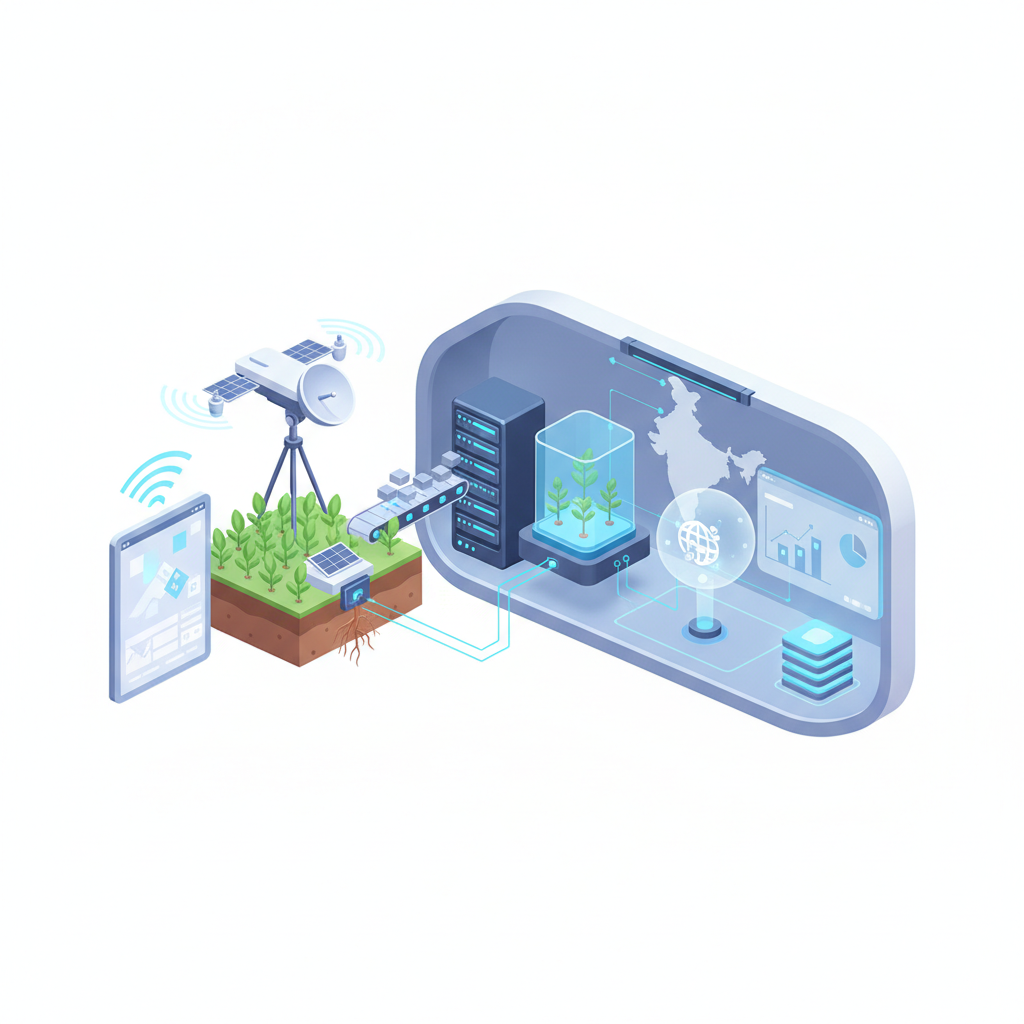
11 Aug UPSC Alert: Digital Crop Survey (DGCES) Boosts Farm Yield Accuracy Nationwide
Crop cutting experimentsDigital data collectionSample survey officeYield estimation systemAgricultural statistics✎ The Digital General Crop Estimation Survey (DGCES) replaces manual, paper-based crop yield estimation with a fully digital, geotagged, and real-time mobile application system to enhance transparency, accuracy, and timeliness in…
Subject Relevance — Where This Topic Fits
- GS Paper III — Technology, Economic Development, Agriculture
- Prelims: Digital Agriculture Mission, Crop Cutting Experiments (CCE), Geotagging in agriculture, Mobile-based data collection, Agricultural statistics
- Essay: The role of technology in transforming agricultural governance in India, Data-driven policymaking for sustainable agriculture
Quick Revision: The Digital General Crop Estimation Survey (DGCES) replaces manual, paper-based crop yield estimation with a fully digital, geotagged, and real-time mobile application system to enhance transparency, accuracy, and timeliness in agricultural statistics.
Why is this in the news?
The Digital General Crop Estimation Survey (DGCES), implemented by the Ministry of Agriculture and Farmers’ Welfare, has been expanded to 23 states and Union Territories as of August 2026. This initiative, initially piloted during the Kharif season of 2023-24 in 10 states, represents a significant shift toward digital, transparent, and real-time agricultural data collection, addressing long-standing challenges in crop yield estimation and agricultural statistics.
Background
- Agricultural statistics in India have historically relied on manual, paper-based methods for crop cutting experiments (CCEs), leading to delays, inconsistencies, and limited transparency in yield estimation.
- The National Sample Survey Office (NSSO) and the Ministry of Agriculture and Farmers’ Welfare have long emphasized the need for modernisation to improve the accuracy and reliability of agricultural data.
- The Digital India initiative, launched in 2015, provided the foundational framework for integrating technology into governance, including agriculture, through initiatives like the Digital Agriculture Mission.
- The Government of India’s focus on doubling farmers’ income by 2022-23 necessitated robust, real-time data systems to inform policy interventions and market decisions.
- The DGCES aligns with global best practices, such as the use of remote sensing and mobile applications in agricultural statistics, as seen in countries like the United States and Brazil.
- The scheme is part of a broader push toward evidence-based policymaking in agriculture, complementing other digital initiatives like the Soil Health Card and PM-KISAN.
What is the Digital General Crop Estimation Survey (DGCES)?
- The DGCES is a digital platform designed to modernise the process of crop yield estimation in India by replacing traditional paper-based methods with a fully digital, mobile application-based workflow.
- It is implemented under the aegis of the Ministry of Agriculture and Farmers’ Welfare, with technical support from the National Informatics Centre (NIC) and the Mahalanobis National Crop Forecast Centre (MNCFC).
- The survey uses geotagging, time-stamping, and photographic evidence to ensure transparency, accountability, and accuracy in data collection during Crop Cutting Experiments (CCEs).
- The system enables real-time data collection through a mobile app, which is uploaded to a centralised web-based dashboard for monitoring, validation, and analysis.
- DGCES standardises data collection and verification processes across states, reducing discrepancies and improving the consistency of agricultural statistics.
- The platform facilitates online supervision and faster compilation of crop yield estimates, thereby enhancing the timeliness of data dissemination to policymakers, researchers, and farmers.
- The phased implementation of DGCES began with a pilot in 10 states during the Kharif season of 2023-24, followed by expansion to 22 states/UTs in the Rabi season of 2023-24, and is currently operational in 23 states/UTs.
- The expansion is contingent upon state government preparedness, availability of digital infrastructure, and capacity building of field officials.
Key Features
| Feature | Significance |
|---|---|
| Phased Implementation | Ensures systematic rollout with pilot testing in select districts before national expansion, reducing implementation risks. |
| Mobile Application for Real-Time Data Collection | Enables instantaneous data capture during Crop Cutting Experiments (CCE), minimising lag and human error. |
| Geo-Tagging and Time-Stamping | Provides verifiable spatial and temporal proof of data collection, enhancing transparency and reducing fraud. |
| Paperless Workflow | Eliminates manual records, reducing administrative burden and improving data integrity. |
| Web-Based Monitoring Dashboard | Facilitates centralised oversight, enabling real-time tracking of CCE progress across states. |
| Standardised Data Collection Protocols | Ensures uniformity in methodologies, improving comparability and reliability of yield estimates. |
Why it Matters
Agricultural Policy and Governance
- Enhances the accuracy of crop yield estimates, critical for evidence-based policy formulation in food security, procurement, and price stabilisation.
- Strengthens the credibility of India’s agricultural statistics, which are used by global agencies like FAO and World Bank for comparative assessments.
- Supports the implementation of schemes such as PM-KISAN and PM-AASHA by providing reliable yield data for beneficiary identification and payout calculations.
Economic Implications
- Improves market efficiency by reducing information asymmetry between farmers, traders, and policymakers regarding crop output.
- Facilitates better agricultural credit disbursement by providing verifiable yield data to financial institutions.
- Reduces post-harvest losses by enabling timely interventions based on accurate yield forecasts.
Technological and Institutional Impact
- Demonstrates the scalability of digital governance tools in rural India, paving the way for similar initiatives in other sectors.
- Enhances the capacity of state agricultural departments through training in digital tools and data management.
- Promotes inter-state data comparability, fostering collaborative agricultural research and policy development.
Challenges
1. Digital Divide and Infrastructure Gaps
- Rural areas, particularly in hilly and tribal regions, may lack reliable internet connectivity, hindering real-time data transmission.
- Inadequate digital literacy among field staff could lead to suboptimal utilisation of the mobile application.
UPSC Link: GS-III: Science & Technology
2. Data Privacy and Security
- Geo-tagged and time-stamped data collection raises concerns about the privacy of farmers’ land records and personal information.
- Cybersecurity risks may expose sensitive agricultural data to unauthorised access or manipulation.
UPSC Link: GS-II: Governance
3. Standardisation Across States
- Variations in state-level agricultural practices and reporting formats may undermine the uniformity of data collection.
- Resistance to change from traditional paper-based systems could slow down adoption in some states.
UPSC Link: GS-II: Federalism
4. Human Resource Constraints
- Shortage of trained personnel to operate the digital platform and conduct CCEs effectively.
- High attrition rates in state agricultural departments may disrupt the continuity of data collection.
UPSC Link: GS-II: Human Resource
5. Cost and Sustainability
- Initial setup and maintenance costs for digital infrastructure may strain state budgets.
- Long-term funding mechanisms for scaling up and sustaining the system remain uncertain.
UPSC Link: GS-III: Economic Development
Challenges — UPSC Perspective
| Issue | Concern |
|---|---|
| Connectivity in Remote Areas | Limited internet penetration in rural and tribal regions may disrupt real-time data transmission. |
| Digital Literacy Deficits | Inadequate training of field staff could lead to errors in data entry and utilisation. |
| Data Privacy Risks | Geo-tagged data collection may expose sensitive land records to privacy breaches. |
| State-Level Disparities | Variations in agricultural practices and reporting formats may reduce data comparability. |
| Cybersecurity Threats | Vulnerability to hacking or data breaches could compromise the integrity of yield estimates. |
| Resource Constraints | High costs and shortage of trained personnel may hinder effective implementation. |
Way Forward
- Accelerate the rollout to the remaining states/UTs by assessing and addressing digital infrastructure gaps.
- Conduct capacity-building programmes for state agricultural departments on digital tools and data management.
- Develop a robust cybersecurity framework to safeguard sensitive agricultural data.
- Establish a grievance redressal mechanism for farmers to report discrepancies in yield estimates.
- Integrate the DGCIES platform with other agricultural databases (e.g., land records, weather data) for holistic insights.
- Pilot blockchain-based verification for CCE data to enhance transparency and tamper-proofing.
- Allocate dedicated funds in state budgets for the maintenance and scaling of digital infrastructure.
- Promote public-private partnerships to leverage expertise in digital governance and data analytics.
UPSC Value Addition
Keywords for Mains Answer-Writing
Digital General Crop Estimation Survey (DGCE S) · Crop Cutting Experiments (CCE) · Agricultural statistics · National Statistical Office (NSO) · Geotagging · Time-stamping · Digital ecosystem for agriculture · Agricultural data transparency · Ministry of Agriculture and Farmers’ Welfare · Pilot projects in agriculture · Standardisation of agricultural data · Real-time data collection · Web-based dashboards for monitoring · Phased implementation of schemes
Concept Flow
Agricultural yield estimation → Traditional paper-based CCEs → Data inaccuracies and delays → Need for digital transformation → DGCIES pilot (Khari 2023) → Phased expansion → Real-time data collection → Standardised protocols → Enhanced transparency and accuracy → Evidence-based policy formulation → Food security and market efficiency.
Prelims Practice Questions
Q1. Consider the following statements regarding the Digital General Crop Estimation Survey (DGCE S):
1. DGCE S is implemented under the aegis of the Ministry of Agriculture and Farmers’ Welfare.
2. It utilises geotagging and time-stamping to enhance transparency in crop estimation.
3. DGCE S has been operational in all states of India since its inception.
4. The survey employs a mobile application for real-time data collection.
How many of the above statements are correct?
- Only one
- Only two
- Only three
- All
Answer: All — Statements 1, 2, and 4 are correct. Statement 3 is incorrect as DGCE S is implemented in a phased manner and is currently operational in 23 states/UTs, not all states.
Q2. Assertion (A): The Digital General Crop Estimation Survey (DGCE S) aims to standardise data collection and verification processes across states.
Reason (R): Standardisation improves the accuracy, reliability, and timeliness of crop yield estimates.
Options:
A. Both A and R are true, and R is the correct explanation of A.
B. Both A and R are true, but R is NOT the correct explanation of A.
C. A is true, but R is false.
D. A is false, but R is true.
- A
- B
- C
- D
Answer: A — Both Assertion (A) and Reason (R) are true, and R correctly explains A. DGCE S standardises data collection (A) to improve accuracy and timeliness (R).
Q3. Match the following columns related to the Digital General Crop Estimation Survey (DGCE S):
Column I (Feature) | Column II (Description)
— | —
1. Geotagging | A. Ensures data is collected at the correct time
2. Time-stamping | B. Provides location-specific data for verification
3. Web-based dashboard | C. Enables real-time monitoring and supervision
4. Mobile application | D. Facilitates paperless workflow for data collection
Options:
A. 1-B, 2-A, 3-C, 4-D
B. 1-A, 2-B, 3-D, 4-C
C. 1-C, 2-D, 3-A, 4-B
D. 1-D, 2-C, 3-B, 4-A
- A
- B
- C
- D
Answer: A — 1-B (Geotagging provides location-specific data), 2-A (Time-stamping ensures correct timing), 3-C (Web-based dashboard enables monitoring), 4-D (Mobile application facilitates paperless workflow).
Mains Practice Question
✍ The Digital General Crop Estimation Survey (DGCE S) represents a paradigm shift in India’s agricultural statistics ecosystem. Critically examine the significance of DGCE S in enhancing the accuracy, transparency, and timeliness of crop yield estimates. Also, analyse the challenges in its phased implementation across states. (15 Marks)
Approach: MODEL-ANSWER SKELETON:
1. **Introduction (2 Marks)**
– Define DGCE S and its objective: to modernise crop yield estimation through digital tools.
– Context: Traditional Crop Cutting Experiments (CCE) faced issues of manual errors, delays, and lack of transparency.
2. **Significance of DGCE S (6 Marks)**
– **Accuracy and Reliability**: Use of geotagging, time-stamping, and photographic evidence reduces human errors and ensures data integrity.
– **Transparency and Accountability**: Digital workflow with real-time data collection and web-based dashboards enhances public trust and reduces scope for manipulation.
– **Standardisation**: Uniform protocols across states improve comparability and consistency of data.
– **Efficiency**: Automation and digital tools expedite data processing and dissemination, enabling timely policy decisions.
3. **Challenges in Implementation (5 Marks)**
– **Digital Divide**: Uneven digital infrastructure and connectivity in rural areas hinder seamless implementation.
– **Capacity Building**: Need for training field officials in digital tools and data management.
– **State-Level Coordination**: Variation in administrative capacities and priorities across states affects uniform rollout.
– **Data Privacy and Security**: Ensuring secure storage and handling of sensitive agricultural data.
4. **Conclusion (2 Marks)**
– DGCE S is a transformative initiative but requires sustained investment in infrastructure, training, and inter-state coordination to realise its full potential. Its success will significantly impact agricultural policy, market stability, and farmer welfare.
Source: PIB (Press Information Bureau)
Generated by AanyaAi for educational purpose.

- आईसीएआर द्वारा स्वच्छता अभियान: गणेश विसर्जन से पर्यावरण संरक्षण तक - September 26, 2026
- ICAR’s Cleanliness Drive: Sustainable Waste Management for UPSC 2026 - September 26, 2026
- मुख्य चुनाव आयुक्त की ‘सर्वोच्च’ भूमिका: चुनाव आयुक्तों को ‘गैर-कार्यात्मक’ बना रही चुनौती - September 26, 2026

No Comments