


09 Aug UPSC Alert: Farmers Criticize Budget 2026; Industry Hails Key Announcements
✎ The revised Agricultural Budget allocates ₹785 crore for micro-irrigation to cover 2,22,794 acres, with 100% subsidy for small and marginal farmers, while maintaining free three-phase electricity for agriculture.
Subject Relevance — Where This Topic Fits
- GS Paper III — Agriculture, Irrigation and Rural Development | GS Paper III — Issues related to Direct and Indirect Farm Subsidies and Minimum Support Prices | GS Paper III — Major Crops — Cropping Patterns in various parts of the country | GS Paper III — Food Processing and Related Industries in India — Scope and Significance
- Prelims: Agricultural Budget, Micro-irrigation, Three-phase electricity for agriculture, Organic certification, Farm ponds, Borewells and tube wells, Subsidy for pumpsets, Rain-fed agriculture
- Essay: Agricultural distress and policy responses in India: Challenges and Solutions, Balancing industrial growth with sustainable agricultural practices
Quick Revision: The revised Agricultural Budget allocates ₹785 crore for micro-irrigation to cover 2,22,794 acres, with 100% subsidy for small and marginal farmers, while maintaining free three-phase electricity for agriculture.
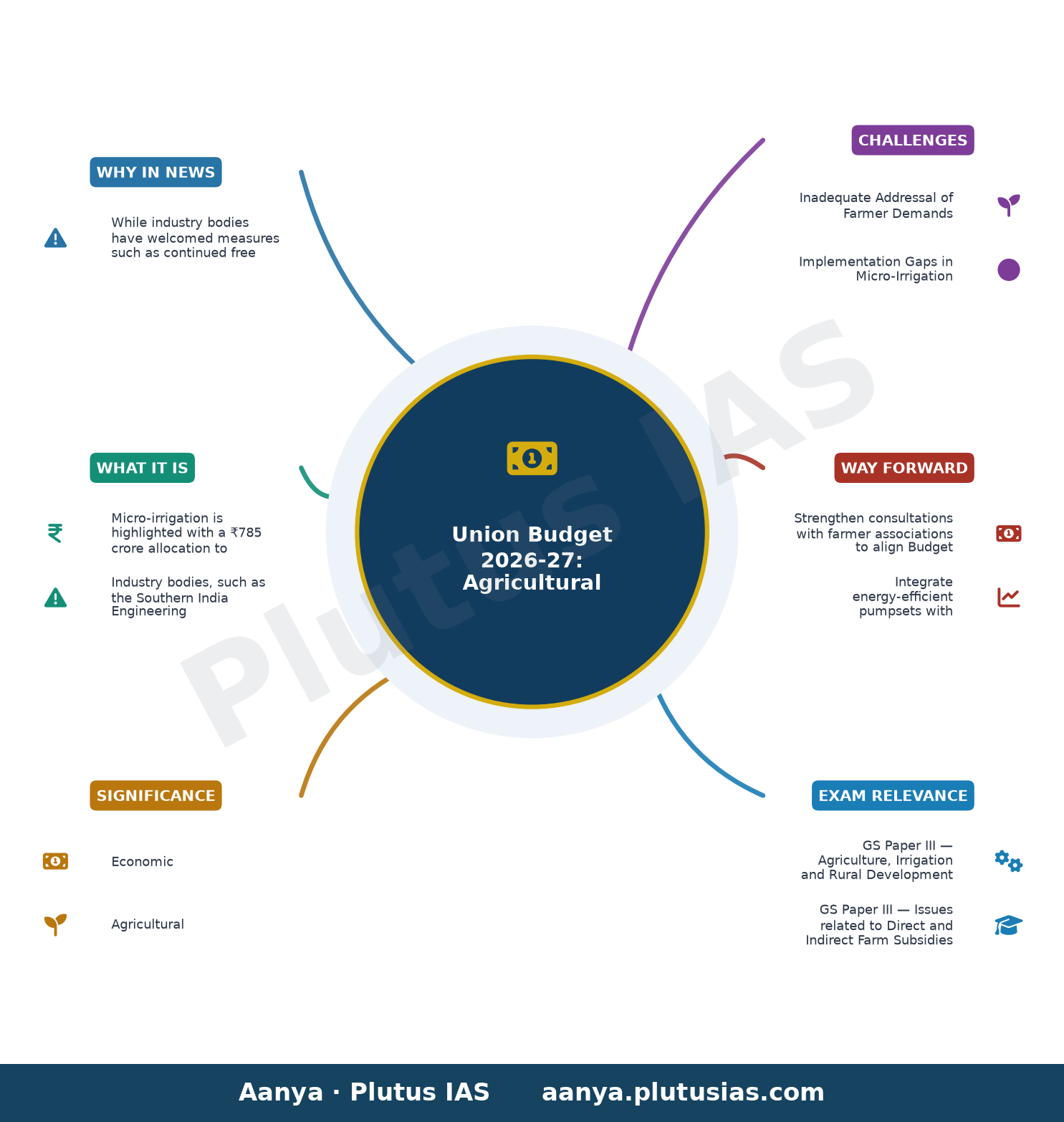
Why is this in the news?
While industry bodies have welcomed measures such as continued free three-phase electricity for agriculture and allocations for micro-irrigation, farmer associations have expressed disappointment over the lack of focus on organic certification infrastructure in Coimbatore and inadequate provisions for solar pumps. This divergence underscores the persistent challenges in aligning agricultural policy with ground-level realities, particularly in rain-fed regions and areas transitioning to organic farming.
Background
- Tamil Nadu, a major agricultural state, faces significant challenges such as high dependence on monsoon rains, declining groundwater tables, and fragmented landholdings, necessitating targeted interventions.
- Previous Budgets have introduced schemes like the Pradhan Mantri Krishi Sinchayee Yojana (PMKSY) to enhance irrigation coverage, but implementation gaps persist, particularly in small and marginal holdings.
- The organic farming sector in India is growing at ~20% annually, with Tamil Nadu being a key contributor, but certification infrastructure remains underdeveloped, especially in non-metro regions like Coimbatore.
What is the revised Agricultural Budget’s Agricultural Policy Framework?
- Micro-irrigation is highlighted with a ₹785 crore allocation to cover 2,22,794 acres, benefiting ~95,000 farmers, with 100% subsidy for small and marginal farmers and 75% for others.
- Industry bodies, such as the Southern India Engineering Manufacturers Association (SIEMA) and Indian Pump Manufacturers Association (IPMA), have welcomed the focus on micro-irrigation and efficient water use, noting its potential to enhance agricultural productivity.
- The allocation for irrigation and micro-irrigation aligns with the Sustainable Development Goals (SDG 2: Zero Hunger) and SDG 6 (Clean Water and Sanitation), emphasising resource efficiency and climate resilience.
Key Features
| Feature | Significance |
|---|---|
| Allocation of ₹7,432.58 crore for free three-phase electricity to agricultural operations | Ensures reliable energy supply for irrigation, reducing operational costs for farmers and supporting agricultural productivity. |
| ₹785 crore allocation for micro-irrigation expansion to 2,22,794 acres | Promotes water-use efficiency, reduces wastage, and enhances agricultural productivity, particularly for small and marginal farmers. |
| 100% subsidy for small and marginal farmers under micro-irrigation scheme | Removes financial barriers for resource-constrained farmers, incentivizing adoption of efficient irrigation techniques. |
| 75% subsidy for other farmers under micro-irrigation scheme | Encourages broader participation in water-saving technologies, aligning with national goals of sustainable agriculture. |
| Focus on creating additional irrigation sources (borewells, tube wells, farm ponds) | Expands irrigation coverage, mitigates dependence on monsoon, and enhances crop resilience in rain-fed areas. |
Why it Matters
Economic
- The Budget’s emphasis on irrigation and micro-irrigation aligns with the economic objective of enhancing agricultural productivity, which is critical for rural incomes and food security.
- Subsidies for micro-irrigation and free electricity reduce input costs for farmers, potentially improving their profitability and reducing debt burdens.
- Industry associations’ positive response highlights the Budget’s role in fostering growth in the agricultural machinery and irrigation sectors, creating employment opportunities.
Agricultural
- The Budget addresses the critical need for irrigation infrastructure, particularly in rain-fed regions, by expanding sources like borewells and farm ponds.
- Micro-irrigation initiatives directly contribute to water conservation, a pressing challenge given India’s depleting groundwater resources and erratic monsoons.
- The focus on agri-business, while noted by farmers, suggests a shift towards value addition and post-harvest management, which can enhance farm incomes.
Environmental
- Promotion of micro-irrigation and efficient water-use practices reduces groundwater exploitation, contributing to long-term environmental sustainability.
- Expansion of irrigation sources like farm ponds aids in groundwater recharge, mitigating the adverse effects of over-extraction.
Social
- Subsidies for small and marginal farmers ensure inclusivity, preventing agrarian distress and promoting equitable growth in the agricultural sector.
- Reliable irrigation and energy support reduce the vulnerability of farmers to climate variability, enhancing socio-economic resilience.
Challenges
1. Inadequate Addressal of Farmer Demands
- The Budget’s silence on demands such as an organic certification office in Coimbatore reflects a disconnect between policy formulation and ground realities.
- Farmers’ perception of the Budget as agri-business-centric, rather than agriculture-focused, indicates a need for more inclusive consultations.
UPSC Link: GS3: Agricultural Marketing and Supply Chain
2. Implementation Gaps in Micro-Irrigation
- While the allocation for micro-irrigation is substantial, effective implementation requires robust monitoring to ensure subsidies reach intended beneficiaries.
- The absence of a clear mechanism for integrating energy-efficient pumpsets with micro-irrigation systems may limit the scheme’s impact.
UPSC Link: GS3: Water Resources and Irrigation Management
3. Groundwater Depletion and Over-Exploitation
- Despite efforts to expand irrigation, unregulated extraction of groundwater for agriculture remains a critical challenge, exacerbated by free electricity policies.
- The Budget’s focus on micro-irrigation must be complemented by stricter groundwater management policies to prevent further depletion.
UPSC Link: GS3: Conservation of Natural Resources
4. Climate Vulnerability and Rain-Fed Agriculture
- The Budget’s emphasis on rain-fed agriculture highlights the persistent challenge of climate variability, which threatens food security and farmer livelihoods.
- Limited focus on climate-resilient agriculture, such as drought-resistant crops or weather-indexed insurance, leaves farmers exposed to risks.
UPSC Link: GS3: Disaster Management and Climate Change
5. Subsidy Distribution and Leakages
- Subsidies, while beneficial, are prone to leakages and inefficiencies, particularly in schemes targeting small and marginal farmers.
- The Budget does not address mechanisms to prevent diversion of subsidies to ineligible beneficiaries or ensure timely disbursal.
UPSC Link: GS3: Public Distribution System and Subsidies
Challenges — UPSC Perspective
| Issue | Concern |
|---|---|
| Farmer demands ignored | Policy disconnect with ground realities, risking agrarian distress. |
| Groundwater depletion | Unregulated extraction threatens long-term agricultural sustainability. |
| Implementation gaps in micro-irrigation | Subsidies may not reach intended beneficiaries, limiting impact. |
| Climate vulnerability | Insufficient focus on climate-resilient agriculture, exposing farmers to risks. |
| Subsidy leakages | Inefficiencies in subsidy distribution may dilute the scheme’s benefits. |
Government Initiatives — Must-Memorise for Prelims
- Micro Irrigation Fund (under Pradhan Mantri Krishi Sinchayee Yojana)
- Pradhan Mantri Krishi Sinchayee Yojana (PMKSY)
- Sub-Mission on Agricultural Mechanization (SMAM)
Way Forward
- Strengthen consultations with farmer associations to align Budget allocations with ground-level requirements, particularly in organic certification and irrigation infrastructure.
- Integrate energy-efficient pumpsets with micro-irrigation subsidies to ensure holistic support for water-use efficiency.
- Enhance groundwater management policies, including stricter regulations on borewell drilling and promotion of water-saving technologies.
- Expand climate-resilient agriculture initiatives, such as drought-resistant crop varieties and weather-indexed insurance, to mitigate climate risks.
- Improve monitoring and evaluation mechanisms for subsidy schemes to prevent leakages and ensure timely disbursal to eligible farmers.
- Promote public-private partnerships to enhance the reach of irrigation and micro-irrigation schemes, leveraging industry expertise.
- Develop a robust certification system for organic products, with regional offices to facilitate farmer participation and market access.
UPSC Value Addition
Keywords for Mains Answer-Writing
Agricultural Budget 2026-27 Tamil Nadu · Micro-irrigation subsidy scheme · Agricultural pump industry · Water-use efficiency in agriculture · Organic certification infrastructure · Rain-fed to assured irrigation transition · Agrarian distress and policy response · State-level agricultural budget allocations · Solar pump schemes in agriculture · Irrigation infrastructure development
Concept Flow
Farmer associations demand organic certification office and improved irrigation support → Budget allocates funds for free electricity and micro-irrigation but lacks organic certification focus → Industry welcomes irrigation initiatives but highlights gaps in implementation → Farmers perceive Budget as agri-business-centric, ignoring core agricultural needs → Challenges like groundwater depletion and subsidy leakages persist → Way forward requires inclusive policy design, stricter groundwater management, and climate-resilient agriculture.
Prelims Practice Questions
Q1. Consider the following statements regarding the Tamil Nadu Agricultural Budget 2026-27:
1. The Budget allocated ₹785 crore for extending micro-irrigation to 2,22,794 acres.
2. The subsidy for micro-irrigation is 100% for small and marginal farmers and 75% for other farmers.
3. The Budget announced the establishment of an organic certification office in Coimbatore.
4. The Budget allocated ₹7,432.58 crore for providing free three-phase electricity to agricultural operations.
How many of the above statements are correct?
- Only one
- Only two
- Only three
- All four
Answer: Only three — Statements 1, 2, and 4 are correct as per the Budget announcements. Statement 3 is incorrect as the Budget did not announce the establishment of an organic certification office in Coimbatore.
Q2. Assertion (A): The Tamil Nadu Agricultural Budget 2026-27 emphasizes micro-irrigation and efficient water-use in agriculture.
Reason (R): The Budget allocated ₹785 crore to extend micro-irrigation to 2,22,794 acres, benefiting about 95,000 farmers, with higher subsidies for small and marginal farmers.
Options:
A. Both A and R are true, and R is the correct explanation of A.
B. Both A and R are true, but R is not the correct explanation of A.
C. A is true, but R is false.
D. A is false, but R is true.
Answer: ? — Both the Assertion (A) and Reason (R) are true, and R correctly explains A as the Budget’s emphasis on micro-irrigation is substantiated by the allocation and subsidy details provided.
Q3. Match the following agricultural initiatives with their respective allocations in the Tamil Nadu Budget 2026-27:
Column I (Initiative) | Column II (Allocation)
———————————————–|————————-
A. Micro-irrigation extension | 1. ₹7,432.58 crore
B. Free three-phase electricity for agriculture| 2. ₹785 crore
C. Organic certification infrastructure | 3. Not announced
D. Solar pump schemes | 4. Inadequate announcement
- A-2, B-1, C-3, D-4
- A-1, B-2, C-3, D-4
- A-2, B-1, C-4, D-3
- A-1, B-2, C-4, D-3
Answer: A-2, B-1, C-3, D-4 — The correct pairing is: A (Micro-irrigation extension) with ₹785 crore (2), B (Free three-phase electricity) with ₹7,432.58 crore (1), C (Organic certification infrastructure) with no announcement (3), and D (Solar pump schemes) with inadequate announcement (4).
Mains Practice Question
✍ Critically analyse the Tamil Nadu Agricultural Budget 2026-27 in the context of addressing agrarian distress and promoting sustainable agriculture. Also examine the adequacy of the announced measures in bridging the gap between rain-fed and assured irrigation systems. (15 Marks)
Approach: MODEL-ANSWER SKELETON:
1. **Context of Agrarian Distress in Tamil Nadu**:
– Brief overview of challenges faced by farmers in Tamil Nadu: water scarcity, debt burden, price volatility, and lack of irrigation infrastructure.
– Reference to farmer associations’ demands (e.g., organic certification office in Coimbatore, adequate solar pump schemes).
2. **Budgetary Measures and Their Significance**:
– **Micro-irrigation extension**: Allocation of ₹785 crore for 2,22,794 acres; subsidy structure (100% for small/marginal farmers, 75% for others); impact on water conservation and productivity.
– **Free three-phase electricity**: ₹7,432.58 crore allocation for reliable irrigation; role in reducing operational costs for farmers.
– **Irrigation infrastructure**: Focus on borewells, tube wells, farm ponds, and transition of rain-fed land to assured irrigation.
3. **Gaps and Criticisms**:
– **Organic certification infrastructure**: Absence of an office in Coimbatore despite demand; implications for organic farmers.
– **Solar pump schemes**: Inadequate announcements; lack of integration with micro-irrigation systems.
– **Industry perspective**: Need for energy-efficient pumpsets to complement micro-irrigation; subsidy gaps.
4. **Sustainability and Equity**:
– Assessment of whether the measures address both environmental sustainability (water-use efficiency) and social equity (subsidies for marginal farmers).
– Comparison with national schemes (e.g., PM-KISAN, PM-KRISHI SINCHAYEE YOJANA) for context.
5. **Way Forward**:
– Suggestions for improving the Budget: Strengthening organic certification infrastructure, enhancing solar pump schemes, and ensuring better convergence with national programmes.
– Role of state-level institutions (e.g., Tamil Nadu Agricultural University) in implementation and monitoring.
Source: The Hindu
Generated by AanyaAi for educational purpose.

- Gurugram’s groundwater extraction exceeds limit by 212%; HC seeks ban - October 4, 2026
- स्वतंत्रता सेनानी श्यामजी कृष्ण वर्मा की जन्म जयंती पर पीएम का श्रद्धांजलि - October 4, 2026
- KWML’s Feasibility Reports for Water Metro in 18 Cities: UPSC & PCS Insights - October 3, 2026

No Comments