


05 Aug UPSC Alert: Govt Reviews Online Child Safety Laws Amid Global Trends
✎ The Government’s review of children’s online safety framework integrates the IT Act, IT Rules 2021, and DPDP Act 2023 to address risks like cyberbullying, online exploitation, and digital addiction while balancing innovation…
Subject Relevance — Where This Topic Fits
- GS Paper II — Governance, Constitution, Polity, Social Justice and International Relations (Digital Governance, Cyber Diplomacy) | GS Paper III — Science and Technology, Economic Development, Environment and Security (Cybersecurity, Data Governance, Digital Economy)
- Prelims: Digital Personal Data Protection Act, 2023, Information Technology Act, 2000, IT Rules 2021, Cyberbullying, Online Child Sexual Exploitation (OCSE), Intermediary Liability, Data Localisation, Digital Well-being, Cyber Hygiene, MeitY, ISEA Project
- Essay: The ethical imperative of balancing innovation with fundamental rights in the digital age, Governance challenges in regulating emerging technologies: A case study of children’s online safety
Quick Revision: The Government’s review of children’s online safety framework integrates the IT Act, IT Rules 2021, and DPDP Act 2023 to address risks like cyberbullying, online exploitation, and digital addiction while balancing innovation, privacy, and constitutional rights.
Why is this in the news?
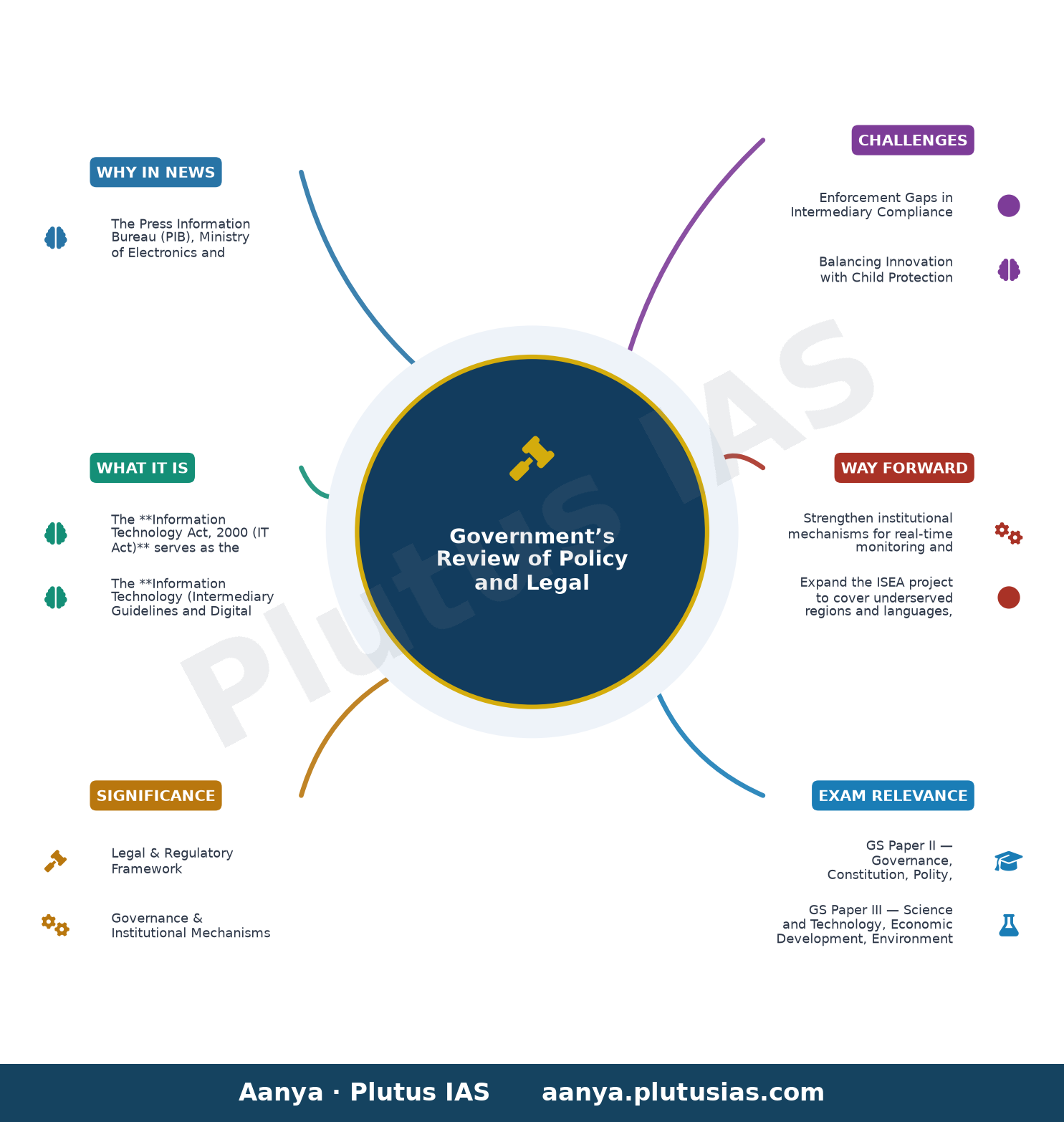
The Press Information Bureau (PIB), Ministry of Electronics and Information Technology (MeitY), has highlighted the Government of India’s ongoing review of the policy and legal framework governing children’s online safety in light of global developments. This initiative underscores the need to address emerging risks such as harmful content, cyberbullying, online exploitation, and digital addiction while ensuring a balance between innovation, privacy, and user protection within India’s constitutional and legal framework.
Background
- The Information Technology Act, 2000 (IT Act) and the Information Technology (Intermediary Guidelines and Digital Media Ethics Code) Rules, 2021 (IT Rules) form the primary legal instruments regulating digital intermediaries and user safety in India.
- The Digital Personal Data Protection Act, 2023 (DPDP Act) introduces a comprehensive framework for the protection of personal data, including provisions specific to children’s online privacy and parental consent.
- India’s digital ecosystem has witnessed exponential growth, with over 800 million internet users, including a significant proportion of children and adolescents.
- Global regulatory trends, such as the European Union’s Digital Services Act (DSA) and the United Kingdom’s Online Safety Act, have influenced India’s approach to online safety and intermediary liability.
- The Ministry of Electronics and Information Technology (MeitY) has been actively engaged in capacity-building and awareness initiatives, such as the Information Security Education and Awareness (ISEA) project, to promote cyber hygiene and digital literacy.
- The Government’s review process integrates constitutional principles, technological advancements, and stakeholder consultations to ensure a responsive and adaptive regulatory framework.
What is the Government’s Framework for Children’s Online Safety?
- The **Information Technology Act, 2000 (IT Act)** serves as the foundational legislation governing digital intermediaries, cybercrimes, and data protection in India.
- The **Information Technology (Intermediary Guidelines and Digital Media Ethics Code) Rules, 2021 (IT Rules)** impose obligations on intermediaries, including social media platforms, to exercise due diligence, remove illegal content within 3 hours of a court order or government directive, and prevent the hosting of material harmful to children.
- The **Digital Personal Data Protection Act, 2023 (DPDP Act)** establishes a robust legal framework for the processing of personal data, with specific provisions for children, including mandatory parental consent for data processing and restrictions on targeted advertising and behavioral tracking of minors.
- The **Information Security Education and Awareness (ISEA) Project**, implemented by MeitY, aims to enhance cybersecurity literacy through training programs, workshops, and awareness campaigns targeting students, educators, law enforcement, and the general public.
- The Government’s review process is guided by the **principles of proportionality, necessity, and balance**, ensuring that regulatory measures do not stifle innovation or infringe upon fundamental rights, including freedom of expression and privacy.
- Stakeholder consultations with technology companies, civil society organisations, child rights advocates, and legal experts are integral to the policy and legal review, ensuring a multi-dimensional approach to online safety.
- The Government monitors global regulatory developments, such as the **EU’s Digital Services Act (DSA)** and **UK’s Online Safety Act**, to align India’s framework with international best practices while addressing domestic challenges.
Key Features
| Feature | Significance |
|---|---|
| Information Technology Act, 2000 (IT Act) | Provides the foundational legal framework for digital governance, including intermediary liability and cybersecurity obligations. |
| IT Rules, 2021 (Intermediary Guidelines and Digital Media Ethics Code) | Mandates due diligence by intermediaries to prevent hosting of harmful content, including material harmful to children, and enforces removal of illegal content within 3 hours of notice. |
| Digital Personal Data Protection Act, 2023 (DPDP Act) | Regulates processing of digital personal data with explicit provisions for child privacy, including mandatory parental consent and prohibition of targeted advertising to children. |
| Information Security Education & Awareness (ISEA) Project | Aims to build human resource capacity in cybersecurity and raise awareness among diverse stakeholders, including students, teachers, and law enforcement. |
| Global Regulatory Benchmarking | Government reviews international practices and regulatory approaches to align domestic policies with evolving global standards for child online safety. |
Why it Matters
Legal & Regulatory Framework
- The IT Act and IT Rules establish a multi-layered legal structure to address cyber threats, including those targeting children, while balancing innovation and user protection.
- The DPDP Act introduces robust data protection norms, particularly for minors, ensuring their digital privacy and autonomy are legally safeguarded.
- Mandatory reporting of cybercrimes under the IT Rules and relevant penal laws (e.g., POCSO Act) strengthens the enforcement mechanism for child protection.
Governance & Institutional Mechanisms
- The Ministry of Electronics and Information Technology (MeitY) proactively engages with stakeholders to address emerging cyber threats and align policies with technological advancements.
- The ISEA project demonstrates a structured approach to capacity-building and public awareness, critical for fostering a cyber-safe ecosystem.
- Regular reviews of domestic frameworks against global benchmarks ensure that India’s regulatory regime remains adaptive to international best practices.
Social & Ethical Dimensions
- Child online safety is not merely a legal obligation but a societal imperative, given the pervasive risks of cyberbullying, exploitation, and digital addiction.
- The DPDP Act’s emphasis on parental consent and restrictions on behavioral tracking reflects a rights-based approach to child protection in the digital age.
- Public awareness initiatives under ISEA address the digital divide by equipping diverse user groups with the knowledge to navigate online spaces safely.
Challenges
1. Enforcement Gaps in Intermediary Compliance
- Despite stringent IT Rules, ensuring timely removal of illegal content (e.g., child sexual abuse material) remains a challenge due to the scale and decentralization of digital platforms.
- Monitoring compliance by global intermediaries operating in India requires robust institutional mechanisms and international cooperation.
UPSC Link: GS3: Cybersecurity & Digital Governance
2. Balancing Innovation with Child Protection
- Over-regulation may stifle technological innovation, particularly in AI-driven platforms, while under-regulation exposes children to risks like deepfake abuse or algorithmic manipulation.
- The DPDP Act’s restrictions on targeted advertising to children could impact the revenue models of digital services, necessitating careful policy calibration.
UPSC Link: GS3: Technology & Ethics
3. Digital Divide and Accessibility
- Limited digital literacy among children, especially in rural and marginalized communities, exacerbates vulnerabilities to online risks.
- Language barriers in awareness materials (e.g., regional content) may reduce the effectiveness of public outreach programs like ISEA.
UPSC Link: GS2: Social Justice & Governance
4. Cross-Border Jurisdictional Challenges
- Child exploitation material hosted on foreign servers poses jurisdictional hurdles, requiring bilateral and multilateral agreements for effective investigation and prosecution.
- Differences in data protection laws across jurisdictions (e.g., EU’s GDPR vs. India’s DPDP Act) complicate compliance for global platforms.
UPSC Link: GS2: International Relations
5. Emerging Threats in the Metaverse and AI
- The rise of immersive technologies (e.g., metaverse) introduces new risks like virtual grooming, identity theft, and AI-generated harmful content targeting children.
- Existing legal frameworks may not adequately address these futuristic threats, necessitating proactive policy updates.
UPSC Link: GS3: Science & Technology
Challenges — UPSC Perspective
| Issue | Concern |
|---|---|
| Timely Content Removal | Intermediaries may fail to act within the 3-hour window for illegal content removal, delaying justice for victims. |
| Parental Consent Mechanisms | Verifying parental consent for children’s data processing is logistically complex, especially for orphaned or homeless children. |
| Cross-Platform Coordination | Lack of standardized reporting mechanisms across platforms hinders unified action against cyber threats. |
| Dark Web and Encrypted Platforms | Anonymity tools and encryption make it difficult to trace and prosecute offenders targeting children online. |
| Cultural and Linguistic Diversity | Awareness campaigns may not resonate equally across India’s diverse linguistic and cultural groups. |
| Data Localization Constraints | Strict data localization norms under DPDP Act could limit the ability of law enforcement to access critical evidence stored abroad. |
Way Forward
- Strengthen institutional mechanisms for real-time monitoring and enforcement of IT Rules, including AI-driven content moderation tools.
- Expand the ISEA project to cover underserved regions and languages, with a focus on digital literacy for children and parents.
- Establish a dedicated task force under MeitY to address cross-border cybercrimes against children, in collaboration with INTERPOL and other agencies.
- Introduce mandatory cyber hygiene modules in school curricula, aligned with the National Education Policy 2020.
- Develop a unified reporting portal for cyber threats, integrating inputs from intermediaries, law enforcement, and civil society.
- Enhance public-private partnerships to co-develop child-safe technologies, such as age-verification systems and AI-based threat detection.
- Conduct periodic reviews of the DPDP Act’s implementation to assess its effectiveness in balancing innovation and child protection.
- Promote international cooperation through bilateral and multilateral agreements to harmonize data protection and cybercrime laws.
UPSC Value Addition
Keywords for Mains Answer-Writing
Children’s Online Safety · Information Technology Act, 2000 · IT Rules, 2021 · Digital Personal Data Protection Act, 2023 · Cyberbullying · Online Exploitation · Digital Well-being · Intermediary Liability · MeitY · Cyber Hygiene
Constitutional & Policy Linkages
- [‘Article 14: Equality before law’, ‘Ensures non-discriminatory protection for all children in digital spaces.’]
- [‘Article 15(3): Special provisions for children’, ‘Empowers the state to enact laws for child welfare, including online safety.’]
- [‘Article 21: Right to Privacy’, ‘Protects children’s digital autonomy and personal data from unauthorized processing.’]
- [‘Article 21A: Right to Education’, ‘Extends to digital learning, necessitating safe online environments for children.’]
Concept Flow
Digital adoption in education and communication → Increased exposure to online risks (cyberbullying, exploitation, addiction) → Need for legal frameworks (IT Act, IT Rules, DPDP Act) → Enactment of IT Act (2000) and IT Rules (2021) → Establishment of intermediary liability and due diligence norms → Mandatory content removal and reporting mechanisms → Passage of DPDP Act (2023) → Introduction of child-specific data protection provisions → Emphasis on parental consent and restrictions on targeted advertising → Implementation of ISEA project → Capacity-building and awareness generation → Empowerment of stakeholders (students, teachers, law enforcement) to mitigate risks → Global regulatory benchmarking → Adaptation of domestic policies to international best practices → Alignment with frameworks like GDPR and COPPA → Emergence of metaverse and AI technologies → New risks (virtual grooming, deepfakes) → Requirement for proactive policy updates and technological safeguards → Enforcement challenges → Cross-border jurisdictional hurdles → Need for international cooperation and institutional reforms
Prelims Practice Questions
Q1. Consider the following statements regarding the Information Technology (Intermediary Guidelines and Digital Media Ethics Code) Rules, 2021:
1. Intermediaries must remove unlawful content within 36 hours of receiving a court order or government directive.
2. Intermediaries are required to ensure that no information is hosted, published, or transmitted that is harmful to children.
3. The Rules mandate that intermediaries must obtain parental consent for processing the personal data of children under the Digital Personal Data Protection Act, 2023.
How many of the above statements are correct?
- Only one
- Only two
- All three
- None
Answer: Only two — Statement 1 is incorrect; the Rules require removal within 3 hours, not 36. Statement 2 is correct as per Rule 3(1)(b). Statement 3 is incorrect; parental consent is mandated under the DPDP Act, 2023, not the IT Rules, 2021.
Q2. Assertion (A): The Digital Personal Data Protection Act, 2023, prohibits the processing of personal data of children in a manner that is detrimental to their well-being, such as tracking or targeted advertising.
Reason (R): The Act mandates that all data processing activities must be conducted with the explicit consent of the data principal, irrespective of age.
- Both A and R are true, and R is the correct explanation of A
- Both A and R are true, but R is not the correct explanation of A
- A is true, but R is false
- A is false, but R is true
Answer: A is true, but R is false — Assertion (A) is true as the DPDP Act, 2023, explicitly prohibits harmful processing of children’s data. Reason (R) is false because the Act does not require explicit consent for all data processing; it mandates parental consent for children’s data.
Q3. Match the following legal frameworks with their primary objectives:
Column I
A. Information Technology Act, 2000
B. IT Rules, 2021
C. Digital Personal Data Protection Act, 2023
Column II
1. Regulates digital personal data processing and ensures privacy
2. Provides a legal framework for cybersecurity and electronic transactions
3. Imposes obligations on intermediaries to ensure user safety and remove unlawful content
- A-2, B-3, C-1
- A-1, B-2, C-3
- A-3, B-1, C-2
- A-2, B-1, C-3
Answer: A-2, B-3, C-1 — A matches with 2 (IT Act, 2000 regulates cybersecurity and electronic transactions). B matches with 3 (IT Rules, 2021 impose obligations on intermediaries). C matches with 1 (DPDP Act, 2023 regulates digital personal data processing).
Mains Practice Question
✍ The Government of India has recently emphasized the need for a robust policy and legal framework to ensure children’s online safety, citing global best practices and emerging risks such as cyberbullying, online exploitation, and digital addiction. In this context, critically examine the adequacy of the Information Technology Act, 2000, the IT Rules, 2021, and the Digital Personal Data Protection Act, 2023, in addressing these challenges. Also, discuss the role of the Ministry of Electronics and Information Technology (MeitY) in fostering digital well-being and cyber hygiene among children. (15 Marks)
Approach: MODEL-ANSWER SKELETON:
1. **Introduction (1 mark)**
– Briefly define the scope of children’s online safety and its significance in the digital age.
– Mention the global context and India’s regulatory response.
2. **Analysis of Legal Frameworks (8 marks)**
– **Information Technology Act, 2000**: Highlight its role in regulating cybercrimes and electronic transactions (Sections 66F, 67B). Discuss limitations in addressing online harms specific to children.
– **IT Rules, 2021**: Evaluate the obligations on intermediaries (Rule 3(1)(b)), the 3-hour removal mandate for unlawful content, and the duty to prevent harmful content. Critique the enforcement challenges and gaps in addressing cyberbullying and digital addiction.
– **Digital Personal Data Protection Act, 2023**: Assess its provisions on children’s data (Section 9), parental consent, and prohibition of harmful processing (e.g., tracking, targeted advertising). Discuss its effectiveness in balancing innovation and privacy.
– **Comparative Analysis**: Contrast the strengths and weaknesses of these frameworks in addressing the multidimensional risks faced by children online.
3. **Role of MeitY (3 marks)**
– Discuss MeitY’s initiatives like the Information Security Education and Awareness (ISEA) project, including the scale of workshops conducted (6,650 workshops, 11.37 lakh participants).
– Highlight the importance of cyber hygiene and digital literacy programs for children, teachers, and parents.
– Critique the reach and impact of these initiatives, suggesting improvements for broader coverage.
4. **Conclusion and Way Forward (3 marks)**
– Summarize the adequacy of the current legal and policy framework.
– Propose measures such as stricter enforcement, mandatory digital literacy programs in schools, and collaboration with tech platforms to enhance children’s online safety.
– Emphasize the need for a multi-stakeholder approach involving government, civil society, and private sector.
Source: PIB (Press Information Bureau)
Generated by AanyaAi for educational purpose.

- कर्नाटक में उद्योग-आधारित पाठ्यक्रम तैयार करेगा विशेष समिति: मुख्यमंत्री - September 23, 2026
- Karnataka to Form Industry-Aligned Curriculum Committee: CM’s Vision for Tech Education - September 23, 2026
- बिहार सरकार का बड़ा कदम: 25 हजार परिवारों को सौर ऊर्जा सहायता, 534 प्रखंडों में सोलर मार्ट खोले जाएंगे - September 23, 2026

No Comments