


11 Aug UPSC Alert: Govt to Build 109 Martyr Memorials for Naxal-Affected Families
✎ The Chhattisgarh initiative integrates memorialisation, administrative redressal, and skill-based rehabilitation to address the socio-economic and psychological impacts of Left-Wing Extremism, operationalising constitutional…
Subject Relevance — Where This Topic Fits
- GS Paper II — Governance, Administration and Challenges — Welfare Schemes for Vulnerable Sections | GS Paper III — Security Challenges and their Management — Left-Wing Extremism and Counter-Terrorism Measures
- Prelims: Naxalism, Left-Wing Extremism (LWE), Uncompensated Victims, Compassionate Appointment, Skill Development Initiatives, QR Code-enabled Memorials, State Intelligence Bureau (SIB) Dashboard
- Essay: Rehabilitation as a Pillar of National Security: Balancing Justice and Development in Conflict Zones, Memorialisation and Memory: The Role of Public Institutions in Acknowledging Sacrifice
Quick Revision: The Chhattisgarh initiative integrates memorialisation, administrative redressal, and skill-based rehabilitation to address the socio-economic and psychological impacts of Left-Wing Extremism, operationalising constitutional obligations through institutional mechanisms.
Why is this in the news?
The Government of Chhattisgarh has announced a multi-pronged initiative to address the long-standing grievances of families affected by Naxal violence, including the construction of 109 martyr memorials, a special campaign to resolve pending compensation cases, and targeted rehabilitation measures for repatriated youth. This policy response underscores the state’s commitment to institutional accountability and societal reintegration in areas historically impacted by Left-Wing Extremism (LWE).
Background
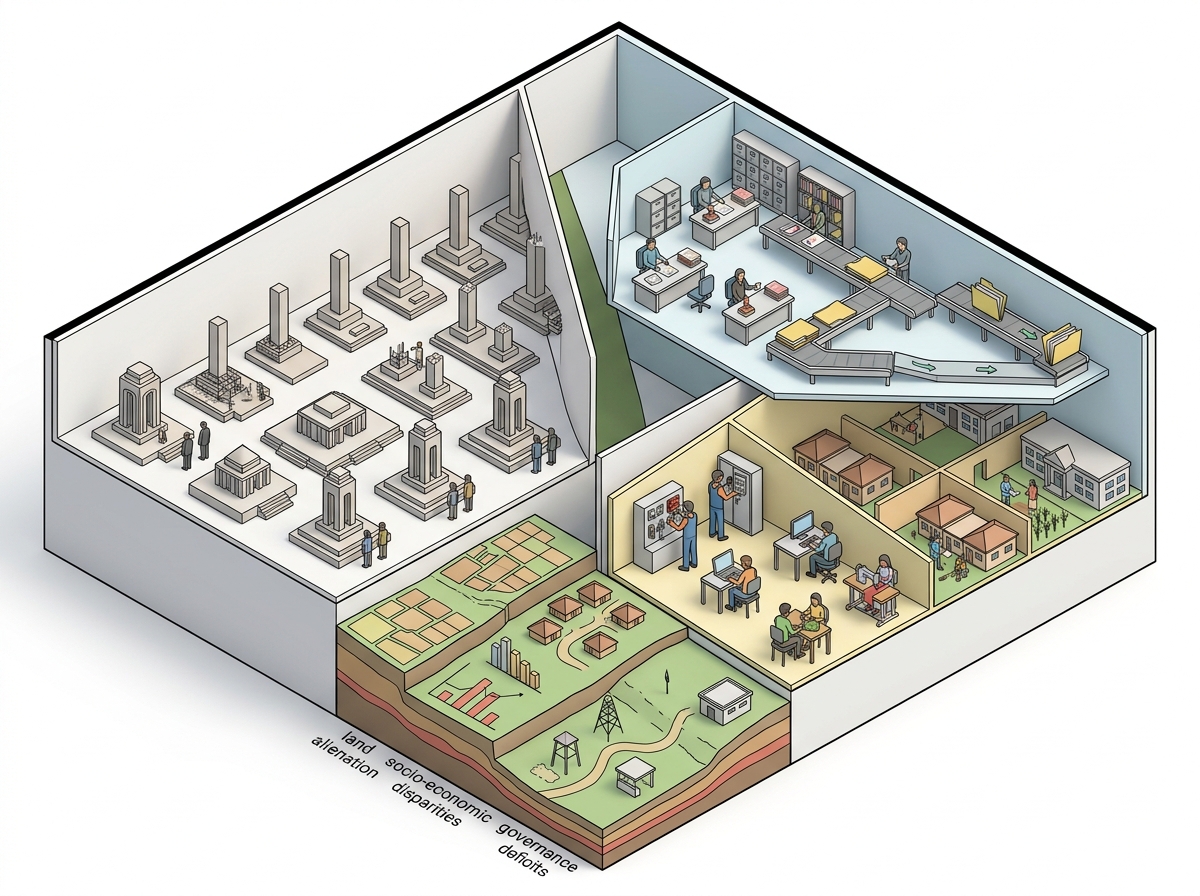
- Naxalism, classified as a form of Left-Wing Extremism (LWE), has persisted in certain regions of India since the late 1960s, primarily driven by socio-economic disparities, land alienation, and governance deficits.
- The Government of India, through the Ministry of Home Affairs (MHA), has designated 90 districts across 10 states as LWE-affected, with Chhattisgarh, Jharkhand, Odisha, and Bihar being among the most severely impacted.
- Memorialisation of security personnel and civilians killed in extremist violence is a recognised practice in post-conflict governance, aimed at acknowledging sacrifice and fostering social cohesion.
What constitutes the Chhattisgarh Government’s Rehabilitation and Memorialisation Framework for Naxal-Affected Families?
- Martyr Memorials (109): The initiative proposes the construction of 109 memorials dedicated to security personnel and civilians who lost their lives in Naxal-related violence. These memorials are envisaged not merely as physical structures but as interactive public spaces equipped with QR codes to provide real-time access to biographical data, incident narratives, and state-recognised compensation details.
- Special Campaign for Pending Cases: A dedicated administrative drive will be launched to identify and expedite the resolution of pending compensation and relief claims of affected families, ensuring that no eligible beneficiary is excluded due to procedural delays or documentation gaps.
- Compassionate Appointment: The policy reaffirms the provision of 100% compassionate appointment for eligible kin of martyrs, aligning with the constitutional directive to provide immediate livelihood support to bereaved families in the wake of state-protected duty-related fatalities.
- Skill Development and Employment Linkages: Rehabilitated youth, including those repatriated from other states, will be integrated into skill development programmes and state-specific initiatives, with a focus on employability in local industries and public sector undertakings.
- State Intelligence Bureau (SIB) Dashboard: A centralised digital dashboard will be operationalised to monitor the status of compensation claims, rehabilitation progress, and employment linkages, enabling data-driven governance and transparency in implementation.
Key Features
| Feature | Significance |
|---|---|
| Construction of 109 Martyr Memorials | Provides a structured mechanism for memorialising security personnel and civilians killed in Naxal violence, ensuring their sacrifices are formally acknowledged and documented through QR-coded historical records. |
| 100% Compassionate Appointment for Martyr Families | Guarantees immediate employment to next-of-kin of martyrs, addressing socio-economic vulnerability and aligning with the constitutional directive of welfare for defence personnel’s families under Article 39(b). |
| Special Campaign for Pending Relief Cases | Aims to resolve backlog of compensation and rehabilitation claims, ensuring timely disbursement of ex-gratia and rehabilitation packages to eligible families. |
| Skill Development for Rehabilitated Youth | Focuses on vocational training and employment linkage for youth returning from Naxal-affected areas or rehabilitation centres, facilitating their mainstream integration. |
| Inter-State Coordination for Repatriation | Facilitates return of displaced youth to their home states through bilateral agreements, ensuring continuity of support and reducing administrative delays. |
Why it Matters
Governance and Public Policy
- Demonstrates a structured, multi-pronged approach to address the socio-economic fallout of Left-Wing Extremism (LWE) through memorialisation, compensation, and rehabilitation.
- Highlights the role of state-level policy innovation in conflict-affected regions, complementing central schemes such as the ‘National Policy and Action Plan to Address LWE’ (2015).
- Emphasises the integration of memorialisation with administrative action, ensuring that symbolic gestures translate into tangible benefits for affected communities.
Social Justice and Inclusion
- Reinforces the state’s commitment to the welfare of marginalised groups, particularly families of security personnel and civilians affected by insurgency, in line with constitutional principles of equity and dignity.
- Addresses the psychological and economic trauma of conflict-affected populations by ensuring compensation, employment, and skill development, thereby promoting social cohesion.
Security and Counter-Insurgency
- Acknowledges the human cost of LWE operations and seeks to mitigate grievances among affected populations, potentially reducing recruitment pools for insurgent groups.
- Aligns with the broader counter-insurgency strategy of ‘Winning Hearts and Minds’ by combining hard security measures with socio-economic rehabilitation.
Administrative Efficiency
- Introduces a dashboard-based monitoring system (SI B Dashboard) to track rehabilitation and compensation cases, enhancing transparency and accountability in public service delivery.
- Leverages technology (QR codes) for memorial documentation, improving historical accuracy and public access to information.
Challenges
1. Implementation Gaps in Compensation Disbursement
- Delays in processing and disbursing compensation due to bureaucratic hurdles, lack of digital records, or disputes over eligibility criteria.
- Risk of exclusion errors where eligible families are inadvertently omitted due to incomplete or outdated beneficiary databases.
UPSC Link: GS-II: Welfare schemes for vulnerable sections
2. Sustainability of Skill Development Initiatives
- Limited availability of industry-aligned vocational training programmes in conflict-affected districts, leading to poor employment outcomes.
- High attrition rates among trainees due to socio-economic pressures or lack of post-training support mechanisms.
UPSC Link: GS-III: Skill development and employment
3. Inter-State Coordination Bottlenecks
- Differences in rehabilitation policies across states may lead to inconsistencies in support provided to repatriated youth.
- Administrative delays in verifying identities and eligibility due to lack of standardised documentation across states.
UPSC Link: GS-II: Centre-State relations
4. Memorialisation and Historical Narrative Management
- Potential politicisation of memorial sites, with competing narratives emerging about the causes and consequences of Naxal violence.
- Risk of memorials becoming mere symbolic gestures without sustained community engagement or educational value.
UPSC Link: GS-II: Role of institutions in nation-building
5. Psychosocial Rehabilitation Needs
- Inadequate provision for mental health support for trauma-affected families, particularly children and elderly dependents of martyrs.
- Stigma associated with Naxal-affected identities may hinder social reintegration despite economic rehabilitation.
UPSC Link: GS-II: Social empowerment and inclusion
Challenges — UPSC Perspective
| Issue | Concern |
|---|---|
| Data Discrepancies in Beneficiary Lists | Inaccuracies in records of affected families may lead to exclusion or duplication in compensation schemes. |
| Low Awareness Among Eligible Beneficiaries | Limited outreach and information dissemination may prevent deserving families from availing benefits. |
| Infrastructure Gaps in Vocational Training Centres | Insufficient training facilities in remote areas may constrain skill development programmes. |
| Bureaucratic Delays in Case Resolution | Protracted administrative processes may undermine the efficacy of the special campaign for pending cases. |
| Community Resistance to Repatriation | Local resistance or lack of trust in state mechanisms may hinder the return of displaced youth. |
Government Initiatives — Must-Memorise for Prelims
- Compensation Scheme for Victims of Terrorist/Insurgent Violence (State-specific)
Way Forward
- Establish a dedicated grievance redressal mechanism for pending compensation cases, with monthly progress reviews at the district level.
- Expand vocational training partnerships with private sector entities to align skill development with local industry demands.
- Develop a standardised inter-state protocol for repatriation of displaced youth, including joint verification mechanisms and post-repatriation support.
- Launch community awareness campaigns in Naxal-affected districts to ensure eligible families are informed about available schemes and memorialisation processes.
- Integrate mental health services into rehabilitation packages, including counselling for trauma-affected families and youth.
- Enhance the SI B Dashboard with real-time tracking of memorial construction progress and beneficiary outreach metrics.
- Conduct periodic audits of compensation disbursement to identify systemic bottlenecks and rectify data gaps.
- Foster public-private partnerships for the maintenance of martyr memorials, ensuring their upkeep and educational utility.
UPSC Value Addition
Keywords for Mains Answer-Writing
Naxal-affected families · Martyr memorials · Special campaign for pending relief cases · Rehabilitation of ex-Naxals · Skill development for returnees · Compassionate appointments · Socio-economic rehabilitation · Left-Wing Extremism (LWE) · Victim compensation · Governance in conflict zones
Constitutional & Policy Linkages
- Article 39(b): Directive Principles of State Policy on securing equitable distribution of resources.
- Article 41: Right to public assistance in cases of unemployment, old age, sickness, and disablement.
- Article 46: Promotion of educational and economic interests of Scheduled Castes, Scheduled Tribes, and other weaker sections.
Concept Flow
Left-Wing Extremism (LWE) → Human Cost (Martyrs and Affected Families) → State Response: Memorialisation and Compensation (109 Memorials, 100% Appointment) → Administrative Action: Special Campaign for Pending Cases and SI B Dashboard → Rehabilitation Focus: Skill Development and Inter-State Repatriation → Outcome: Socio-Economic Integration and Conflict Resolution → Feedback Loop: Monitoring, Audits, and Community Awareness for Sustainability
Prelims Practice Questions
Q1. Consider the following statements regarding the rehabilitation of Naxal-affected families in India:
1. The Union Government has approved the construction of 109 martyr memorials exclusively for security personnel killed in Naxal violence.
2. The Chhattisgarh government has initiated a special campaign to expedite pending relief and compensation cases for victims of Naxal violence.
3. The Union Government mandates 100% compassionate appointments for the families of all security personnel killed in Naxal-affected areas.
How many of the above statements are correct?
- Only one
- Only two
- All three
- None
Answer: All three — Statement 1 is incorrect as the memorials include both security personnel and civilian victims. Statement 2 is correct as per the reported initiative. Statement 3 is incorrect; compassionate appointments are provided but not universally at 100% for all security personnel families across India.
Q2. Assertion (A): The construction of martyr memorials in Naxal-affected areas is primarily symbolic and does not contribute to socio-economic rehabilitation.
Reason (R): The memorials are designed to include QR codes providing detailed information about the martyrs and the incidents, and are part of a broader governance strategy to acknowledge victims and facilitate relief mechanisms.
Options:
A. Both A and R are true, and R is the correct explanation of A.
B. Both A and R are true, but R is not the correct explanation of A.
C. A is true, but R is false.
D. A is false, but R is true.
Answer: ? — Assertion (A) is false because the memorials are not merely symbolic; they are integrated into a governance framework aimed at socio-economic rehabilitation through relief and compensation mechanisms. Reason (R) is true as the memorials include QR codes and are part of a broader strategy.
Q3. Match the following initiatives with their respective objectives in the context of Naxal-affected areas:
Column I (Initiative) | Column II (Objective)
1. 109 Martyr Memorials | A. Expedite pending relief and compensation cases
2. Special Campaign for Pending Cases | B. Provide skill development and employment to rehabilitated youth
3. Compassionate Appointments | C. Acknowledge and document the sacrifices of victims
4. Skill Development for Returnees | D. Ensure employment for families of security personnel killed in violence
Options:
A. 1-C, 2-A, 3-D, 4-B
B. 1-A, 2-C, 3-B, 4-D
C. 1-D, 2-B, 3-A, 4-C
D. 1-B, 2-D, 3-C, 4-A
- A
- B
- C
- D
Answer: A — 1-C: Memorials are designed to acknowledge and document sacrifices. 2-A: The special campaign aims to expedite pending relief cases. 3-D: Compassionate appointments ensure employment for families of security personnel. 4-B: Skill development initiatives target rehabilitated youth for employment.
Mains Practice Question
✍ Critically examine the socio-economic rehabilitation measures for Naxal-affected families in India, with particular reference to the construction of martyr memorials, special campaigns for pending relief cases, and skill development initiatives for returnees. (15 Marks)
Approach: MODEL-ANSWER SKELETON:
1. **Introduction (2 marks)**
– Define Left-Wing Extremism (LWE) and its socio-economic impact on affected families.
– Mention the Union Government’s policy framework (e.g., National Policy and Action Plan to Address LWE, 2015) and state-level initiatives like Chhattisgarh’s recent measures.
2. **Martyr Memorials (4 marks)**
– **Symbolic and Governance Role**: Memorials serve as acknowledgment of sacrifices and may include QR codes for victim information, aligning with the Right to Information (RTI) Act, 2005.
– **Limitations**: Potential for politicisation or exclusion of civilian victims; sustainability challenges in maintenance.
– **Comparison**: Contrast with memorials in other conflict zones (e.g., Jammu & Kashmir) and their socio-economic impact.
3. **Special Campaigns for Pending Relief Cases (4 marks)**
– **Legal Framework**: Reference to the Compensatory Affective Relief Scheme (CARS) and the role of District Legal Services Authorities (DLSAs) under the Legal Services Authorities Act, 1987.
– **Challenges**: Bureaucratic delays, lack of awareness among victims, and coordination gaps between state and central agencies.
– **Best Practices**: Cite examples of successful fast-track courts (e.g., NIA Special Courts) or state-specific models.
4. **Skill Development and Employment for Returnees (3 marks)**
– **Government Schemes**: Link to the Skill India Mission, Deendayal Upadhyaya Grameen Kaushalya Yojana (DDUGKY), and state-level vocational training programs.
– **Challenges**: Stigma, lack of trust in mainstream institutions, and market access barriers.
– **Psychosocial Support**: Reference to the need for trauma-informed rehabilitation, drawing on the WHO’s guidelines on mental health in emergencies.
5. **Conclusion (2 marks)**
– **Balanced View**: Acknowledge the progress in policy design but highlight implementation gaps.
– **Recommendations**: Strengthen inter-departmental coordination, community-based monitoring, and victim-centric grievance redressal mechanisms.
– **Constitutional Context**: Reference to Directive Principles of State Policy (Article 38, 39, 41) and Fundamental Duties (Article 51A) to underscore the state’s obligation.
Source: amarujala.com
Generated by AanyaAi for educational purpose.

- KWML’s Feasibility Reports for Water Metro in 18 Cities: UPSC & PCS Insights - October 3, 2026
- ओडिशा में वन्यजीव अनुसंधान अनुदान कार्यक्रम शुरू, सिमिलिपाल में 300 कैमरे और बढ़ेंगे - October 3, 2026
- India Summons Pakistan High Commission Official Over Violation - October 3, 2026

No Comments