


12 Aug UPSC Alert: Justice Yashwant Varma Cash Row Report in Parliament Today
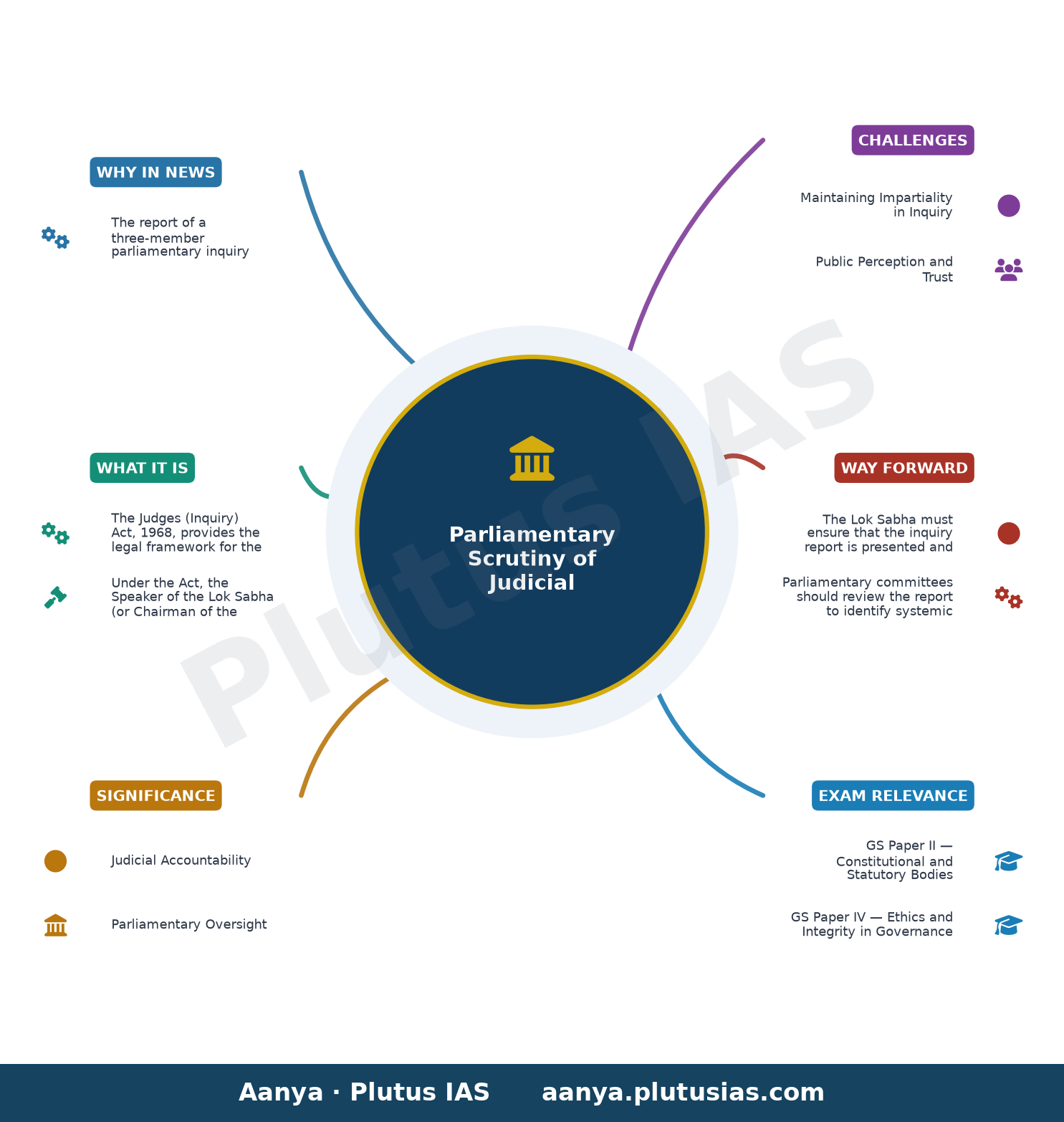
✎ The Judges (Inquiry) Act, 1968, enables Parliament to investigate allegations of misconduct against judges through a structured committee process, with findings tabled in Parliament to ensure transparency and institutional…
Subject Relevance — Where This Topic Fits
- GS Paper II — Constitutional and Statutory Bodies | GS Paper IV — Ethics and Integrity in Governance
- Prelims: Judges (Inquiry) Act, 1968, Constitutional provisions on judicial accountability, Role of Parliament in judicial oversight, High Court judges’ transfer and posting, Institutional integrity of the judiciary
- Essay: Ethical governance and the accountability of constitutional functionaries, The balance between judicial independence and institutional accountability
Quick Revision: The Judges (Inquiry) Act, 1968, enables Parliament to investigate allegations of misconduct against judges through a structured committee process, with findings tabled in Parliament to ensure transparency and institutional accountability.
Why is this in the news?
The report of a three-member parliamentary inquiry committee into alleged irregularities involving cash at the official residence of former Justice Yashwant Varma is set to be tabled in the Lok Sabha on 12 August 2026. This development underscores the procedural mechanisms available under Indian law to examine allegations against judges, even after their resignation, and highlights the constitutional safeguards designed to balance judicial independence with public accountability.
Background
- The incident traces back to 14 March 2025, when a fire at Justice Varma’s official residence in Delhi led to the discovery of charred currency in a storeroom, prompting allegations of financial impropriety.
- The matter escalated to a parliamentary inquiry under the Judges (Inquiry) Act, 1968, which empowers Parliament to investigate allegations of misconduct against judges, including those who have resigned.
- The three-member committee, constituted by the Speaker of the Lok Sabha, submitted its report to the Speaker in May 2026, setting the stage for parliamentary scrutiny.
- The tabling of the report in the Lok Sabha marks a critical phase in the institutional response to allegations against constitutional functionaries, even after they have ceased to hold office.
What is the Judges (Inquiry) Act, 1968, and how does parliamentary scrutiny of judicial conduct function?
- The Judges (Inquiry) Act, 1968, provides the legal framework for the investigation of allegations of misconduct against judges of the Supreme Court and High Courts. It empowers Parliament to constitute a committee to inquire into such allegations, ensuring a structured and impartial process.
- Under the Act, the Speaker of the Lok Sabha (or Chairman of the Rajya Sabha) may constitute a committee comprising three members—typically a Supreme Court judge, a High Court judge, and a distinguished jurist or legal expert—to conduct the inquiry.
- The inquiry committee examines evidence, records statements, and submits a report to the Speaker or Governor, which may include findings of fact, conclusions on misconduct, and recommendations for further action, including removal from office.
- The Act mandates that the inquiry process be conducted in camera to protect the dignity and privacy of the judge, while ensuring transparency in the final report presented to Parliament or the relevant constitutional authority.
- Parliamentary scrutiny under this Act is distinct from judicial review; it is a constitutional mechanism to uphold institutional integrity and public trust in the judiciary, without encroaching upon judicial independence.
- The tabling of the report in Parliament does not automatically lead to punitive action but serves as a public record of the inquiry’s findings, which may inform further legislative, administrative, or constitutional steps.
- The process underscores the principle that judges, like other constitutional functionaries, are subject to accountability mechanisms that are constitutionally ordained and procedurally rigorous.
Key Features
| Feature | Significance |
|---|---|
| Inquiry under the Judges (Inquiry) Act, 1968 | Establishes a parliamentary mechanism for investigating allegations against sitting or former judges, ensuring accountability within the constitutional framework. |
| Three-member Committee Composition | Typically includes senior judicial or parliamentary figures to ensure impartiality and expertise in the inquiry process. |
| Submission to Lok Sabha Speaker | The report is first submitted to the Speaker, who then places it before the House, adhering to parliamentary procedure. |
| Resignation of Justice Yashwant Varma | Removes the subject of the inquiry from the judiciary, rendering the parliamentary removal process moot but not negating the inquiry’s findings. |
| Presentation of Report in Parliament | Ensures transparency and public scrutiny of the inquiry’s conclusions, reinforcing democratic oversight. |
Why it Matters
Judicial Accountability
- Demonstrates the constitutional principle that judges, like other constitutional functionaries, are subject to scrutiny for alleged misconduct, even after resignation.
- Reinforces public trust in the judiciary by demonstrating that no individual is above scrutiny, regardless of institutional affiliation.
Parliamentary Oversight
- Highlights the role of Parliament in holding constitutional functionaries accountable through mechanisms like the Judges (Inquiry) Act, 1968.
- Ensures that allegations against high-ranking officials are investigated through a structured, multi-tiered process involving judicial and parliamentary authorities.
Rule of Law
- Upholds the principle that all individuals, irrespective of their position, are subject to the same legal and institutional scrutiny.
- Prevents the perception of impunity by ensuring that allegations are investigated and findings are made public, even if the subject is no longer in office.
Challenges
1. Maintaining Impartiality in Inquiry
- Ensuring that the inquiry committee remains free from bias or external influence, given the high-profile nature of the case.
- Balancing transparency with the need to protect sensitive information that may arise during the investigation.
UPSC Link: Judicial accountability mechanisms
2. Public Perception and Trust
- Addressing concerns that the inquiry may be perceived as politically motivated or influenced by institutional pressures.
- Ensuring that the findings are communicated clearly to the public to maintain confidence in the judiciary and parliamentary processes.
UPSC Link: Role of media in judicial accountability
3. Legal and Procedural Complexities
- Navigating the legal nuances of investigating allegations against a former judge, including jurisdiction and evidentiary standards.
- Ensuring that the inquiry adheres to due process while maintaining efficiency in its proceedings.
UPSC Link: Judges (Inquiry) Act, 1968
Challenges — UPSC Perspective
| Issue | Concern |
|---|---|
| Perception of Political Interference | Risk that the inquiry may be seen as influenced by partisan interests, undermining its credibility. |
| Handling of Sensitive Evidence | Ensuring that evidence, such as financial records or witness testimonies, is managed securely and confidentially. |
| Timeliness of Proceedings | Balancing the need for a thorough inquiry with the public’s expectation of timely resolution. |
| Post-Resignation Jurisdiction | Determining the legal authority to investigate a former judge and the scope of such investigations. |
| Public Communication | Ensuring that the findings are disseminated in a manner that is accessible and understandable to the general public. |
Way Forward
- The Lok Sabha must ensure that the inquiry report is presented and discussed in a manner that upholds transparency and accountability.
- Parliamentary committees should review the report to identify systemic gaps in judicial or administrative oversight that may have contributed to the incident.
- The judiciary should consider strengthening internal mechanisms for monitoring the conduct of its members, including financial disclosures and asset management.
- Institutions should enhance training for judges and administrative staff on ethical standards, conflict resolution, and compliance with institutional rules.
- Public awareness campaigns should be conducted to educate citizens about the role of parliamentary and judicial oversight in maintaining accountability.
- The government and judiciary should collaborate to establish clear protocols for handling allegations against high-ranking officials, including former judges.
- Mechanisms for whistleblower protection should be reviewed to ensure that individuals reporting misconduct are safeguarded from retaliation.
UPSC Value Addition
Keywords for Mains Answer-Writing
Judicial accountability · Inquiry against Judges · Judges (Inquiry) Act, 1968 · Parliamentary scrutiny of Judiciary · Separation of Powers · Judicial Independence · Constitutional morality · Judicial ethics · Parliamentary privileges · Procedural justice
Constitutional & Policy Linkages
- {‘Article 124(4)’: ‘Procedure for removal of judges’}
- {‘Article 142’: ‘Enforcement of judicial orders and accountability’}
- {‘Article 21’: ‘Right to fair investigation and due process’}
Concept Flow
Allegation of misconduct involving a High Court judge → Incident triggers internal and parliamentary scrutiny → Formation of a three-member inquiry committee under the Judges (Inquiry) Act, 1968 → Committee conducts investigation, collects evidence, and submits report to Lok Sabha Speaker → Report presented in Parliament for public scrutiny and discussion → Findings inform future reforms in judicial accountability and oversight
Prelims Practice Questions
Q1. Consider the following statements regarding the Judges (Inquiry) Act, 1968:
1. It empowers Parliament to investigate allegations of misbehaviour or incapacity against Supreme Court or High Court judges.
2. The inquiry committee must consist of a Supreme Court judge, a Chief Justice of a High Court, and a distinguished jurist.
3. The report of the inquiry committee is binding on the President of India.
4. The Act provides for the removal of a judge through a motion passed by a special majority in Parliament.
How many of the above statements are correct?
- Only one
- Only two
- Only three
- All four
Answer: Only three — Statements 1 and 4 are correct. Statement 2 is incorrect as the committee must include a Supreme Court judge, a High Court Chief Justice, and a distinguished jurist but the report is not binding on the President (Statement 3).
Q2. Assertion (A): The principle of judicial independence requires that judges should not be subjected to parliamentary scrutiny for their actions.
Reason (R): The Judges (Inquiry) Act, 1968, provides a mechanism to investigate allegations of misbehaviour against judges while ensuring their independence is not compromised.
Options:
A. Both A and R are true, and R is the correct explanation of A.
B. Both A and R are true, but R is not the correct explanation of A.
C. A is true, but R is false.
D. A is false, but R is true.
- A
- B
- C
- D
Answer: ? — Assertion (A) is false because judicial independence does not preclude parliamentary scrutiny under the Constitution. Reason (R) is true as the Act provides a balanced mechanism for inquiry without compromising judicial independence.
Mains Practice Question
✍ The inquiry report against a former High Court judge, arising from an alleged incident at a government residence, is being tabled in Parliament under the Judges (Inquiry) Act, 1968. Critically examine the constitutional and institutional implications of such parliamentary scrutiny of the judiciary. (15 Marks)
Approach: MODEL-ANSWER SKELETON:
1. **Constitutional Framework** (4 points):
– Article 124(4) and Article 217(1)(b) of the Constitution provide for removal of judges on grounds of proved misbehaviour or incapacity.
– Judges (Inquiry) Act, 1968, operationalises this by setting up a three-member committee (Supreme Court judge, High Court Chief Justice, and a distinguished jurist) for inquiry.
– The Act balances judicial independence (Article 50) with accountability through a parliamentary process.
– The report is presented to Parliament but is not binding; Parliament may proceed with an impeachment motion if the report substantiates misbehaviour.
2. **Separation of Powers and Judicial Independence** (4 points):
– Judicial independence is a basic feature of the Constitution (Supreme Court in S.P. Gupta v. Union of India, 1981).
– Parliamentary scrutiny must not encroach upon the core judicial function or undermine public confidence in the judiciary.
– The process must adhere to principles of natural justice, including notice, opportunity to be heard, and reasoned findings.
– Recent Supreme Court observations (e.g., in Indira Jaising v. Supreme Court of India, 2023) emphasise the need for procedural fairness in such inquiries.
3. **Parliamentary Role and Accountability** (4 points):
– Parliament’s role is to ensure transparency and accountability without compromising judicial autonomy.
– The inquiry report’s presentation in Parliament serves as a check on potential misconduct while respecting the doctrine of separation of powers.
– The process must avoid political interference or populist pressures that could undermine judicial credibility.
– The outcome depends on the nature of findings: if misbehaviour is proved, Parliament may initiate impeachment; otherwise, the matter may be closed.
4. **Contemporary Relevance and Challenges** (3 points):
– The case reflects the evolving expectations of transparency in the judiciary post-2015 NJAC judgment (Supreme Court Advocates-on-Record Association v. Union of India).
– Challenges include balancing public interest with the need to protect judges from frivolous or politically motivated allegations.
– The process must ensure that inquiries are conducted expeditiously to avoid prolonged uncertainty for the judiciary.
Source: amarujala.com
Generated by AanyaAi for educational purpose.

- Madras HC on Veeramani POCSO Case: Let SIT Work Without Interference - September 30, 2026
- पीएम मोदी और ट्रंप ने भारत-अमेरिका संबंधों पर चर्चा की - September 30, 2026
- Cabinet approves ITMS for Delhi: Smart Traffic to cut jams & boost safety - September 30, 2026

No Comments