


06 Aug UPSC Alert: Lok Sabha Passes Taxation Bill with UPI MDR Provision
✎ The Taxation and Other Laws (Amendment) Bill, 2026, enables selective imposition of MDR on UPI transactions while extending long-term tax exemptions for electronics manufacturing, aiming to balance fiscal sustainability with…
Subject Relevance — Where This Topic Fits
- GS Paper III — Indian Economy: Issues relating to Planning, Mobilisation of Resources, Growth, Development and Employment | GS Paper III — Effects of Liberalisation on the Economy | GS Paper III — Role of External State and Non-state Actors in Creating Challenges to Internal Security
- Prelims: Merchant Discount Rate (MDR), Payment and Settlement Systems Act, 2007, Zero-MDR regime, Foreign Portfolio Investors (FPIs), Contract Manufacturing in Electronics, Customs-bonded Warehouses, Data Localisation, Tax Certainty for Fund Managers
- Essay: The interplay between fiscal policy and technological sovereignty: India’s push for electronics manufacturing and digital payments, India’s balancing act: attracting global capital while ensuring domestic value addition in strategic sectors
Quick Revision: The Taxation and Other Laws (Amendment) Bill, 2026, enables selective imposition of MDR on UPI transactions while extending long-term tax exemptions for electronics manufacturing, aiming to balance fiscal sustainability with India’s digital and industrial policy objectives.
Why is this in the news?
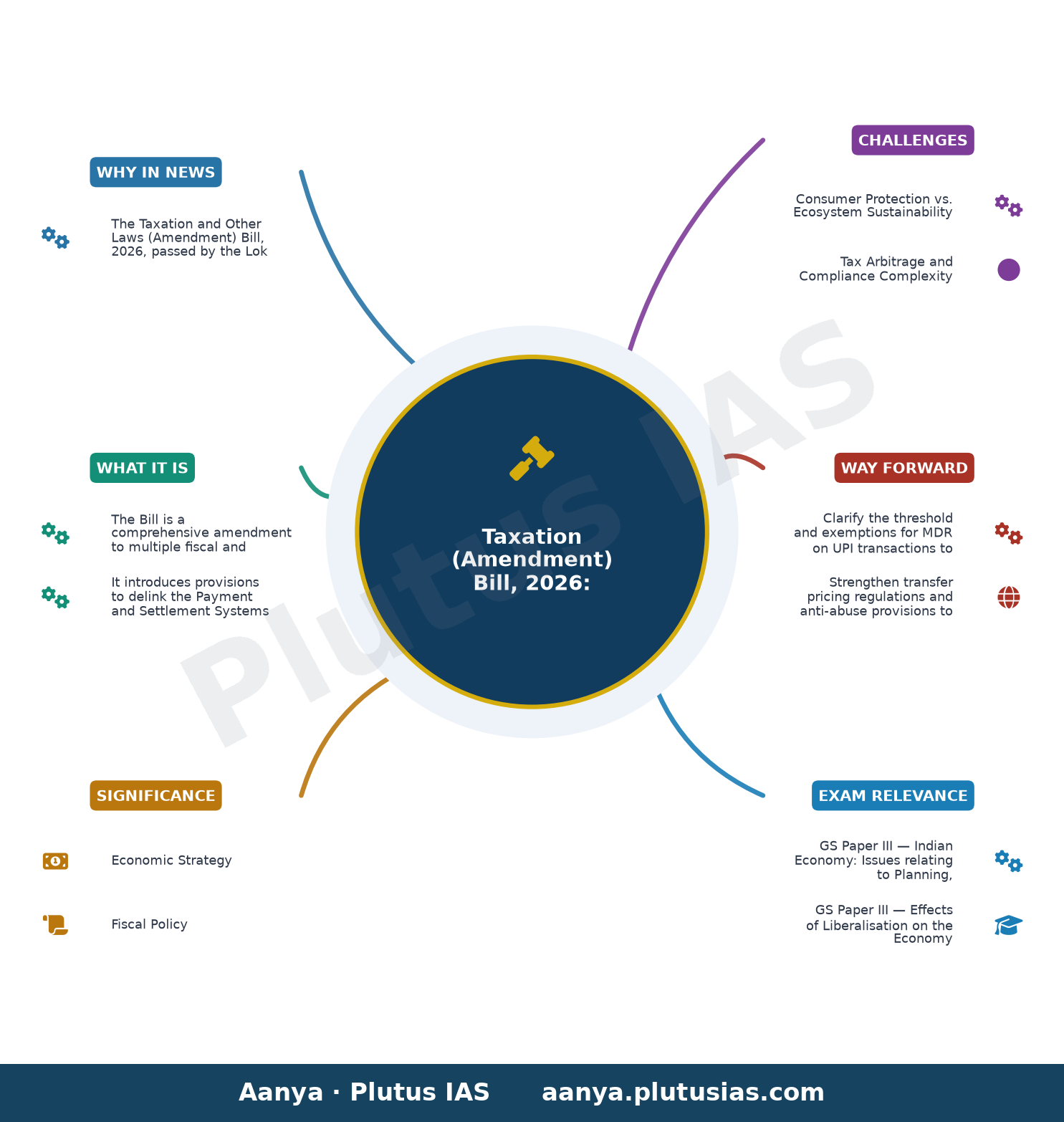
The Taxation and Other Laws (Amendment) Bill, 2026, passed by the Lok Sabha on August 6, 2026, introduces critical amendments to the Payment and Settlement Systems Act, 2007, enabling the government to levy Merchant Discount Rates (MDR) on UPI transactions above a specified threshold. This legislative move, aimed at supporting domestic electronics manufacturing and attracting foreign capital, marks a significant shift from the existing zero-MDR regime and aligns with broader policy objectives to monetise digital payment infrastructure while ensuring fiscal sustainability.
Background
- Currently, banks and payment system providers are prohibited from levying charges on UPI and RuPay card transactions.
- The Payment and Settlement Systems Act, 2007, originally framed to regulate payment systems, did not envisage the scale or commercial implications of real-time payment systems like UPI, necessitating legislative amendments to address emerging fiscal and industrial policy challenges.
- India’s electronics manufacturing sector, valued at approximately USD 100 billion in 2023, remains heavily import-dependent, with a trade deficit of USD 150 billion in electronic goods, prompting policy interventions to boost domestic production and reduce reliance on imports.
- The Bill extends the existing income-tax exemption until 2040-41.
- Global fund managers, particularly in the financial services sector, have faced tax uncertainties in India due to the ‘control and management’ test under the Income Tax Act, 1961, which could trigger taxability of global income if fund managers are based in India.
- The Reserve Bank of India (RBI) has repeatedly highlighted the need for a sustainable model for digital payment infrastructure financing, citing the absence of MDR as a structural gap in the ecosystem.
What is the Taxation and Other Laws (Amendment) Bill, 2026?
- The Bill is a comprehensive amendment to multiple fiscal and regulatory statutes, including the Income Tax Act, 1961, and the Payment and Settlement Systems Act, 2007, aimed at enhancing India’s attractiveness as an investment destination for electronics manufacturing and digital infrastructure.
- It introduces provisions to delink the Payment and Settlement Systems Act from the Income Tax Act, enabling independent regulatory oversight of digital payment systems while maintaining fiscal policy flexibility.
- The Bill empowers the Central Government to notify specific electronic payment modes or transactions that shall remain free of charges, thereby allowing selective imposition of Merchant Discount Rates (MDR) on high-value UPI transactions or other digital payment instruments.
- To incentivise electronics manufacturing, the Bill extends the income-tax exemption for foreign companies engaged in contract manufacturing of specified electronic goods (e.g., mobile phones, laptops, servers) until FY 2040-41, aligning with the ‘Make in India’ vision.
- The Bill provides process certainty to make it easier for overseas cloud companies to use data centres.
- The amendments also address tax certainty for foreign portfolio investors (FPIs) by exempting interest income and capital gains from investments in government securities, replacing a June 2026 ordinance to provide legislative permanence.
- The Bill seeks to facilitate the relocation of fund managers to India by relaxing the ‘control and management’ test under the Income Tax Act, thereby reducing the risk of global income becoming taxable in India for offshore funds managed from Indian jurisdictions.
Key Features
| Feature | Significance |
|---|---|
| Delinking Payment and Settlement Systems Act from Income Tax Act | Enables independent regulatory framework for digital payments, reducing procedural overlaps and enhancing clarity for stakeholders. |
| Legal framework for altering zero-MDR regime on UPI/RuPay | Provides statutory basis for introducing Merchant Discount Rate (MDR) on select UPI transactions, potentially incentivising digital payment infrastructure. |
| 15-year income-tax exemption for foreign electronics contract manufacturers (until FY 2040-41) | Strengthens domestic electronics manufacturing by reducing tax burden, aligning with ‘Make in India’ objectives and global supply chain diversification. |
| Tax exemption for foreign companies storing components in customs-bonded warehouses | Encourages pre-manufacturing storage in India, reducing logistics costs and enhancing supply chain resilience for electronics production. |
| Simplification of regulatory framework for foreign cloud service providers | Facilitates data localisation compliance and reduces barriers for global tech firms to operate data centres in India, supporting digital sovereignty. |
Why it Matters
Economic Strategy
- Enhances India’s attractiveness as an investment destination for electronics manufacturing by offering long-term tax incentives, aligning with global supply chain shifts post-pandemic.
- Introduces a potential revenue model for digital payment infrastructure via MDR, balancing consumer convenience with ecosystem sustainability.
- Supports the government’s ‘Atmanirbhar Bharat’ initiative by incentivising domestic value addition in electronics, a sector critical for reducing import dependence.
Fiscal Policy
- Extends tax exemptions for foreign portfolio investors in government securities, reinforcing India’s commitment to global capital markets and reducing tax arbitrage concerns.
- Provides process certainty for overseas fund managers relocating to India, reducing compliance ambiguity and encouraging financial sector growth.
- Clarifies tax treatment of foreign cloud providers, addressing long-standing ambiguities in data-centre operations and cross-border digital services.
Digital Payments Ecosystem
- Introduces a conditional MDR regime for UPI transactions above ₹2,000, potentially addressing the cost burden on payment aggregators and banks while maintaining affordability for small transactions.
- Legalises the government’s power to regulate MDR, moving away from an absolute zero-charge model to a more flexible, market-driven approach.
- Balances consumer protection (zero charges for small transactions) with ecosystem sustainability (selective MDR for high-value transactions).
Manufacturing and Supply Chain
- Extends tax benefits for contract manufacturing of specified electronics, including mobile phones and servers, directly supporting the ‘Production Linked Incentive (PLI)’ scheme for electronics.
- Incentivises storage of components in customs-bonded warehouses, reducing working capital costs and improving just-in-time inventory management for manufacturers.
- Aligns with global trends of reshoring electronics production, particularly in the context of geopolitical supply chain realignments.
Challenges
1. Consumer Protection vs. Ecosystem Sustainability
- Introduction of MDR risks increasing costs for end-users, particularly for high-value transactions, potentially undermining the government’s push for digital inclusion.
- Zero-MDR for small transactions may create a cross-subsidisation burden, where high-volume, low-value transactions subsidise high-value ones, raising equity concerns.
- Regulatory ambiguity persists regarding the threshold (₹2,000) and exemptions, which could lead to disputes or unintended exclusions.
UPSC Link: GS3: Digital economy and issues of inclusivity
2. Tax Arbitrage and Compliance Complexity
- Extending tax exemptions to foreign investors may invite scrutiny over profit shifting or tax base erosion, necessitating robust transfer pricing mechanisms.
- Simplification of tax rules for fund managers and cloud providers could inadvertently create loopholes, requiring stringent anti-abuse provisions.
- Retroactive application of exemptions (e.g., for government securities) may face legal challenges, as seen in past disputes over retrospective taxation.
UPSC Link: GS3: Taxation and fiscal federalism
3. Supply Chain and Infrastructure Bottlenecks
- While tax incentives encourage electronics manufacturing, India’s infrastructure gaps (e.g., power, logistics, skilled labour) may limit the realisation of these benefits.
- Customs-bonded warehouses, though incentivised, require significant investment in cold-chain and security infrastructure to handle sensitive electronic components.
- Dependence on imported components for electronics manufacturing may persist, as domestic supply chains for critical inputs (e.g., semiconductors) remain underdeveloped.
UPSC Link: GS3: Industrial policy and infrastructure
4. Data Localisation and Digital Sovereignty
- Simplifying rules for foreign cloud providers may conflict with India’s data localisation mandates (e.g., under the Digital Personal Data Protection Act), creating regulatory inconsistencies.
- Granting exemptions to global tech firms without reciprocal data-sharing agreements could raise concerns over national security and digital autonomy.
- The absence of a clear data governance framework may deter smaller domestic players from competing with established foreign cloud providers.
UPSC Link: GS3: Science and technology in governance
Challenges — UPSC Perspective
| Issue | Concern |
|---|---|
| Consumer backlash over MDR on high-value UPI transactions | Potential erosion of digital payment adoption, particularly among price-sensitive segments. |
| Risk of tax revenue loss due to extended exemptions | Strain on fiscal consolidation efforts, especially if exemptions are not offset by increased economic activity. |
| Regulatory overlap between Payment and Settlement Systems Act and Income Tax Act | Possible confusion in compliance requirements for digital payment providers. |
| Limited domestic capacity in electronics component manufacturing | Continued reliance on imports, undermining the goal of self-reliance in critical sectors. |
| Data sovereignty concerns with relaxed cloud provider rules | Conflict with India’s data localisation policies and national security imperatives. |
Way Forward
- Clarify the threshold and exemptions for MDR on UPI transactions to balance ecosystem sustainability with consumer affordability, possibly through a phased implementation.
- Strengthen transfer pricing regulations and anti-abuse provisions to prevent profit shifting by foreign investors benefiting from tax exemptions.
- Accelerate infrastructure development in customs-bonded warehouses and logistics hubs to fully realise the benefits of tax incentives for electronics manufacturing.
- Harmonise data localisation policies with the simplified regulatory framework for cloud providers, ensuring compliance with the Digital Personal Data Protection Act.
- Conduct periodic reviews of tax exemptions to assess their impact on revenue and economic growth, with sunset clauses for sunset provisions.
- Enhance skill development programmes in electronics manufacturing to address the human capital gap and reduce dependence on imported labour.
- Establish a grievance redressal mechanism for digital payment providers to address MDR-related disputes and ensure transparency in fee structures.
UPSC Value Addition
Keywords for Mains Answer-Writing
Taxation and Other Laws (Amendment) Bill 2026 · Merchant Discount Rate (MDR) on UPI transactions · Payment and Settlement Systems Act, 2007 · zero-MDR regime · electronic manufacturing in India · foreign portfolio investors (FPIs) · data localisation for cloud service providers · contract manufacturing incentives · customs-bonded warehouses · tax exemptions for electronic goods
Constitutional & Policy Linkages
- [‘Article 265: Taxation must be by authority of law’, ‘Ensures that any MDR imposition is statutorily mandated, not arbitrary.’]
- [‘Article 301: Freedom of trade and commerce’, ‘Balances consumer protection with the right to conduct business in digital payments.’]
Concept Flow
Government introduces Taxation and Other Laws (Amendment) Bill to amend Payment and Settlement Systems Act, 2007 → → Bill delinks digital payment regulations from income tax provisions, providing statutory basis for MDR → → Provision for MDR on UPI transactions above ₹2,000 introduced to incentivise payment infrastructure → → Tax exemptions extended to foreign electronics manufacturers and cloud providers to boost domestic production and digital services → → Potential increase in costs for high-value UPI transactions may reduce adoption among price-sensitive users → → Revenue from MDR could fund digital payment ecosystem sustainability and consumer awareness programmes → → Long-term impact depends on infrastructure development, skill enhancement, and regulatory clarity.
Prelims Practice Questions
Q1. Consider the following statements regarding the Taxation and Other Laws (Amendment) Bill, 2026:
1. The Bill seeks to delink the Payment and Settlement Systems Act, 2007 from the Income Tax Act.
2. It proposes to extend the income-tax exemption for foreign companies engaging in contract manufacturing of electronic goods until 2040-41.
3. The Bill mandates a 15% MDR on all UPI transactions irrespective of the transaction amount.
4. It facilitates the relocation of fund managers to India by reducing compliance conditions.
How many of the above statements are correct?
- Only one
- Only two
- Only three
- All four
Answer: Only three — Statements 1, 2, and 4 are correct. Statement 3 is incorrect as the Bill allows the government to specify transactions exempt from MDR rather than mandating a uniform 15% MDR.
Q2. Assertion (A): The Taxation and Other Laws (Amendment) Bill, 2026, aims to promote electronic manufacturing in India by extending tax exemptions.
Reason (R): The Bill identifies specified electronic products such as mobile phones, laptops, and servers, and provides 15-year tax exemptions for foreign companies storing components in customs-bonded warehouses.
In the context of the above two statements, which one of the following is correct?
- Both A and R are true, and R is the correct explanation of A.
- Both A and R are true, but R is not the correct explanation of A.
- A is true, but R is false.
- A is false, but R is true.
Answer: Both A and R are true, but R is not the correct explanation of A. — Both the assertion and reason are true, and the reason correctly explains the assertion as the Bill explicitly targets electronic manufacturing through tax incentives.
Q3. Match the following provisions of the Taxation and Other Laws (Amendment) Bill, 2026, with their corresponding objectives:
Column I (Provision) | Column II (Objective)
— | —
A. Delinking Payment and Settlement Systems Act from Income Tax Act | 1. Facilitate relocation of fund managers to India
B. Extension of income-tax exemption for contract manufacturers until 2040-41 | 2. Promote electronic manufacturing
C. 15-year tax exemption for foreign companies using customs-bonded warehouses | 3. Provide legal framework for MDR on UPI transactions
D. Reduction of compliance conditions for fund managers | 4. Ensure process certainty for foreign cloud companies
Select the correct match:
- A-3, B-2, C-4, D-1
- A-3, B-2, C-1, D-4
- A-2, B-3, C-4, D-1
- A-4, B-1, C-2, D-3
Answer: A-3, B-2, C-1, D-4 — A matches with 3 (delinking for legal framework on MDR), B matches with 2 (electronic manufacturing), C matches with 4 (customs-bonded warehouses for supply chain), and D matches with 1 (fund manager relocation).
Mains Practice Question
✍ The Taxation and Other Laws (Amendment) Bill, 2026, represents a strategic shift in India’s policy framework to attract foreign capital, promote domestic manufacturing, and introduce flexibility in digital payment regulations. Critically examine the key provisions of the Bill and analyse their potential impact on India’s economic landscape. Also, discuss the implications of introducing Merchant Discount Rate (MDR) on UPI transactions for different stakeholders. (15 Marks)
Approach: MODEL-ANSWER SKELETON:
1. **Introduction**: Contextualise the Bill as part of India’s broader economic reforms to attract FDI and boost manufacturing (e.g., ‘Make in India’, PLI schemes). Mention the zero-MDR regime and its rationale.
2. **Key Provisions and Analysis**:
– **Delinking Payment and Settlement Systems Act from Income Tax Act**: Explain the significance of this delinking for regulatory clarity and autonomy of the RBI in framing payment policies.
– **MDR on UPI Transactions**: Discuss the proposed framework (e.g., exemption for transactions below ₹2,000, potential MDR for higher transactions). Analyse the RBI Governor’s stance on ‘someone has to pay the cost’ and the trade-off between user convenience and revenue generation for payment service providers.
– **Tax Exemptions for Electronic Manufacturing**: Highlight the extension of exemptions until 2040-41 for contract manufacturers and the 15-year exemption for customs-bonded warehouses. Link to the PLI scheme for electronics and the goal of reducing import dependence.
– **Facilitating Fund Managers**: Explain the reduction in compliance conditions to prevent global income from becoming taxable in India, citing the relocation of fund managers as a step toward financial sector liberalisation.
3. **Stakeholder Implications of MDR on UPI**:
– **Consumers**: Potential increase in transaction costs for high-value UPI payments; impact on digital payment adoption.
– **Merchants**: Shift in cost burden from consumers to merchants; potential impact on small businesses.
– **Banks and Payment Service Providers**: Revenue generation opportunities but risk of reduced UPI usage if costs are passed on.
– **Government**: Revenue collection from MDR but potential trade-off with digital inclusion goals.
4. **Critique and Challenges**:
– **Digital Inclusion**: Fear of MDR discouraging digital payment adoption among low-income groups.
– **Competition**: Potential distortion in the payments ecosystem if MDR is applied selectively.
– **Global Precedents**: Compare with global models (e.g., Singapore’s tiered MDR system) to assess feasibility.
5. **Conclusion**: Balance the need for revenue generation and economic growth with the imperative of maintaining a user-friendly digital payments ecosystem. Suggest a phased implementation with safeguards for small transactions.
Source: Times of India
Generated by AanyaAi for educational purpose.

- तमिलनाडु के लिए क्या है ‘एल नीनो’ और उत्तर-पूर्वी मानसून का खतरा? - September 23, 2026
- El Nino & Northeast Monsoon: Impact on Tamil Nadu for UPSC 2026 - September 23, 2026
- हिमाचल में डिजिटल भुगतान क्रांति: बिलासपुर अव्वल, महिलाओं की भागीदारी 93% तक पहुंची - September 23, 2026

No Comments