


31 Jul UPSC Alert: Mission Saksham Anganwadi & Poshan 2.0 to Cover All Beneficiaries with Nutrition Support
✎ Mission Saksham Anganwadi and Poshan 2.0 under NFSA 2013’s Schedule-II (2023) provides age-specific supplementary nutrition (THR, snacks, hot meals) to children (6m–6y), pregnant/lactating women, adolescent girls (14–18y), and…
Subject Relevance — Where This Topic Fits
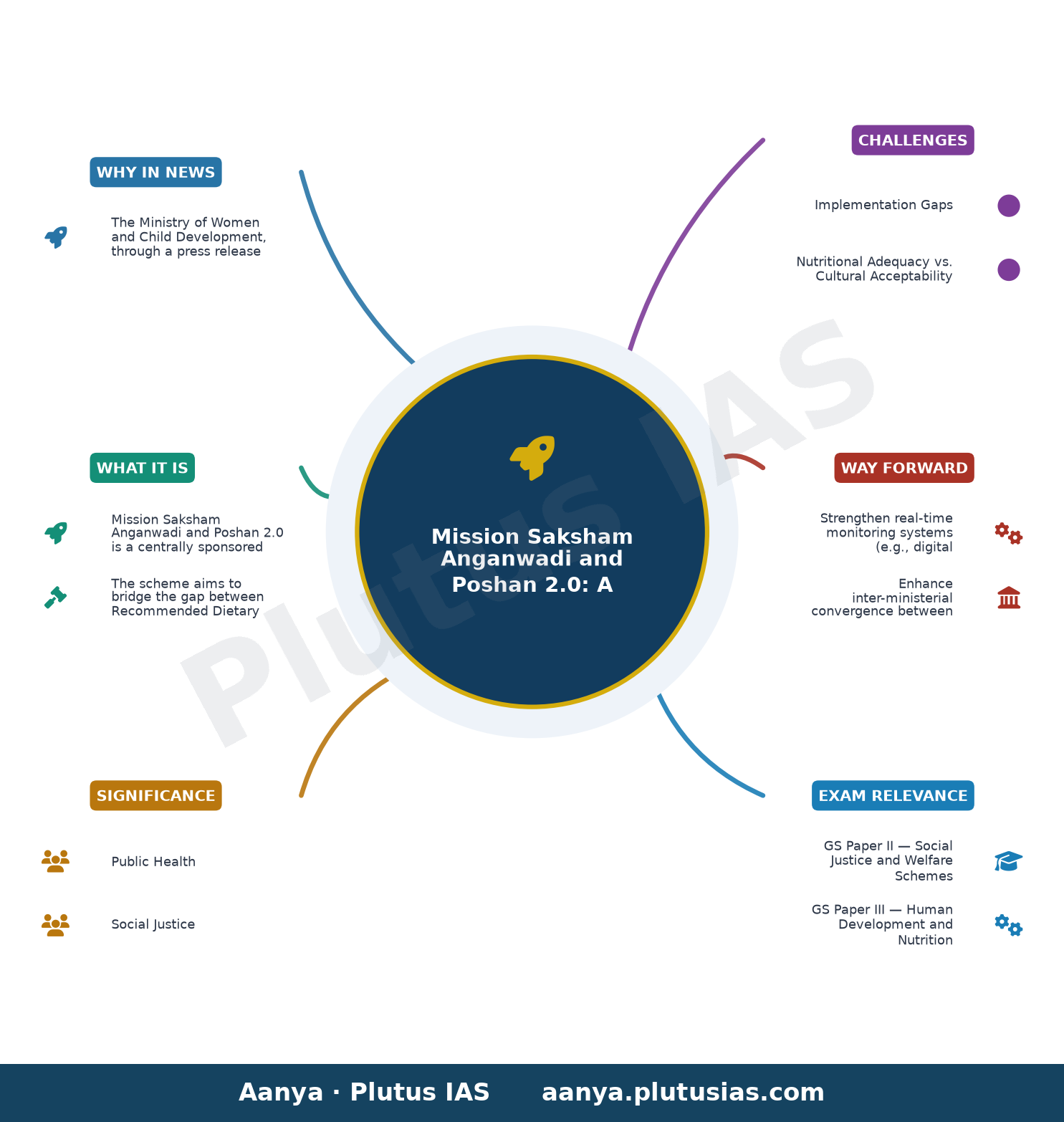
- GS Paper II — Social Justice and Welfare Schemes | GS Paper III — Human Development and Nutrition
- Prelims: National Food Security Act (NFSA) 2013, Poshan 2.0, Supplementary Nutrition Programme (SNP), Recommended Dietary Allowance (RDA), Face Recognition System (FRS), Take-Home Ration (THR), Severe Acute Malnutrition (SAM), Micro-nutrient deficiencies
- Essay: Nutrition as a cornerstone of human capital formation, The role of public policy in addressing malnutrition and food insecurity
Quick Revision: Mission Saksham Anganwadi and Poshan 2.0 under NFSA 2013’s Schedule-II (2023) provides age-specific supplementary nutrition (THR, snacks, hot meals) to children (6m–6y), pregnant/lactating women, adolescent girls (14–18y), and SAM children, with FRS-enabled THR delivery and emphasis on diet diversity and micronutrient sufficiency.
Why is this in the news?
The Ministry of Women and Child Development, through a press release dated 31 July 2026, announced the expansion of supplementary nutrition coverage under Mission Saksham Anganwadi and Poshan 2.0 to all eligible beneficiaries, including children aged 6 months to 6 years, pregnant and lactating women, adolescent girls (14–18 years), and severely malnourished children (SAM). This initiative aligns with the revised nutritional norms under Schedule-II of the National Food Security Act (NFSA), 2013, and introduces a multi-modal delivery system—comprising Take-Home Ration (THR), morning snacks, and hot-cooked meals—while leveraging technology such as Face Recognition Systems (FRS) for targeted distribution.
Background
- The National Food Security Act (NFSA), 2013, mandates the provision of supplementary nutrition to pregnant women, lactating mothers, and children under six years through the Integrated Child Development Services (ICDS) scheme.
- Poshan 2.0, launched in 2021 as an umbrella scheme consolidating earlier programmes like POSHAN Abhiyaan and Anganwadi Services, aims to improve nutritional outcomes through convergence, technology, and community engagement.
- Despite progress, India faces persistent challenges of child and maternal malnutrition, with high rates of stunting (35.5%), wasting (19.3%), and underweight children (32.1%) as per the National Family Health Survey (NFHS-5, 2019–21).
- The revised nutritional norms under NFSA’s Schedule-II (2023) reflect a shift from calorie-centric to balanced, diet-diversity-based standards, emphasizing protein quality, healthy fats, and essential micronutrients.
- The introduction of Face Recognition Systems (FRS) in Anganwadi centres ensures targeted delivery of Take-Home Ration (THR) to mothers/guardians of children aged 6–23 months, reducing leakages and enhancing accountability.
- Supplementary nutrition under Poshan 2.0 is now provided in multiple formats—THR, morning snacks, and hot-cooked meals—to address diverse dietary needs and cultural preferences across states.
What is Mission Saksham Anganwadi and Poshan 2.0?
- Mission Saksham Anganwadi and Poshan 2.0 is a centrally sponsored scheme under the Ministry of Women and Child Development, integrating earlier programmes like ICDS, POSHAN Abhiyaan, and Scheme for Adolescent Girls (SAG) into a unified framework.
- The scheme aims to bridge the gap between Recommended Dietary Allowance (RDA) and Average Daily Intake (ADI) by providing supplementary nutrition to vulnerable groups, including children (6 months–6 years), pregnant/lactating women, adolescent girls (14–18 years), and severely malnourished children (SAM).
- Supplementary nutrition is delivered through three modalities: Take-Home Ration (THR) for children aged 6–23 months (distributed via FRS-enabled Anganwadi centres), morning snacks, and hot-cooked meals for older children and women.
- Nutritional norms under the scheme align with the revised Schedule-II of the NFSA (2023), ensuring age-specific calorie and protein intake along with seven essential micronutrients (calcium, zinc, iron, dietary folate, vitamin A, vitamin B6, and vitamin B12).
- For children aged 6–12 months, the scheme provides 200 kcal and 8–10g protein; for 1–3 years, 400 kcal and 15–20g protein; and for 3–6 years, 400 kcal and 15–20g protein, alongside micronutrients.
- Severely Acute Malnourished (SAM) children (6 months–5 years) receive additional THR to address acute nutritional deficits, with distribution monitored through community-based mechanisms.
- The scheme emphasizes diet diversity by incorporating locally available foods such as millets, pulses, vegetables, nuts, and indigenous ingredients, tailored to regional dietary habits and cultural preferences.
- Technology integration, including FRS for identity verification and digital monitoring of THR distribution, enhances transparency, reduces leakages, and ensures last-mile delivery to intended beneficiaries.
Key Features
| Feature | Significance |
|---|---|
| Comprehensive Nutritional Coverage | Ensures targeted delivery of supplementary nutrition to vulnerable groups: children (6 months–6 years), pregnant women, lactating mothers, and adolescent girls (14–18 years), addressing gaps between Recommended Dietary Allowance (RDA) and Average Daily Intake (ADI). |
| Multi-modal Delivery Mechanism | Provides nutrition through Take-Home Ration (THR), morning snacks, and hot cooked meals, enhancing accessibility and reducing dependency on single-point distribution. |
| Age-specific Nutritional Standards | Prescribes calibrated caloric and protein intake (e.g., 200 kcal & 8–10g protein for 6–12 months, 400 kcal & 15–20g protein for 1–3 and 3–6 years) alongside 7 essential micronutrients, aligning with revised Schedule-II of NFSA 2013. |
| Face Recognition System (FRS) | Uses biometric authentication at Anganwadi centres to ensure accurate and transparent distribution of THR to mothers/guardians of children aged 6–23 months, minimising leakages. |
| Culturally Sensitive Menu Design | Empowers states/UTs to tailor menus using locally available foods (millets, pulses, vegetables, nuts) to improve dietary diversity and acceptability, addressing regional dietary preferences. |
| Enhanced Standards for SAM Children | Extends supplementary nutrition to severely malnourished children (6 months–5 years) via THR, ensuring targeted intervention for acute undernutrition. |
Why it Matters
Public Health
- Reduces stunting, wasting, and micronutrient deficiencies among children under 6 years by ensuring age-appropriate, balanced nutrition, directly contributing to the achievement of Sustainable Development Goal 2 (Zero Hunger).
- Improves maternal and child health outcomes by addressing nutritional gaps during pregnancy, lactation, and adolescence, thereby lowering maternal mortality and low birth weight incidences.
- Promotes dietary diversity through integration of locally sourced foods, mitigating the risk of hidden hunger and fostering long-term nutritional resilience.
Social Justice
- Operationalises the Directive Principles of State Policy (Article 39(f), 41, 42, 47) by ensuring equitable access to nutrition for marginalised groups, including Scheduled Castes, Scheduled Tribes, and economically weaker sections.
- Strengthens the Right to Food (Article 21) by guaranteeing supplementary nutrition as a statutory entitlement under the National Food Security Act (NFSA), 2013.
Governance & Technology
- Leverages biometric authentication (FRS) to enhance transparency, reduce pilferage, and ensure last-mile delivery of welfare benefits, setting a precedent for other welfare schemes.
- Demonstrates a shift from quantity-centric to quality-centric nutrition governance, aligning with global best practices in public health nutrition.
Economic
- Reduces long-term economic burden on healthcare systems by preventing nutrition-related diseases and disabilities, thereby improving workforce productivity and human capital development.
- Supports agricultural diversification by incentivising the use of locally grown nutrient-dense foods, indirectly boosting rural livelihoods.
Nutrition Science
- Adopts a lifecycle approach to nutrition, recognising the critical windows of opportunity (pregnancy, infancy, adolescence) for intervention, in line with the 1,000 Days Initiative.
- Integrates macronutrients (proteins, fats) and micronutrients (iron, zinc, vitamin A, folate, B6, B12, calcium) to address both overt and covert malnutrition.
Challenges
1. Implementation Gaps
- Inconsistent quality control across states/UTs may lead to suboptimal nutritional outcomes, particularly in regions with limited monitoring capacity.
- Delayed disbursement of funds under Poshan 2.0 may disrupt the supply chain of THR and hot-cooked meals, affecting beneficiary participation.
UPSC Link: GS-II: Welfare Schemes
2. Nutritional Adequacy vs. Cultural Acceptability
- Balancing evidence-based nutritional standards with local dietary preferences remains a challenge, risking low consumption of THR in certain communities.
- Over-reliance on processed THR (e.g., fortified blended foods) may undermine the promotion of traditional, nutrient-dense foods.
UPSC Link: GS-II: Social Sector
3. Monitoring and Evaluation
- Absence of real-time data on consumption patterns and nutritional impact hampers evidence-based policy adjustments.
- Underreporting of Severe Acute Malnutrition (SAM) cases due to stigma or lack of awareness may lead to under-coverage of high-risk children.
UPSC Link: GS-II: Governance
4. Logistical and Supply Chain Constraints
- Seasonal fluctuations in the availability of local ingredients (e.g., millets, pulses) may disrupt menu planning and nutritional consistency.
- Inadequate storage facilities in Anganwadi centres pose risks of spoilage and contamination, particularly in high-temperature regions.
UPSC Link: GS-III: Food Processing and Supply Chain
5. Inter-sectoral Coordination
- Poor coordination between the Ministry of Women and Child Development (MWCD), Ministry of Health and Family Welfare (MoHFW), and state governments may lead to duplication or gaps in service delivery.
- Limited convergence with other nutrition programmes (e.g., Mid-Day Meal Scheme, ICDS) risks fragmented implementation.
UPSC Link: GS-II: Intergovernmental Relations
6. Awareness and Behavioural Barriers
- Low awareness among beneficiaries about the nutritional benefits of supplementary foods may reduce uptake, particularly in rural and tribal areas.
- Cultural taboos (e.g., avoidance of certain foods during pregnancy) may hinder the adoption of diversified diets.
UPSC Link: GS-II: Social Empowerment
Challenges — UPSC Perspective
| Issue | Concern |
|---|---|
| Fund Flow Delays | Disruptions in the supply chain of THR and hot-cooked meals due to delayed release of central funds. |
| Quality Assurance | Variability in the nutritional quality of THR across states, risking suboptimal health outcomes. |
| Cultural Sensitivity | Mismatch between prescribed menus and local dietary habits, leading to low consumption. |
| Data Deficiency | Lack of real-time monitoring of nutritional impact and beneficiary feedback. |
| Storage Constraints | Inadequate infrastructure in Anganwadi centres for safe storage of perishable foods. |
| Stigma and Awareness | Underreporting of SAM cases and low beneficiary engagement due to lack of awareness. |
Government Initiatives — Must-Memorise for Prelims
- Poshan 2.0 (Prime Minister’s Overarching Scheme for Holistic Nutrition)
- Integrated Child Development Services (ICDS) Scheme
- National Food Security Act (NFSA), 2013 (Schedule-II)
- Saksham Anganwadi and Poshan 2.0
Way Forward
- Strengthen real-time monitoring systems (e.g., digital dashboards) to track THR distribution, consumption, and nutritional outcomes at the Anganwadi level.
- Enhance inter-ministerial convergence between MWCD, MoHFW, and state governments to ensure seamless service delivery and avoid duplication.
- Invest in capacity-building for Anganwadi workers to improve awareness campaigns on nutrition, hygiene, and the benefits of supplementary foods.
- Promote local procurement of nutrient-dense foods (e.g., millets, pulses) through Farmer Producer Organisations (FPOs) to ensure sustainability and cost-effectiveness.
- Establish a grievance redressal mechanism for beneficiaries to report delays, quality issues, or non-delivery of THR, with provisions for timely resolution.
- Conduct periodic nutritional audits of THR and hot-cooked meals to ensure compliance with revised Schedule-II standards under NFSA 2013.
- Expand the use of biometric authentication (FRS) to all eligible beneficiaries, including pregnant women and adolescent girls, to ensure transparency.
- Integrate Poshan 2.0 with the Poshan Tracker app to enable data-driven policy adjustments and improve beneficiary targeting.
UPSC Value Addition
Keywords for Mains Answer-Writing
Mission Saksham Anganwadi and Poshan 2.0 · Supplementary Nutrition · National Food Security Act 2013 · Recommended Dietary Allowance (RDA) · Take-Home Ration (THR) · Face Recognition System (FRS) · Severe Acute Malnutrition (SAM) · Nutritional diversity · Anganwadi Services · Micro-nutrient supplementation · Nutrition Rehabilitation Centres (NRCs) · Poshan Tracker · Integrated Child Development Services (ICDS) · Maternal and Child Nutrition
Constitutional & Policy Linkages
- Article 47 (DPSP: Raising the level of nutrition and standard of living)
- Article 39(f) (DPSP: Children’s right to healthy development)
- Article 41 (DPSP: Right to public assistance in cases of unemployment, old age, sickness, and disablement)
Concept Flow
Economic and social inequities → Undernutrition and micronutrient deficiencies → Revised NFSA Schedule-II (2023) → Poshan 2.0 and Saksham Anganwadi (2026) → Multi-modal delivery (THR, hot meals, snacks) → Age-specific nutritional standards → Face Recognition System (FRS) for transparency → Improved dietary diversity via local foods → Enhanced maternal and child health outcomes → Contribution to SDG 2 (Zero Hunger) and SDG 3 (Good Health and Well-being)
Prelims Practice Questions
Q1. Consider the following statements regarding Mission Saksham Anganwadi and Poshan 2.0:
1. It provides supplementary nutrition to children aged 6 months to 6 years, pregnant women, lactating mothers, and adolescent girls (14-18 years).
2. Supplementary nutrition is provided in the form of Take-Home Ration (THR), morning snacks, and hot-cooked meals.
3. The Supplementary Nutrition Programme is implemented exclusively through the Public Distribution System (PDS).
4. Severe Acute Malnutrition (SAM) children receive additional nutrition under this mission.
How many of the above statements are correct?
- Only one
- Only two
- Only three
- All four
Answer: Only three — Statements 1, 2, and 4 are correct. Statement 3 is incorrect as the programme is implemented through Anganwadi Centres, not exclusively through PDS.
Q2. Assertion (A): The Supplementary Nutrition Programme under Mission Saksham Anganwadi and Poshan 2.0 provides 7 essential micronutrients in addition to calories and proteins.
Reason (R): The programme aligns with the nutritional norms prescribed in the Revised Schedule-II of the National Food Security Act, 2013.
Options:
A. Both A and R are true, and R is the correct explanation of A.
B. Both A and R are true, but R is NOT the correct explanation of A.
C. A is true, but R is false.
D. A is false, but R is true.
Answer: ? — Both Assertion (A) and Reason (R) are true. The programme provides 7 essential micronutrients (calcium, zinc, iron, dietary folate, vitamin A, vitamin B6, and vitamin B12) alongside calories and proteins, and the nutritional norms are derived from the Revised Schedule-II of the NFSA, 2013.
Mains Practice Question
✍ The Supplementary Nutrition Programme under Mission Saksham Anganwadi and Poshan 2.0 represents a paradigm shift from calorie-centric to quality- and diversity-focused nutritional interventions. Critically examine the design and implementation of this programme, highlighting its alignment with the National Food Security Act, 2013, and its potential to address malnutrition in India. Also, assess the challenges in ensuring last-mile delivery and acceptance of supplementary nutrition among beneficiaries. (15 Marks)
Approach: MODEL-ANSWER SKELETON:
1. **Introduction** (2 Marks)
– Briefly define Mission Saksham Anganwadi and Poshan 2.0 and its objectives.
– Contextualise the shift from calorie-centric to quality- and diversity-focused nutrition.
2. **Design and Implementation** (5 Marks)
– **Nutritional Norms**: Explain the revised nutritional standards (RDA vs. ADI gap bridging) and the inclusion of 7 essential micronutrients.
– **Target Beneficiaries**: List the categories (children 6 months–6 years, pregnant/lactating women, adolescent girls 14–18 years, SAM children).
– **Delivery Mechanisms**: Describe Take-Home Ration (THR), morning snacks, hot-cooked meals, and the use of Face Recognition System (FRS) for THR distribution.
– **Legal Framework**: Link to the Revised Schedule-II of the National Food Security Act, 2013 (January 2023 amendments).
3. **Alignment with NFSA, 2013** (3 Marks)
– Explain how the programme operationalises the NFSA’s mandate for nutritional security.
– Discuss the role of Anganwadi Centres as delivery platforms under the ICDS framework.
4. **Challenges in Last-Mile Delivery and Acceptance** (3 Marks)
– **Logistical Issues**: Supply chain, storage, and distribution bottlenecks.
– **Cultural and Socio-Economic Factors**: Local dietary habits, acceptability of THR, and awareness among beneficiaries.
– **Monitoring and Accountability**: Role of Poshan Tracker and community engagement.
5. **Conclusion** (2 Marks)
– Summarise the programme’s strengths and gaps.
– Offer a balanced view on its potential to reduce malnutrition, with suggestions for improvement (e.g., strengthening local procurement, community participation, and real-time monitoring).
Source: PIB (Press Information Bureau)
Generated by AanyaAi for educational purpose.

- वायुसेना को मिला बड़ा हथियार: ₹811 करोड़ के 160 स्मार्ट एंटी-एयरफील्ड वेपन समझौता - September 23, 2026
- UPSC Exam Alert: Defence Ministry signs ₹811 Crore SAT-SAAW deal for IAF - September 23, 2026
- आरबीआई 24 सितंबर 2026 को ओवरनाइट वीआरआरआर नीलामी करेगा: यूपीएससी-पीसीएस परीक्षा के लिए महत्वपूर्ण - September 23, 2026

No Comments