


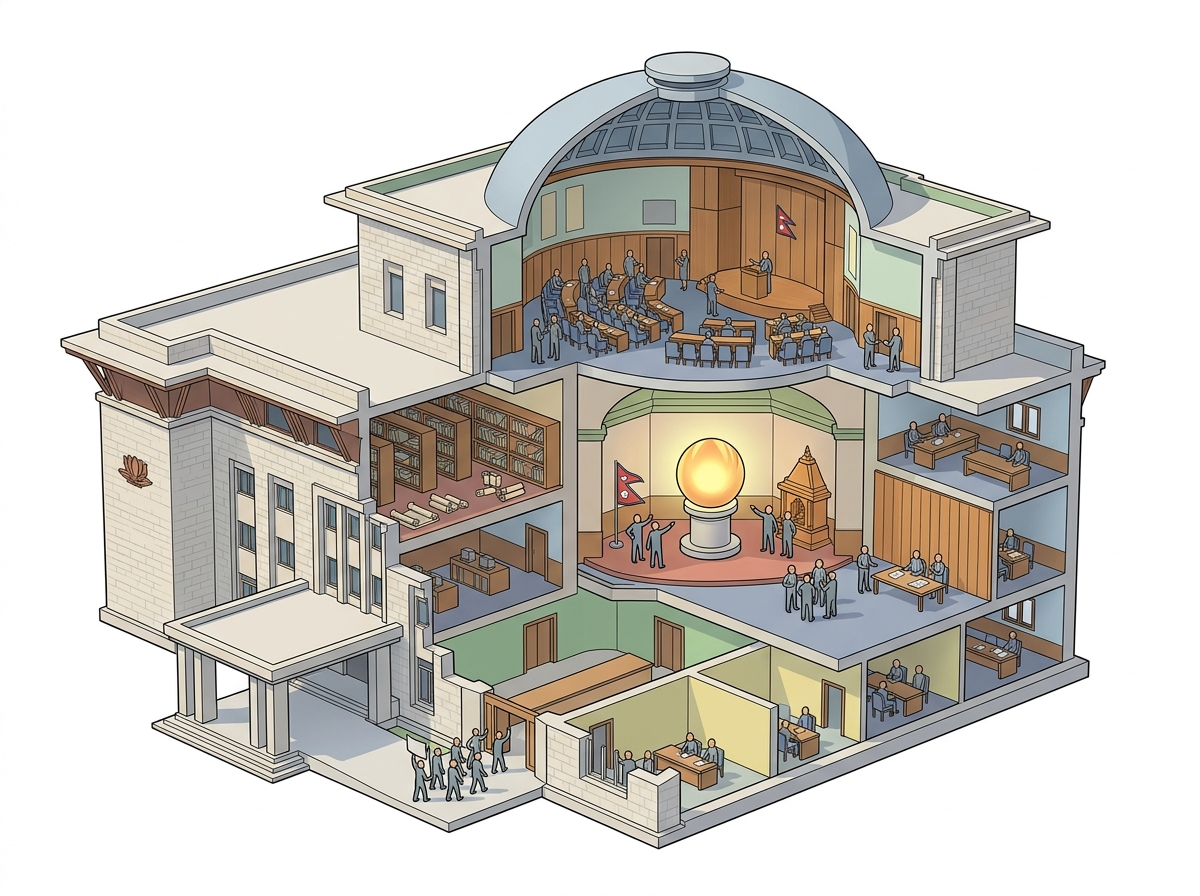
17 Aug UPSC Alert: Nepal’s Hindu Rashtra Push & Constitutional Amendment Demand Explained
✎ Article 4 of Nepal’s 2015 Constitution declares Nepal a 'secular' state; ongoing amendments may revise this provision amid debates on religious identity and federalism.
Subject Relevance — Where This Topic Fits
- GS Paper II — International Relations (India-Nepal relations, regional geopolitics) | GS Paper II — Polity and Governance (Constitutional amendments, secularism, federalism)
Quick Revision: Article 4 of Nepal’s 2015 Constitution declares Nepal a ‘secular’ state; ongoing amendments may revise this provision amid debates on religious identity and federalism.
Why is this in the news?
Nepal’s ongoing constitutional amendment process has provided a platform for Hindu Rashtra proponents to demand the removal of the term ‘secular’ from Article 4 of the Constitution. Organisations such as the Vishwa Hindu Parishad (VHP) Nepal and the Rastriya Prajatantra Party (RPP) have submitted formal proposals to the government, arguing for the restoration of Nepal’s historical religious identity while asserting that religious freedom for all communities will be preserved. This development underscores the intersection of constitutional reform, religious identity, and federal governance in Nepal.
Background
- Nepal adopted a secular federal democratic republican constitution in 2015, replacing its previous Hindu monarchy-based system.
- The 2015 Constitution declared Nepal a ‘secular’ state, reflecting its religious and cultural diversity.
- The current constitutional amendment process, initiated by the government, aims to address demands for changes across 245 of the Constitution’s 308 articles.
- Hindu Rashtra proponents argue that the term ‘secular’ undermines Nepal’s historical and cultural identity rooted in Hindu, Buddhist, and Kirat traditions.
- The Rastriya Prajatantra Party (RPP) has been a vocal advocate for reinstating Nepal’s Hindu identity while maintaining federalism.
- The debate reflects broader tensions between constitutional secularism and the preservation of cultural-religious heritage in South Asian polities.
What is the Nepal Constitution Amendment Process and the Debate on Article 4?
- The Nepal Constitution, promulgated in 2015, establishes Nepal as a ‘secular, federal democratic republic’ under Article 4.
- Article 4 defines Nepal as a ‘secular’ state, ensuring freedom of religion and prohibiting religious discrimination.
- The current amendment process allows for revisions to the Constitution, with proposals submitted by political parties, civil society, and religious organisations.
- Hindu Rashtra proponents, including the VHP Nepal, argue for the removal of the term ‘secular’ to restore Nepal’s identity as a Hindu-majority state while preserving religious freedom.
- The Rastriya Prajatantra Party (RPP) advocates for a broader debate on religious identity, monarchy, and federalism within the amendment process.
- The debate highlights the challenge of balancing constitutional secularism with the preservation of cultural and religious heritage.
- The amendment process is governed by Article 274 of the Nepal Constitution, which outlines the procedure for constitutional revisions.
- The outcome of these amendments could reshape Nepal’s political and social landscape, influencing its secular credentials and federal structure.
Key Features
| Feature | Significance |
|---|---|
| Demand to amend Article 4 of Nepal’s Constitution | Seeks removal of the term ‘secular’ to redefine Nepal’s constitutional identity as a Hindu Rashtra, aligning with religious and cultural aspirations of certain groups. |
| Proposed Hindu Rashtra model with Sanaatan framework | Advocates for a state identity rooted in Sanaatan (Hindu-Buddhist-Kirat) traditions while purportedly preserving religious freedom for all communities. |
| Role of Hindu nationalist organisations (e.g., VHP Nepal) | Actively lobbying for constitutional amendments through formal petitions, leveraging the ongoing constitutional review process. |
| Involvement of political parties (e.g., RPP) | Raising demands for constitutional amendments to include Hindu Rashtra, monarchy, and federal structure debates in the broader discourse. |
| Constitutional review process in Nepal | A structured mechanism for amending 245 out of 308 constitutional provisions, providing a procedural avenue for such demands. |
Why it Matters
Constitutional and Legal
- Represents a potential shift in Nepal’s constitutional identity from a secular federal democratic republic (established in 2015) to a Hindu Rashtra, altering the foundational principles of governance.
Political and Governance
- Highlights the intersection of religion and politics in Nepal’s constitutional framework, with demands for identity-based governance models.
Social and Cultural
- Reflects the aspirations of certain sections of society to align Nepal’s national identity with Hindu-Buddhist-Kirat traditions, while raising questions about inclusivity and minority rights.
Institutional
- Demonstrates the role of civil society organisations (e.g., VHP Nepal) and political parties in shaping constitutional discourse through formal and informal channels.
Challenges
1. Ensuring Inclusivity and Minority Rights
- A Hindu Rashtra model risks marginalising non-Hindu communities, particularly Muslims, Christians, and indigenous groups, potentially violating constitutional guarantees of equality and religious freedom.
- Historical tensions between religious communities in Nepal underscore the need for safeguards to prevent social fragmentation.
UPSC Link: GS-II: Fundamental Rights and DPSP
2. Balancing Majoritarian Aspirations with Democratic Pluralism
- The demand challenges Nepal’s secular democratic framework, raising questions about the compatibility of majoritarian religious identity with democratic governance.
UPSC Link: GS-II: Secularism and Pluralism
3. Procedural and Legal Constraints in Constitutional Amendment
- Nepal’s constitutional amendment process requires a two-thirds majority in Parliament, making the passage of such amendments politically and procedurally complex.
UPSC Link: GS-II: Constitutional Amendment Process
4. Potential for Social and Political Polarisation
- The discourse could deepen societal divisions, particularly if framed as a zero-sum contest between religious and secular identities.
UPSC Link: GS-II: Communal Harmony and Social Cohesion
5. Impact on Nepal-India Relations
- Given cultural and religious ties, a shift in Nepal’s constitutional identity could influence bilateral relations, particularly in areas of soft power and diaspora engagement.
UPSC Link: GS-II: India-Nepal Relations
Challenges — UPSC Perspective
| Issue | Concern |
|---|---|
| Removal of ‘secular’ from Article 4 | Undermines Nepal’s constitutional commitment to religious neutrality and equality. |
| Potential marginalisation of non-Hindu communities | Risks violating constitutional guarantees of religious freedom and minority rights. |
| Political polarisation over identity politics | Could destabilise Nepal’s democratic and pluralistic ethos. |
| Procedural hurdles in constitutional amendment | Requires broad consensus, making passage uncertain. |
| Impact on Nepal’s secular democratic framework | Threatens the foundational principles established in the 2015 Constitution. |
Way Forward
- Nepal’s Parliament must ensure that any constitutional amendment process adheres to democratic norms, including broad consultations with all stakeholders.
- Civil society organisations and political parties should prioritise dialogue to reconcile majoritarian aspirations with minority rights and secular principles.
- Legal safeguards must be embedded to protect the rights of religious minorities and indigenous communities in any revised constitutional framework.
- The international community, particularly India, should monitor developments to ensure they do not exacerbate regional tensions or undermine Nepal’s democratic institutions.
- Educational and awareness campaigns should be conducted to foster a shared understanding of Nepal’s pluralistic identity and the risks of identity-based governance.
- Nepal’s judiciary must be prepared to interpret constitutional amendments in a manner that upholds fundamental rights and democratic values.
- Regional forums (e.g., SAARC) could facilitate discussions on the implications of such constitutional changes for South Asian secularism and pluralism.
UPSC Value Addition
Keywords for Mains Answer-Writing
Nepal Constitution Amendment · Article 4 of Nepal Constitution · Hindu Rashtra debate · Religious freedom in Nepal · Secularism vs religious identity · Constitutional amendment process · Federal Democratic Republic of Nepal · Article 4 of Indian Constitution (for contrast) · Religious pluralism · Nepalese political dynamics · 2015 Nepal Constitution · Religious freedom and state identity · Sunatana Dharma · Kirat traditions · Buddhist traditions in Nepal
Constitutional & Policy Linkages
- [‘Article 4 of Nepal’s Constitution (2015)’, ‘Defines Nepal as a secular state.’]
- [‘Fundamental Rights (Part 3 of Nepal’s Constitution)’, ‘Guarantees equality and religious freedom.’]
- [‘Constitutional Amendment Process (Article 274)’, ‘Outlines the procedural requirements for amendments.’]
Concept Flow
Rise of Hindu Rashtra advocacy in Nepal → Proposal to amend Article 4 of the Constitution → Petitions by organisations like VHP Nepal → Political parties (e.g., RPP) endorsing the demand → Constitutional review process initiated → Debate on secularism vs. religious identity → Potential amendment to Nepal’s constitutional identity → Challenges to inclusivity and minority rights → Impact on Nepal’s secular democratic framework.
Prelims Practice Questions
Q1. Consider the following statements regarding the Constitution of Nepal (2015):
1. Nepal is declared a secular state under Article 4.
2. The Constitution provides for a federal democratic republican structure.
3. Article 4 explicitly mentions the protection of all religions equally.
4. The Constitution was promulgated after the first Constituent Assembly failed to draft it.
How many of the above statements are correct?
- Only one
- Only two
- Only three
- All four
Answer: Only three — Statements 1, 2, and 3 are correct. Statement 4 is incorrect as the Constitution was promulgated by the second Constituent Assembly in 2015 after the first assembly was dissolved in 2012 without finalizing the draft.
Q2. Assertion (A): The demand for declaring Nepal a Hindu Rashtra is primarily based on the majority Hindu population.
Reason (R): The 2015 Constitution of Nepal declares the country a secular state, which some groups argue undermines Nepal’s Hindu and Sanātana Dharma traditions.
Options:
A. Both A and R are true, and R is the correct explanation of A.
B. Both A and R are true, but R is not the correct explanation of A.
C. A is true, but R is false.
D. A is false, but R is true.
Answer: ? — Assertion (A) is partially true but oversimplifies the demand, which also includes Sanātana Dharma and cultural traditions. Reason (R) is true as the secular status of the Constitution is a key point of contention. However, R does not fully explain A, as the demand is not solely demographic but also cultural-identitarian.
Q3. Match the following religious-cultural traditions with their corresponding descriptions in the context of Nepal’s constitutional debate:
Column I (Tradition)
1. Sanātana Dharma
2. Kirat traditions
3. Buddhist traditions
4. Hindu Rashtra
Column II (Description)
A. Indigenous tribal religious practices of the Kirat people, including nature worship.
B. A proposed state identity that integrates Hindu, Buddhist, and Kirat traditions under a single civilizational framework.
C. The eternal, all-encompassing religious and philosophical tradition encompassing Hinduism, Buddhism, and Jainism.
D. A religious tradition that emphasizes non-violence, meditation, and the Middle Way, historically linked to the Mauryan Emperor Ashoka.
Options:
A. 1-C, 2-A, 3-D, 4-B
B. 1-A, 2-C, 3-D, 4-B
C. 1-B, 2-A, 3-C, 4-D
D. 1-D, 2-B, 3-A, 4-C
Answer: ? — 1-C: Sanātana Dharma refers to the eternal tradition encompassing Hinduism, Buddhism, and Jainism. 2-A: Kirat traditions are indigenous tribal practices. 3-D: Buddhist traditions emphasize non-violence and meditation. 4-B: Hindu Rashtra is proposed as a state identity integrating these traditions.
Mains Practice Question
✍ The 2015 Constitution of Nepal declares the country a secular federal democratic republic. In recent times, demands have emerged to amend Article 4 to redefine Nepal’s state identity as a Hindu Rashtra while preserving religious freedom. Critically examine the constitutional, political, and socio-cultural dimensions of this debate. (15 Marks)
Approach: MODEL-ANSWER SKELETON:
1. **Constitutional Context**:
– Article 4 of the 2015 Constitution explicitly declares Nepal a secular state, ensuring freedom of religion and protection of religious and cultural sites (Art. 26).
– Contrast with India’s secularism (Art. 25-28) and Nepal’s pre-2015 Hindu monarchy status.
2. **Demand for Amendment**:
– Arguments for Hindu Rashtra: Cultural identity, majority Hindu population, and preservation of Sanātana Dharma (Hindu-Buddhist-Kirat synthesis).
– Arguments against: Secularism as a safeguard for minority religions (Islam, Christianity, indigenous faiths) and Nepal’s pluralistic identity.
3. **Political Dynamics**:
– Role of Hindu Rashtra proponents (e.g., Vishwa Hindu Parishad Nepal, Rastriya Prajatantra Party) in pushing for constitutional changes.
– Federal structure and decentralization: How state identity debates intersect with federalism (Art. 56-57).
4. **Socio-Cultural Dimensions**:
– Sanātana Dharma as a civilizational framework vs. secularism as a modern constitutional principle.
– Historical context: Nepal’s transition from Hindu monarchy to secular republic (2006 People’s Movement, 2015 Constitution).
5. **Legal and Comparative Perspectives**:
– International human rights norms (UDHR Art. 18, ICCPR Art. 18) and their compatibility with state religious identity.
– Comparative examples: Sri Lanka’s constitutional recognition of Buddhism, Malaysia’s dual legal system.
6. **Balanced View and Conclusion**:
– Weigh the merits of preserving cultural identity against the risks of majoritarianism and minority exclusion.
– Emphasize the need for inclusive constitutional amendments that respect both majority sentiment and minority rights.
Source: amarujala.com
Generated by AanyaAi for educational purpose.

- Gurugram’s groundwater extraction exceeds limit by 212%; HC seeks ban - October 4, 2026
- स्वतंत्रता सेनानी श्यामजी कृष्ण वर्मा की जन्म जयंती पर पीएम का श्रद्धांजलि - October 4, 2026
- KWML’s Feasibility Reports for Water Metro in 18 Cities: UPSC & PCS Insights - October 3, 2026

No Comments