


04 Sep UPSC Alert: New Mumbai-Sawantwadi Train Boosts Konkan Connectivity
✎ The CSMT–Sawantwadi Road train enhances Konkan rail connectivity, supports seasonal mobility during Ganesh Chaturthi, and improves freight logistics, thereby contributing to regional economic integration and inclusive development.
Subject Relevance — Where This Topic Fits
- GS Paper III — Infrastructure: Energy, Ports, Roads, Airports, Railways and Waterways | GS Paper III — Development, Inclusion and Employment
- Prelims: Konkan Railway Corporation Limited (KRCL), Konkan Railway, Railway Electrification, Vande Bharat Express, Bullish on Railways, Railway Budget, National Rail Plan 2030, Logistics Efficiency, Coastal Shipping, Sagarmala Project
- Essay: Regional Disparities and Inclusive Growth, Connectivity as a Catalyst for Development
Quick Revision: The CSMT–Sawantwadi Road train enhances Konkan rail connectivity, supports seasonal mobility during Ganesh Chaturthi, and improves freight logistics, thereby contributing to regional economic integration and inclusive development.
Why is this in the news?
The inauguration of a new daily train service between Chhatrapati Shivaji Maharaj Terminus (CSMT), Mumbai, and Sawantwadi Road marks a significant augmentation of rail connectivity in the Konkan region. This initiative addresses long-standing demand for direct connectivity, enhances passenger convenience during peak festival seasons such as Ganesh Chaturthi, and is expected to improve freight logistics, thereby supporting local economies including fishing and agriculture. The deployment of over 350 special trains during the festive period underscores the government’s focus on seasonal mobility management.
Background
- The Konkan Railway, operational since 1998, spans approximately 741 km.
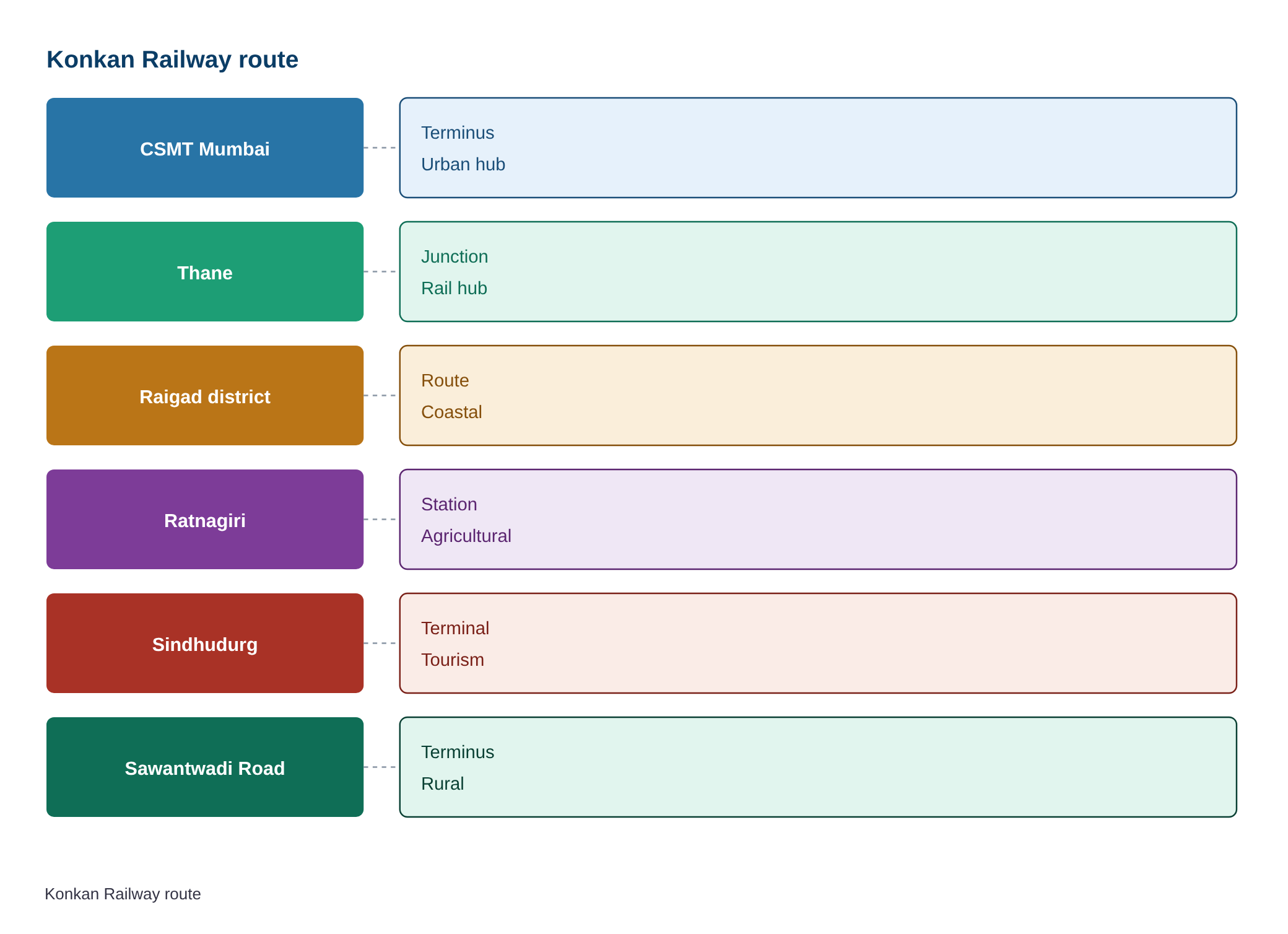
- The route is strategically important for connecting major urban centres in western India, including Mumbai, Thane, Raigad, Ratnagiri, and Sindhudurg districts.
- The Konkan Railway Corporation Limited (KRCL) is a public sector undertaking under the Ministry of Railways, responsible for the operation and maintenance of the Konkan Railway.
- The Konkan Railway has been progressively electrified, with completion of electrification projects enhancing operational efficiency, reducing carbon footprint, and enabling faster train services.
- The National Rail Plan 2030 aims to enhance rail connectivity, reduce logistics costs, and improve last-mile connectivity through dedicated freight corridors and multi-modal integration.
- The Mumbai–Ahmedabad High-Speed Rail Corridor (Bullet Train) and Vande Bharat Express services exemplify modern rail infrastructure development in western India.
What is the CSMT–Sawantwadi Road New Train Service?
- The new daily train service connects Chhatrapati Shivaji Maharaj Terminus (CSMT), Mumbai, to Sawantwadi Road, covering a distance of approximately 510 km with multiple stoppages.
- The train operates overnight from CSMT at 23:55 hrs, reaching Sawantwadi Road at 14:15 hrs the next day, and returns from Sawantwadi Road at 17:20 hrs, arriving back at CSMT at 06:40 hrs the following morning.
- Key intermediate stations include Dadar, Thane, Panvel, Roha, Mangaon, Veer, Khed, Chiplun, Savarda, Aravali Road, and Sangameshwar, enhancing accessibility across Raigad, Ratnagiri, and Sindhudurg districts.
- The service is designed to facilitate seamless passenger movement, particularly during festivals such as Ganesh Chaturthi, when pilgrim and migrant traffic peaks.
- Beyond passenger mobility, the service is expected to improve freight logistics, enabling faster transportation of perishable goods such as fish and agricultural produce from coastal and hinterland regions to Mumbai markets.
- The introduction of this service aligns with the broader objective of enhancing regional connectivity, reducing migration pressures, and fostering economic opportunities in the Konkan region.
- The train is equipped with modern amenities and adheres to safety and punctuality standards, reflecting the ongoing modernization of Indian Railways.
- This initiative complements other rail infrastructure projects in the region, including the electrification of the Konkan Railway and the development of high-speed corridors.
Key Features
| Feature | Significance |
|---|---|
| Route | Connects Mumbai (CSMT) to Savantwadi Road (510 km), enhancing direct rail linkage between Mumbai and the Konkan region. |
| Frequency | Daily service (Train No. 15087/15088) with convenient overnight travel options for passengers. |
| Stoppage Network | Covers key stations: Dadar, Thane, Panvel, Roha, Chiplun, Ratnagiri, and Sindhudurg, improving regional accessibility. |
| Timings | Departure from CSMT at 23:55, arrival at Savantwadi Road at 14:15 next day; return journey departs at 17:20, arrives at 06:40 next day. |
| Special Services | 350+ special trains planned for Ganesh festival, with provision to increase to 370 based on demand. |
| Electrification | Part of Konkan Railway’s 741 km electrification, enabling faster, environmentally sustainable travel. |
Why it Matters
Economic Integration
- Facilitates faster movement of agricultural and fishery produce from Konkan to Mumbai markets, reducing transit time and post-harvest losses.
- Enhances supply chain efficiency for local industries, particularly in Sindhudurg and Ratnagiri districts.
- Promotes tourism by improving connectivity to pilgrimage sites and coastal destinations in the Konkan belt.
Social Development
- Reduces migration pressure by enabling daily commuting for work or education between Mumbai and Konkan, particularly for youth and professionals.
- Strengthens family ties by providing reliable overnight travel options for migrants and students returning home during festivals.
- Improves access to healthcare and higher education in Mumbai for residents of remote Konkan districts.
Strategic Connectivity
- Complements the existing Konkan Railway network, filling gaps in direct rail connectivity between Mumbai and southern Konkan.
- Supports disaster resilience by ensuring alternative transport routes during disruptions in road networks (e.g., monsoon-related landslides).
- Enhances national integration by linking economically vibrant Mumbai with resource-rich Konkan hinterlands.
Environmental Impact
- Electrification of the route reduces carbon footprint compared to diesel-based services, aligning with India’s climate commitments.
- Encourages modal shift from road to rail, potentially reducing road congestion and vehicular emissions in the Mumbai-Konkan corridor.
Challenges
1. Operational Efficiency
- Maintaining punctuality across the 510 km route, given terrain challenges and shared infrastructure with existing Konkan Railway services.
- Ensuring adequate rolling stock availability to meet peak-season demand (e.g., Ganesh festival), without compromising regular services.
UPSC Link: Indian Railways operational challenges
2. Infrastructure Bottlenecks
- Addressing congestion at Mumbai terminals (CSMT) and intermediate stations (e.g., Thane, Panvel) due to high passenger density.
- Upgrading station infrastructure (platforms, amenities) in Konkan districts to handle increased footfall.
UPSC Link: Railway station development
3. Cost and Pricing
- Balancing affordability for local passengers with revenue generation to sustain service quality and infrastructure maintenance.
- Subsidies for seasonal demand (e.g., festivals) without overburdening the exchequer or distorting market pricing.
UPSC Link: Public transport pricing models
4. Regional Equity
- Ensuring equitable benefits across Konkan districts, particularly for economically weaker sections and tribal communities.
- Preventing over-reliance on Mumbai-centric development by promoting Konkan’s local economic hubs.
UPSC Link: Regional disparity in infrastructure
Challenges — UPSC Perspective
| Issue | Concern |
|---|---|
| Monsoon Disruptions | Landslides and flooding may delay services, requiring contingency plans and real-time monitoring. |
| Station Congestion | CSMT and intermediate stations face high footfall; need for phased expansion and crowd management. |
| Rolling Stock Shortage | Peak-season demand (e.g., festivals) may outstrip train availability, risking overcrowding. |
| Last-Mile Connectivity | Poor road links to some stations (e.g., Savantwadi Road) may reduce the service’s utility for rural passengers. |
| Pricing Pressure | Affordability for low-income groups versus commercial viability of the service. |
| Electrification Costs | Ongoing maintenance of electrified tracks and rolling stock in Konkan’s challenging terrain. |
Way Forward
- Integrate this route with Konkan Railway’s existing network for seamless interoperability and reduced transit times.
- Expand station infrastructure in Konkan districts (e.g., platforms, waiting halls, digital signage) to enhance passenger experience.
- Introduce dynamic pricing for peak-season services (e.g., Ganesh festival) to manage demand without compromising affordability.
- Develop last-mile connectivity solutions (e.g., feeder buses, shared mobility) for stations in remote areas.
- Strengthen disaster preparedness protocols for monsoon-related disruptions, including alternative routing options.
- Monitor service performance (punctuality, occupancy) and conduct periodic reviews to address bottlenecks proactively.
- Promote multi-modal transport hubs at key stations (e.g., Thane, Panvel) to integrate rail with metro/bus services.
- Leverage the route’s electrification to explore renewable energy integration (e.g., solar-powered stations) for sustainability.
UPSC Value Addition
Keywords for Mains Answer-Writing
Railway connectivity in Konkan region · Railway Electrification and its benefits · Konkan Railway Corporation Limited (KRCL) · Passenger amenities in Indian Railways · Railway infrastructure development · Regional connectivity in Maharashtra · Railway Electrification and environmental sustainability · Special train services during festivals · Railway network expansion in India · Public transport and economic integration
Constitutional & Policy Linkages
- Article 297: State ownership of railway infrastructure under the Union List (Entry 24, List I).
Concept Flow
Konkan region’s economic isolation → Limited rail connectivity → High migration and supply chain inefficiencies → New Mumbai-Savantwadi route introduced → Enhanced passenger and freight movement → Reduced regional disparities and improved social equity → Long-term economic integration and environmental benefits.
Prelims Practice Questions
Q1. Consider the following statements regarding the Konkan Railway Corporation Limited (KRCL):
1. It operates under the administrative control of the Ministry of Railways.
2. The Konkan Railway route spans approximately 741 km and connects Maharashtra, Goa, and Karnataka.
3. The entire Konkan Railway route has been electrified.
4. The Konkan Railway route is known for its challenging terrain and numerous tunnels.
How many of the above statements are correct?
- Only one
- Only two
- Only three
- All four
Answer: All four — Statements 1, 2, 3, and 4 are all correct. The Konkan Railway Corporation Limited is a subsidiary of the Indian Railways under the Ministry of Railways. The route spans 741 km connecting Maharashtra, Goa, and Karnataka. The entire route has been electrified, and it is known for its challenging terrain with numerous tunnels.
Q2. Assertion (A): The electrification of railway tracks in India has significantly reduced carbon emissions.
Reason (R): Electrified trains produce no direct emissions during operation.
Options:
A. Both A and R are true, and R is the correct explanation of A.
B. Both A and R are true, but R is NOT the correct explanation of A.
C. A is true, but R is false.
D. A is false, but R is true.
Answer: ? — Both the Assertion (A) and Reason (R) are true. Electrified trains produce no direct emissions during operation, which contributes to a reduction in carbon emissions. However, the broader reduction in carbon emissions also depends on the source of electricity generation (renewable vs. fossil fuels).
Q3. Match the following railway zones with their headquarters:
Column I (Railway Zone) | Column II (Headquarters)
1. Konkan Railway | A. Mumbai
2. Central Railway | B. Secunderabad
3. South Central Railway | C. Mumbai CST
4. Western Railway | D. Belapur
Options:
A. 1-D, 2-C, 3-B, 4-A
B. 1-A, 2-C, 3-B, 4-D
C. 1-D, 2-B, 3-C, 4-A
D. 1-A, 2-B, 3-C, 4-D
Answer: ? — The correct matches are: 1. Konkan Railway – D. Belapur, 2. Central Railway – C. Mumbai CST, 3. South Central Railway – B. Secunderabad, 4. Western Railway – A. Mumbai.
Mains Practice Question
✍ The expansion and electrification of railway infrastructure in India are pivotal to enhancing regional connectivity and economic integration. In this context, critically examine the significance of the Konkan Railway Corporation Limited (KRCL) and its recent electrification. Also, assess how such initiatives contribute to sustainable development and public welfare. (15 Marks)
Approach: MODEL-ANSWER SKELETON:
1. **Introduction (2 Marks)**
– Briefly introduce the Konkan Railway Corporation Limited (KRCL) and its operational significance.
– Mention the recent electrification of the Konkan Railway route (741 km) and its completion in record time.
2. **Significance of Konkan Railway (4 Marks)**
– **Regional Connectivity**: Connects key coastal districts of Maharashtra, Goa, and Karnataka, facilitating movement of passengers and goods.
– **Economic Integration**: Enhances trade, tourism, and employment opportunities in the Konkan region.
– **Challenging Terrain**: Highlights the engineering feat of constructing a railway line through hilly and coastal terrain.
– **Public Amenities**: Improves access to education, healthcare, and employment opportunities for local communities.
3. **Electrification and its Benefits (4 Marks)**
– **Environmental Sustainability**: Electrification reduces dependence on diesel, lowering carbon emissions and air pollution.
– **Operational Efficiency**: Faster acceleration, reduced maintenance costs, and improved energy efficiency.
– **Economic Viability**: Lower operational costs over time and potential for integration with renewable energy sources.
– **Safety and Comfort**: Reduced noise and vibration, enhancing passenger experience.
4. **Contribution to Sustainable Development (3 Marks)**
– **Alignment with SDGs**: Contributes to SDG 9 (Industry, Innovation, and Infrastructure) and SDG 13 (Climate Action).
– **Reduction in Carbon Footprint**: Directly reduces emissions from rail transport.
– **Long-term Viability**: Ensures the sustainability of rail transport as a mode of public transport.
5. **Public Welfare and Social Impact (2 Marks)**
– **Enhanced Mobility**: Facilitates travel for pilgrims, students, and migrant workers during festivals and emergencies.
– **Reduction in Migration**: Improves local employment opportunities, reducing the need for out-migration to urban centers.
6. **Conclusion (1 Mark)**
– Summarize the role of KRCL and electrification in fostering inclusive growth, sustainability, and regional development.
Source: PIB (Press Information Bureau)
Maharashtra PCS (MPSC) — State PCS Practice
Prelims: Which of the following statements is correct regarding the newly inaugurated train service from Mumbai CSMT to Sawantwadi Road?
- A. The train service is part of the Mumbai Suburban Railway network.
- B. The inauguration was jointly done by the Union Railway Minister and Union Minister of Commerce & Industry.
- C. The train service connects Maharashtra to Goa.
- D. The train is a semi-high-speed Vande Bharat Express.
Answer: B. The inauguration was jointly done by the Union Railway Minister and Union Minister of Commerce & Industry. — The inauguration was jointly conducted by Union Railway Minister Ashwini Vaishnaw and Union Minister of Commerce & Industry Piyush Goyal, as reported in the given topic.
Mains: Analyze the significance of the newly inaugurated train service from Mumbai CSMT to Sawantwadi Road for Maharashtra’s tourism, trade, and regional connectivity. Discuss the potential economic and social impacts on the Konkan region.
Generated by AanyaAi for educational purpose.
Related guides on our sites
- How to prepare for GS paper 1 for UPSC CSE mains exam
- Best UPSC coaching for IFOS exam
- Best ias coaching in mumbai
- Best mentorship programme for upsc

- India-Australia AUSTRAHIND 2026 Exercise: Key Highlights for UPSC & State PCS - October 22, 2026
- एससीओ बैठक में भारत का आतंकवाद विरोध: क्षेत्रीय सहयोग पर जोर - October 22, 2026
- SEC Directs Strict SC Order Compliance for Andhra ULB Polls - October 22, 2026

No Comments