


07 Aug UPSC Alert: PLI Scheme for Pharma Sector – Key Facts & Challenges
✎ The PLI scheme for pharmaceuticals disburses incentives based on incremental sales of domestically manufactured products, with ₹6,659 crore already released by March 2026, but bulk drug projects face delays due to regulatory and…
Subject Relevance — Where This Topic Fits
- GS Paper III — Indian Economy: Issues relating to Planning, Mobilization of Resources, Growth, Development and Employment | GS Paper II — Government Policies and Interventions for development in various sectors and issues arising out of their design and implementation
- Prelims: Production-Linked Incentive (PLI) Scheme, Pharmaceutical Sector, Fermentation-based bulk drugs, Component-Linked Incentive (CLI), Union Budget 2022-23
- Essay: The Role of Production-Linked Incentives in India’s Self-Reliance Vision, Challenges in Implementing Sector-Specific Incentive Schemes in India
Quick Revision: The PLI scheme for pharmaceuticals disburses incentives based on incremental sales of domestically manufactured products, with ₹6,659 crore already released by March 2026, but bulk drug projects face delays due to regulatory and operational constraints.
Why is this in the news?
The Union Minister of State for Chemicals and Fertilizers, in a written reply to the Lok Sabha on August 7, 2026, provided an update on the progress of the Production-Linked Incentive (PLI) Scheme for the pharmaceutical sector. The scheme, launched in FY 2022-23 with a financial outlay of ₹15,000 crore, has disbursed ₹6,659 crore in incentives by March 2026. However, the PLI scheme for bulk drugs has faced significant implementation challenges, including delays in land acquisition, environmental clearances, high utility costs, and prolonged manufacturing cycles for fermentation-based drugs, resulting in a disbursement of only ₹87.70 crore by the same period.
Background
- The PLI scheme was introduced as part of the Atmanirbhar Bharat initiative to boost domestic manufacturing and reduce import dependence in critical sectors, including pharmaceuticals.
- The pharmaceutical sector is a key component of India’s healthcare infrastructure, contributing significantly to the country’s export earnings and self-sufficiency in essential medicines.
- Bulk drugs (active pharmaceutical ingredients or APIs) are the foundational inputs for formulations, and their domestic production is critical for reducing reliance on imports, particularly from China.
- The PLI scheme for pharmaceuticals is structured to incentivize investment in high-technology production, with disbursements linked to incremental sales of domestically manufactured products.
What is the Production-Linked Incentive (PLI) Scheme for Pharmaceuticals?
- The PLI scheme for pharmaceuticals is a performance-based incentive program introduced in FY 2022-23 with a total financial outlay of ₹15,000 crore.
- The scheme aims to incentivize domestic manufacturing of pharmaceuticals, including formulations and bulk drugs (APIs), to reduce import dependence and enhance self-reliance.
- Incentives are disbursed based on incremental sales of domestically manufactured products, ensuring that subsidies are tied to actual production and market performance.
- The PLI scheme for bulk drugs specifically targets fermentation-based and chemical synthesis-based APIs, which are critical for the production of essential medicines.
- Disbursements under the scheme are contingent on the sale of incentivized products, which has led to delays in fund distribution due to implementation challenges in bulk drug projects.
- The scheme is administered by the Department of Pharmaceuticals under the Ministry of Chemicals and Fertilizers.
- The PLI scheme for pharmaceuticals is part of a broader ecosystem of production-linked incentives, including schemes for medical devices, electronics, and other strategic sectors.
Key Features
| Feature | Significance |
|---|---|
| Financial Outlay of ₹15,000 crore for Pharmaceutical PLI | Provides fiscal stimulus to boost domestic manufacturing of drugs, reducing import dependence and enhancing self-reliance in critical pharmaceuticals. |
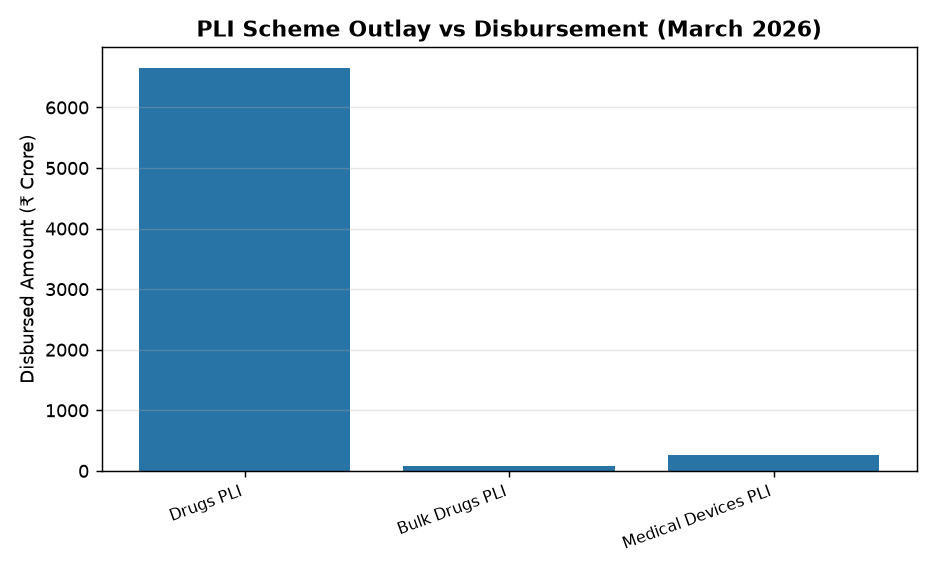
| Disbursement of ₹6,659 crore under Pharmaceutical PLI (as of March 2026) | Demonstrates tangible progress in incentivising production, though utilisation remains partial compared to total outlay. |
| Separate PLI Scheme for Bulk Drugs with ₹6,940 crore outlay | Targets critical intermediates like active pharmaceutical ingredients (APIs), essential for reducing reliance on imports and ensuring supply chain resilience. |
| Disbursement of ₹87.70 crore for Bulk Drugs PLI (as of March 2026) | Reflects slower adoption due to sector-specific challenges, indicating need for targeted interventions. |
| Component-Linked Incentive (CLI) in Medical Devices PLI | Encourages manufacturing of critical components, fostering a robust ecosystem for medical devices. |
| Disbursement of ₹266.64 crore for Medical Devices PLI (as of March 2026) | Signals early-stage traction in a high-value segment with significant import substitution potential. |
Why it Matters
Economic Significance
- Enhances India’s pharmaceutical manufacturing competitiveness by providing fiscal incentives, aligning with the vision of ‘Atmanirbhar Bharat’.
- Reduces import dependence on critical drugs and APIs, improving trade balance and foreign exchange savings.
- Stimulates employment generation in the pharmaceutical and allied sectors, particularly in tier-2 and tier-3 cities.
- Encourages investment in high-technology manufacturing, such as fermentation-based production, which has long-term productivity benefits.
Strategic Significance
- Strengthens India’s position as a global pharmaceutical hub, ensuring uninterrupted supply of essential medicines during geopolitical disruptions.
- Supports the production of critical drugs for domestic consumption and export, reinforcing India’s role in global health security.
- Facilitates the development of a self-sustaining ecosystem for bulk drugs, reducing vulnerabilities in supply chains.
Industrial Policy Significance
- Demonstrates the efficacy of Production-Linked Incentive (PLI) schemes in incentivising large-scale manufacturing in sunrise sectors.
- Highlights the need for sector-specific policy adjustments, such as addressing delays in land acquisition and environmental clearances.
- Showcases the integration of Component-Linked Incentives (CLI) in medical devices, a progressive step towards building a robust manufacturing base.
Challenges
1. Regulatory and Bureaucratic Delays
- Land acquisition processes remain cumbersome, delaying project implementation and disincentivising private investment.
- Environmental clearances for industrial projects face protracted timelines, particularly for fermentation-based bulk drug manufacturing.
- High utility costs (e.g., electricity, water) escalate operational expenses, reducing the net benefit of PLI incentives.
UPSC Link: GS3: Industrial Policy
2. Technological and Operational Bottlenecks
- Fermentation-based bulk drug production relies on biological processes with inherently slow growth rates, extending project timelines.
- Limited domestic capacity for high-value intermediates necessitates reliance on imported technologies and raw materials.
- Supply chain disruptions in critical inputs (e.g., enzymes, media) can stall production schedules.
UPSC Link: GS3: Science & Technology
3. Incentive Disbursement Lag
- PLI disbursements are contingent on sales performance, creating a cash-flow crunch for new projects during initial phases.
- Slow adoption in bulk drugs PLI indicates that sales-based disbursement models may not align with sector-specific realities.
- Administrative delays in processing claims further exacerbate liquidity constraints for manufacturers.
UPSC Link: GS3: Public Finance
4. Sector-Specific Market Dynamics
- Price sensitivity in the pharmaceutical market limits the ability of firms to absorb high utility costs, reducing profit margins.
- Global competition, particularly from China, exerts downward pressure on drug prices, impacting the viability of PLI-supported projects.
- Limited access to finance for MSMEs in the pharmaceutical sector restricts their participation in PLI schemes.
UPSC Link: GS3: Industrial Policy
5. Policy Design Flaws
- Uniform PLI structures across diverse sectors (e.g., drugs vs. medical devices) may not address sector-specific challenges adequately.
- Lack of integration between PLI and other schemes (e.g., Make in India, Pharma Vision 2030) leads to fragmented policy implementation.
- Insufficient focus on R&D and innovation in PLI schemes, limiting long-term competitiveness.
UPSC Link: GS3: Economic Reforms
Challenges — UPSC Perspective
| Issue | Concern |
|---|---|
| Land Acquisition Delays | Protracted processes under the Right to Fair Compensation and Transparency in Land Acquisition Act (RFCTLARR) deter investors. |
| Environmental Clearances | Overlapping jurisdictions of central and state authorities lead to delays in project approvals. |
| High Utility Costs | Escalating electricity and water tariffs reduce the net incentive value for manufacturers. |
| Fermentation-Based Production Lag | Biological constraints in fermentation processes extend project timelines, delaying ROI. |
| Sales-Based Disbursement Model | PLI disbursements tied to sales create liquidity gaps for new entrants. |
| Global Price Competition | China’s dominance in bulk drug production exerts downward pressure on prices, impacting profitability. |
Government Initiatives — Must-Memorise for Prelims
- Production-Linked Incentive (PLI) Scheme for Pharmaceuticals
- Production-Linked Incentive (PLI) Scheme for Bulk Drugs
- Production-Linked Incentive (PLI) Scheme for Medical Devices
Way Forward
- Streamline land acquisition processes by leveraging digital land records and single-window clearances under the Digital India Land Records Modernisation Programme (DILRMP).
- Accelerate environmental clearances by establishing dedicated fast-track committees for pharmaceutical and bulk drug projects.
- Introduce time-bound utility cost subsidies for fermentation-based bulk drug manufacturers to offset operational expenses.
- Reform PLI disbursement mechanisms to include partial upfront payments or milestone-based incentives for new projects.
- Enhance access to finance for MSMEs in the pharmaceutical sector through targeted credit guarantees and low-interest loans.
- Promote R&D in fermentation technologies through public-private partnerships and fiscal incentives for innovation.
- Strengthen domestic supply chains for critical inputs (e.g., enzymes, media) to reduce import dependence.
- Integrate PLI schemes with Pharma Vision 2030 and other industrial policies to ensure cohesive implementation.
UPSC Value Addition
Keywords for Mains Answer-Writing
Production-Linked Incentive (PLI) Scheme · Pharmaceutical Sector · Bulk Drugs · Fermentation-based Manufacturing · Land Acquisition · Environmental Clearances · Public Expenditure · Supply Chain Resilience · Atmanirbhar Bharat · Healthcare Infrastructure · Chemical Synthesis · Policy Implementation Challenges · Union Budget 2022-23 · Department of Pharmaceuticals · Union Minister Anupriya Patel
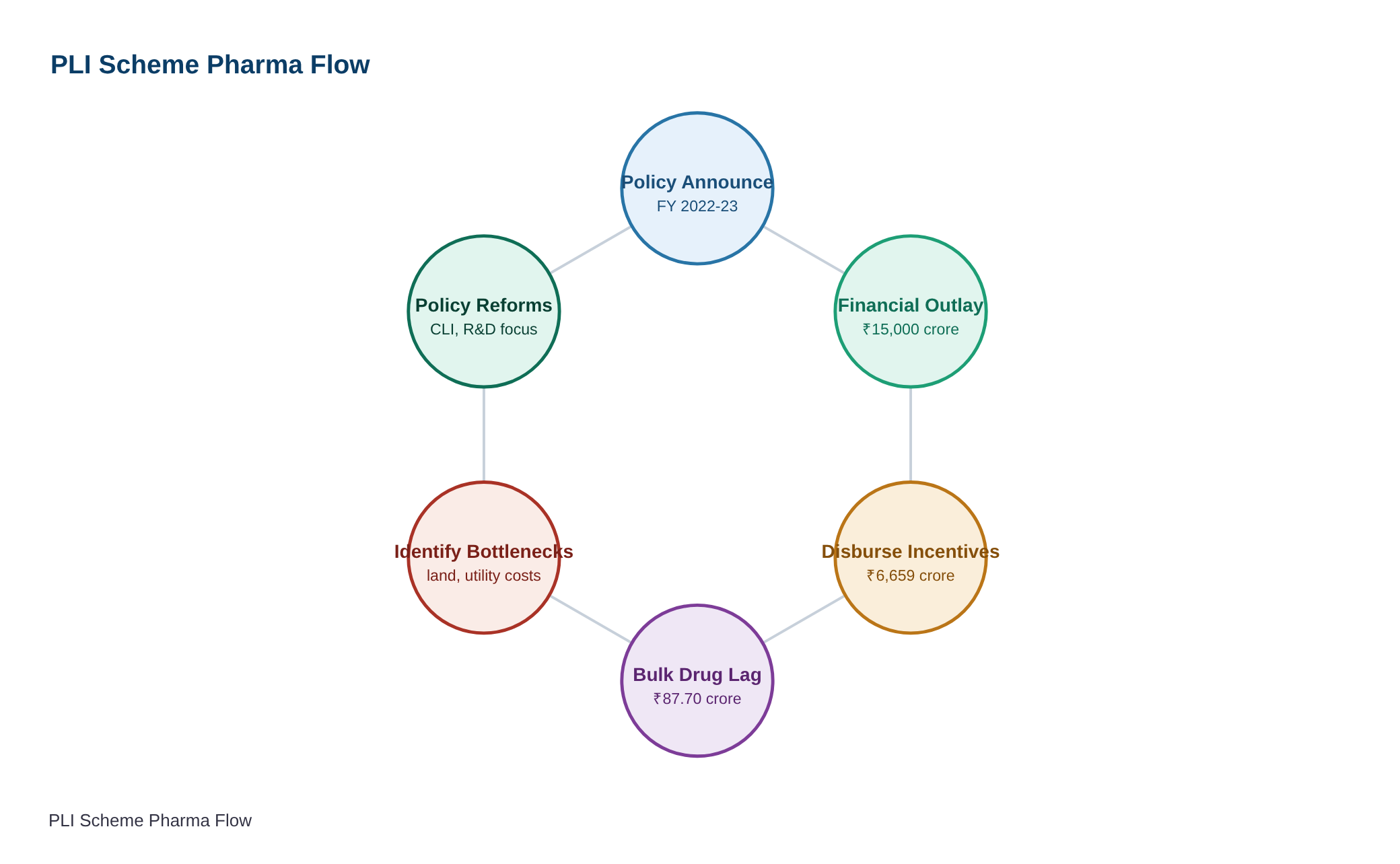
Concept Flow
Policy Announcement of PLI for Pharmaceuticals (FY 2022-23) → Establishment of Financial Outlay (₹15,000 crore) → Sector-Specific Challenges (e.g., fermentation lag, regulatory delays) → Partial Disbursement (₹6,659 crore for drugs; ₹87.70 crore for bulk drugs) → Identification of Bottlenecks (land acquisition, utility costs) → Need for Policy Reforms (CLI integration, R&D focus) → Way Forward (streamlining clearances, financial support)
Prelims Practice Questions
Q1. Consider the following statements regarding the Production-Linked Incentive (PLI) Scheme for the Pharmaceutical Sector:
1. The PLI Scheme for Pharmaceuticals was launched in the Union Budget 2022-23.
2. The scheme aims to provide financial incentives based on the sales of domestically manufactured pharmaceutical products.
3. The PLI Scheme for bulk drugs includes incentives for fermentation-based manufacturing processes.
4. The scheme has faced no implementation challenges such as land acquisition or environmental clearances.
How many of the above statements are correct?
- Only one
- Only two
- Only three
- All
Answer: Only three — Statements 2 and 3 are correct. Statement 1 is incorrect as the PLI Scheme for Pharmaceuticals was launched in the Union Budget 2021-22, not 2022-23. Statement 4 is incorrect as the scheme has faced implementation challenges including land acquisition and environmental clearances.
Q2. Assertion (A): Fermentation-based bulk drug manufacturing relies on the biological activity of living cells, which inherently limits the speed of production.
Reason (R): Unlike chemical synthesis, fermentation-based processes depend on the natural and slower growth rates of microorganisms.
Options:
A. Both A and R are true, and R is the correct explanation of A.
B. Both A and R are true, but R is not the correct explanation of A.
C. A is true, but R is false.
D. A is false, but R is true.
Answer: ? — Both the Assertion (A) and Reason (R) are true, and R correctly explains A. Fermentation-based manufacturing is constrained by the biological growth rates of microorganisms, unlike chemical synthesis, which can be faster and more controlled.
Q3. Match the following columns related to the PLI Scheme for the Pharmaceutical Sector:
Column I (Scheme Component) | Column II (Description)
1. PLI Scheme for Pharmaceuticals | A. Covers incentives for bulk drugs, including fermentation-based manufacturing
2. PLI Scheme for Bulk Drugs | B. Provides financial incentives for medical device manufacturing
3. PLI Scheme for Medical Devices | C. Aims to boost domestic production of finished pharmaceutical formulations
4. Component-Linked Incentive (CLI) | D. A hybrid incentive model combining PLI and component-specific incentives
Options:
A. 1-A, 2-C, 3-B, 4-D
B. 1-C, 2-A, 3-B, 4-D
C. 1-B, 2-A, 3-C, 4-D
D. 1-C, 2-B, 3-A, 4-D
Answer: ? — The correct matches are: 1-C (PLI Scheme for Pharmaceuticals aims to boost domestic production of finished pharmaceutical formulations), 2-A (PLI Scheme for Bulk Drugs covers incentives for bulk drugs, including fermentation-based manufacturing), 3-B (PLI Scheme for Medical Devices provides financial incentives for medical device manufacturing), and 4-D (Component-Linked Incentive is a hybrid incentive model).
Mains Practice Question
✍ The Production-Linked Incentive (PLI) Scheme for the Pharmaceutical Sector represents a strategic intervention to enhance India’s self-reliance in critical healthcare inputs. Critically examine the design, implementation challenges, and outcomes of this scheme with reference to bulk drug manufacturing. Also, analyse the implications of fermentation-based production processes on the scheme’s efficacy and policy sustainability. (15 Marks)
Approach: MODEL-ANSWER SKELETON:
1. **Design of the PLI Scheme for Pharmaceuticals**:
– Launched in Union Budget 2021-22 with a financial outlay of ₹15,000 crore for the pharmaceutical sector and ₹6,940 crore for bulk drugs.
– Aims to incentivize domestic manufacturing of finished formulations and bulk drugs to reduce import dependence.
– Incentives are disbursed based on incremental sales of eligible products, ensuring performance-linked support.
2. **Implementation Challenges in Bulk Drug Manufacturing**:
– **Land Acquisition and Regulatory Hurdles**: Delays in land acquisition and environmental clearances have impeded project timelines.
– **High Utility Costs**: Infrastructure and operational costs, particularly for fermentation-based units, are elevated due to energy-intensive processes.
– **Fermentation-Specific Constraints**: Fermentation relies on the biological growth of microorganisms, which is inherently slower than chemical synthesis, leading to prolonged gestation periods for projects.
– **Disbursement Lag**: Incentives are tied to sales, causing delays in fund disbursement when projects face operational bottlenecks.
3. **Outcomes and Data Insights**:
– As of March 2026, ₹6,659 crore has been disbursed under the Pharmaceutical PLI Scheme, while only ₹87.70 crore has been disbursed under the Bulk Drugs PLI Scheme, indicating slower progress in bulk drug manufacturing.
– Medical Devices PLI Scheme has disbursed ₹266.64 crore, highlighting sectoral disparities in implementation.
4. **Policy Sustainability and Efficacy**:
– **Strengths**: The scheme aligns with the ‘Atmanirbhar Bharat’ initiative, reducing import dependence for critical APIs and intermediates.
– **Weaknesses**: Fermentation-based bulk drug manufacturing faces structural inefficiencies, requiring targeted policy interventions such as streamlined regulatory processes and fiscal support for R&D.
– **Opportunities**: Expansion of fermentation capacity can enhance India’s global competitiveness in niche pharmaceutical segments.
– **Threats**: Persistent implementation challenges may erode investor confidence and delay the realization of strategic objectives.
5. **Conclusion**:
– The PLI Scheme for Pharmaceuticals is a well-intentioned policy with significant potential to bolster India’s pharmaceutical self-reliance.
– However, its success hinges on addressing implementation bottlenecks, particularly in fermentation-based bulk drug manufacturing, through regulatory reforms and targeted incentives.
Source: PIB (Press Information Bureau)
Generated by AanyaAi for educational purpose.

- Madras HC on Veeramani POCSO Case: Let SIT Work Without Interference - September 30, 2026
- पीएम मोदी और ट्रंप ने भारत-अमेरिका संबंधों पर चर्चा की - September 30, 2026
- Cabinet approves ITMS for Delhi: Smart Traffic to cut jams & boost safety - September 30, 2026

No Comments