


27 Jul UPSC Alert: PM Vidyalakshmi Portal for Education Loans Explained
Subject Relevance — Where This Topic Fits
- GS Paper II — Governance, Transparency and Accountability | GS Paper III — Issues related to Direct and Indirect Farm Subsidies and Minimum Support Prices | GS Paper III — Indian Economy and issues relating to Planning, Mobilisation of Resources, Growth, Development and Employment
- Prelims: PM-VidyaLakshmi Portal, Education Loan Interest Subsidy, Credit Guarantee Fund Scheme for Education Loans (CGFSEL), Gross Enrolment Ratio (GER) in Higher Education, Quantitative Higher Education Institutions (QHEIs), Direct Benefit Transfer (DBT), Scheduled Banks, Regional Rural Banks (RRBs)
- Essay: Role of Digital Public Infrastructure in Social Sector Delivery, Higher Education as a Public Good: Equity vs. Marketisation
Quick Revision: PM-VidyaLakshmi provides collateral-free education loans with 3% interest subsidy for eligible students, delivered via a digital portal and linked to academic performance, ensuring equitable access to higher education.
Why is this in the news?
The PM-VidyaLakshmi Portal, launched on 25 February 2025, has achieved significant traction in facilitating collateral-free and guarantee-free education loans to meritorious students admitted to top-quality higher education institutions. As of 21 July 2026, over 1.12 lakh loans aggregating ₹15,634.78 crore have been sanctioned under this scheme, while the associated interest subsidy mechanism has been operationalised through a digital wallet-based Direct Benefit Transfer system.
Background
- The Union Government launched the PM-VidyaLakshmi scheme in November 2024 as a Central Sector Scheme under the Ministry of Education to eliminate financial barriers to higher education.
- The scheme was introduced in alignment with the National Education Policy 2020’s emphasis on equitable access to quality higher education.
- The Gross Enrolment Ratio (GER) in higher education rose from 23.0 in 2013-14 to 30.0 in 2023-24, reflecting policy-driven expansion but also highlighting the need for sustained financial support.
- The portal leverages digital public infrastructure, including Aadhaar-based de-duplication and a digital wallet (PM-VidyaLakshmi Digital Rupee App), to ensure targeted delivery and prevent leakages.
What is the PM-VidyaLakshmi Scheme?
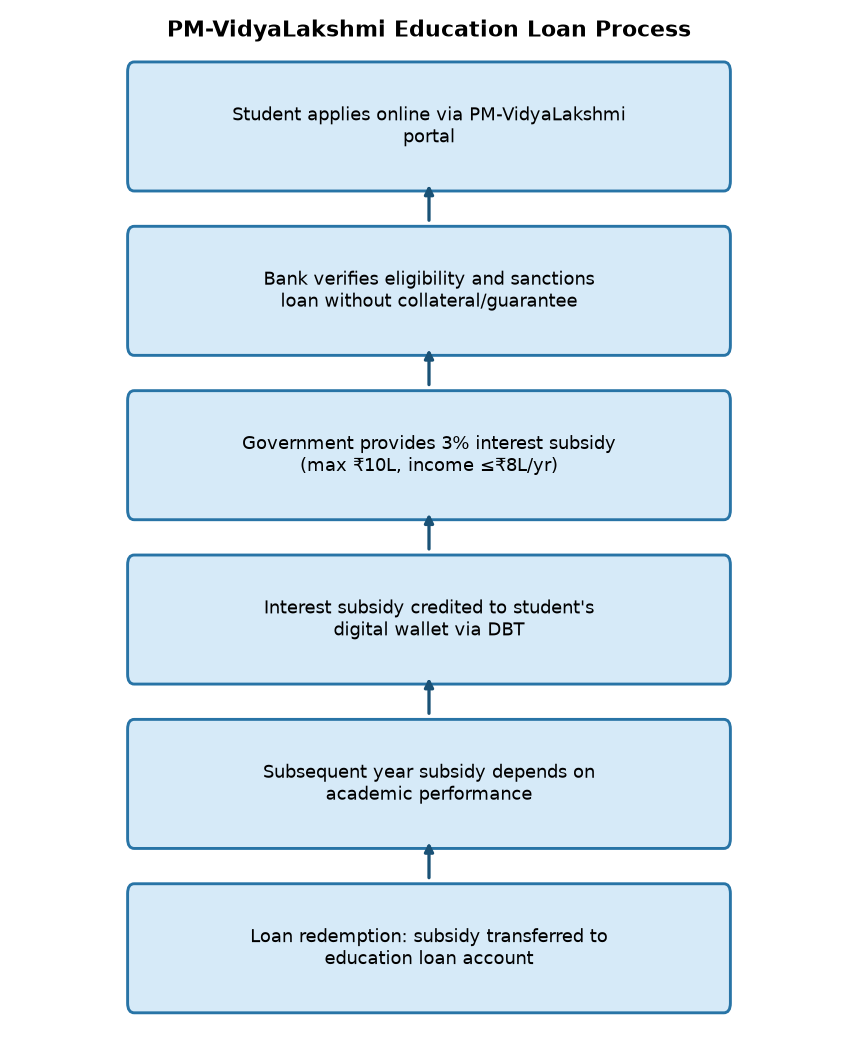
- Central Sector Scheme launched by the Ministry of Education in November 2024 to provide collateral-free and guarantee-free education loans to meritorious students admitted to top-quality higher education institutions.
- Interest Subsidy: For students with annual family income up to ₹8 lakh, a 3% interest subsidy is provided on loans up to ₹10 lakh, subject to annual renewal based on satisfactory academic performance.
- Coverage: Up to 1 lakh new students per year are eligible for the interest subsidy, with a total outlay of ₹3,600 crore approved for the period 2024-25 to 2030-31.
- Digital Platform: The PM-VidyaLakshmi Portal (https://pmvidyalaxmi.co.in) serves as a single-window interface for loan applications, subsidy claims, and academic progress monitoring by banks and institutions.
- Institutional Integration: QHEIs registered on the portal can upload semester-wise academic progress reports to facilitate performance-based continuation of subsidies.
- Bank Participation: The scheme is operational across 12 Public Sector Banks, 20 Private Banks, 25 Regional Rural Banks, and 7 Cooperative Banks, ensuring inclusive access, including for students from rural, tribal, and marginalised communities.
- Monitoring and Transparency: Aadhaar-based de-duplication ensures that only eligible students receive subsidies, while the Digital Rupee App enables Direct Benefit Transfer (DBT) of subsidy amounts directly to the student’s loan account upon redemption.
Key Features
| Feature | Significance |
|---|---|
| Zero-collateral education loan | Enables meritorious students from all socio-economic backgrounds to access high-quality higher education without financial constraints. |
| 3% interest subsidy for family income ≤ ₹8 lakh/year | Reduces the cost of borrowing, making education loans more affordable and sustainable for economically weaker sections. |
| PM-VidyaLakshmi Portal (https://pmvidyalaxmi.co.in) | Provides a unified digital platform for seamless loan application, disbursement, and monitoring of academic progress. |
| Credit guarantee coverage (PM-USP CGFSEL) | Mitigates risk for banks by providing 75% guarantee on loans up to ₹7.5 lakh, ensuring wider access to credit. |
| Academic performance-based continuation of subsidy | Ensures accountability by linking second-year subsidy continuation to satisfactory academic progress. |
Why it Matters
Economic Empowerment
- Enhances human capital formation by facilitating access to higher education, a critical driver of economic growth and innovation.
- Reduces the debt burden on students from lower-income groups, promoting inclusive economic participation.
- Stimulates demand for higher education, indirectly supporting sectors like education technology, infrastructure, and employment.
Social Equity
- Bridges the urban-rural divide by ensuring rural and tribal students can access education loans without collateral or guarantors.
- Promotes gender parity in higher education by removing financial barriers for women from economically disadvantaged backgrounds.
- Supports students from Scheduled Castes, Scheduled Tribes, and Other Backward Classes through targeted financial inclusion.
Educational Outcomes
- Contributes to the rise in Gross Enrolment Ratio (GER) from 23.0 (2013-14) to 30.0 (2023-24) by reducing dropout rates.
- Encourages academic excellence by linking subsidy continuation to performance, fostering a culture of meritocracy.
- Strengthens the employability of graduates by enabling access to quality higher education institutions.
Governance & Digital Public Infrastructure
- Demonstrates the efficacy of Direct Benefit Transfer (DBT) in reducing leakages and ensuring timely subsidy disbursement.
- Showcases the role of digital platforms in streamlining loan processing, reducing bureaucratic delays and corruption.
- Sets a precedent for integrating financial inclusion with educational access through technology-driven governance.
Challenges
1. Awareness and Outreach
- Limited awareness among target beneficiaries, particularly in remote and tribal areas, may hinder optimal utilisation of the scheme.
- Need for multi-lingual dissemination and grassroots-level awareness campaigns to ensure inclusivity.
UPSC Link: GS2: E-governance
2. Bureaucratic and Procedural Delays
- Risk of delays in subsidy disbursement due to cumbersome verification processes or technical glitches in the portal.
- Coordination challenges between banks, educational institutions, and government agencies may slow down loan processing.
UPSC Link: GS2: Government policies
3. Credit Risk and Defaults
- Despite guarantees, banks may still face challenges in recovering loans from students who struggle with repayment post-graduation.
- Need for robust mechanisms to monitor academic performance and ensure subsidy continuity without gaming the system.
UPSC Link: GS3: Financial inclusion
4. Digital Divide
- Students from marginalised communities may lack access to digital infrastructure, limiting their ability to utilise the portal effectively.
- Requires provision of digital literacy programs and offline support mechanisms to bridge the gap.
UPSC Link: GS1: Social empowerment
5. Sustainability of Subsidies
- Long-term financial sustainability of the 3% interest subsidy scheme may be challenged by rising education costs and inflation.
- Need for periodic review of subsidy rates and eligibility criteria to align with economic realities.
UPSC Link: GS3: Economic sustainability
Challenges — UPSC Perspective
| Issue | Concern |
|---|---|
| Limited awareness among beneficiaries | Low utilisation of the scheme, particularly in rural and tribal areas. |
| Bureaucratic delays in subsidy disbursement | Risk of students dropping out due to delayed financial support. |
| Credit risk and defaults post-graduation | Banks may become reluctant to participate, reducing access to loans. |
| Digital divide and low digital literacy | Exclusion of marginalised groups from the benefits of the portal. |
| Sustainability of financial outlay | Long-term affordability of the 3% interest subsidy scheme. |
Government Initiatives — Must-Memorise for Prelims
- PM-VidyaLakshmi Portal
Way Forward
- Strengthen awareness campaigns through partnerships with NGOs, educational institutions, and local governments to reach remote areas.
- Enhance digital literacy programs to ensure all beneficiaries can effectively utilise the PM-VidyaLakshmi Portal.
- Streamline verification processes and reduce bureaucratic delays to expedite loan disbursement and subsidy claims.
- Introduce performance-based incentives for banks to encourage wider participation and reduce defaults.
- Establish a robust monitoring mechanism to track academic performance and ensure subsidy continuity without misuse.
- Periodically review subsidy rates and eligibility criteria to align with inflation and rising education costs.
- Expand the network of participating banks to include more regional rural banks and cooperative banks for greater inclusivity.
UPSC Value Addition
Keywords for Mains Answer-Writing
PM Vidya Lakshmi Portal · Education Loan Scheme · Central Sector Scheme · No Collateral Education Loan · 3% Interest Subsidy · Gross Enrollment Ratio in Higher Education · PM-USP CGFSEL · Credit Guarantee Fund Scheme for Education Loans · Digital Wallet for Subsidy Disbursement · Direct Benefit Transfer in Education · Merit-based Admission to QHEIs · Financial Inclusion in Higher Education
Concept Flow
Meritorious students face financial barriers to higher education → Government introduces PM-VidyaLakshmi to provide zero-collateral loans → Portal (PM-VidyaLakshmi) enables seamless loan applications → Credit guarantee (PM-USP CGFSEL) reduces bank risk → Interest subsidy (3%) for low-income families → Academic performance linked to subsidy continuation → Increased GER and reduced dropout rates → Enhanced human capital and economic growth.
Prelims Practice Questions
Q1. Consider the following statements regarding the PM Vidya Lakshmi Portal: 1. It is a central sector scheme launched in November 2024. 2. It provides education loans without collateral or guarantor to students admitted to top-quality higher education institutions. 3. The portal includes 12 public sector banks, 20 private banks, 25 regional rural banks, and 7 cooperative banks. Which of the statements given above are correct?
- 1 and 2 only
- 2 and 3 only
- 1 and 3 only
- 1, 2 and 3
Answer: 1, 2 and 3 — Statement 1 is correct as the PM Vidya Lakshmi Portal was launched as a central sector scheme in November 2024. Statement 2 is correct as the scheme provides collateral-free and guarantor-free education loans to eligible students. Statement 3 is correct as the portal includes the specified number of banks across categories.
Q2. The PM-USP CGFSEL (Credit Guarantee Fund Scheme for Education Loans) provides a guarantee cover of up to what percentage of the loan amount in case of default?
- 50%
- 60%
- 75%
- 90%
Answer: 75% — Under the PM-USP CGFSEL, the central government provides a guarantee cover of 75% of the loan amount in case of default, ensuring financial security for banks while facilitating collateral-free loans.
Q3. Which of the following is NOT a feature of the PM Vidya Lakshmi Portal?
- Direct Benefit Transfer (DBT) of interest subsidy to students’ loan accounts
- Semester-wise academic progress reporting by registered QHEIs
- Provision of education loans up to ₹15 lakh without collateral
- Interest subsidy of 3% for students with annual family income up to ₹8 lakh
Answer: Provision of education loans up to ₹15 lakh without collateral — While the portal facilitates semester-wise academic progress reporting, it does not mandate or provide this feature as a core feature of the PM Vidya Lakshmi Portal. The other options are explicitly mentioned features of the scheme.
Mains Practice Question
✍ Evaluate the role of the PM Vidya Lakshmi Portal and the PM-USP CGFSEL in enhancing financial inclusion and accessibility in higher education in India. How do these initiatives address the challenges of collateral requirements and affordability for meritorious students from economically weaker sections?
Approach: The answer should first define the PM Vidya Lakshmi Portal and the PM-USP CGFSEL, highlighting their core objectives and mechanisms. Discuss how these schemes eliminate collateral requirements and provide interest subsidies, thereby reducing financial barriers. Examine the impact on gross enrollment ratio (GER) and dropout rates, citing data from the PIB release. Conclude by assessing the role of digital platforms like the PM Vidya Lakshmi Portal in ensuring transparency, efficiency, and last-mile delivery of benefits, particularly for students from rural, tribal, and disadvantaged backgrounds.
Source: PIB (Press Information Bureau)
Generated by AanyaAi for educational purpose.

- फिल्म महोत्सवों के लिए सेंसर छूट बन गई बाधा: 31 फिल्में हुईं प्रभावित - September 21, 2026
- Censor Exemption Denial: How Film Festivals Face Roadblocks in India - September 21, 2026
- कस्तूरीरंगन रिपोर्ट लागू करने की मांग: पश्चिमी घाट संरक्षण पर सरकार से अपील - September 20, 2026

No Comments