


27 Jul UPSC Alert: Special Drive to Clear 16,033 Pending Labour Cases by Aug 2026
Subject Relevance — Where This Topic Fits
- GS Paper II — Governance, Constitution and Polity (Labour Administration) | GS Paper III — Indian Economy and Issues Relating to Planning, Mobilisation of Resources, Growth, Development and Employment (Labour Reforms)
- Prelims: Labour Disputes (Resolution of Industrial Disputes Act, 1947), Industrial Tribunals and Labour Courts, Gratuity (Payment of Gratuity Act, 1972), Maternity Benefit (Maternity Benefit Act, 1961), Chief Labour Commissioner (Central), Conciliation Machinery under Industrial Disputes Act
- Essay: The Role of State in Ensuring Labour Justice: Balancing Efficiency and Equity, Judicial Reforms and Access to Justice in Labour Matters
Quick Revision: The Special Campaign for Disposal of Pending Labour Disputes (1 June–31 August 2026) aims to resolve 16,033 pending cases through existing conciliation and adjudication mechanisms under the Industrial Disputes Act, 1947, with a focus on statutory entitlements such as wages, gratuity, and maternity benefits.
Why is this in the news?
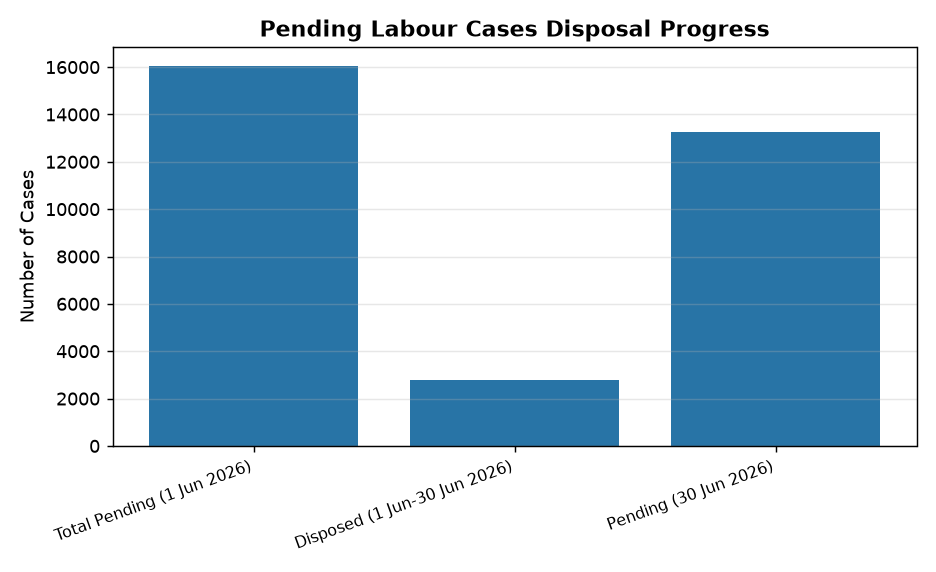
The Ministry of Labour and Employment has initiated a three-month special campaign from 1 June 2026 to 31 August 2026 to expedite the disposal of 16,033 pending labour disputes across the country. This initiative, launched by the Central Office of the Chief Labour Commissioner, aims to resolve long-pending cases related to industrial disputes, wages, gratuity, maternity benefits, and other statutory claims. The campaign underscores the government’s commitment to labour welfare and the operationalisation of institutional mechanisms for timely justice delivery.
Background
- The Industrial Disputes Act, 1947, provides the statutory framework for the resolution of industrial disputes, including conciliation, arbitration, and adjudication through Labour Courts and Industrial Tribunals.
- Pending labour disputes often arise from non-payment of wages, gratuity, maternity benefits, or unfair labour practices, leading to prolonged litigation and economic hardship for workers.
- The Chief Labour Commissioner (Central) and Regional Labour Commissioners play a pivotal role in conciliation and dispute resolution under the Act.
- The government has historically launched special drives to reduce pendency in labour courts, recognising that delayed justice undermines labour rights and industrial harmony.
- The Payment of Gratuity Act, 1972, and the Maternity Benefit (Amendment) Act, 2017, mandate timely disbursement of statutory benefits, but implementation gaps persist.
- The COVID-19 pandemic exacerbated labour disputes, particularly in the informal and gig economy sectors, increasing the backlog of unresolved cases.
What is the Special Campaign for Disposal of Pending Labour Disputes?
- The campaign is a time-bound initiative launched by the Ministry of Labour and Employment to resolve long-pending labour disputes across India within a three-month period (1 June 2026 to 31 August 2026).
- The primary objective is to expedite the disposal of cases pending before Regional Labour Commissioners and Labour Courts, focusing on industrial disputes, wage claims, gratuity, maternity benefits, and other statutory entitlements.
- The campaign leverages existing institutional mechanisms, including conciliation officers, Labour Courts, and Industrial Tribunals, to ensure efficient resolution without compromising procedural fairness.
- The initiative is part of a broader strategy to enhance labour justice delivery, reduce pendency, and strengthen the enforcement of labour laws in India.
- The campaign includes targeted monitoring, periodic reviews, and coordination between central and state authorities to track progress and address bottlenecks.
- The campaign aligns with the government’s ‘Ease of Doing Business’ reforms by reducing legal uncertainty and improving the business environment for employers while safeguarding workers’ rights.
- The initiative also highlights the role of the Chief Labour Commissioner (Central) in overseeing the implementation of labour laws and resolving disputes at the regional level.
Key Features
| Feature | Significance |
|---|---|
| Time-bound Special Campaign | Ensures expeditious disposal of long-pending labour disputes, reducing litigation backlog and enhancing compliance with labour laws. |
| Coverage of Dispute Types | Includes industrial disputes, wage claims, gratuity, maternity benefits, and other statutory entitlements, addressing multi-dimensional labour grievances. |
| Regional Office Coordination | Leverages existing regional labour commissionerates to decentralise dispute resolution, improving accessibility for workers and employers. |
| Quantitative Targeting | Focuses on measurable outcomes (e.g., 2,769 cases resolved in first month) to track progress and accountability. |
| Temporal Urgency | Three-month window (1 June–31 August 2026) imposes structured deadlines, mitigating prolonged delays in justice delivery. |
Why it Matters
Economic
- Reduces transaction costs for businesses by resolving disputes promptly, thereby improving ease of doing business rankings.
- Enhances labour productivity by ensuring timely payment of wages, gratuity, and other statutory dues, reducing worker discontent.
- Encourages formalisation of labour relations by providing a structured mechanism for dispute resolution, reducing shadow economy reliance.
Legal-Administrative
- Strengthens the efficacy of labour adjudication machinery by addressing systemic delays in the Industrial Disputes Act, 1947 framework.
- Promotes adherence to statutory timelines for dispute resolution, aligning with the principle of ‘justice delayed is justice denied’.
- Demonstrates administrative responsiveness to judicial and parliamentary concerns regarding pendency in labour courts.
Social
- Protects vulnerable workers (e.g., those claiming gratuity or maternity benefits) from prolonged financial hardship due to unresolved claims.
- Fosters trust in labour institutions by demonstrating commitment to equitable and efficient dispute resolution.
- Mitigates industrial unrest by preemptively resolving grievances before they escalate into strikes or lockouts.
Policy-Synergy
- Complements the Code on Wages, 2019 and the Code on Social Security, 2020 by operationalising their enforcement through dispute resolution.
- Aligns with the National Labour Policy’s objective of fostering a harmonious industrial relations ecosystem.
Challenges
1. Institutional Capacity Constraints
- Limited manpower in regional labour commissionerates may hinder effective implementation of the campaign.
- Inadequate digital infrastructure for case management could slow down tracking and resolution of disputes.
UPSC Link: Labour Administration
2. Multiplicity of Legal Frameworks
- Overlapping jurisdictions between labour courts, industrial tribunals, and civil courts create procedural confusion.
- Diverse interpretations of statutory provisions (e.g., gratuity entitlement) lead to prolonged litigation.
UPSC Link: Industrial Disputes Act, 1947
3. Worker Awareness Gaps
- Many workers remain unaware of their statutory rights or the dispute resolution mechanisms available.
- Language barriers and illiteracy in certain sectors (e.g., construction) impede access to justice.
UPSC Link: Labour Rights
4. Employer Compliance Deficits
- Reluctance of employers to comply with awards due to weak enforcement mechanisms.
- Deliberate delays in submitting records or attending hearings to prolong disputes.
UPSC Link: Labour Welfare
5. Judicial Pendency Legacy
- Pre-existing backlog of cases in higher forums (e.g., High Courts) may undermine the campaign’s impact.
- Lack of specialised benches for labour disputes exacerbates delays.
UPSC Link: Judicial Reforms
Challenges — UPSC Perspective
| Issue | Concern |
|---|---|
| Regional Office Manpower | Insufficient staffing may lead to incomplete coverage of disputes during the campaign. |
| Digital Case Management | Absence of integrated IT systems may hinder real-time monitoring of case progress. |
| Statutory Overlap | Concurrent applicability of multiple labour laws complicates dispute categorisation. |
| Worker Outreach | Limited awareness campaigns may exclude marginalised worker groups from availing benefits. |
| Enforcement Gaps | Weak penalties for non-compliance with awards reduce deterrence for errant employers. |
Way Forward
- Augment staffing in regional labour commissionerates through temporary deputations or contractual appointments for the campaign duration.
- Develop a unified digital dashboard for real-time tracking of case disposal rates and pendency across regions.
- Conduct mass awareness drives in regional languages, leveraging local NGOs and trade unions to educate workers.
- Establish fast-track mediation cells within regional offices to resolve disputes through conciliation before formal adjudication.
- Strengthen enforcement mechanisms by imposing stricter penalties for non-compliance with awards and mandating quarterly compliance audits.
- Integrate the campaign’s outcomes with the e-Shram portal to ensure seamless tracking of resolved cases and worker benefits.
- Constitute a high-powered committee to review systemic bottlenecks in labour adjudication and recommend structural reforms.
UPSC Value Addition
Keywords for Mains Answer-Writing
Industrial Disputes Act, 1947 · Labour adjudication mechanisms · Grievance redressal in labour disputes · Wage and gratuity claims settlement · Maternity Benefit Act, 1961 · Central Industrial Relations Machinery · Labour welfare and enforcement · Judicial efficiency in labour matters · Constitutional provisions for labour rights (Article 24, 39, 43) · Role of Labour Courts and Industrial Tribunals · Pending labour cases backlog · Government initiatives for labour welfare
Constitutional & Policy Linkages
- [‘Article 43’, ‘Directive Principles of State Policy on living wages’]
- [‘Article 21’, ‘Right to livelihood and fair trial’]
- [‘Article 14’, ‘Equality before law in labour rights enforcement’]
Concept Flow
Long-pending labour disputes → Administrative backlog → Economic inefficiency and worker distress → Special campaign announcement → Time-bound targets and decentralised resolution → Initial case disposal (2,769 cases in first month) → Resolution of disputes → Timely payment of wages/gratuity → Enhanced worker productivity and trust in institutions → Reduced litigation pendency → Improved ease of doing business → Formalisation of labour relations → Strengthened labour market institutions → Sustainable industrial harmony → Alignment with National Labour Policy objectives
Prelims Practice Questions
Q1. Which of the following is NOT a statutory claim that can be adjudicated under the special campaign launched by the Labour and Employment Ministry?
- A. Wage disputes
- B. Gratuity claims
- C. Maternity benefits
- D. Property tax disputes
Answer: D. Property tax disputes — The special campaign focuses on industrial disputes and statutory claims such as wages, gratuity, maternity benefits, and other labour-related dues. Property tax disputes fall outside the purview of labour adjudication mechanisms.
Q2. The special campaign for settlement of pending labour cases is being conducted by which authority under the Labour and Employment Ministry?
- A. Employees’ Provident Fund Organisation (EPFO)
- B. Directorate General of Mines Safety (DGMS)
- C. Central Industrial Relations Machinery (CIRM)
- D. National Skill Development Corporation (NSDC)
Answer: C. Central Industrial Relations Machinery (CIRM) — The Central Industrial Relations Machinery (CIRM), under the Chief Labour Commissioner’s office, is responsible for the special campaign to expedite the settlement of pending labour cases.
Q3. Which constitutional provision empowers the State to make provisions for securing just and humane conditions of work and for maternity relief?
- A. Article 19(1)(g)
- B. Article 24
- C. Article 39(e)
- D. Article 43
Answer: D. Article 43 — Article 39(e) of the Directive Principles of State Policy directs the State to ensure that the health and strength of workers are not abused and that citizens are not forced by economic necessity to enter avocations unsuited to their age or strength. Article 43 further elaborates on securing just and humane conditions of work.
Mains Practice Question
✍ Examine the significance of the recent special campaign launched by the Labour and Employment Ministry to expedite the settlement of pending labour cases. How does this initiative align with the constitutional provisions and statutory frameworks governing labour rights in India? Substantiate your answer with relevant legal provisions and judicial precedents.
Approach: The answer should begin by contextualising the special campaign within the broader framework of labour adjudication in India, highlighting its objectives and the categories of disputes it targets (e.g., wages, gratuity, maternity benefits). Subsequently, link the initiative to constitutional provisions such as Article 39(e) and Article 43, which mandate the State to ensure just and humane conditions of work. Discuss the role of the Central Industrial Relations Machinery (CIRM) and Labour Courts/Industrial Tribunals in enforcing these rights. Conclude by assessing the potential impact of the campaign on reducing pendency and improving labour welfare, while also addressing challenges such as resource constraints and the need for systemic reforms.
Source: PIB (Press Information Bureau)
Generated by AanyaAi for educational purpose.


No Comments